Africa Self Injection Device Market Outlook (2022-2033)

Historic Data: 2022-2024   |   Base Year: 2025   |   Forecast Period: 2026-2033
Report Content: Market Scope, Market Segmentation, Market Dynamics, and Competitive Analysis

Report Coverage:
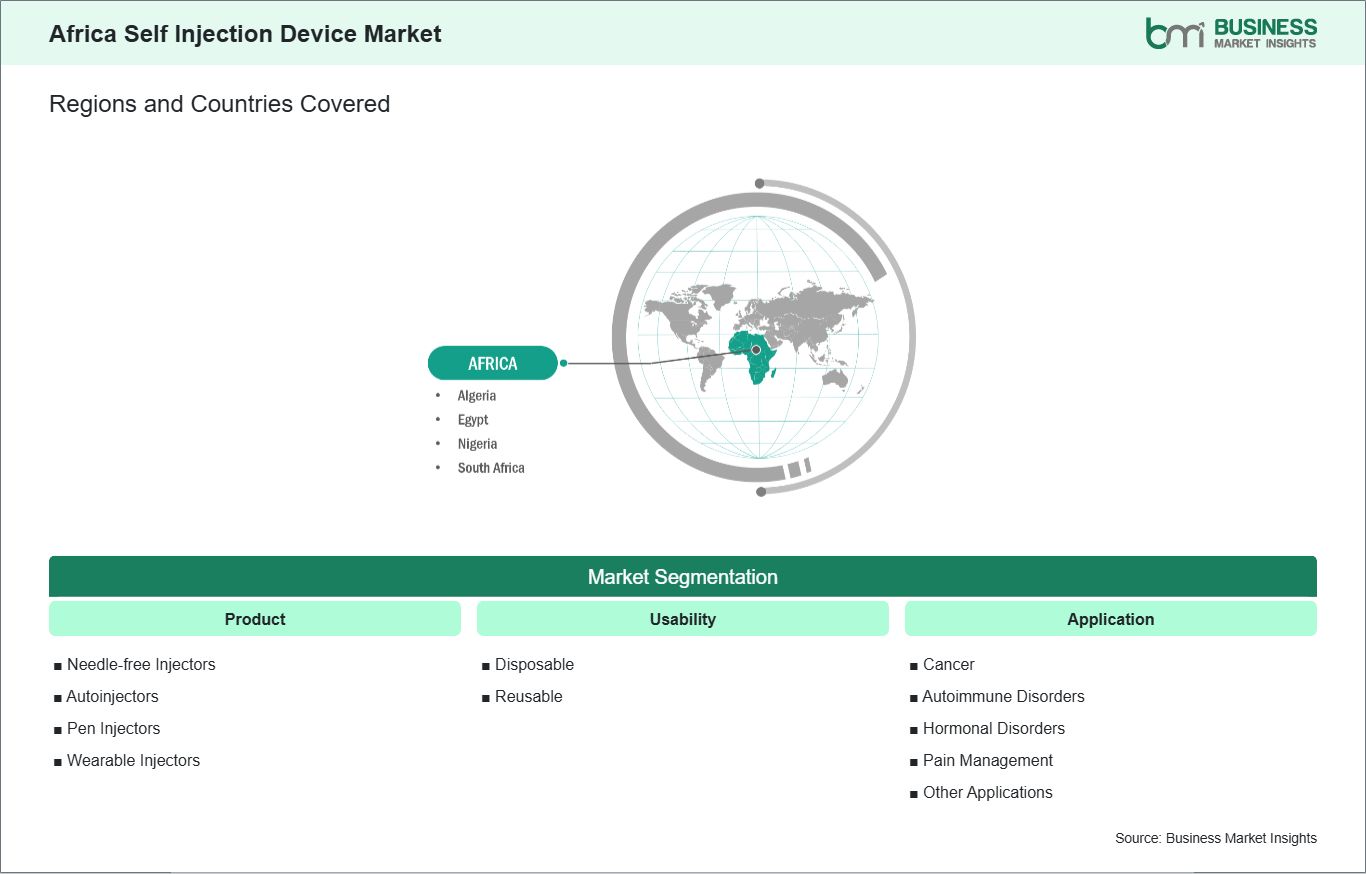
  • Product (Needle-free Injectors, Autoinjectors, Pen Injectors, Wearable Injectors)
  • Usability (Disposable, Reusable)
  • Application (Cancer, Autoimmune Disorders, Hormonal Disorders, Pain Management, Other Applications)

No. of Pages: 150
Report Code: BMIPUB00034863
Category: Life Sciences
Africa Self Injection Device Market

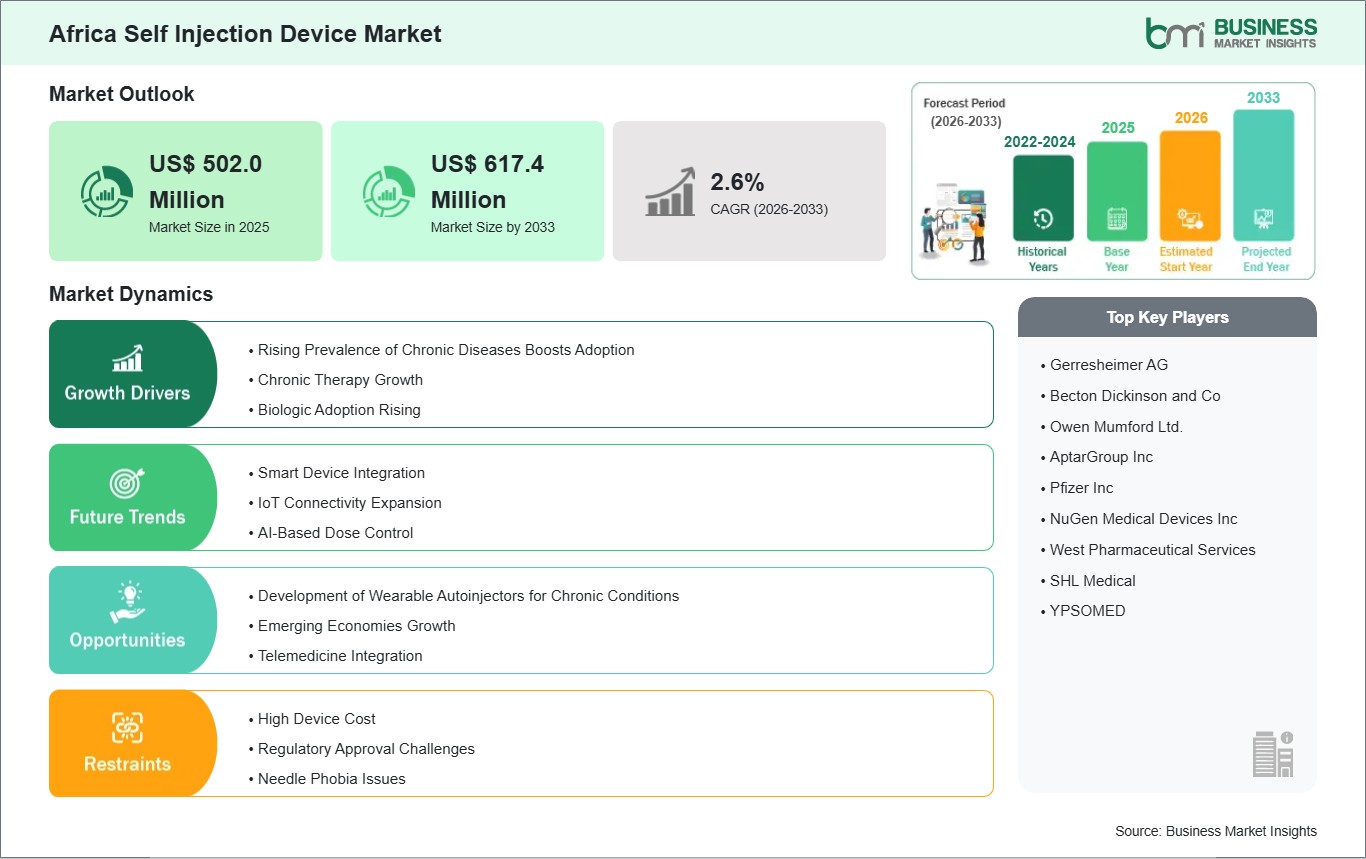
The Africa Self Injection Device Market size is expected to reach US$ 617.4 million by 2033 from US$ 502.0 million in 2025. The market is estimated to record a CAGR of 2.6 % from 2026 to 2033.

Executive Summary and Africa Self Injection Device Market Analysis:

The self injection device market in Africa is propelled by the increasing prevalence of chronic diseases and an expanding shift towards patient-centric care models. Healthcare stakeholders across Africa are recognizing the critical role of self-administration technologies, including pen injectors, autoinjectors, and wearable delivery systems, in improving treatment adherence outside traditional clinical settings. The market expansion is underpinned by demographic dynamics, with a growing middle class demanding more convenient and flexible therapeutic options, particularly for conditions such as diabetes, rheumatoid arthritis, and other long-term chronic illnesses. Technological advancements are reshaping competitive dynamics, with device manufacturers investing in intuitive designs that reduce user error and enhance safety profiles.

Regulatory agencies in key African markets are gradually aligning with international standards, which strengthens the credibility of imported devices and encourages multinational companies to deepen their footprint. Additionally, strategic partnerships between global OEMs and regional distributors are improving market reach, enabling broader access across urban and peri-urban healthcare channels. While cost sensitivity and variation in healthcare infrastructure remain challenges, public-private initiatives aimed at expanding primary care and remote health services contribute to increased adoption of self-injection solutions. These initiatives are particularly impactful in countries with higher non-communicable disease burdens, where decentralizing care delivery via self-injection devices can alleviate pressure on hospital systems. The overall market is positioned for sustained momentum as healthcare ecosystems adapt to evolving patient expectations and therapeutic needs.

Africa Self Injection Device Market - Strategic Insights:

global-market-strategic-framework
Get more information on this report

Africa Self Injection Device Market Segmentation Analysis:

Key segments that contributed to the derivation of the Africa self injection device market analysis are product, usability, and application.

  • By product, the self injection device market is segmented into needle-free Injectors, autoinjectors, pen Injectors, and wearable Injectors. The needle-free Injectors segment dominated the market in 2025.
  • Based on usability, the self injection device market is categorized into disposable and reusable. The disposable segment dominated the market in 2025.
  • In terms of application, the market is classified into cancer, autoimmune disorders, hormonal disorders, pain management, and other applications. The autoimmune disorders segment dominated the market in 2025.

Africa Self Injection Device Market Drivers and Opportunities:

Rising Prevalence of Chronic Diseases Boosts Adoption

Africa is experiencing a steady rise in chronic diseases, particularly in urban areas where lifestyle changes and longer life expectancy are becoming more common. Conditions such as diabetes, hypertension, and autoimmune disorders are increasingly being managed through long-term treatment plans. This trend is encouraging the adoption of self-injection devices because they allow patients to administer medication at home. Self-injection devices support better treatment continuity, especially in communities where travel time and access to healthcare facilities can be challenging. In several African countries, healthcare systems are adapting to a growing need for chronic disease care by improving outpatient and community-based services. Self-injection devices promote patient independence and reduce reliance on facility-based administration. Healthcare professionals are also recognizing that patients who can self-administer medication often experience improved consistency in their treatment schedules. This shift is particularly important for patients who require regular medication and cannot always visit clinics. As private clinics and specialty hospitals expand, more patients are seeking modern and convenient treatment options. Self-injection devices are becoming a preferred choice for chronic disease management because they simplify the administration process and help patients maintain treatment routines. With rising awareness among patients and clinicians, self-injection devices are increasingly being included in treatment plans across the continent. This trend is expected to continue as healthcare systems focus more on patient-centered care and long-term treatment management.

Development of Wearable Autoinjectors for Chronic Conditions

Wearable autoinjectors are designed to be worn on the body and deliver medication automatically over a period of time, offering a hands-free and less intrusive method of treatment. For patients managing long-term conditions such as autoimmune diseases or chronic pain, wearable autoinjectors can simplify therapy by reducing the need for repeated injections. This technology is becoming more attractive as patients and clinicians seek solutions that improve treatment convenience and support consistent medication administration. In regions with more developed healthcare infrastructure, such as parts of North Africa and Southern Africa, wearable autoinjectors are beginning to appear in specialty clinics and private healthcare settings. These markets are often more open to advanced medical devices, and clinicians are exploring wearable options as a way to improve patient comfort and adherence. In addition, the growing presence of telehealth services in these regions supports the adoption of wearable devices because they can be integrated into remote monitoring systems, which allows clinicians to track treatment patterns and provide guidance without requiring frequent in-person appointments. Despite their potential, wearable autoinjectors are in an emerging stage in many African markets due to cost concerns and limited awareness. Several patients and healthcare providers continue to rely on traditional injection devices that are easier to source and more affordable. However, manufacturers are responding by developing more accessible wearable options and partnering with local distributors to improve availability. As chronic disease management continues to evolve and healthcare systems focus on long-term care strategies, wearable autoinjectors are expected to become more widely accepted.

Africa Self Injection Device Market Size and Share Analysis:

The Africa Self Injection Device Market demonstrates steady growth, with size and share analysis highlighting evolving trends and competitive dynamics among key players. The report examines subsegments categorized within product, usability, and application, offering insights into their contribution to overall market performance.

By product, the needle-free Injectors subsegment dominated the market in 2025, driven by growing preference for painless and convenient drug delivery among patients managing chronic conditions in Africa.

Based on usability, the disposable subsegment dominated the market in 2025, driven by high demand for low-cost, easy-to-use devices that reduce infection risk and simplify waste management in healthcare settings across Africa.

In terms of application, the autoimmune disorders subsegment dominated the market in 2025, driven by increasing adoption of biologic therapies requiring frequent injections and rising awareness of self-management options in African markets.

Africa Self Injection Device Market Report Highlights:

Report Attribute Details
Market size in 2025 US$ 502.0 Million
Market Size by 2033 US$ 617.4 Million
CAGR (2026 - 2033)2.6%
Historical Data 2022-2024
Forecast period 2026-2033
Segments Covered By Product
  • Needle-free Injectors
  • Autoinjectors
  • Pen Injectors
  • Wearable Injectors
By Usability
  • Disposable
  • Reusable
By Application
  • Cancer
  • Autoimmune Disorders
  • Hormonal Disorders
  • Pain Management
  • Other Applications
Regions and Countries Covered
Africa Egypt, South Africa, Nigeria, Algeria
Market leaders and key company profiles
  • Gerresheimer AG
  • Becton Dickinson and Co
  • Owen Mumford Ltd.
  • AptarGroup Inc
  • Pfizer Inc
  • NuGen Medical Devices Inc
  • West Pharmaceutical Services
  • SHL Medical
  • YPSOMED
Get more information on this report

Africa Self Injection Device Market Report Coverage and Deliverables:

The "Africa Self Injection Device Market Size and Forecast (2022–2033)" report provides a detailed analysis of the market covering below areas:

  • Africa Self Injection Device Market size and forecast at regional and country levels for all market segments covered under the scope
  • Africa Self Injection Device Market trends, as well as drivers, restraints, and opportunities
  • Africa Self Injection Device Market analysis covering key trends, regional framework, major players, regulations, and recent developments
  • Industry landscape and competition analysis covering market concentration, heat map analysis, prominent players, and recent developments for the Africa Self Injection Device Market
  • Detailed company profiles, including SWOT analysis

Africa Self Injection Device Market Geographic Insights:

The geographical scope of the Africa Self Injection Device Market report is divided into Egypt, South Africa, Nigeria, and Algeria. Nigeria held the largest share in 2025.

The Africa self-injection device market is experiencing steady growth, driven by a rising prevalence of chronic diseases, expanding biologics adoption, and growing patient preference for home-based care. Among African countries, Nigeria stands out as the largest market, primarily due to its large population exceeding 220 million, increasing incidence of diabetes, autoimmune conditions, and allergies, and gradual improvements in healthcare infrastructure. Patient awareness remains moderate, but initiatives by pharmaceutical companies and NGOs to educate on self-administration are supporting adoption. Devices with simplified designs, auto-retractable needles, and minimal preparation requirements are favored to accommodate low health literacy and variable patient dexterity.

Egypt represents a high-potential market due to its well-established urban healthcare systems and growing private sector penetration. The country exhibits a rising demand for prefilled pens and autoinjectors for hormone therapies, insulin delivery, and emergency epinephrine use. Reimbursement remains limited outside private insurance, making affordability and reusable device formats key factors for adoption. Egypt's regulatory environment is evolving, and local trials and approvals are increasingly shaping the market entry strategies of global manufacturers. South Africa demonstrates a mature market compared to most sub-Saharan countries, with structured healthcare programs, a high prevalence of chronic diseases, and government-supported biologic therapies.

Adoption is influenced by urban-rural disparities, with metropolitan centers such as Johannesburg and Cape Town leading in uptake. Connectivity features in devices—such as dose tracking apps—are gaining traction among tech-savvy patients, reflecting an emerging trend toward digital health integration. Algeria shows moderate growth, primarily driven by public healthcare initiatives and growing awareness of self-administration therapies. Chronic conditions such as diabetes and rheumatoid arthritis are key drivers, and devices that offer simplified administration, ergonomic design, and temperature resilience for hot climates are preferred.

Regulatory approvals are often a prerequisite for uptake, and local distribution partnerships significantly impact market penetration. The overall market is shaped by population scale, urban-rural healthcare disparities, disease prevalence, affordability, and device usability. Nigeria dominates the regional landscape, while Egypt, South Africa, and Algeria represent high-potential markets where ergonomic design, affordability, and patient education remain critical for growth.

global-market-geography
Get more information on this report

Africa Self Injection Device Market Research Report Guidance:

  • The report includes qualitative and quantitative data in the Africa Self Injection Device Market across product, usability, application, and geography.
  • The report starts with the key takeaways (chapter 2), highlighting key trends and outlook of the Africa Self Injection Device Market.
  • Chapter 3 focuses on the research methodology of the study.
  • Chapter 4 includes ecosystem analysis.
  • Chapter 5 highlights the major industry dynamics in the Africa Self Injection Device Market, including factors that are driving the market, prevailing deterrents, potential opportunities, as well as future trends. Impact analysis of these drivers and restraints is also covered in this section.
  • Chapter 6 discusses the Africa Self Injection Device Market scenario, in terms of historical market revenues, and forecast till the year 2033.
  • Chapters 7 to 10 cover Africa Self Injection Device Market segments by product, usability, application, and geography across Egypt, South Africa, Nigeria, and Algeria. They cover the market revenue, forecast, and factors driving the market.
  • Chapter 11 describes the competitive analysis along with the heat map analysis for the key players operating in the market.
  • Chapter 12 describes the industry landscape analysis. It provides detailed descriptions of business activities such as market initiatives, new developments, mergers, and joint ventures globally, along with a competitive landscape.
  • Chapter 13 provides detailed profiles of the major companies operating in the Africa Self Injection Device Market. Companies have been profiled on the basis of their key facts, business descriptions, products, financial overview, SWOT analysis, and key developments.
  • Chapter 14, i.e., the appendix, is inclusive of a brief overview of the company, list of abbreviations, and disclaimer.

Africa Self Injection Device Market News and Key Development:

The Africa Self Injection Device Market is evaluated by gathering qualitative and quantitative data post primary and secondary research, which includes important corporate publications, association data, and databases. A few of the key developments in the Africa self injection device market are:

  • In June 2025, a new initiative in Kenya was launched to allow pharmacists to offer the self-injectable contraceptive Sayana Press (Depot Medroxyprogesterone Acetate, DMPA-SC) in private pharmacies. The program involves training pharmacists to counsel and, where appropriate, assist women with this prefilled self-injectable contraceptive, thereby expanding access beyond traditional health facilities into the private sector.
  • In May 2025, the National Agency for Food and Drug Administration and Control (NAFDAC) announced that Afrimedical Manufacturing and Supplies Ltd's 0.5 ml auto-disable (AD) syringe received World Health Organization (WHO) prequalification. This marks the first time a Turkish manufacturer and the first in West and Central Africa has achieved WHO prequalification for this type of injection device, making the product eligible for procurement by major global health agencies and supporting immunization and injectable delivery efforts across the region.

Key Sources Referred:

  • World Health Organization (WHO)
  • Organisation for Economic Cooperation and Development (OECD)
  • The World Bank Group
  • Worldometer
  • The Lancet
  • International Bar Association
  • International Trade Administration
The List of Companies - Africa Self Injection Device Market
  • Gerresheimer AG
  • Becton Dickinson and Co
  • Owen Mumford Ltd.
  • AptarGroup Inc
  • Pfizer Inc
  • NuGen Medical Devices Inc
  • West Pharmaceutical Services
  • SHL Medical
  • YPSOMED
Frequently Asked Questions
How big is the Africa Self Injection Device Market?

The Africa Self Injection Device Market is valued at US$ 502.0 Million in 2025, it is projected to reach US$ 617.4 Million by 2033.

What is the CAGR for Africa Self Injection Device Market by (2026 - 2033)?

As per our report Africa Self Injection Device Market, the market size is valued at US$ 502.0 Million in 2025, projecting it to reach US$ 617.4 Million by 2033. This translates to a CAGR of approximately 2.6% during the forecast period.

What segments are covered in this report?

The Africa Self Injection Device Market report typically cover these key segments-

  • Product (Needle-free Injectors, Autoinjectors, Pen Injectors, Wearable Injectors)
  • Usability (Disposable, Reusable)
  • Application (Cancer, Autoimmune Disorders, Hormonal Disorders, Pain Management, Other Applications)

What is the historic period, base year, and forecast period taken for Africa Self Injection Device Market?

The historic period, base year, and forecast period can vary slightly depending on the specific market research report. However, for the Africa Self Injection Device Market report:

  • Historic Period : 2022-2024
  • Base Year : 2025
  • Forecast Period : 2026-2033
  • Who are the major players in Africa Self Injection Device Market?

    The Africa Self Injection Device Market is populated by several key players, each contributing to its growth and innovation. Some of the major players include:

  • Gerresheimer AG
  • Becton Dickinson and Co
  • Owen Mumford Ltd.
  • AptarGroup Inc
  • Pfizer Inc
  • NuGen Medical Devices Inc
  • West Pharmaceutical Services
  • SHL Medical
  • YPSOMED
  • Who should buy this report?

    The Africa Self Injection Device Market report is valuable for diverse stakeholders, including:

    • Investors: Provides insights for investment decisions pertaining to market growth, companies, or industry insights. Helps assess market attractiveness and potential returns.
    • Industry Players: Offers competitive intelligence, market sizing, and trend analysis to inform strategic planning, product development, and sales strategies.
    • Suppliers and Manufacturers: Helps understand market demand for components, materials, and services related to concerned industry.
    • Researchers and Consultants: Provides data and analysis for academic research, consulting projects, and market studies.
    • Financial Institutions: Helps assess risks and opportunities associated with financing or investing in the concerned market.

    Essentially, anyone involved in or considering involvement in the Africa Self Injection Device Market value chain can benefit from the information contained in a comprehensive market report.

    Available Report Formats

    pdf-format excel-format pptx-format
    Buy Now
    Sales Assistance
    +1 646 791 7070 (US & UK)
    Customization Form

    Please tell us your area of interest
    (Market Segments/ Regions and Countries/ Companies)