Market Summary
Executive Summary and Market Analysis
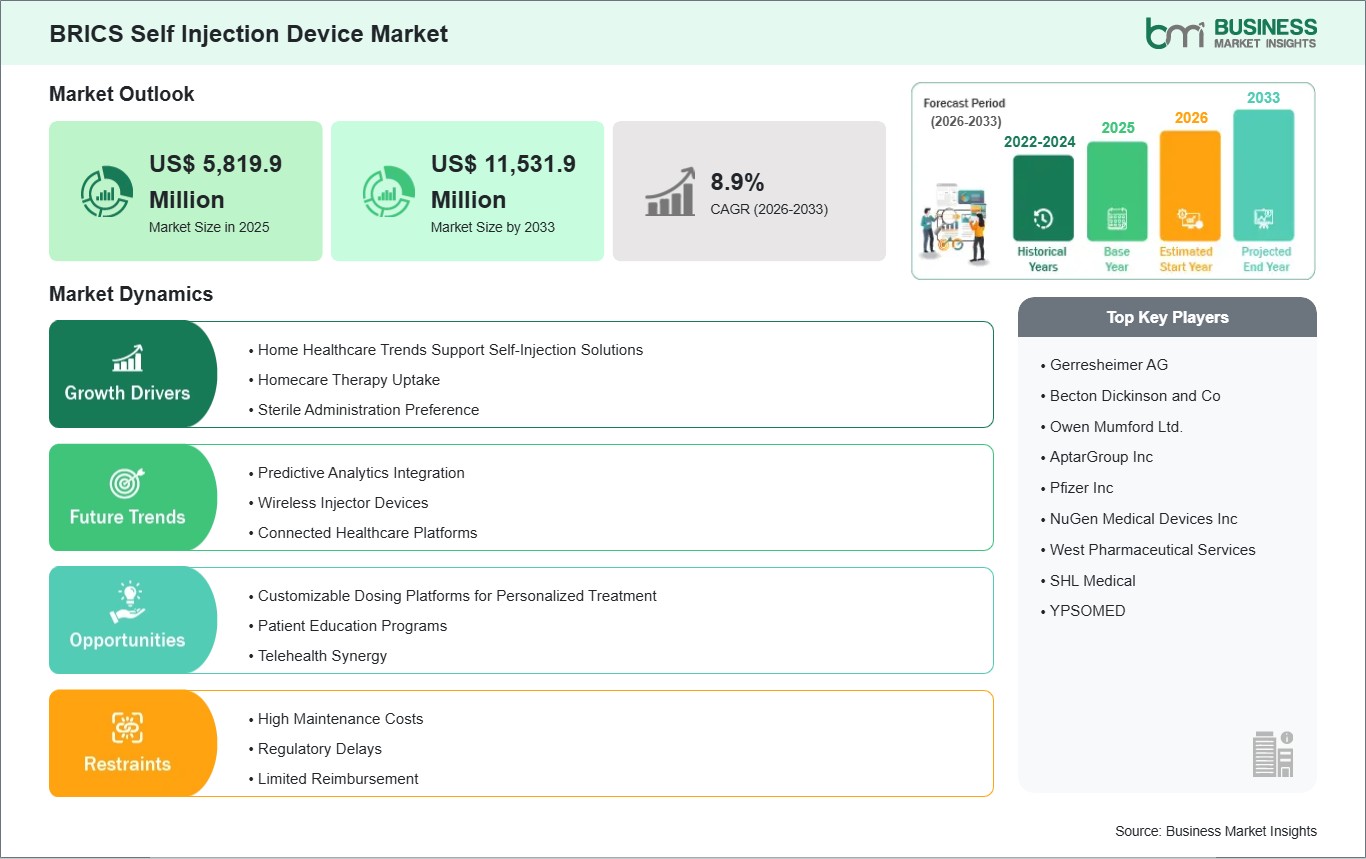
The BRICS self-injection device market is experiencing significant transformation as healthcare systems in Brazil, Russia, India, China, and South Africa adapt to rising chronic disease prevalence and expanding access to biologic therapies. Across these diverse economies, increasing patient preference for home-based care and the decentralization of therapeutic delivery has elevated the strategic importance of autoinjectors, pen injectors, wearable injectors, and prefilled syringes. Self-injection devices are crucial components of integrated chronic care pathways that promote adherence, reduce hospital burdens, and enhance patient autonomy. Growth drivers include rising incidence of diabetes, autoimmune disorders, and oncology indications that benefit from subcutaneous administration, coupled with widening distribution channels such as retail pharmacies, e-commerce platforms, and specialty clinics. The competitive landscape reflects a mix of global device manufacturers, local innovators, and contract manufacturers seeking to differentiate through technological enhancements, including ergonomic designs, dose feedback mechanisms, and safety locks that mitigate needle-stick injuries.
China and India are progressively aligning device approval frameworks with international quality standards, while Russia and Brazil continue to refine regulatory review timelines to expedite access. South Africa is focused on expanding public sector access and leveraging public-private partnerships to improve distribution in underserved regions. Manufacturers adopt tiered product strategies and local partnerships to optimize price points. Stakeholder collaboration—involving payers, healthcare professionals, and patient advocacy groups—is increasingly recognized as essential to drive adoption, improve training, and ensure effective use. Overall, the market presents a dynamic and heterogeneous landscape, where patient-centric innovation and strategic market positioning are key determinants of competitive success and long-term sustainability.
Segment Analysis
BRICS Self Injection Device Market Segmentation
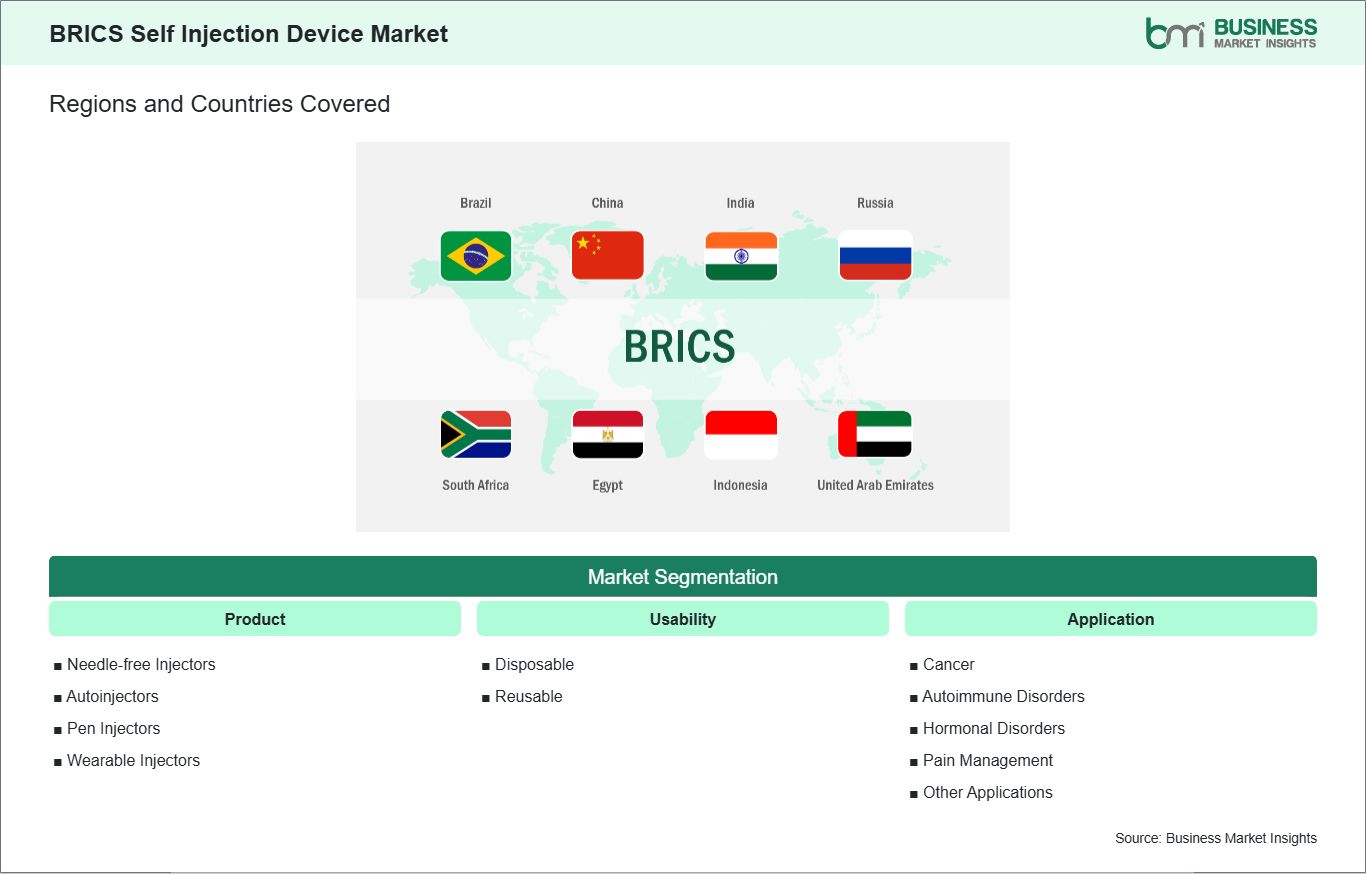
Key segments that contributed to the derivation of the BRICS self injection device market analysis are product, usability, and application.
- By product, the self injection device market is segmented into needle-free Injectors, autoinjectors, pen Injectors, and wearable Injectors. The needle-free Injectors segment dominated the market in 2025.
- Based on usability, the self injection device market is categorized into disposable and reusable. The disposable segment dominated the market in 2025.
- In terms of application, the market is classified into cancer, autoimmune disorders, hormonal disorders, pain management, and other applications. The autoimmune disorders segment dominated the market in 2025.
Market Forces
BRICS Self Injection Device Market Drivers and Opportunities
Home Healthcare Trends Support Self-Injection Solutions
Across the BRICS, home healthcare is increasingly viewed as a practical solution to rising chronic disease burden and stretched hospital capacity. Self-injection devices support this trend by enabling patients to manage long-term therapies at home, reducing the need for frequent outpatient visits. In major urban centers across the region, the demand for home-based care is driven by busy lifestyles and the high cost of repeated hospital visits. Self-injection devices are therefore becoming more common in patient routines, particularly for conditions requiring consistent dosing over long periods. In semi-urban and rural areas, where healthcare infrastructure can be uneven, self-injection devices are especially valuable. Home administration allows patients to avoid long travel times to centralized clinics, making treatment more accessible. BRICS health systems are increasingly supporting home care through nurse training programs and remote patient monitoring initiatives. Such programs have led to higher confidence among patients in self-administration and improved adherence, as patients receive guidance through home visits or telehealth consultations. Across the BRICS, growth is observed in private home healthcare services that bundle device training with ongoing support. These services often include device demonstrations, waste disposal guidance, and follow-up reminders. Overall, the home healthcare trend is reshaping the market by making self-administration a mainstream component of chronic disease management.
Customizable Dosing Platforms for Personalized Treatment
Personalized medicine is emerging as a major market driver, particularly as biologic therapies and insulin analogs become more widely used. Self-injection platforms with customizable dosing allow patients to adjust doses according to their daily needs and physician guidance. This convenience is especially important in regions where treatment plans may require frequent dose changes based on lifestyle, diet, and disease progression. Devices with flexible dosing also reduce the risk of under- or over-dosing, improving clinical outcomes and patient confidence. Advanced dosing platforms are increasingly integrating features such as adjustable dial settings, dose memory functions, and user-friendly interfaces that reduce errors.
Customizable dosing tools help clinicians tailor treatment plans while enabling patients to self-manage more effectively. These devices are typically favored in environments where access to regular clinical follow-up is limited. The region is also witnessing a rise in combination therapy regimens, which increases the need for adaptable injection platforms. Patients on multiple therapies benefit from devices that can support different dose ranges and provide consistent performance across various formulations, driving demand for more versatile self-injection systems.
Size and Share Analysis
BRICS Self Injection Device Market Size and Share Analysis
The BRICS Self Injection Device Market demonstrates steady growth, with size and share analysis highlighting evolving trends and competitive dynamics among key players. The report examines subsegments categorized within product, usability, and application, offering insights into their contribution to overall market performance.
By product, the needle-free Injectors subsegment dominated the market in 2025, driven by increasing patient demand for painless, safer delivery methods that reduce needle-associated anxiety and risks.
Based on usability, the disposable subsegment dominated the market in 2025, driven by a preference for easy-to-use, single-use devices that improve hygiene and lower infection concerns.
In terms of application, the autoimmune disorders subsegment dominated the market in 2025, driven by the growing burden of chronic autoimmune diseases requiring frequent self-administered injectable treatments.
Report Coverage
BRICS Self Injection Device Market Report Coverage and Deliverables
The "BRICS Self Injection Device Market Size and Forecast (2022–2033)" report provides a detailed analysis of the market covering below areas:
- BRICS Self Injection Device Market size and forecast at regional and country levels for all market segments covered under the scope
- BRICS Self Injection Device Market trends, as well as drivers, restraints, and opportunities
- BRICS Self Injection Device Market Analysis covering key trends, regional framework, major players, regulations, and recent developments
- Industry landscape and competition analysis covering market concentration, heat map analysis, prominent players, and recent developments for the BRICS Self Injection Device Market
- Detailed company profiles, including SWOT analysis
Geographic Insights
BRICS Self Injection Device Market Geographic Insights
The geographical scope of the BRICS Self Injection Device Market report is divided into Russia, Brazil, South Africa, India, the UAE, and China. China held the largest share in 2025.
Country-level dynamics within the BRICS self-injection device market reveal pronounced heterogeneity shaped by local healthcare infrastructure, regulatory environments, and patient behaviors. Brazil is characterized by an established and sophisticated medical device landscape supported by a large chronic disease burden, strong public and private insurance systems, and advanced hospital procurement channels; autoinjectors and pen devices for diabetes and autoimmune therapies dominate uptake, with expanding interest in wearable injectors and smart platforms. Brazil's regulatory authority, ANVISA, has been streamlining device approvals, encouraging market entry while maintaining stringent quality standards.
Russia demonstrates growth driven by public sector institutional demand and increasing private insurance coverage; the Russian market emphasizes ease-of-use and safety features in self-injection devices—particularly in endocrinology and rheumatology applications—with domestic manufacturers competing alongside global players. India is marked by high price sensitivity and a vast underserved rural population, prompting manufacturers to adopt cost-competitive product lines, localized assembly, and decentralized distribution channels; demand for insulin pens and affordable autoinjectors remains particularly strong.
China has a rapidly advancing market with regulatory alignment to international standards, extensive telemedicine penetration, and significant investment in smart connected devices that integrate digital patient support.
Urban centres in South Africa witness high adoption of advanced self-injection formats, whereas rural regions continue to lag, signalling opportunities for targeted education and distribution strategies. Across BRICS, manufacturers must tailor approaches to country-specific reimbursement pathways, regulatory requirements, and patient education needs to maximize market penetration and sustainable growth.
Industry Activity
Recent Developments
The BRICS Self Injection Device Market is evaluated by gathering qualitative and quantitative data post primary and secondary research, which includes important corporate publications, association data, and databases. A few of the key developments in the BRICS self injection device market are:
- In June 2025, Eli Lilly received regulatory approval in India to launch its Mounjaro KwikPen in multiple dosage strengths (2.5 mg to 15 mg), expanding its self-injection delivery options for diabetes and obesity management. This approval marks a significant expansion of injectable therapy devices tailored for the Indian chronic care market and aligns with rising demand for convenient, at-home administration formats. The KwikPen format is designed to support personalized treatment regimens and compete directly with existing weekly pen injectors. Increased competition in the Indian self-injection pen segment is expected to drive broader adoption and improved access for patients requiring weekly dosing regimens.
- In December 2025, South Africa introduced an innovative, long-acting HIV-prevention injectable regimen, Lenacapavir, administered twice yearly, as part of a public health rollout; although not a traditional chronic disease self-injection device, this injectable delivery approach underscores the region's adoption of self-administered or minimally clinician-dependent injection therapies in BRICS public health programs. Such deployments highlight broader movement toward long-acting injectable formats with simplified administration schedules for patient convenience.
Trust & Transparency
Research Methodology
The market analysis combines proprietary research with secondary data from government agencies, company disclosures, regulatory filings, industry databases and expert interviews. Market estimates are validated through data triangulation, cross-market benchmarking and analyst
review.
View Full Research Methodology
Key Sources Referred:
World Health Organization (WHO) Organisation for Economic Cooperation and Development (OECD) The World Bank Group Worldometer The Lancet International Bar Association International Trade Administration