Europe Self Injection Device Market Outlook (2022-2033)

Historic Data: 2022-2024   |   Base Year: 2025   |   Forecast Period: 2026-2033
Report Content: Market Scope, Market Segmentation, Market Dynamics, and Competitive Analysis

Report Coverage:
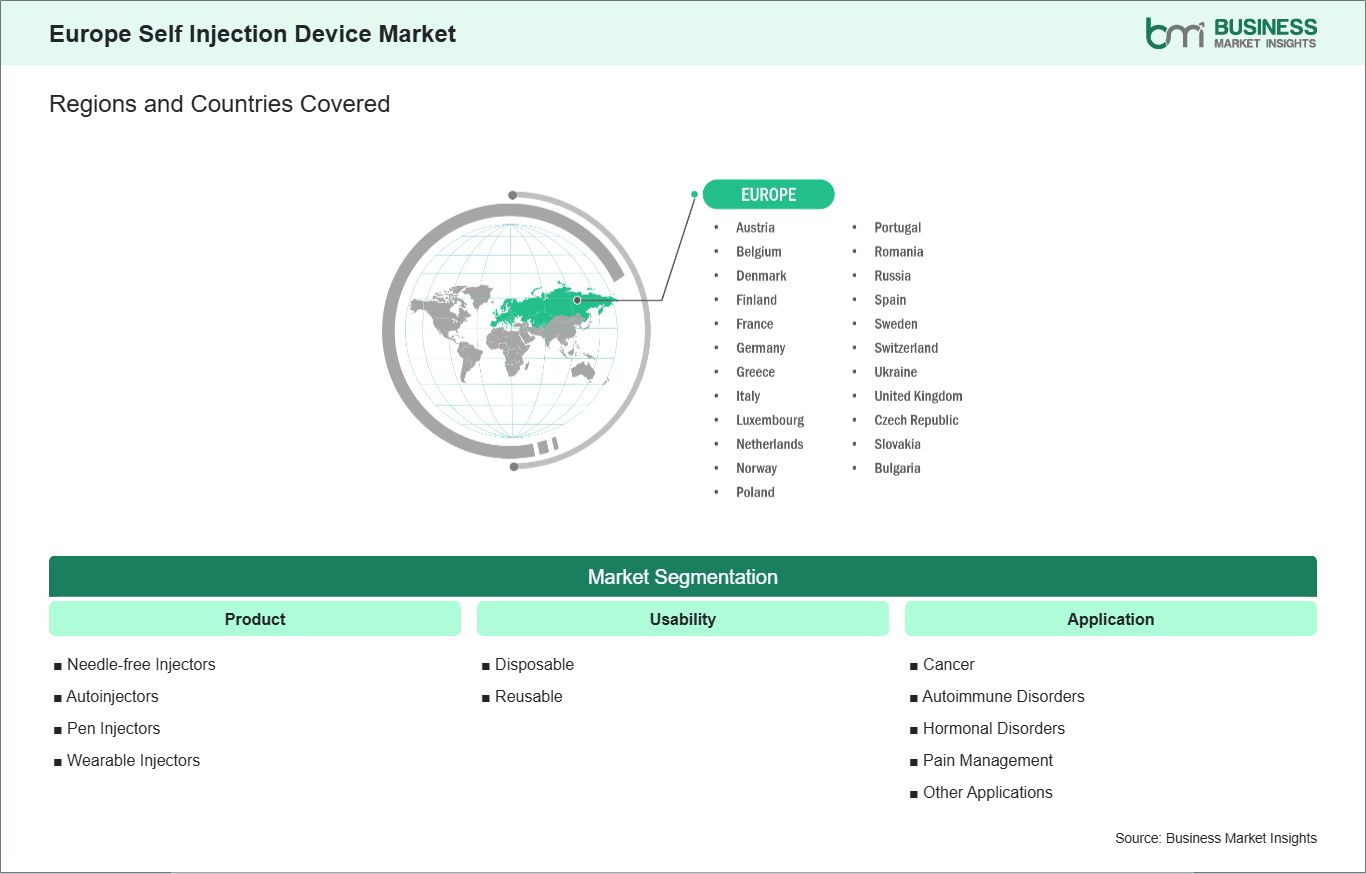
  • Product (Needle-free Injectors, Autoinjectors, Pen Injectors, Wearable Injectors)
  • Usability (Disposable, Reusable)
  • Application (Cancer, Autoimmune Disorders, Hormonal Disorders, Pain Management, Other Applications)

No. of Pages: 150
Report Code: BMIPUB00034874
Category: Life Sciences
Europe Self Injection Device Market

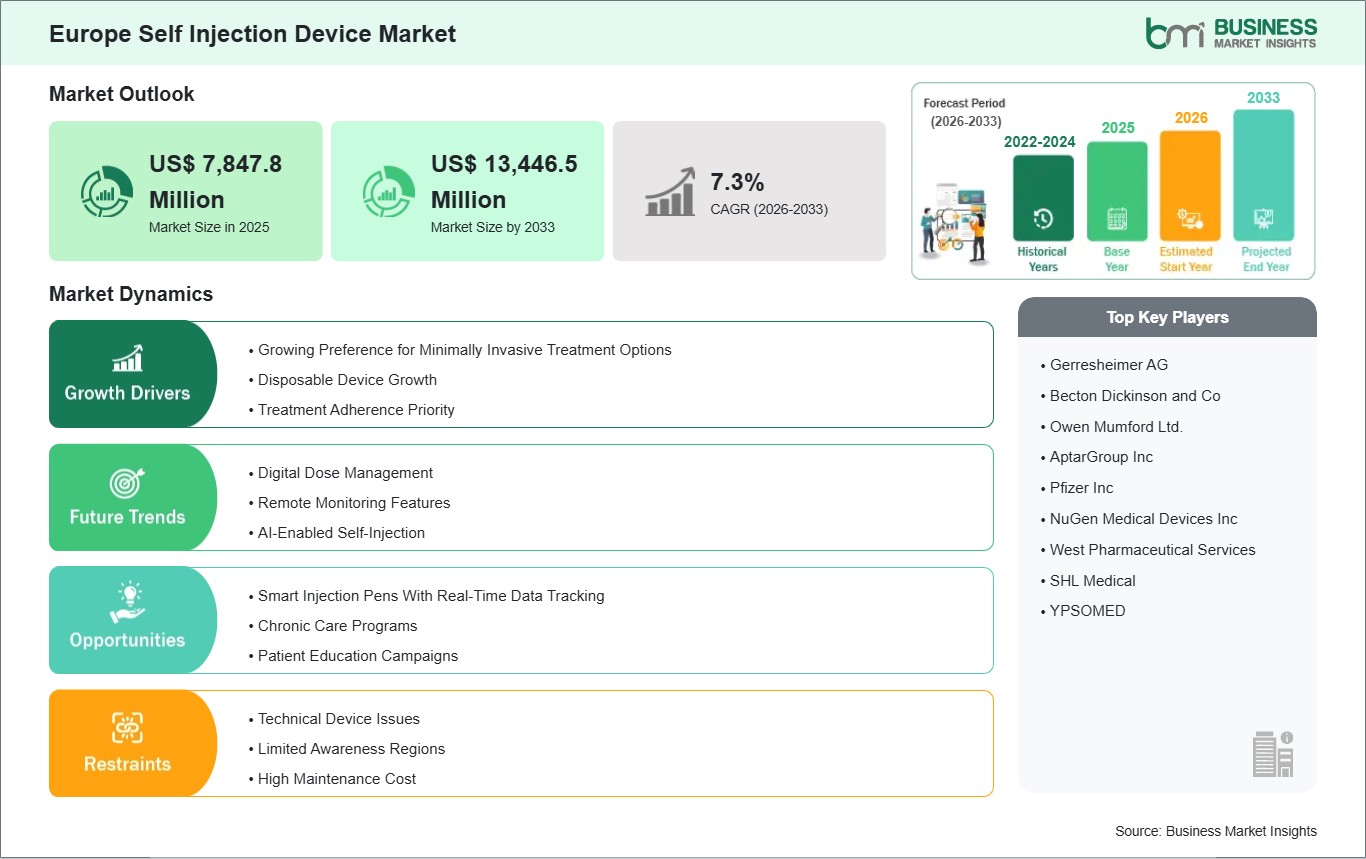
The Europe Self Injection Device Market size is expected to reach US$ 13,446.5 million by 2033 from US$ 7,847.8 million in 2025. The market is estimated to record a CAGR of 7.3 % from 2026 to 2033.

Executive Summary and Europe Self Injection Device Market Analysis:

The Europe self-injection device market is characterized by rapid transformation as healthcare systems across Western and Eastern Europe increasingly embrace decentralized care delivery and patient-centric treatment models. Chronic disease prevalence—particularly diabetes, autoimmune disorders, and osteoporosis—continues to drive demand for self-administration platforms that enhance convenience, adherence, and overall therapeutic outcomes. Self-injection devices, spanning pen injectors, autoinjectors, wearable injectors, and prefilled syringes are becoming core components of outpatient care protocols, reducing pressure on hospital infrastructure and supporting long-term disease management.

The competitive landscape features a mix of established multinational medical device manufacturers and innovative regional players. Key players are competing through technological enhancements in device ergonomics, safety features, and digital connectivity. Regulatory frameworks across Europe are becoming more cohesive with the implementation of the Medical Device Regulation (MDR), which emphasizes product safety, durability, and post-market surveillance, thereby increasing the compliance burden on device developers but also raising overall quality standards.

Key market drivers include expanded reimbursement frameworks in countries such as Germany, the UK, and France, where national health insurers recognize the value of at-home care models that reduce overall treatment costs and improve patient satisfaction. Challenges include pricing pressures from public payers, wide disparities in adoption rates across Eastern and Southern Europe, and the need for robust patient education programs to ensure correct device usage and minimize injection-related errors. Distribution channels are also evolving, with digital pharmacies and specialty e-commerce platforms playing a growing role alongside traditional retail pharmacy networks. Overall, the market reflects a sophisticated healthcare environment, marked by strong innovation pipelines, stringent regulatory expectations, and diverse adoption patterns.

Europe Self Injection Device Market - Strategic Insights:

global-market-strategic-framework
Get more information on this report

Europe Self Injection Device Market Segmentation Analysis:

Key segments that contributed to the derivation of the Europe self injection device market analysis are product, usability, and application.

  • By product, the self injection device market is segmented into needle-free Injectors, autoinjectors, pen Injectors, and wearable Injectors. The needle-free Injectors segment dominated the market in 2025.
  • Based on usability, the self injection device market is categorized into disposable and reusable. The disposable segment dominated the market in 2025.
  • In terms of application, the market is classified into cancer, autoimmune disorders, hormonal disorders, pain management, and other applications. The autoimmune disorders segment dominated the market in 2025.

Europe Self Injection Device Market Drivers and Opportunities:

Growing Preference for Minimally Invasive Treatment Options

Across Western Europe, there is a strong shift toward minimally invasive treatment options, driven by high patient expectations for comfort, convenience, and safety. Patients managing chronic conditions such as diabetes, multiple sclerosis, and rheumatoid arthritis increasingly prefer autoinjectors and pen systems over traditional syringes. These devices reduce pain and anxiety and simplify self-administration. In this region, advanced healthcare infrastructure and high patient awareness support the adoption of devices with features such as prefilled dosing, ergonomic grips, and low-injection force. Clinics and specialist centers often recommend self-injection as a preferred method for long-term therapies, enabling patients to maintain active lifestyles without frequent hospital visits.

Northern Europe shows a particularly strong preference for minimally invasive devices due to high standards of patient-centered care and a strong focus on preventive health. Self-injection solutions are frequently integrated into outpatient care pathways, allowing patients to receive biologics and insulin therapies at home. Health systems emphasize patient training and safety, supporting the adoption of devices that minimize user error and reduce the risk of needlestick injuries. This trend is also supported by strong home care programs and pharmacy-led patient education initiatives, which increase confidence in self-administration and improve adherence. In Southern Europe, where aging populations and chronic disease prevalence are high, the preference for minimally invasive treatment is driven by clinical need and lifestyle factors.

Many patients prefer self-injection devices that allow treatment flexibility. Autoinjectors and pen injectors provide this convenience and are increasingly used in urban healthcare networks. Eastern Europe is also witnessing growing adoption of minimally invasive options as healthcare systems modernize and access to outpatient care expands.

Smart Injection Pens With Real-Time Data Tracking

In Western Europe, smart injection pens are increasingly adopted as part of digital health initiatives aimed at improving adherence and outcomes. These devices often connect to mobile apps to record dose timing, injection history, and adherence patterns. Healthcare providers in this region use real-time data to monitor patient behavior and identify missed doses. Smart pens are particularly popular for insulin therapy and biologics, where dosing accuracy and consistent adherence are crucial. Patients also appreciate the convenience of automatic logging and reminders, which help them manage complex treatment schedules.

There is high digital literacy and strong telehealth integration in Northern Europe. Patients often use digital health platforms for chronic disease management. Real-time tracking enables healthcare teams to conduct remote monitoring and support. In regions with widely used electronic health records, smart pen data can be shared with clinicians to optimize dosing plans and identify patterns that indicate complications or poor adherence. This convenience supports a shift toward proactive care.

Southern Europe is gradually adopting smart injection pens, driven by increasing smartphone penetration and growing patient demand for connected health solutions. In urban areas, patient support programs are beginning to include digital training on app-based dose tracking, which is valuable for patients managing multiple therapies. Eastern Europe is witnessing slower but steady adoption of smart pens, mainly in major urban centers where digital infrastructure and telehealth services are developed. As digital health investments increase across the region, smart injection pens are expected to become more common.

Europe Self Injection Device Market Size and Share Analysis:

The Europe Self Injection Device Market demonstrates steady growth, with size and share analysis highlighting evolving trends and competitive dynamics among key players. The report examines subsegments categorized within product, usability, and application, offering insights into their contribution to overall market performance.

By product, the needle-free Injectors subsegment dominated the market in 2025, driven by strong patient demand for less painful and more convenient drug delivery solutions that reduce needle-related anxiety.

Based on usability, the disposable subsegment dominated the market in 2025, driven by widespread preference for single-use devices that enhance hygiene and minimize infection risk.

In terms of application, the autoimmune disorders subsegment dominated the market in 2025, driven by the rising prevalence of chronic autoimmune diseases requiring frequent self-administered injectable treatments.

Europe Self Injection Device Market Report Highlights:

Report Attribute Details
Market size in 2025 US$ 7,847.8 Million
Market Size by 2033 US$ 13,446.5 Million
CAGR (2026 - 2033)7.3%
Historical Data 2022-2024
Forecast period 2026-2033
Segments Covered By Product
  • Needle-free Injectors
  • Autoinjectors
  • Pen Injectors
  • Wearable Injectors
By Usability
  • Disposable
  • Reusable
By Application
  • Cancer
  • Autoimmune Disorders
  • Hormonal Disorders
  • Pain Management
  • Other Applications
Regions and Countries Covered
Europe Belgium, Austria, Finland, Denmark, Greece, Poland, Romania, Russia, Ukraine, Czech Republic, Slovakia, Bulgaria, Italy, Luxembourg, Germany, Switzerland, France, Netherlands, Norway, Portugal, Spain, Sweden, UK
Market leaders and key company profiles
  • Gerresheimer AG
  • Becton Dickinson and Co
  • Owen Mumford Ltd.
  • AptarGroup Inc
  • Pfizer Inc
  • NuGen Medical Devices Inc
  • West Pharmaceutical Services
  • SHL Medical
  • YPSOMED
Get more information on this report

Europe Self Injection Device Market Report Coverage and Deliverables:

The "Europe Self Injection Device Market Size and Forecast (2022–2033)" report provides a detailed analysis of the market covering below areas:

  • Europe Self Injection Device Market size and forecast at regional and country levels for all market segments covered under the scope
  • Europe Self Injection Device Market trends, as well as drivers, restraints, and opportunities
  • Europe Self Injection Device Market analysis covering key trends, regional framework, major players, regulations, and recent developments
  • Industry landscape and competition analysis covering market concentration, heat map analysis, prominent players, and recent developments for the Europe Self Injection Device Market
  • Detailed company profiles, including SWOT analysis

Europe Self Injection Device Market Geographic Insights:

The geographical scope of the Europe Self Injection Device Market report is divided into Belgium, Austria, Finland, Denmark, Greece, Poland, Romania, Russia, Ukraine, the Czech Republic, Slovakia, Bulgaria, Italy, Luxembourg, Germany, Switzerland, France, the Netherlands, Norway, Portugal, Spain, Sweden, and the UK. Germany held the largest share in 2025.

Country-level dynamics within the Europe self-injection device market reveal significant heterogeneity shaped by healthcare infrastructure maturity, reimbursement policies, and patient expectations across major regional markets. Germany continues to lead in device innovation adoption, driven by strong statutory health insurance coverage, widespread chronic disease management programs, and early integration of digital health technologies. German physicians and payers are particularly receptive to smart injectors that offer remote monitoring and adherence analytics, fostering a competitive environment for connected devices.

In the UK, the National Health Service's (NHS) emphasis on cost-effectiveness and patient-centric care has accelerated the adoption of self-injection platforms, particularly in autoimmune and endocrinological therapies. At the same time, policy shifts, including real-world evidence initiatives, support integration of digital adherence tools into routine practice. France reflects high uptake of ergonomic pen injectors and autoinjectors in hospital and outpatient settings, supported by robust reimbursement frameworks that mitigate out-of-pocket costs and drive physician confidence in self-administration models. Italy and Spain show growing interest in self-injection devices. However, economic constraints and regional disparities in healthcare delivery require targeted awareness and education campaigns to boost adoption beyond metropolitan centres.

Nordic countries demonstrate advanced integration of wearable injectors and remote patient management tools, aided by national digital health strategies that align payer incentives with technology adoption. Meanwhile, Eastern European markets such as Poland and the Czech Republic are experiencing accelerated uptake as regulatory convergence with European standards and rising disposable incomes improve accessibility and affordability. Across all these countries, effective physician engagement, tailored patient education programs, and alignment with local reimbursement frameworks remain critical to achieving sustainable adoption rates.

global-market-geography
Get more information on this report

Europe Self Injection Device Market Research Report Guidance:

  • The report includes qualitative and quantitative data in the Europe Self Injection Device Market across product, usability, application, and geography.
  • The report starts with the key takeaways (chapter 2), highlighting key trends and outlook of the Europe Self Injection Device Market.
  • Chapter 3 focuses on the research methodology of the study.
  • Chapter 4 includes ecosystem analysis.
  • Chapter 5 highlights the major industry dynamics in the Europe Self Injection Device Market, including factors that are driving the market, prevailing deterrents, potential opportunities, as well as future trends. Impact analysis of these drivers and restraints is also covered in this section.
  • Chapter 6 discusses the Europe Self Injection Device Market scenario, in terms of historical market revenues, and forecast till the year 2033.
  • Chapters 7 to 10 cover Europe Self Injection Device Market segments by product, usability, application, and geography across Belgium, Austria, Finland, Denmark, Greece, Poland, Romania, Russia, Ukraine, the Czech Republic, Slovakia, Bulgaria, Italy, Luxembourg, Germany, Switzerland, France, the Netherlands, Norway, Portugal, Spain, Sweden, and the UK. They cover the market revenue forecast and factors driving the market.
  • Chapter 11 describes the competitive analysis along with the heat map analysis for the key players operating in the market.
  • Chapter 12 describes the industry landscape analysis. It provides detailed descriptions of business activities such as market initiatives, new developments, mergers, and joint ventures globally, along with a competitive landscape.
  • Chapter 13 provides detailed profiles of the major companies operating in the Europe Self Injection Device Market. Companies have been profiled on the basis of their key facts, business descriptions, products, financial overview, SWOT analysis, and key developments.
  • Chapter 14, i.e., the appendix, is inclusive of a brief overview of the company, a list of abbreviations, and a disclaimer.

Europe Self Injection Device Market News and Key Development:

The Europe Self Injection Device Market is evaluated by gathering qualitative and quantitative data post primary and secondary research, which includes important corporate publications, association data, and databases. A few of the key developments in the Europe self injection device market are:

  • In December 2025, AstraZeneca's Saphnelo (anifrolumab) was approved in the European Union for subcutaneous self-administration via a new prefilled pen for adult systemic lupus erythematosus, following a positive CHMP recommendation. This approval enables patients to transition from clinic-based infusions to convenient at-home injections, expanding self-injection options for autoimmune disease treatments. The move aligns with increasing regulatory support for self-administered biologics in Europe's evolving care models. It also represents one of the latest EU authorizations broadening self-injection access beyond common chronic indications.
  • In October 2025, SCHOTT Pharma launched the first 5.5 ml prefillable staked-needle glass syringe designed for large-volume biologic self-injection at home, compatible with Ypsomed's YpsoMate 5.5 ml autoinjector. This innovation enables safe and stable delivery of high-dose biologics in subcutaneous settings, supporting broader homecare treatment strategies for complex therapies. The product's introduction across European supply channels enhances device ecosystem options for pharma companies developing next-generation treatments. Its launch underscores a shift toward enabling large-volume self-administration outside clinical environments.

Key Sources Referred:

  • World Health Organization (WHO)
  • Organisation for Economic Cooperation and Development (OECD)
  • The World Bank Group
  • Worldometer
  • The Lancet
  • International Bar Association
  • International Trade Administration
The List of Companies - Europe Self Injection Device Market
  • Gerresheimer AG
  • Becton Dickinson and Co
  • Owen Mumford Ltd.
  • AptarGroup Inc
  • Pfizer Inc
  • NuGen Medical Devices Inc
  • West Pharmaceutical Services
  • SHL Medical
  • YPSOMED
Frequently Asked Questions
How big is the Europe Self Injection Device Market?

The Europe Self Injection Device Market is valued at US$ 7,847.8 Million in 2025, it is projected to reach US$ 13,446.5 Million by 2033.

What is the CAGR for Europe Self Injection Device Market by (2026 - 2033)?

As per our report Europe Self Injection Device Market, the market size is valued at US$ 7,847.8 Million in 2025, projecting it to reach US$ 13,446.5 Million by 2033. This translates to a CAGR of approximately 7.3% during the forecast period.

What segments are covered in this report?

The Europe Self Injection Device Market report typically cover these key segments-

  • Product (Needle-free Injectors, Autoinjectors, Pen Injectors, Wearable Injectors)
  • Usability (Disposable, Reusable)
  • Application (Cancer, Autoimmune Disorders, Hormonal Disorders, Pain Management, Other Applications)

What is the historic period, base year, and forecast period taken for Europe Self Injection Device Market?

The historic period, base year, and forecast period can vary slightly depending on the specific market research report. However, for the Europe Self Injection Device Market report:

  • Historic Period : 2022-2024
  • Base Year : 2025
  • Forecast Period : 2026-2033
  • Who are the major players in Europe Self Injection Device Market?

    The Europe Self Injection Device Market is populated by several key players, each contributing to its growth and innovation. Some of the major players include:

  • Gerresheimer AG
  • Becton Dickinson and Co
  • Owen Mumford Ltd.
  • AptarGroup Inc
  • Pfizer Inc
  • NuGen Medical Devices Inc
  • West Pharmaceutical Services
  • SHL Medical
  • YPSOMED
  • Who should buy this report?

    The Europe Self Injection Device Market report is valuable for diverse stakeholders, including:

    • Investors: Provides insights for investment decisions pertaining to market growth, companies, or industry insights. Helps assess market attractiveness and potential returns.
    • Industry Players: Offers competitive intelligence, market sizing, and trend analysis to inform strategic planning, product development, and sales strategies.
    • Suppliers and Manufacturers: Helps understand market demand for components, materials, and services related to concerned industry.
    • Researchers and Consultants: Provides data and analysis for academic research, consulting projects, and market studies.
    • Financial Institutions: Helps assess risks and opportunities associated with financing or investing in the concerned market.

    Essentially, anyone involved in or considering involvement in the Europe Self Injection Device Market value chain can benefit from the information contained in a comprehensive market report.

    Available Report Formats

    pdf-format excel-format pptx-format
    Buy Now
    Sales Assistance
    +1 646 791 7070 (US & UK)
    Customization Form

    Please tell us your area of interest
    (Market Segments/ Regions and Countries/ Companies)