Asia Pacific Self Injection Device Market Outlook (2022-2033)

Historic Data: 2022-2024   |   Base Year: 2025   |   Forecast Period: 2026-2033
Report Content: Market Scope, Market Segmentation, Market Dynamics, and Competitive Analysis

Report Coverage:
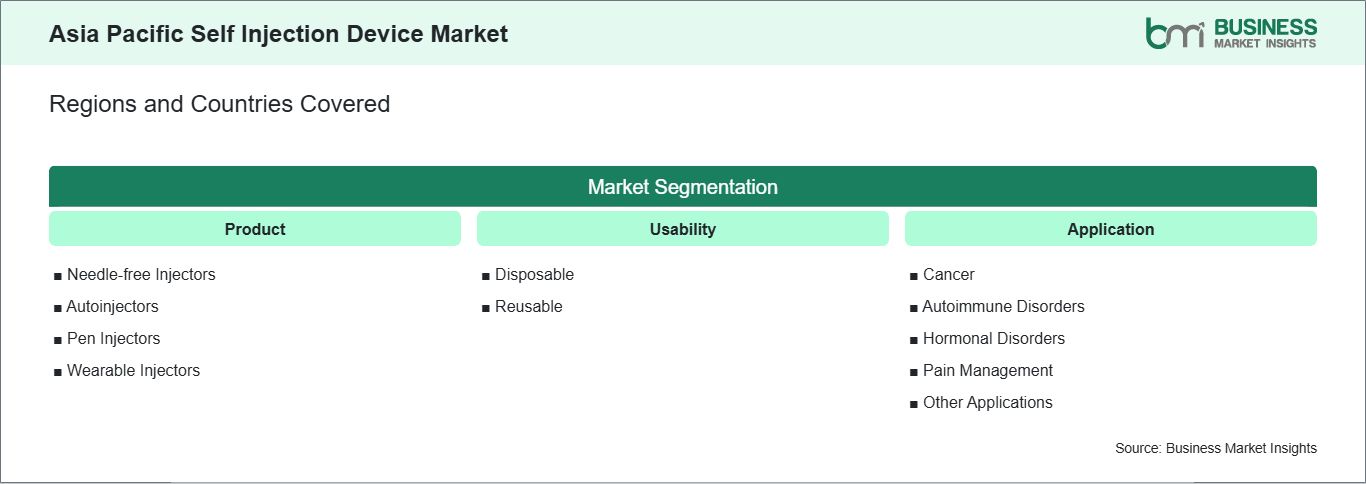
  • Product (Needle-free Injectors, Autoinjectors, Pen Injectors, Wearable Injectors)
  • Usability (Disposable, Reusable)
  • Application (Cancer, Autoimmune Disorders, Hormonal Disorders, Pain Management, Other Applications)

No. of Pages: 150
Report Code: BMIPUB00034875
Category: Life Sciences
Asia Pacific Self Injection Device Market

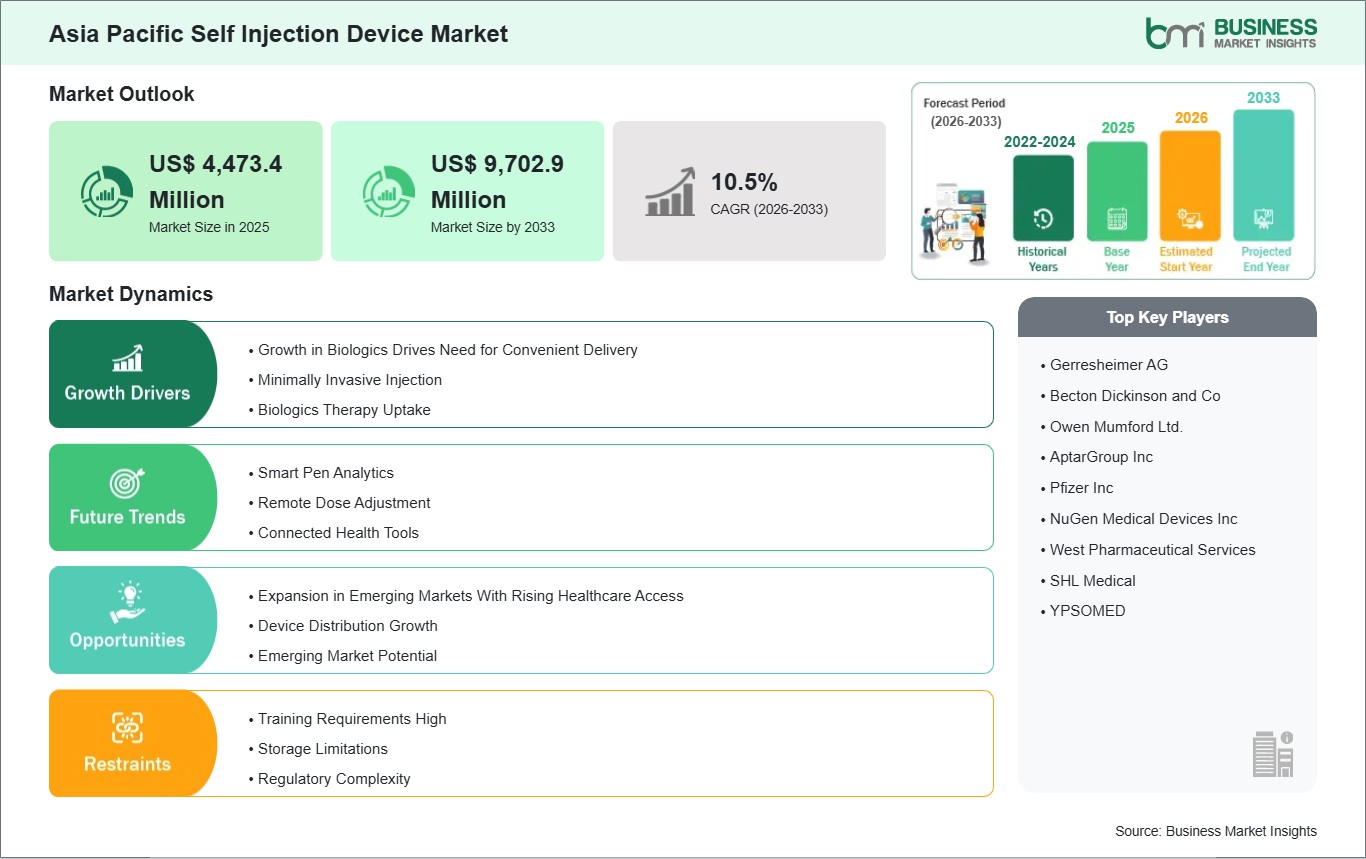
The Asia Pacific Self Injection Device Market size is expected to reach US$ 9,702.9 million by 2033 from US$ 4,473.4 million in 2025. The market is estimated to record a CAGR of 10.5 % from 2026 to 2033.

Executive Summary and Asia Pacific Self Injection Device Market Analysis:

The Asia Pacific self injection device market is driven by shifting patient preferences, healthcare delivery modernization, and mounting chronic disease burdens. The increasing prevalence of conditions such as diabetes, rheumatoid arthritis, and multiple sclerosis is creating sustained demand for at-home drug delivery solutions, reducing hospital dependency and improving medication adherence. Self-injection systems encompassing autoinjectors, pen injectors, wearable injectors, and prefilled syringes are evolving beyond basic injection tools to incorporate smarter features like dose tracking, feedback alerts, and enhanced safety mechanics, reflecting broader digital health integration trends in the region. This shift aligns with expanding telemedicine adoption, particularly in markets with constrained healthcare access, enabling remote monitoring and patient support in community settings.

The competitive landscape is marked by global majors and innovative local players investing in research to differentiate on usability, connectivity, and patient education. Meanwhile, challenges such as high unit costs, patient training gaps, and heterogeneous regulatory environments can inhibit uptake, especially in price-sensitive segments where healthcare coverage is limited. Manufacturers are addressing these barriers through tiered product offerings and strategic partnerships that enhance distribution reach and after-sales support. Hospital pharmacies remain central to device distribution, while online channels are rapidly gaining traction due to digital penetration and consumer convenience. Notably, patient literacy campaigns and integration with national chronic care initiatives are emerging as key strategic levers for accelerating adoption. Market success will increasingly depend on balancing technological innovation with accessibility and patient empowerment strategies that resonate across advanced and emerging healthcare landscapes in Asia Pacific.

Asia Pacific Self Injection Device Market - Strategic Insights:

global-market-strategic-framework
Get more information on this report

Asia Pacific Self Injection Device Market Segmentation Analysis:

Key segments that contributed to the derivation of the Asia Pacific self injection device market analysis are product, usability, and application.

  • By product, the self injection device market is segmented into needle-free Injectors, autoinjectors, pen Injectors, and wearable Injectors. The needle-free Injectors segment dominated the market in 2025.
  • Based on usability, the self injection device market is categorized into disposable and reusable. The disposable segment dominated the market in 2025.
  • In terms of application, the market is classified into cancer, autoimmune disorders, hormonal disorders, pain management, and other applications. The autoimmune disorders segment dominated the market in 2025.

Asia Pacific Self Injection Device Market Drivers and Opportunities:

Growth in Biologics Drives Need for Convenient Delivery

Asia Pacific is witnessing rapid growth in biologic therapies, driven by the rising prevalence of chronic diseases such as rheumatoid arthritis, psoriasis, and diabetes. In Japan and South Korea, where biologics have become standard treatment for autoimmune conditions, self-injection devices are increasingly preferred due to the frequency of dosing and long-term therapy requirements. Patients often need weekly or biweekly injections, making clinic visits impractical. In Japan, patient support programs and nurse training initiatives at hospitals have helped patients transition to at-home self-injection, especially for therapies such as insulin analogs and monoclonal antibodies used in rheumatoid arthritis.

In China, the biologics market is expanding as domestic biopharmaceutical companies introduce biosimilars and original biologic products. This expansion has increased the demand for patient-friendly delivery systems that support long-term treatment adherence. In urban centers like Shanghai and Beijing, specialty clinics are recommending autoinjectors for chronic conditions because they reduce administration errors and provide consistent dosing. This trend is also seen in oncology supportive care, where patients use self-injection devices for supportive biologic therapies to manage side effects outside hospital settings.

Australia and New Zealand show strong adoption of self-injection devices driven by clinical preference and patient lifestyle. With a high proportion of elderly patients living independently, convenient self-administration has become essential for biologic therapies. Public health programs and private insurers increasingly support self-injection devices, particularly for diabetes and chronic inflammatory diseases. Overall, the expansion of biologics is creating sustained demand for user-friendly self-injection devices across the Asia Pacific.

Expansion in Emerging Markets With Rising Healthcare Access

Emerging markets in Asia Pacific are rapidly expanding healthcare access through infrastructure development, insurance reforms, and improved distribution networks. In India, self-injection devices are increasingly used for diabetes management and autoimmune therapies. Many Indian patients now purchase insulin pens through private pharmacies, supported by patient education campaigns run by clinics and NGOs. As public hospitals face capacity challenges, self-administration reduces clinic burden and supports treatment continuity for patients who cannot travel regularly for injections. Southeast Asian markets such as Indonesia, Vietnam, and the Philippines are also experiencing notable growth.

In Indonesia, improved access to primary care services has led to wider adoption of self-injection devices, particularly insulin pens. Health insurance expansion in some provinces is increasing affordability, while community health centers provide basic injection training. In Vietnam, the growth of private clinics and urban healthcare services is supporting the adoption of autoinjectors for chronic conditions, with patients increasingly seeking convenient and time-saving treatment options. In the Philippines, a growing middle class and increased pharmacy availability are driving adoption of self-injection devices for diabetes and chronic inflammatory conditions.

In the Middle East and Central Asia, markets such as Kazakhstan and the Gulf Cooperation Council (GCC) states are also contributing to regional growth. In the UAE and Saudi Arabia, the high prevalence of diabetes and improved healthcare infrastructure have led to greater demand for insulin pens and prefilled syringes. Patients in major cities prefer self-administration because of supportive health education and easy access to pharmacies. In Kazakhstan, expanding primary care services and increasing chronic disease awareness are creating opportunities for self-injection device adoption.

Asia Pacific Self Injection Device Market Size and Share Analysis:

The Asia Pacific Self Injection Device Market demonstrates steady growth, with size and share analysis highlighting evolving trends and competitive dynamics among key players. The report examines subsegments categorized within product, usability, and application, offering insights into their contribution to overall market performance.

By product, the needle-free Injectors subsegment dominated the market in 2025, driven by growing demand for painless and safer delivery options that reduce needle anxiety and infection risk.

Based on usability, the disposable subsegment dominated the market in 2025, driven by patient preference for convenient, single-use devices that ensure hygiene and reduce contamination.

In terms of application, the autoimmune disorders subsegment dominated the market in 2025, driven by the increasing prevalence of chronic autoimmune conditions requiring frequent self-administered biologic injections.

Asia Pacific Self Injection Device Market Report Highlights:

Report Attribute Details
Market size in 2025 US$ 4,473.4 Million
Market Size by 2033 US$ 9,702.9 Million
CAGR (2026 - 2033)10.5%
Historical Data 2022-2024
Forecast period 2026-2033
Segments Covered By Product
  • Needle-free Injectors
  • Autoinjectors
  • Pen Injectors
  • Wearable Injectors
By Usability
  • Disposable
  • Reusable
By Application
  • Cancer
  • Autoimmune Disorders
  • Hormonal Disorders
  • Pain Management
  • Other Applications
Regions and Countries Covered
Asia-Pacific China, India, Japan, Australia, Bangladesh, Indonesia, Malaysia, New Zealand, Philippines, Singapore, South Korea, Taiwan, Thailand, Vietnam
Market leaders and key company profiles
  • Gerresheimer AG
  • Becton Dickinson and Co
  • Owen Mumford Ltd.
  • AptarGroup Inc
  • Pfizer Inc
  • NuGen Medical Devices Inc
  • West Pharmaceutical Services
  • SHL Medical
  • YPSOMED
Get more information on this report

Asia Pacific Self Injection Device Market Report Coverage and Deliverables:

The "Asia Pacific Self Injection Device Market Size and Forecast (2022–2033)" report provides a detailed analysis of the market covering below areas:

  • Asia Pacific Self Injection Device Market size and forecast at regional and country levels for all market segments covered under the scope
  • Asia Pacific Self Injection Device Market trends, as well as drivers, restraints, and opportunities
  • Asia Pacific Self Injection Device Market analysis covering key trends, regional framework, major players, regulations, and recent developments
  • Industry landscape and competition analysis covering market concentration, heat map analysis, prominent players, and recent developments for the Asia Pacific Self Injection Device Market
  • Detailed company profiles, including SWOT analysis

Asia Pacific Self Injection Device Market Geographic Insights:

The geographical scope of the Asia Pacific Self Injection Device Market report is divided into China, India, Japan, Australia, Bangladesh, Indonesia, Malaysia, New Zealand, Philippines, Singapore, South Korea, Taiwan, Thailand, and Vietnam. China held the largest share in 2025.

The dynamics of the Asia Pacific self-injection device market vary by country based on economic maturity, healthcare infrastructure, and patient behavior. The market in China is underpinned by its vast patient population, robust biopharmaceutical manufacturing ecosystem, and supportive healthcare reforms that accelerate the adoption of self-administration tools. China's investments in expanding biosimilar and biologic therapies support a parallel surge in demand for compatible self-injection devices across therapeutic areas. Japan, with its significant aging population and high technology adoption rate, prioritizes ease-of-use and discreet delivery systems, making it a fertile ground for premium pen injectors and smart devices, bolstered by regulatory frameworks that expedite novel device approvals and streamline market entry.

South Korea is distinguished by its rapid integration of digital health into chronic disease care, making smart connected injectors and data-enabled platforms particularly resonant among tech-savvy patients and providers. India has a high prevalence of diabetes and autoimmune disorders, along with expanding healthcare access and increasing patient willingness to adopt home-based therapies. Affordability and localized training programs remain essential enablers for the adoption of self-injection devices.

Southeast Asian countries such as Australia and New Zealand show advanced uptake supported by strong insurance coverage and patient education initiatives, while emerging markets in Southeast Asia are characterized by incremental progress as infrastructure and reimbursement systems evolve. Across the region, market participants are tailoring go-to-market strategies to reflect local regulatory requirements, cultural preferences, and healthcare financing realities. This highlights the need for nuanced approaches that resonate with individual country contexts within the broader Asia Pacific landscape.

global-market-geography
Get more information on this report

Asia Pacific Self Injection Device Market Research Report Guidance:

  • The report includes qualitative and quantitative data in the Asia Pacific Self Injection Device Market across product, usability, application, and geography.
  • The report starts with the key takeaways (chapter 2), highlighting the trends and outlook of the Asia Pacific Self Injection Device Market.
  • Chapter 3 focuses on the research methodology of the study.
  • Chapter 4 includes ecosystem analysis.
  • Chapter 5 highlights the major industry dynamics in the Asia Pacific Self Injection Device Market, including factors that are driving the market, prevailing deterrents, potential opportunities, as well as future trends. Impact analysis of these drivers and restraints is also covered in this section.
  • Chapter 6 discusses the Asia Pacific Self Injection Device Market scenario, in terms of historical market revenues, and forecast till the year 2033.
  • Chapters 7 to 10 cover Asia Pacific Self Injection Device Market segments by product, usability, application, and geography across China, India, Japan, Australia, Bangladesh, Indonesia, Malaysia, New Zealand, Philippines, Singapore, South Korea, Taiwan, Thailand, and Vietnam. They cover the market revenue forecast and factors driving the market.
  • Chapter 11 describes the competitive analysis along with the heat map analysis for the key players operating in the market.
  • Chapter 12 describes the industry landscape analysis. It provides detailed descriptions of business activities such as market initiatives, new developments, mergers, and joint ventures globally, along with a competitive landscape.
  • Chapter 13 provides detailed profiles of the major companies operating in the Asia Pacific Self Injection Device Market. Companies have been profiled on the basis of their key facts, business descriptions, products, financial overview, SWOT analysis, and key developments.
  • Chapter 14, i.e., the appendix, is inclusive of a brief overview of the company, a list of abbreviations, and a disclaimer.

Asia Pacific Self Injection Device Market News and Key Development:

The Asia Pacific Self Injection Device Market is evaluated by gathering qualitative and quantitative data post primary and secondary research, which includes important corporate publications, association data, and databases. A few of the key developments in the Asia Pacific self injection device market are:

  • In July 2025, Terumo Corporation officially launched the Immucise Intradermal Injection System, a novel injection platform designed to deliver vaccines and other approved drugs into the dermal layer with precision. The device is CE marked and FDA cleared for use from infancy through adulthood, offering improved immune response potential with reduced vaccine volume requirements. This launch underscores strategic innovation in minimally invasive delivery technologies for the Asia Pacific and global biopharma markets. The product's commercial introduction reflects investment in expanding injection system options beyond traditional subcutaneous devices.
  • In June 2025, Ypsomed AG opened its first dedicated production site in China to bolster regional manufacturing of self-injection devices, including autoinjectors and pen injectors, with an annual capacity targeted at 100 million units. This facility enhances Asia Pacific supply chain resilience and shortens lead times for device deployment across China and neighboring markets. The production expansion supports rising biologics adoption and chronic disease management programs necessitating robust self-injection solutions. This infrastructural development signals deeper industrial anchoring of self-injection technologies in APAC.

Key Sources Referred:

  • World Health Organization (WHO)
  • Organisation for Economic Cooperation and Development (OECD)
  • The World Bank Group
  • Worldometer
  • The Lancet
  • International Bar Association
  • International Trade Administration
The List of Companies - Asia Pacific Self Injection Device Market
  • Gerresheimer AG
  • Becton Dickinson and Co
  • Owen Mumford Ltd.
  • AptarGroup Inc
  • Pfizer Inc
  • NuGen Medical Devices Inc
  • West Pharmaceutical Services
  • SHL Medical
  • YPSOMED
Frequently Asked Questions
How big is the Asia Pacific Self Injection Device Market?

The Asia Pacific Self Injection Device Market is valued at US$ 4,473.4 Million in 2025, it is projected to reach US$ 9,702.9 Million by 2033.

What is the CAGR for Asia Pacific Self Injection Device Market by (2026 - 2033)?

As per our report Asia Pacific Self Injection Device Market, the market size is valued at US$ 4,473.4 Million in 2025, projecting it to reach US$ 9,702.9 Million by 2033. This translates to a CAGR of approximately 10.5% during the forecast period.

What segments are covered in this report?

The Asia Pacific Self Injection Device Market report typically cover these key segments-

  • Product (Needle-free Injectors, Autoinjectors, Pen Injectors, Wearable Injectors)
  • Usability (Disposable, Reusable)
  • Application (Cancer, Autoimmune Disorders, Hormonal Disorders, Pain Management, Other Applications)

What is the historic period, base year, and forecast period taken for Asia Pacific Self Injection Device Market?

The historic period, base year, and forecast period can vary slightly depending on the specific market research report. However, for the Asia Pacific Self Injection Device Market report:

  • Historic Period : 2022-2024
  • Base Year : 2025
  • Forecast Period : 2026-2033
  • Who are the major players in Asia Pacific Self Injection Device Market?

    The Asia Pacific Self Injection Device Market is populated by several key players, each contributing to its growth and innovation. Some of the major players include:

  • Gerresheimer AG
  • Becton Dickinson and Co
  • Owen Mumford Ltd.
  • AptarGroup Inc
  • Pfizer Inc
  • NuGen Medical Devices Inc
  • West Pharmaceutical Services
  • SHL Medical
  • YPSOMED
  • Who should buy this report?

    The Asia Pacific Self Injection Device Market report is valuable for diverse stakeholders, including:

    • Investors: Provides insights for investment decisions pertaining to market growth, companies, or industry insights. Helps assess market attractiveness and potential returns.
    • Industry Players: Offers competitive intelligence, market sizing, and trend analysis to inform strategic planning, product development, and sales strategies.
    • Suppliers and Manufacturers: Helps understand market demand for components, materials, and services related to concerned industry.
    • Researchers and Consultants: Provides data and analysis for academic research, consulting projects, and market studies.
    • Financial Institutions: Helps assess risks and opportunities associated with financing or investing in the concerned market.

    Essentially, anyone involved in or considering involvement in the Asia Pacific Self Injection Device Market value chain can benefit from the information contained in a comprehensive market report.

    Available Report Formats

    pdf-format excel-format pptx-format
    Buy Now
    Sales Assistance
    +1 646 791 7070 (US & UK)
    Customization Form

    Please tell us your area of interest
    (Market Segments/ Regions and Countries/ Companies)