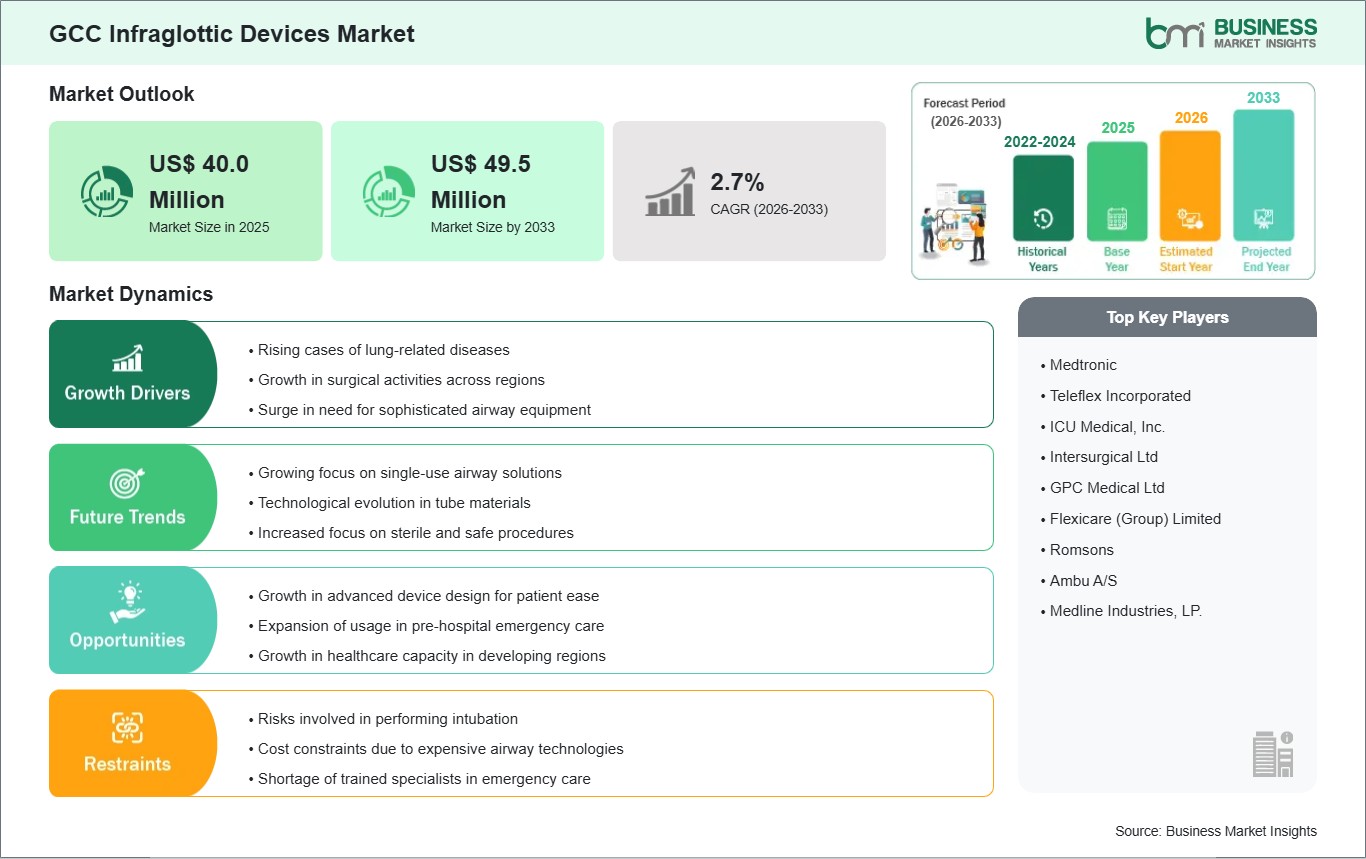
The GCC Infraglottic Devices market size is expected to reach US$ 49.5 million by 2033 from US$ 40.0 million in 2025. The market is estimated to record a CAGR of 2.7% from 2026 to 2033.
The market for infraglottic devices in the GCC is experiencing significant growth owing to increased spending on healthcare infrastructure development and improved focus on providing advanced critical care. Infraglottic devices include tracheostomy tubes and endotracheal tubes and are used for airway management in surgeries and other critical procedures. There has been a marked increase in the incidence of chronic respiratory diseases like asthma and COPD in GCC countries, contributing to the rising demand for infraglottic devices. Besides, there have been several programs initiated by governments to modernize their healthcare systems, which also involve increasing ICU capacity and improving surgical facilities.
Despite the growth potential, the market faces certain challenges. High costs associated with advanced devices can limit adoption in smaller healthcare facilities, and there is a shortage of trained professionals for complex airway management procedures in some areas. However, the presence of international manufacturers, combined with increased awareness of patient safety and infection control practices, has encouraged adoption of disposable and technologically enhanced devices. The ongoing focus on establishing specialized trauma centers and enhancing emergency medical services in urban hubs is expected to maintain steady demand for infraglottic devices across the GCC in the coming years.

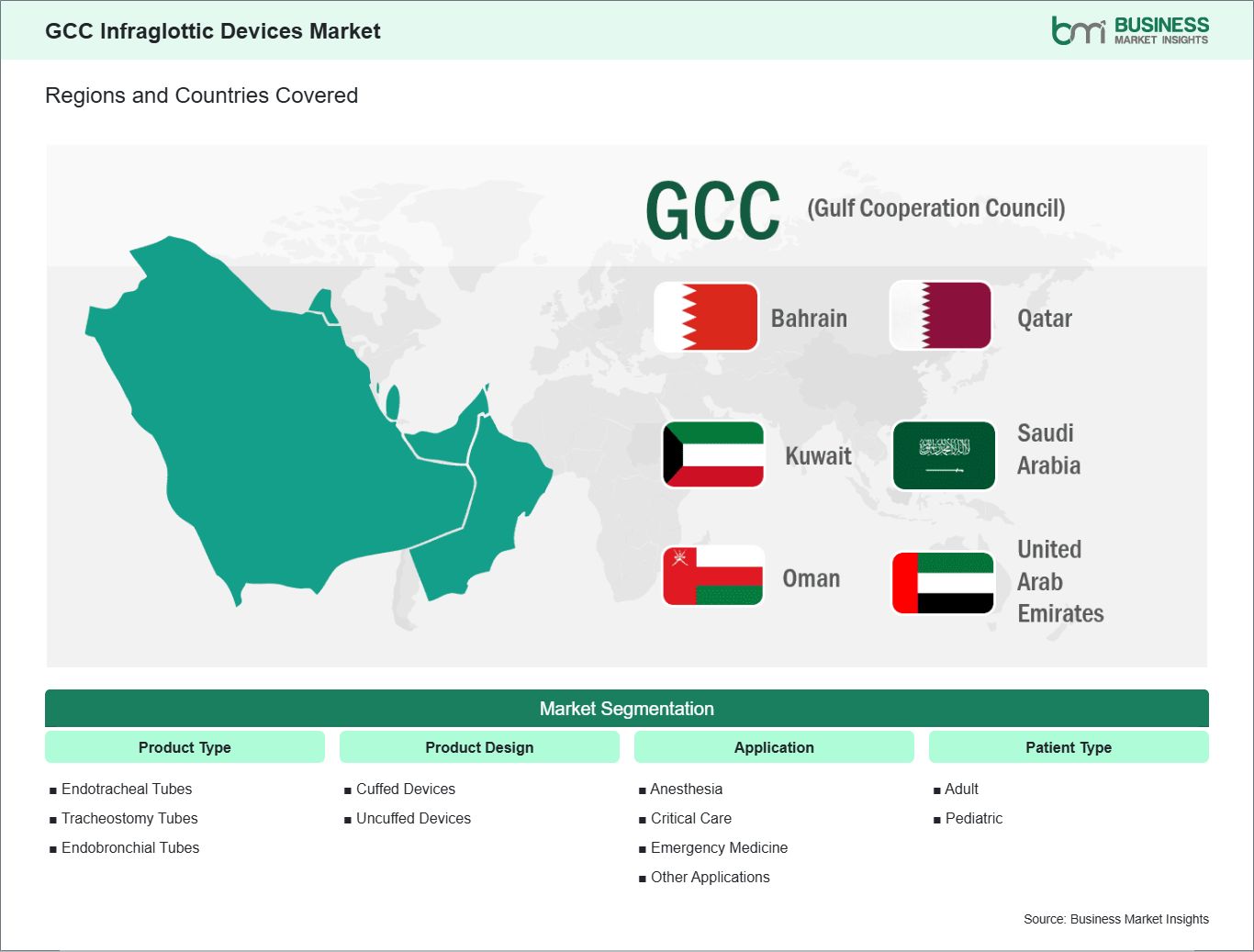
Key segments that contributed to the derivation of the North America infraglottic devices market analysis are product type, product design, application, patient type, and end user.
The GCC countries, which include Saudi Arabia, the UAE, Qatar, Kuwait, Bahrain, and Oman, are witnessing a surge in incidences of lung disorders. The high incidence of smoking, desert pollution, and pollution caused by urban settings are some of the main reasons behind such respiratory problems as asthma and COPD among others. Besides, there has been an increase in viral respiratory infections and pneumonia, adding another challenge to the healthcare system in the form of more patients in need of ventilators. Hospitals have started relying heavily on devices like endotracheal and tracheostomy tubes for adequate airway management.
Healthcare awareness and screening programs are improving in the GCC, leading to earlier identification of respiratory disorders. This has increased hospital admissions for both planned interventions and emergency treatments, emphasizing the need for reliable airway solutions. The combination of chronic respiratory diseases, acute infections, and growing patient admissions is steadily boosting the demand for infraglottic devices across the region. Hospitals are focusing on efficient airway management to reduce complications and improve patient outcomes. As respiratory health challenges continue to rise, the GCC market for infraglottic devices is expected to grow steadily, supported by increased healthcare capacity and better access to specialized care.
The GCC region presents strong opportunities for infraglottic devices with advanced designs that improve patient comfort and procedural efficiency. Healthcare facilities in the region prioritize patient safety and convenience, driving demand for devices that are easier to use, less invasive, and more adaptable to different clinical situations. Innovative endotracheal and tracheostomy tubes with softer materials, enhanced flexibility, and improved sealing mechanisms are increasingly being adopted to reduce patient discomfort and procedural complications. These devices are particularly valuable in intensive care units, emergency departments, and surgical settings where quick and reliable airway management is critical.
Moreover, GCC countries are investing heavily in modernizing healthcare infrastructure and integrating advanced medical technologies. Manufacturers are introducing devices suitable for both high-volume hospitals and smaller clinics, including portable airway solutions that support home and emergency care. Training programs for healthcare professionals are also expanding, ensuring that advanced devices can be used effectively. As hospitals and clinics continue to focus on enhancing patient experience and reducing procedural risks, the adoption of these innovative airway devices is expected to rise steadily. This creates a significant opportunity for market players to introduce next-generation infraglottic devices across the GCC, supporting better patient outcomes and more efficient respiratory care.
The GCC infraglottic devices market is experiencing steady growth, with market size and share analysis reflecting evolving treatment preferences and competitive dynamics among key players. The report evaluates important subsegments categorized within product type, product design, application, patient type, and end user, highlighting their respective contributions to overall market performance.
By product type, the endotracheal tubes subsegment dominated the market in 2025 due to their widespread use in airway management during surgeries, critical care, and emergency settings, offering reliable ventilation support and ease of insertion across diverse clinical scenarios.
Among product design, the cuffed devices subsegment dominated the market in 2025 due to their ability to provide effective airway sealing, prevent aspiration, and enable controlled ventilation, making them highly preferred in intensive care and surgical procedures requiring precise airway management.
Based on application, the anesthesia subsegment dominated the market in 2025 due to the high volume of surgical procedures requiring airway management, consistent use of endotracheal tubes during general anesthesia, and increasing demand for safe and controlled ventilation in operating rooms.
In terms of patient type, the adult subsegment dominated the market in 2025 due to higher incidence of chronic respiratory diseases, greater number of surgical procedures, and increased hospitalization rates requiring airway management and ventilatory support in adult populations.
By end user, the hospitals subsegment dominated the market in 2025 due to availability of advanced infrastructure, high patient inflow, presence of intensive care units, and continuous requirement for airway management devices during surgeries and emergency treatments.
| Report Attribute | Details |
|---|---|
| Market size in 2025 | US$ 40.0 Million |
| Market Size by 2033 | US$ 49.5 Million |
| CAGR (2026 - 2033) | 2.7% |
| Historical Data | 2022-2024 |
| Forecast period | 2026-2033 |
| Segments Covered | By Product Type
|
|
Regions and Countries Covered
| |
| GCC | UAE, Bahrain, Saudi Arabia, Oman, Qatar, Kuwait |
| Market leaders and key company profiles |
|
The "GCC Infraglottic Devices Market Size and Forecast (2022–2033)" report provides a detailed analysis of the market covering below areas:
The geographical scope of the GCC Infraglottic Devices market report is divided into: Saudi Arabia, the United Arab Emirates (UAE), Qatar, Kuwait, Bahrain, and Oman. Saudi Arabia held the largest share in 2025.
Saudi Arabia dominates the GCC infraglottic devices market due to its well-funded healthcare system, extensive hospital network, and strong focus on modern medical technologies. Hospitals and tertiary care centers across major cities are equipped with advanced ICU and surgical facilities, where infraglottic devices are routinely used for anesthesia, emergency care, and critical interventions. Rising surgical volumes, coupled with a higher prevalence of respiratory disorders, drive consistent demand for these devices throughout the country.
The nation also benefits from government-led initiatives aimed at expanding emergency medical services and establishing specialized trauma centers, which further increase the utilization of airway management devices. The presence of leading international and regional manufacturers ensures access to high-quality and innovative solutions. Challenges include the high cost of sophisticated devices and the need for specialized training for healthcare professionals. Nevertheless, Saudi Arabia’s ongoing investments in hospital modernization, focus on patient safety, and adoption of advanced airway management techniques reinforce its leading position in the GCC infraglottic devices market.

The GCC Infraglottic Devices market is evaluated by gathering qualitative and quantitative data post primary and secondary research, which includes important corporate publications, association data, and databases. A few of the key developments in the GCC Infraglottic Devices market are:
The GCC Infraglottic Devices Market is valued at US$ 40.0 Million in 2025, it is projected to reach US$ 49.5 Million by 2033.
As per our report GCC Infraglottic Devices Market, the market size is valued at US$ 40.0 Million in 2025, projecting it to reach US$ 49.5 Million by 2033. This translates to a CAGR of approximately 2.7% during the forecast period.
The GCC Infraglottic Devices Market report typically cover these key segments-
The historic period, base year, and forecast period can vary slightly depending on the specific market research report. However, for the GCC Infraglottic Devices Market report:
The GCC Infraglottic Devices Market is populated by several key players, each contributing to its growth and innovation. Some of the major players include:
The GCC Infraglottic Devices Market report is valuable for diverse stakeholders, including:
Essentially, anyone involved in or considering involvement in the GCC Infraglottic Devices Market value chain can benefit from the information contained in a comprehensive market report.
Please tell us your area of interest
(Market Segments/ Regions and Countries/ Companies)