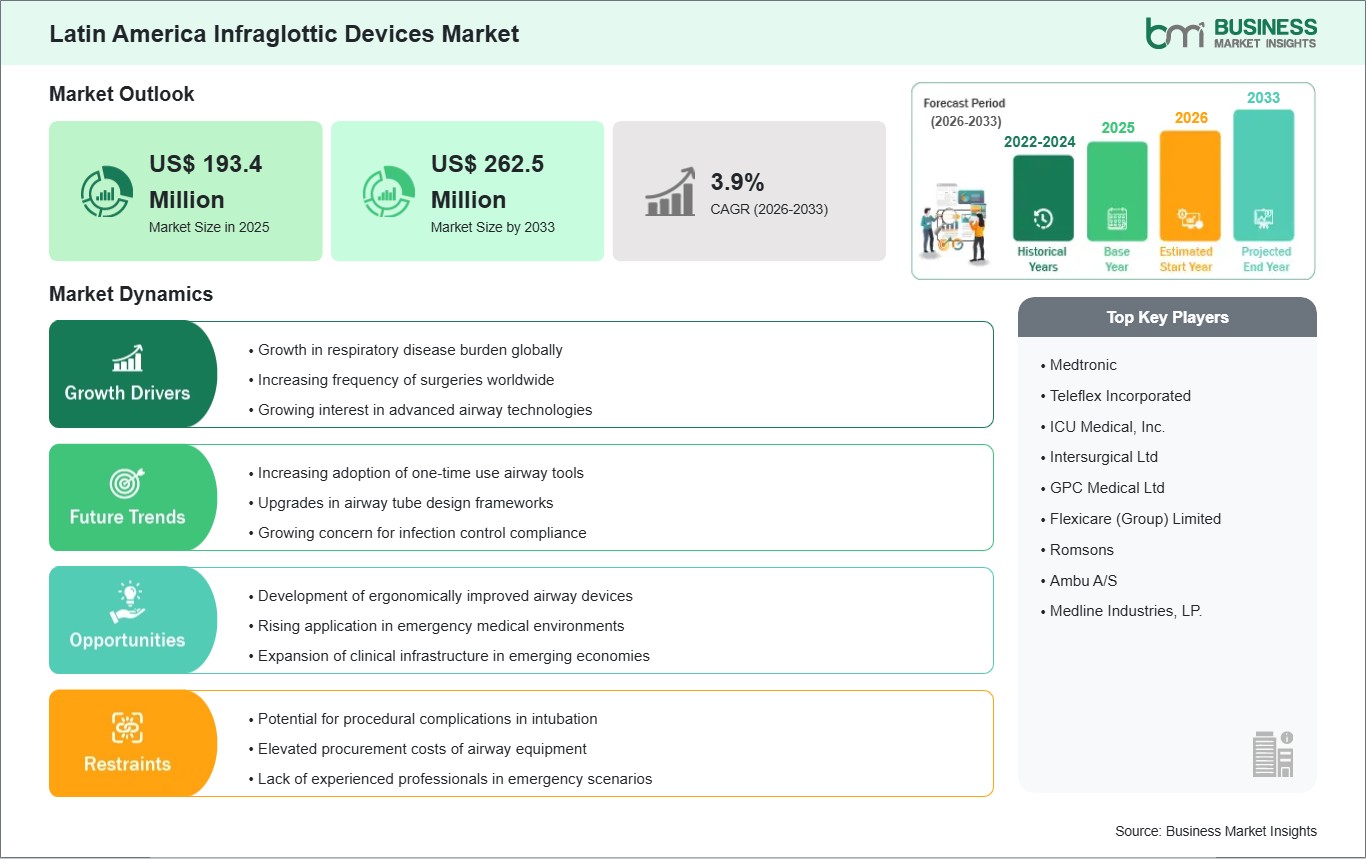
The Latin America Infraglottic Devices market size is expected to reach US$ 262.5 million by 2033 from US$ 193.4 million in 2025. The market is estimated to record a CAGR of 3.9% from 2026 to 2033.
The Latin American infraglottic devices market continues on its upward trend, aided in no small part by increasing amounts of healthcare investment (more surgical procedures), as well as the increased recognition of the benefits of advanced airway management technologies. Mexico, Brazil, and Argentina each contribute significantly to the overall market; however, Mexico has the largest share of the Latin American infraglottic device market because of its large hospital system, government efforts to upgrade existing health care facilities to incorporate more technologically savvy options, and its position as a distribution point for all major types of medical device manufacturers. Furthermore, the demand for infraglottic devices in Latin America stems from the increasing number of respiratory diseases, the increasing number of trauma victims seeking urgent care, and the need to implement reliable emergency care systems.
One characteristic of the Latin American market environment is the focus on border health care cooperation and medical tourism. For example, Mexico benefits from patients from its neighboring nations and even those from North America. In this case, there is a special need for the use of medical technology in private hospitals. At the same time, Brazil concentrates its efforts on making available critical care units in its public hospitals, while Argentina pays attention to training for anesthesiologists and ER professionals. This variety of activities within the region determines a special atmosphere that Mexico creates through its leadership.

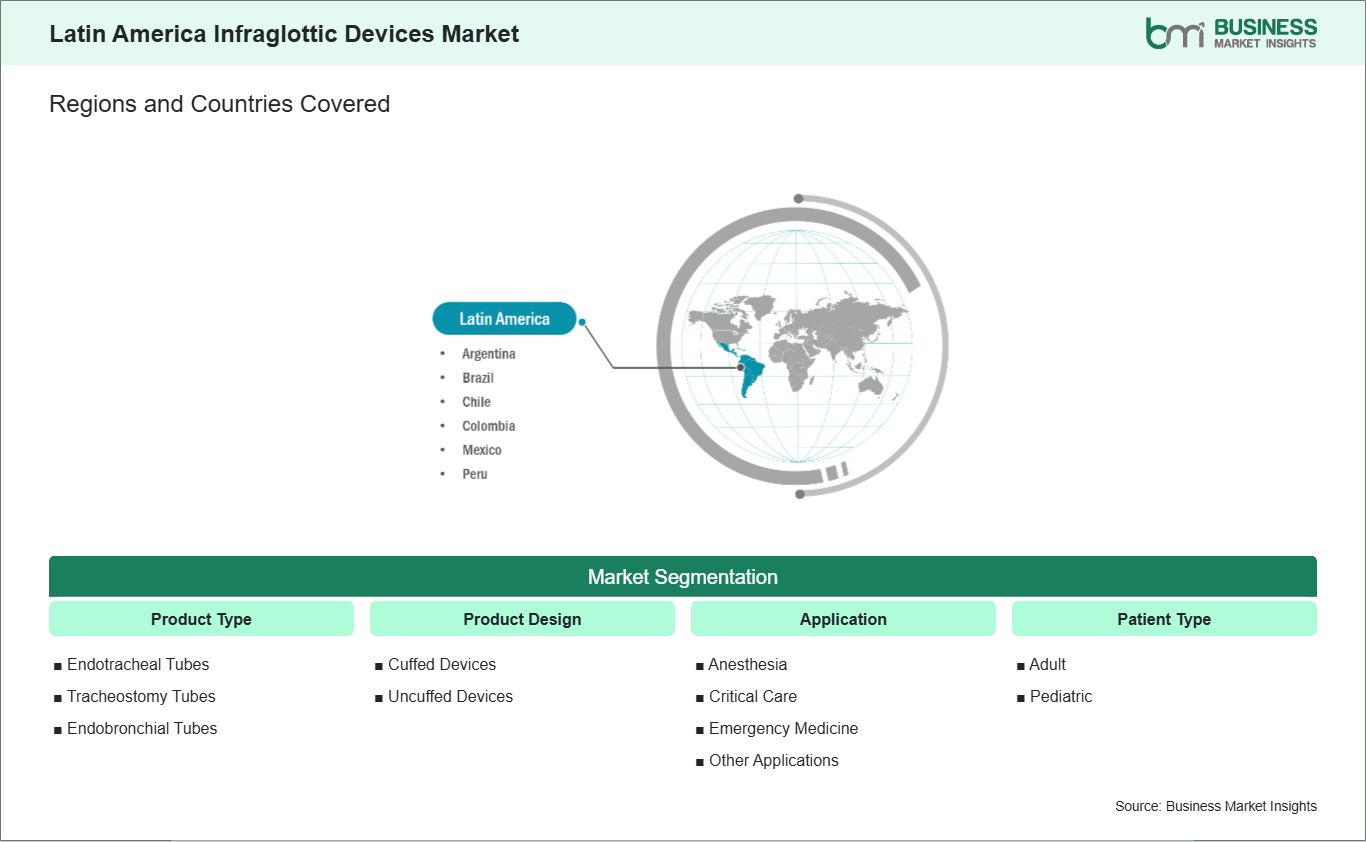
Key segments that contributed to the derivation of the North America infraglottic devices market analysis are product type, product design, application, patient type, and end user.
There is an increasing number of respiratory diseases in Latin America, and this has led to an increase in the need for infraglottic devices in Latin America. Some of the causes of the increase in respiratory illnesses include air pollution in urban areas, smoking, and occupation-related pollution. Moreover, respiratory infections like pneumonia and influenza have continued to affect people from different age groups in the region. Emergency departments in hospitals are witnessing more cases where people are brought in for the management of airways in order to ensure proper ventilation.
Healthcare systems in countries such as Brazil, Mexico, and Argentina are expanding their capacity to manage respiratory conditions, resulting in more hospital admissions and surgical procedures that need airway support. Infraglottic devices are critical during intensive care, surgeries, and emergency transport, where maintaining airflow is essential. The combination of chronic respiratory conditions and recurring infections increases the number of patients needing airway intervention, strengthening the demand for reliable and effective infraglottic devices. As awareness of respiratory health grows and healthcare access improves, the patient pool in Latin America continues to expand, further supporting consistent adoption of these devices across hospitals, surgical centers, and emergency services throughout the region.
Latin America presents significant opportunities for infraglottic devices with ergonomic designs that improve patient comfort and procedural efficiency. Many healthcare facilities face high patient volumes and limited trained staff, making devices that are simple to use and reduce procedural complexity highly valuable. Innovative endotracheal and tracheostomy tubes with improved flexibility, better sealing, and softer materials are being adopted to enhance patient comfort and reduce complications during insertion and prolonged use. Such improvements are particularly important in intensive care units and emergency settings, where speed and accuracy are critical.
Moreover, the region is witnessing increased adoption of modern medical technologies and training programs, allowing healthcare providers to integrate advanced devices more effectively. Portable and user-friendly airway solutions are gaining traction in smaller clinics and emergency response units, improving accessibility and outcomes for patients in remote or under-resourced areas. As hospitals and care centers continue to prioritize patient safety and comfort, ergonomically improved infraglottic devices are expected to see growing acceptance. This trend creates a substantial opportunity for manufacturers to expand their presence in Latin America by introducing next-generation devices designed for efficiency, patient well-being, and ease of use in both high-volume and low-resource healthcare environments.
The Latin America infraglottic devices market is experiencing steady growth, with market size and share analysis reflecting evolving treatment preferences and competitive dynamics among key players. The report evaluates important subsegments categorized within product type, product design, application, patient type, and end user, highlighting their respective contributions to overall market performance.
By product type, the endotracheal tubes subsegment dominated the market in 2025 due to their widespread use in airway management during surgeries, critical care, and emergency settings, offering reliable ventilation support and ease of insertion across diverse clinical scenarios.
Among product design, the cuffed devices subsegment dominated the market in 2025 due to their ability to provide effective airway sealing, prevent aspiration, and enable controlled ventilation, making them highly preferred in intensive care and surgical procedures requiring precise airway management.
Based on application, the anesthesia subsegment dominated the market in 2025 due to the high volume of surgical procedures requiring airway management, consistent use of endotracheal tubes during general anesthesia, and increasing demand for safe and controlled ventilation in operating rooms.
In terms of patient type, the adult subsegment dominated the market in 2025 due to higher incidence of chronic respiratory diseases, greater number of surgical procedures, and increased hospitalization rates requiring airway management and ventilatory support in adult populations.
By end user, the hospitals subsegment dominated the market in 2025 due to availability of advanced infrastructure, high patient inflow, presence of intensive care units, and continuous requirement for airway management devices during surgeries and emergency treatments.
| Report Attribute | Details |
|---|---|
| Market size in 2025 | US$ 193.4 Million |
| Market Size by 2033 | US$ 262.5 Million |
| CAGR (2026 - 2033) | 3.9% |
| Historical Data | 2022-2024 |
| Forecast period | 2026-2033 |
| Segments Covered | By Product Type
|
|
Regions and Countries Covered
| |
| Latin America | Mexico, Brazil, Argentina, Peru, Chile, Colombia |
| Market leaders and key company profiles |
|
The "Latin America Infraglottic Devices Market Size and Forecast (2022–2033)" report provides a detailed analysis of the market covering below areas:
The geographical scope of the Latin America Infraglottic Devices market report is divided into: Brazil, Mexico, Argentina, Colombia, Chile, and Peru. Mexico held the largest share in 2025.
The infraglottic devices market in Latin America is dominated by Mexico because of its increased health infrastructure, presence of many private hospitals, and its significance in medical tourism. The major cities of Mexico, including Mexico City, Monterrey, and Guadalajara, have been considered centers for advanced surgical procedures, emergencies, and other procedures where infraglottic devices are commonly used. Proximity to the US further influences the market because cross-border patients look for cost-effective but quality health care services.
A unique aspect of Mexico’s leadership is its dual focus on domestic healthcare modernization and international patient inflows. Private hospitals are investing heavily in advanced technologies to attract medical tourists, while government programs aim to strengthen public healthcare facilities and emergency response systems. Local distributors and partnerships with global manufacturers ensure steady supply, making Mexico a reliable hub for device availability across the region. Another defining factor is the emphasis on specialized training, with universities and medical schools integrating airway management modules into their curricula. This combination of infrastructure, international appeal, and professional development cements Mexico’s position as the dominant market in Latin America, setting benchmarks for adoption and innovation in infraglottic devices.

The Latin America Infraglottic Devices market is evaluated by gathering qualitative and quantitative data post primary and secondary research, which includes important corporate publications, association data, and databases. A few of the key developments in the Latin America Infraglottic Devices market are:
The Latin America Infraglottic Devices Market is valued at US$ 193.4 Million in 2025, it is projected to reach US$ 262.5 Million by 2033.
As per our report Latin America Infraglottic Devices Market, the market size is valued at US$ 193.4 Million in 2025, projecting it to reach US$ 262.5 Million by 2033. This translates to a CAGR of approximately 3.9% during the forecast period.
The Latin America Infraglottic Devices Market report typically cover these key segments-
The historic period, base year, and forecast period can vary slightly depending on the specific market research report. However, for the Latin America Infraglottic Devices Market report:
The Latin America Infraglottic Devices Market is populated by several key players, each contributing to its growth and innovation. Some of the major players include:
The Latin America Infraglottic Devices Market report is valuable for diverse stakeholders, including:
Essentially, anyone involved in or considering involvement in the Latin America Infraglottic Devices Market value chain can benefit from the information contained in a comprehensive market report.
Please tell us your area of interest
(Market Segments/ Regions and Countries/ Companies)