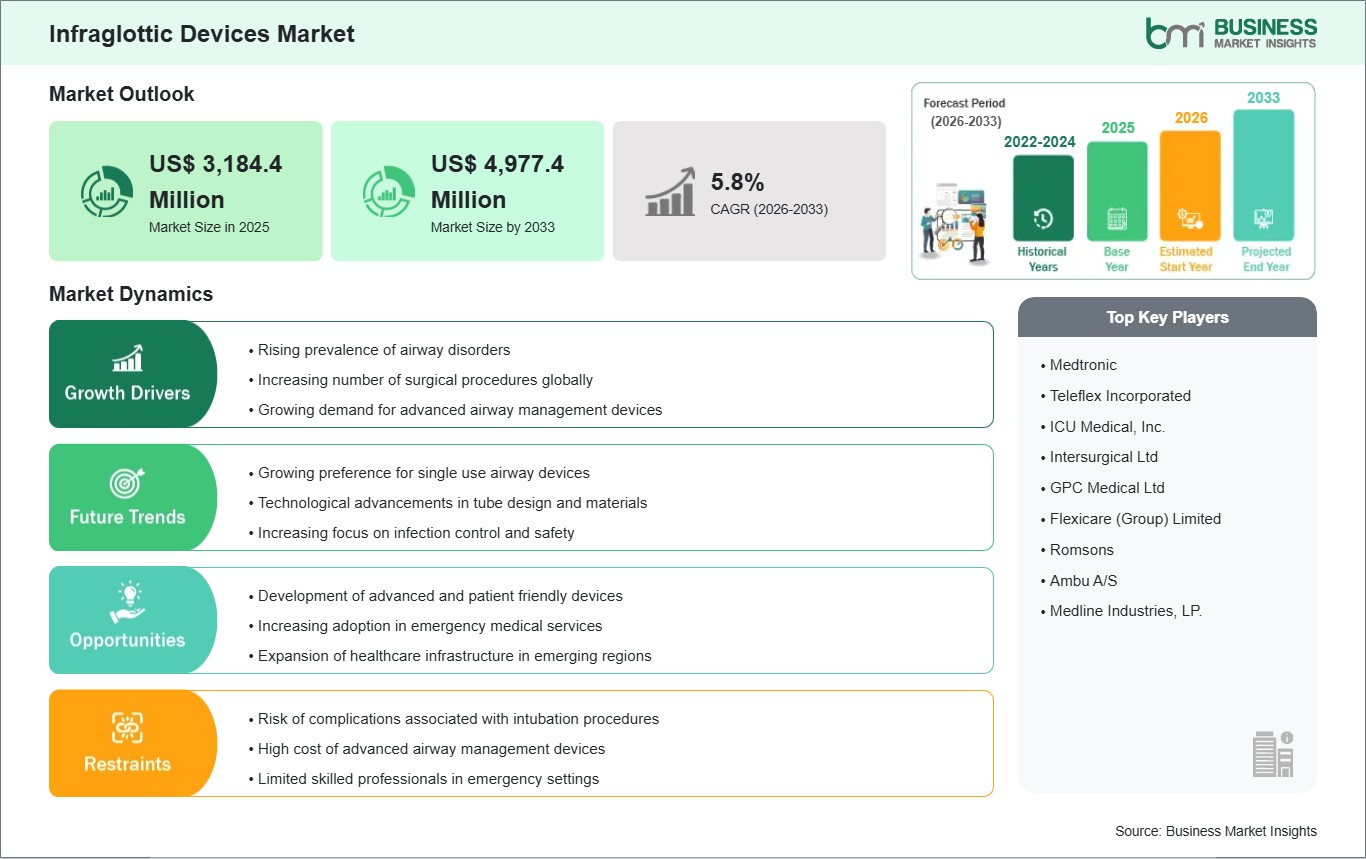
The infraglottic devices market size is expected to reach US$ 4,977.4 million by 2033 from US$ 3,184.4 million in 2025. The market is estimated to record a CAGR of 5.4% from 2026 to 2033.
Infraglottic devices represent a vital component of airway management, particularly in scenarios where securing and maintaining airway patency below the vocal cords is essential. Devices such as endotracheal tubes and tracheostomy tubes are indispensable in surgical procedures, critical care, and emergency medicine. The rising prevalence of respiratory diseases, including chronic obstructive pulmonary disease (COPD) and asthma, necessitates reliable airway support. The increasing number of surgical interventions has amplified the demand for airway management solutions. Intensive care units (ICUs), where patients require prolonged ventilation, drive the adoption of these devices.
Manufacturers are focusing on enhancing device design to improve safety, reduce complications, and increase patient comfort. The growing preference for cuffed devices highlights the emphasis on preventing aspiration and ensuring controlled ventilation. Hospitals remain the largest end users due to their advanced infrastructure and high patient inflow. Emergency medical services are expanding their reliance on these devices. Rising healthcare investments are strengthening supply chains and accessibility. The market is poised for steady growth, driven by clinical necessity, technological progress, and heightened focus on patient safety and outcomes.

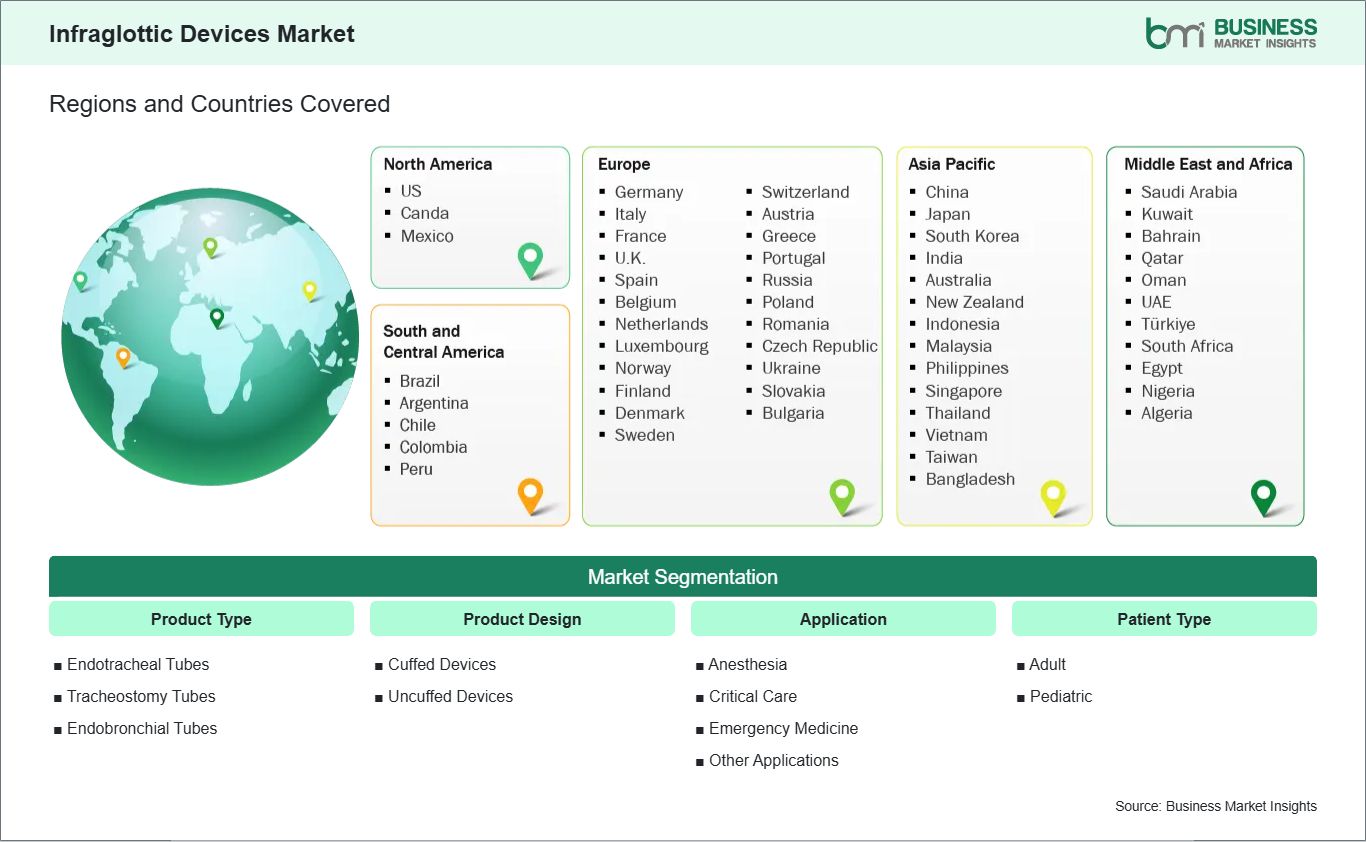
Key segments that contributed to the derivation of the North America infraglottic devices market analysis are product type, product design, application, patient type, and end user.
The increased prevalence of respiratory disorders such as chronic obstructive pulmonary disorder (COPD), asthma, and acute respiratory distress syndrome (ARDS) influences the use of infraglottic products. Patients with such disorders may suffer from impaired breathing, and they might need mechanical ventilation. Tracheostomy and endotracheal tubes play an important role in keeping the airways patent and in ensuring that the oxygen reaches its destination. With the increasing prevalence of respiratory disorders among all age groups, the number of patients requiring admission to the ICU has risen.
However, acute emergencies, including infections, injuries, and post-surgery patients, have been identified as other causes of an increasing number of admissions into critical care units. Patients who need respiratory support for a prolonged period require tracheostomy tubes, which are safer and more sustainable when compared to endotracheal tubes. There is increased adoption of advanced devices that are developed to reduce complications associated with respiratory support, such as airway injury and aspiration, ensuring maximum comfort for the patient throughout the treatment process. Efforts to reduce morbidity and mortality rates have emphasized infraglottic devices in today's health sector. With the prevalence of respiratory ailments increasing, there will always be a need for reliable airway management, ensuring the growth of the market.
Manufacturers are innovating with devices in ways that allow easier insertions of devices, cause less trauma to the patient upon insertion, and increase patient comfort during long-term ventilation. Innovations of modern infraglottic devices include an improved cuff material to cause fewer pressure-related injuries, antimicrobial coating on the cuff to reduce the risk of infection and an enhanced flexibility of the tube to conform to each patient's anatomy to provide the best possible care in critical care settings where patients may be dependent on the airway device for a longer period of time and receive continuous ventilation. Devices are being customized to specific groups, such as pediatrics or geriatrics, using different sizes, materials, or design considerations for those populations, providing safety and effectiveness based on clinical scenarios.
Healthcare professionals are using equipment that is compatible with sophisticated monitoring systems and ventilators to enable better control and improve results. By concentrating on lowering the hazards associated with procedures such as airway damage and inhalation, there is an emphasis on achieving higher levels of safety and effectiveness in healthcare settings. With the increasing emphasis on providing patient-focused care across healthcare organizations, the need for technologically advanced infraglottic equipment is likely to grow. While this enhances the quality of patient outcomes, it makes the task easier for healthcare practitioners who can manage their patients' respiratory conditions.
The global infraglottic devices market is experiencing steady growth, with market size and share analysis reflecting evolving treatment preferences and competitive dynamics among key players. The report evaluates important subsegments categorized within product type, product design, application, patient type, and end user, highlighting their respective contributions to overall market performance.
By product type, the endotracheal tubes subsegment dominated the market in 2025 due to their widespread use in airway management during surgeries, critical care, and emergency settings, offering reliable ventilation support and ease of insertion across diverse clinical scenarios.
Among product design, the cuffed devices subsegment dominated the market in 2025 due to their ability to provide effective airway sealing, prevent aspiration, and enable controlled ventilation, making them highly preferred in intensive care and surgical procedures requiring precise airway management.
Based on application, the anesthesia subsegment dominated the market in 2025 due to the high volume of surgical procedures requiring airway management, consistent use of endotracheal tubes during general anesthesia, and increasing demand for safe and controlled ventilation in operating rooms.
In terms of patient type, the adult subsegment dominated the market in 2025 due to higher incidence of chronic respiratory diseases, greater number of surgical procedures, and increased hospitalization rates requiring airway management and ventilatory support in adult populations.
By end user, the hospitals subsegment dominated the market in 2025 due to availability of advanced infrastructure, high patient inflow, presence of intensive care units, and continuous requirement for airway management devices during surgeries and emergency treatments.
| Report Attribute | Details |
|---|---|
| Market size in 2025 | US$ 3,184.4 Million |
| Market Size by 2033 | US$ 4,977.4 Million |
| Global CAGR (2026 - 2033) | 5.8% |
| Historical Data | 2022-2024 |
| Forecast period | 2026-2033 |
| Segments Covered | By Product Type
|
|
Regions and Countries Covered
| |
| North America | US, Canada, Mexico |
| Europe | Germany, Italy, France, U.K., Spain, Belgium, Netherlands, Luxembourg, Norway, Finland, Denmark, Sweden, Switzerland, Austria, Greece, Portugal, Russia, Poland, Romania, Czech Republic, Ukraine, Slovakia, Bulgaria |
| Asia-Pacific | China, Japan, South Korea, India, Australia, New Zealand, Indonesia, Malaysia, Philippines, Singapore, Thailand, Vietnam, Taiwan, Bangladesh |
| South and Central America | Brazil, Argentina, Chile, Colombia, Peru |
| Middle East and Africa | Saudi Arabia, United Arab Emirates, Kuwait, Bahrain, Qatar, Oman, Turkiye, South Africa, Egypt, Nigeria, Algeria |
| Market leaders and key company profiles |
|
The "Infraglottic Devices Market Size and Forecast (2022–2033)" report provides a detailed analysis of the market covering below areas:
The geographical scope of the infraglottic devices market report is divided into: North America, Asia Pacific, Europe, the Middle East & Africa, and South & Central America. North America held the largest share in 2025.
North America enjoys supremacy over other regions because of the developed health infrastructure and the presence of various respiratory problems. Infraglottic devices are extensively required owing to the availability of an effective medical facility and hospitals, which include critical care facilities and ambulance services. Healthcare technology is adopted extensively in the US and Canada owing to their focus on patient safety. Leading market players present in North America make sure to incorporate the latest developments in the product design and technology used.
High healthcare expenditures enable healthcare facilities to purchase advanced products in airway management. An increase in the number of surgeries and patients admitted to ICUs drives the need for tracheostomy and endotracheal tubes. Manufacturers are developing safer and more efficient medical devices that cause fewer risks and minimize patient discomfort. Although Asia Pacific emerges as a rapidly growing market because of improving healthcare infrastructure and increased awareness, the dominant position of North America will be ensured due to the mentioned factors.

The infraglottic devices market is evaluated by gathering qualitative and quantitative data post primary and secondary research, which includes important corporate publications, association data, and databases. A few of the key developments in the Infraglottic Devices market are:
The Infraglottic Devices Market is valued at US$ 3,184.4 Million in 2025, it is projected to reach US$ 4,977.4 Million by 2033.
As per our report Infraglottic Devices Market, the market size is valued at US$ 3,184.4 Million in 2025, projecting it to reach US$ 4,977.4 Million by 2033. This translates to a CAGR of approximately 5.8% during the forecast period.
The Infraglottic Devices Market report typically cover these key segments-
The historic period, base year, and forecast period can vary slightly depending on the specific market research report. However, for the Infraglottic Devices Market report:
The Infraglottic Devices Market is populated by several key players, each contributing to its growth and innovation. Some of the major players include:
The Infraglottic Devices Market report is valuable for diverse stakeholders, including:
Essentially, anyone involved in or considering involvement in the Infraglottic Devices Market value chain can benefit from the information contained in a comprehensive market report.
Please tell us your area of interest
(Market Segments/ Regions and Countries/ Companies)