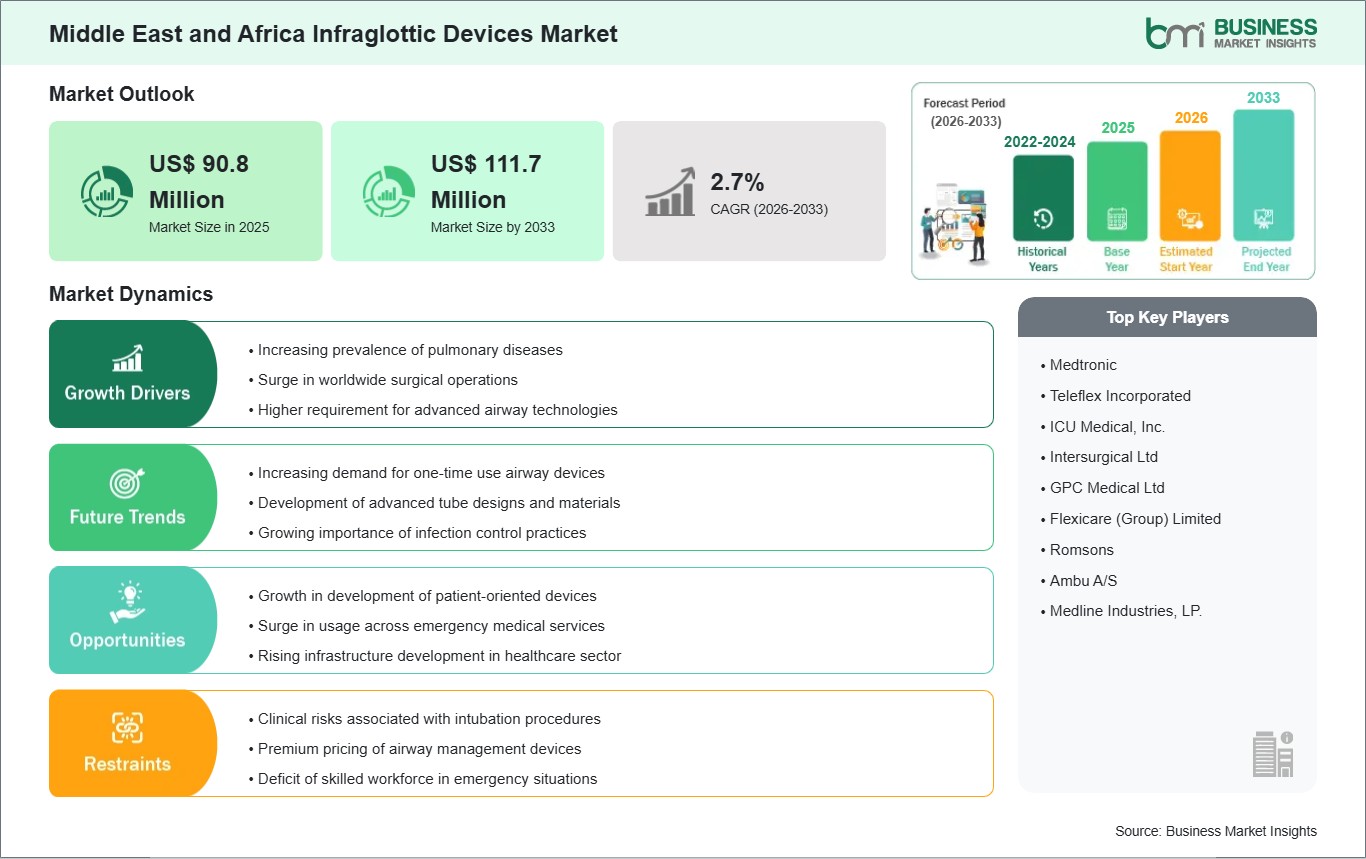
The Middle East and Africa Infraglottic Devices market size is expected to reach US$ 111.7 million by 2033 from US$ 90.8 million in 2025. The market is estimated to record a CAGR of 2.7% from 2026 to 2033.
The MEA market for infraglottic devices is experiencing steady evolution due to growing incidences of respiratory illnesses, expansion of infrastructure in hospitals, and an increase in the number of surgical procedures in the region. The infraglottic devices include endotracheal and tracheostomy tubes and are very important for providing a patent airway in intensive care units, during anesthesia, and in emergency cases. Countries in the MEA region have been making significant investments towards upgrading their critical care facilities, especially those located in metropolitan cities. There is increased emphasis on the use of single-use airway devices because of increased safety measures.
However, the market faces challenges, including limited access to advanced medical devices in rural or economically constrained regions and a shortage of trained healthcare professionals capable of performing complex airway procedures. Regulatory variations across countries also affect the uniform adoption of devices. Despite these obstacles, ongoing government healthcare modernization programs, partnerships with international medical device companies, and a growing focus on improving respiratory care are expected to sustain demand across the MEA region, particularly in countries investing in tertiary care and specialized surgical centers.

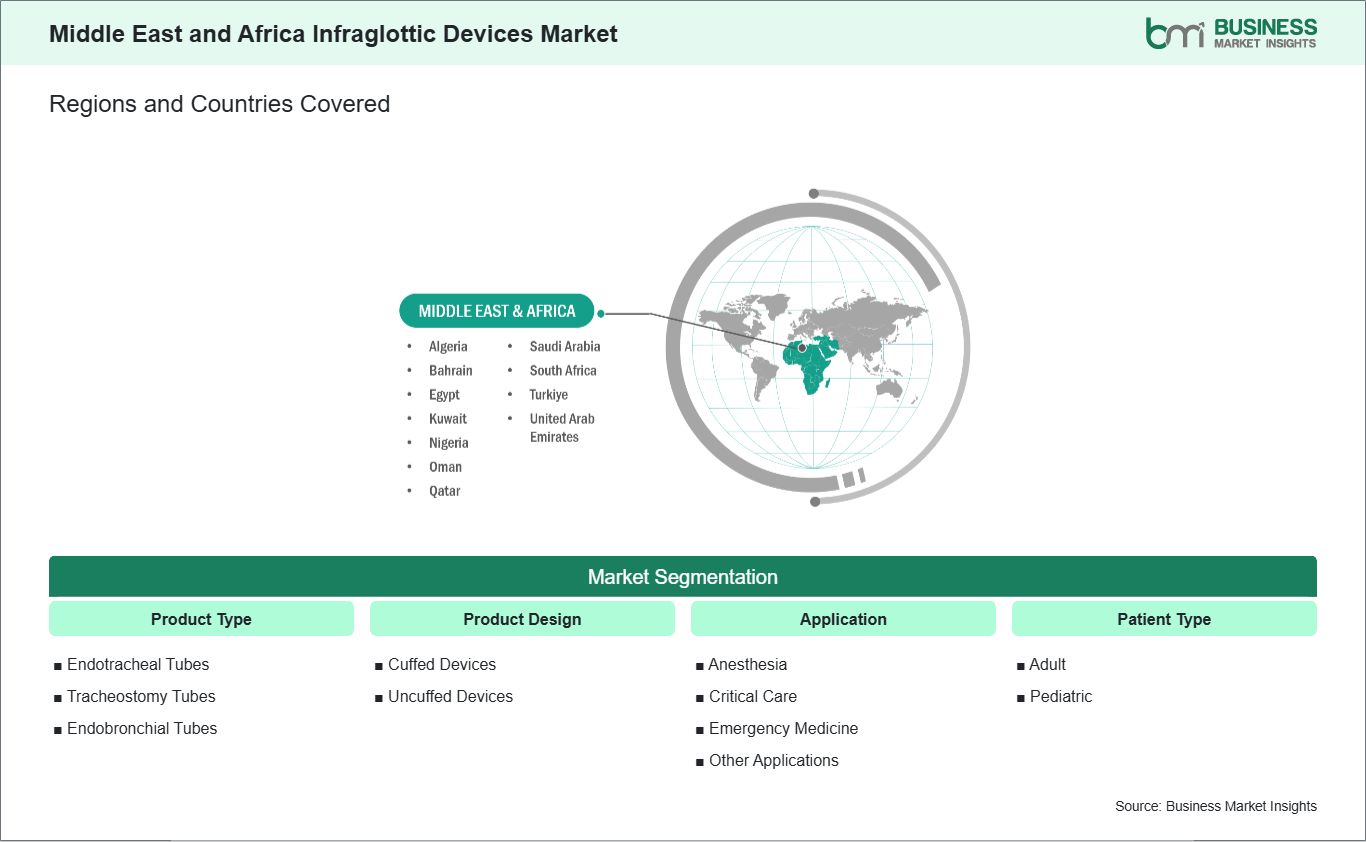
Key segments that contributed to the derivation of the North America infraglottic devices market analysis are product type, product design, application, patient type, and end user.
Infraglottic Devices Market Outlook in the Middle East and Africa is propelled by the increase in the prevalence of respiratory issues in the region. Nevertheless, the reasons for respiratory problems are highly different depending on the geographical sub-region. For instance, there has been a considerable increase in cases of chronic obstructive pulmonary disease (COPD), asthma, and respiratory distress due to the presence of urban areas with excessive tobacco smoking in the Middle East, specifically among the GCC member states. Sandstorms that take place in the region can also result in respiratory problems. All these factors make it necessary to stabilize the airways of the patients using infraglottic devices, such as endotracheal tubes. The region has a consistent need for high-end airway equipment.
In the rest of Africa, the driving force is even further increased by the prevalence of infectious respiratory illnesses such as pneumonia and tuberculosis. For instance, in many developing healthcare facilities in Africa, the aforementioned infections lead to severe cases of respiratory failure, resulting in emergent intubation and prolonged tracheostomy treatment. Additionally, the prevalence of accidents on roads and trauma cases in urbanizing regions has compelled authorities in those countries to invest in the purchase of emergency airway kits. Improved public health programs in countries such as Nigeria, Kenya, and Egypt make it possible for the use of infraglottic devices to be accessible through emergency medical services.
MEA market is unique in providing opportunities to incorporate patient-friendly infraglottic products in the area of healthcare. Currently, in the Middle East, there is a revolution taking place in terms of building intelligent health systems; thus, there is ample room for development of such products that will focus on the safety and comfort of patients. The new-generation infraglottic products, using ultra-soft biomaterials with sensor technology, can enable the clinician to check the inflation status of the device. This is very important in the context of the increasing number of hospitals being set up privately in the Middle East, where there is a need to prevent tracheal injuries from equipment.
In the African context, the opportunity lies in the development of patient-centric devices that are also environment-ready. There is a growing demand for high-performance, single-use infraglottic solutions that simplify the clinical workflow in resource-constrained settings. These disposable devices eliminate the need for complex sterilization processes, thereby reducing the risk of cross-contamination and hospital-acquired infections. Furthermore, the emergence of ergonomic, ready-to-use kits allows mid-level healthcare providers to perform procedures with greater precision and less patient discomfort. As countries like Rwanda and Ghana invest in modular clinics and digital health pilots, there is a fertile ground for "smart" tracheostomy tubes that can be managed even in home-care or remote settings. This dual focus on comfort and accessibility provides a strategic pathway for manufacturers to penetrate the diverse MEA healthcare landscape.
The Middle East and Africa infraglottic devices market is experiencing steady growth, with market size and share analysis reflecting evolving treatment preferences and competitive dynamics among key players. The report evaluates important subsegments categorized within product type, product design, application, patient type, and end user, highlighting their respective contributions to overall market performance.
By product type, the endotracheal tubes subsegment dominated the market in 2025 due to their widespread use in airway management during surgeries, critical care, and emergency settings, offering reliable ventilation support and ease of insertion across diverse clinical scenarios.
Among product design, the cuffed devices subsegment dominated the market in 2025 due to their ability to provide effective airway sealing, prevent aspiration, and enable controlled ventilation, making them highly preferred in intensive care and surgical procedures requiring precise airway management.
Based on application, the anesthesia subsegment dominated the market in 2025 due to the high volume of surgical procedures requiring airway management, consistent use of endotracheal tubes during general anesthesia, and increasing demand for safe and controlled ventilation in operating rooms.
In terms of patient type, the adult subsegment dominated the market in 2025 due to higher incidence of chronic respiratory diseases, greater number of surgical procedures, and increased hospitalization rates requiring airway management and ventilatory support in adult populations.
By end user, the hospitals subsegment dominated the market in 2025 due to availability of advanced infrastructure, high patient inflow, presence of intensive care units, and continuous requirement for airway management devices during surgeries and emergency treatments.
| Report Attribute | Details |
|---|---|
| Market size in 2025 | US$ 90.8 Million |
| Market Size by 2033 | US$ 111.7 Million |
| CAGR (2026 - 2033) | 2.7% |
| Historical Data | 2022-2024 |
| Forecast period | 2026-2033 |
| Segments Covered | By Product Type
|
|
Regions and Countries Covered
| |
| Middle East and Africa | Saudi Arabia, United Arab Emirates, Kuwait, Bahrain, Qatar, Oman, Turkiye, South Africa, Egypt, Nigeria, Algeria |
| Market leaders and key company profiles |
|
The "Middle East and Africa Infraglottic Devices Market Size and Forecast (2022–2033)" report provides a detailed analysis of the market covering below areas:
The geographical scope of the Middle East and Africa Infraglottic Devices market report is divided into: Saudi Arabia, the United Arab Emirates, Kuwait, Bahrain, Qatar, Oman, Turkiye, South Africa, Egypt, Nigeria, Algeria, and the Rest of MEA. Turkiye held the largest share in 2025.
Turkiye dominates the MEA infraglottic devices market due to its rapidly modernizing healthcare infrastructure, extensive hospital network, and strong focus on advanced critical care services. Hospitals in Turkiye are equipped with state-of-the-art ICUs and surgical centers, where infraglottic devices are routinely used for anesthesia, trauma, and emergency care. A rising burden of chronic respiratory conditions and increasing surgical volumes further supports the demand for high-quality airway management devices.
The presence of both domestic and international manufacturers ensures consistent availability of technologically advanced devices. Additionally, government initiatives aimed at expanding healthcare access and modernizing hospitals in urban and semi-urban regions contribute to Turkiye’s market dominance. Training programs for anesthesiologists and critical care specialists are also enhancing device utilization. Challenges remain in certain rural areas with limited access to advanced facilities, but overall healthcare investment and the push toward innovation in patient safety and infection control reinforce Turkiye’s leading position in the MEA infraglottic devices market.

The Middle East and Africa Infraglottic Devices market is evaluated by gathering qualitative and quantitative data post primary and secondary research, which includes important corporate publications, association data, and databases. A few of the key developments in the Middle East and Africa Infraglottic Devices market are:
The Middle East and Africa Infraglottic Devices Market is valued at US$ 90.8 Million in 2025, it is projected to reach US$ 111.7 Million by 2033.
As per our report Middle East and Africa Infraglottic Devices Market, the market size is valued at US$ 90.8 Million in 2025, projecting it to reach US$ 111.7 Million by 2033. This translates to a CAGR of approximately 2.7% during the forecast period.
The Middle East and Africa Infraglottic Devices Market report typically cover these key segments-
The historic period, base year, and forecast period can vary slightly depending on the specific market research report. However, for the Middle East and Africa Infraglottic Devices Market report:
The Middle East and Africa Infraglottic Devices Market is populated by several key players, each contributing to its growth and innovation. Some of the major players include:
The Middle East and Africa Infraglottic Devices Market report is valuable for diverse stakeholders, including:
Essentially, anyone involved in or considering involvement in the Middle East and Africa Infraglottic Devices Market value chain can benefit from the information contained in a comprehensive market report.
Please tell us your area of interest
(Market Segments/ Regions and Countries/ Companies)