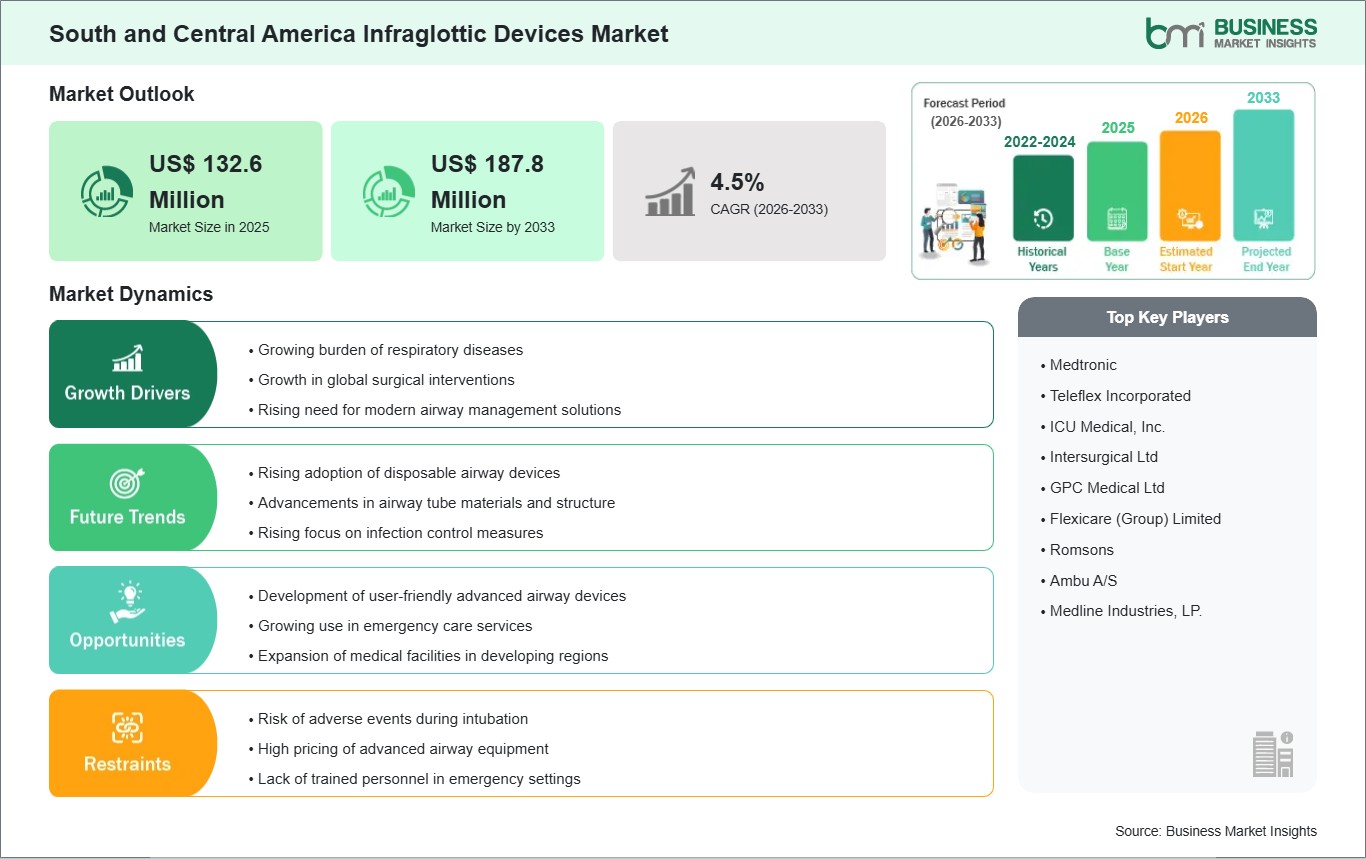
The South and Central America Infraglottic Devices market size is expected to reach US$ 187.8 million by 2033 from US$ 132.6 million in 2025. The market is estimated to record a CAGR of 5.8% from 2026 to 2033.
The infraglottic devices market in South America and Central America is gradually growing and is influenced by various factors such as improved healthcare facilities, an increased number of surgeries being performed, and increased awareness regarding new airway management products. Some of the important countries include Brazil, Mexico, and Argentina, but Brazil holds a leading position owing to its huge population base and effective hospital sector. Other factors driving the regional demand include incidence rates of respiratory disorders and accidents.
One unique aspect of this market is that there is an increasing drive towards healthcare access and innovation within the region. The initiative spearheaded by Brazil is bolstered by the drive in Argentina towards healthcare education, while Mexico leads in healthcare cooperation between countries. As more healthcare programs are being implemented by governments within the region, emergency systems have been gaining importance, and this has opened doors for the use of infraglottic devices. On the other hand, private hospitals are adopting state-of-the-art technology as they attempt to entice patients who seek specialized treatment.

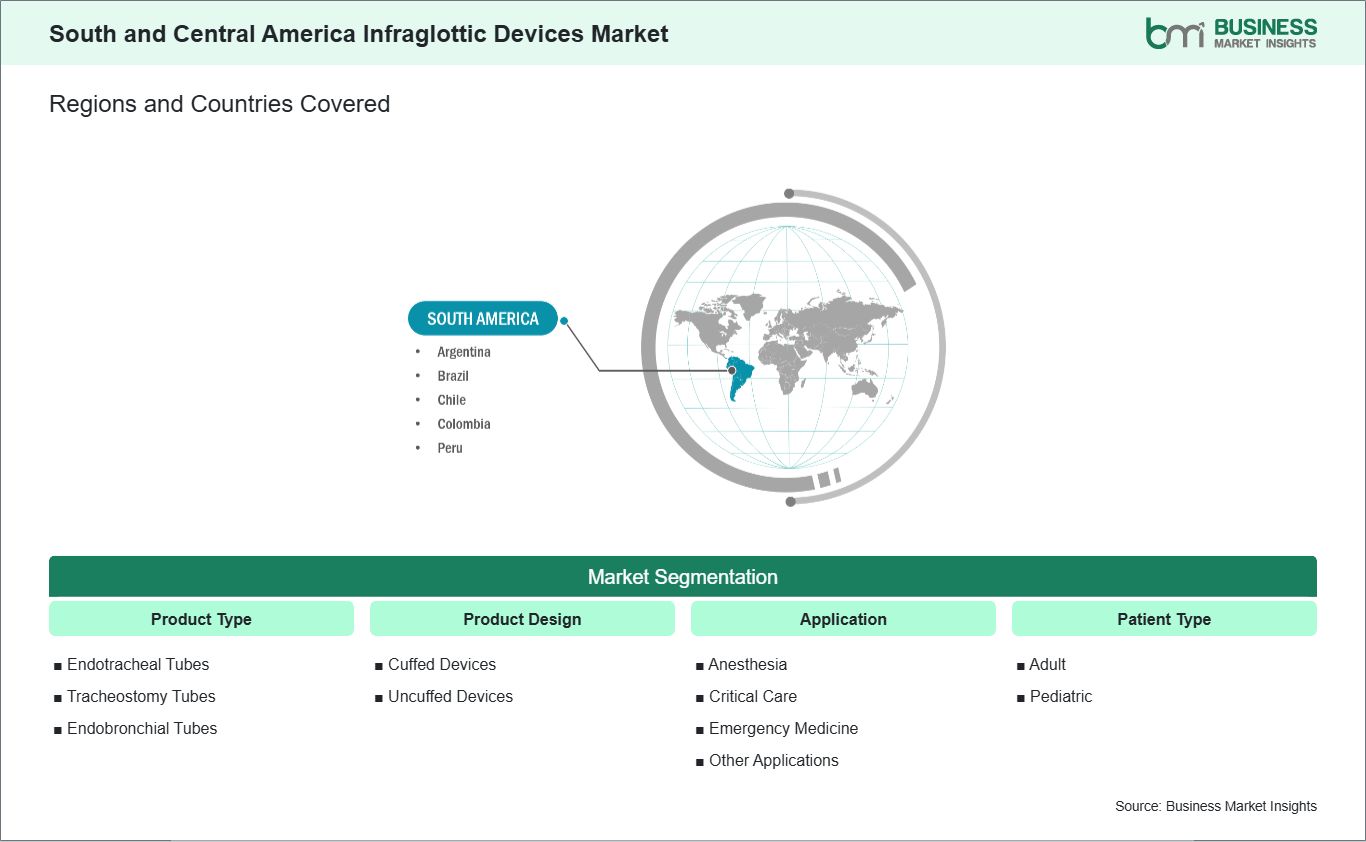
Key segments that contributed to the derivation of the North America infraglottic devices market analysis are product type, product design, application, patient type, and end user.
The infraglottic devices market in South and Central America is experiencing considerable growth, mainly because of the significant disease burden related to chronic and infectious respiratory diseases. In countries such as Brazil, Argentina, and Colombia, the incidence of COPD has been growing steadily as a result of the chronic inhalation of urban pollutants and excessive smoking. Moreover, the region continues to experience a recurring issue with respiratory viruses, especially flu and RSV, which cause acute respiratory failure in children and elderly patients. This medical reality calls for a large number of emergency intubations and tracheostomies, guaranteeing a constant need for airway management devices.
Furthermore, the expansion of healthcare access and trauma services across Central American nations and the Andean subregion is a vital contributor to market stability. Governments are increasingly investing in the modernization of emergency medical services to manage the high rate of road traffic accidents and acute trauma cases, where securing a definitive airway is a critical first step in patient stabilization. In Brazil, the rise in thoracic and cardiovascular surgeries within a growing network of specialized cardiac centers also fuels the consumption of high-quality endotracheal tubes. As these nations strive to reduce hospital mortality rates associated with respiratory distress, the procurement of infraglottic devices has transitioned from a supplemental need to a core component of the regional medical infrastructure.
A significant opportunity in the South and Central American market lies in the adoption of advanced, easy-to-use infraglottic devices that address the region's specific clinical and economic needs. In many parts of the region, there is a push to improve patient outcomes while managing a shortage of specialized anesthesiology staff in rural and underserved areas. The introduction of "smart" infraglottic solutions—equipped with ergonomic designs and video-assisted guidance—allows healthcare providers to perform successful intubations with greater confidence and reduced risk of trauma. By lowering the technical barrier for securing an airway, these innovative devices are becoming highly sought after by emergency departments and modular clinics that require rapid, reliable results in high-pressure environments.
Additionally, there is a clear trend toward the utilization of high-performance, single-use infraglottic devices as a strategy to enhance infection control. Many healthcare facilities in Mexico and the Southern Cone are increasingly opting for disposable endotracheal and tracheostomy kits to eliminate the logistical and financial burdens associated with complex sterilization processes. These patient-centric innovations often utilize ultra-soft, biocompatible materials that reduce the incidence of tracheal scarring and mucosal injury, which is a major focus for private hospitals aiming to improve the quality of care metrics. As regional manufacturers and international players partner to provide cost-effective yet sophisticated airway solutions, the market is well-positioned to integrate these advanced technologies into the standard of care across diverse healthcare settings.
The South and Central America infraglottic devices market is experiencing steady growth, with market size and share analysis reflecting evolving treatment preferences and competitive dynamics among key players. The report evaluates important subsegments categorized within product type, product design, application, patient type, and end user, highlighting their respective contributions to overall market performance.
By product type, the endotracheal tubes subsegment dominated the market in 2025 due to their widespread use in airway management during surgeries, critical care, and emergency settings, offering reliable ventilation support and ease of insertion across diverse clinical scenarios.
Among product design, the cuffed devices subsegment dominated the market in 2025 due to their ability to provide effective airway sealing, prevent aspiration, and enable controlled ventilation, making them highly preferred in intensive care and surgical procedures requiring precise airway management.
Based on application, the anesthesia subsegment dominated the market in 2025 due to the high volume of surgical procedures requiring airway management, consistent use of endotracheal tubes during general anesthesia, and increasing demand for safe and controlled ventilation in operating rooms.
In terms of patient type, the adult subsegment dominated the market in 2025 due to higher incidence of chronic respiratory diseases, greater number of surgical procedures, and increased hospitalization rates requiring airway management and ventilatory support in adult populations.
By end user, the hospitals subsegment dominated the market in 2025 due to availability of advanced infrastructure, high patient inflow, presence of intensive care units, and continuous requirement for airway management devices during surgeries and emergency treatments.
| Report Attribute | Details |
|---|---|
| Market size in 2025 | US$ 132.6 Million |
| Market Size by 2033 | US$ 187.8 Million |
| CAGR (2026 - 2033) | 4.5% |
| Historical Data | 2022-2024 |
| Forecast period | 2026-2033 |
| Segments Covered | By Product Type
|
|
Regions and Countries Covered
| |
| South and Central America | Brazil, Argentina, Chile, Colombia, Peru |
| Market leaders and key company profiles |
|
The "South and Central America Infraglottic Devices Market Size and Forecast (2022–2033)" report provides a detailed analysis of the market covering below areas:
The geographical scope of the South and Central America Infraglottic Devices market report is divided into: Brazil, Argentina, Chile, Colombia, Peru, and the Rest of South and Central America. Brazil held the largest share in 2025.
Brazil dominates the South and Central American infraglottic devices market, driven by its comprehensive healthcare system, large patient base, and strong government focus on healthcare modernization. Major cities such as São Paulo, Rio de Janeiro, and Brasília serve as hubs for advanced medical care, where infraglottic devices are widely used in anesthesia, intensive care, and trauma management. Brazil’s extensive public hospital network ensures broad access, while private hospitals contribute to the adoption of cutting‑edge technologies.
A unique aspect of Brazil’s leadership is its emphasis on public health programs and localized innovation. The government has invested heavily in expanding emergency care facilities and training medical professionals, ensuring that airway management practices are integrated across both urban and rural settings. Brazil also benefits from a growing domestic medical technology sector, which collaborates with universities and research institutions to develop cost‑effective solutions tailored to regional needs. Another defining factor is the country’s role as a supplier within South America, distributing devices to neighboring nations and strengthening regional healthcare integration. This combination of scale, accessibility, and innovation cements Brazil’s position as the dominant market in South and Central America, setting benchmarks for adoption and advancement of infraglottic devices.

The South and Central America Infraglottic Devices market is evaluated by gathering qualitative and quantitative data post primary and secondary research, which includes important corporate publications, association data, and databases. A few of the key developments in the South and Central America Infraglottic Devices market are:
The South and Central America Infraglottic Devices Market is valued at US$ 132.6 Million in 2025, it is projected to reach US$ 187.8 Million by 2033.
As per our report South and Central America Infraglottic Devices Market, the market size is valued at US$ 132.6 Million in 2025, projecting it to reach US$ 187.8 Million by 2033. This translates to a CAGR of approximately 4.5% during the forecast period.
The South and Central America Infraglottic Devices Market report typically cover these key segments-
The historic period, base year, and forecast period can vary slightly depending on the specific market research report. However, for the South and Central America Infraglottic Devices Market report:
The South and Central America Infraglottic Devices Market is populated by several key players, each contributing to its growth and innovation. Some of the major players include:
The South and Central America Infraglottic Devices Market report is valuable for diverse stakeholders, including:
Essentially, anyone involved in or considering involvement in the South and Central America Infraglottic Devices Market value chain can benefit from the information contained in a comprehensive market report.
Please tell us your area of interest
(Market Segments/ Regions and Countries/ Companies)