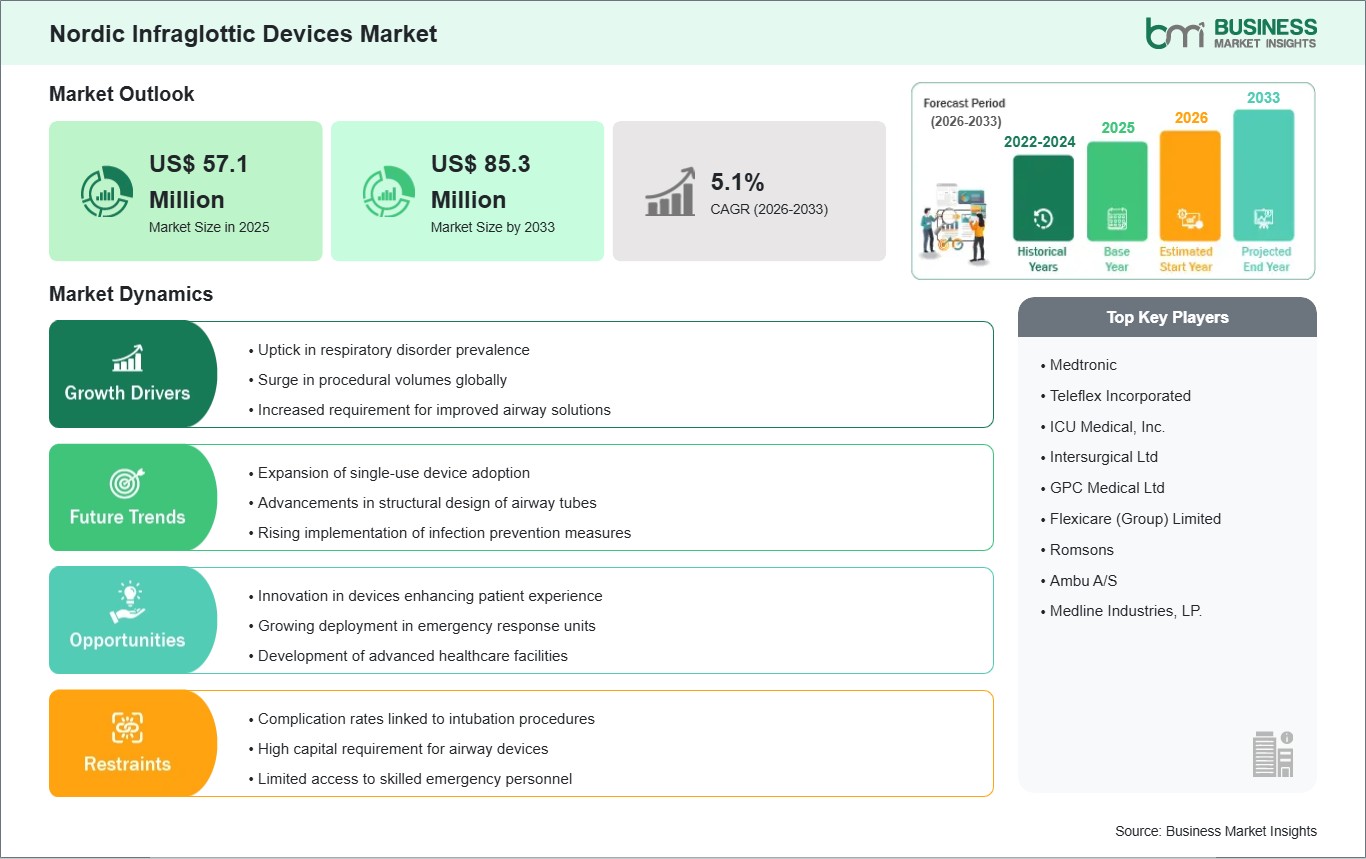
The Nordic Infraglottic Devices market size is expected to reach US$ 85.3 million by 2033 from US$ 57.1 million in 2025. The market is estimated to record a CAGR of 5.1% from 2026 to 2033.
The Nordic infraglottic devices market is defined by advanced healthcare systems, strong emphasis on patient safety, and widespread adoption of innovative medical technologies. Countries such as Sweden, Denmark, Norway, and Finland contribute to regional demand, but Sweden dominates due to its robust hospital infrastructure, strong research ecosystem, and leadership in medical innovation. The region benefits from high surgical volumes, well‑developed emergency care networks, and government initiatives that prioritize critical care modernization.
A distinctive feature of the Nordic market is the integration of technology with healthcare delivery. Digital health platforms, telemedicine, and simulation‑based training are widely used to enhance the effectiveness of airway management practices. The region also places strong emphasis on sustainability, with hospitals and manufacturers adopting eco‑friendly practices in medical device production and usage. Demographic factors, particularly aging populations, further drive demand for surgical and critical care interventions. Together, these elements make the Nordic market unique, positioning it as a leader in combining innovation, patient safety, and sustainability in the adoption of infraglottic devices.

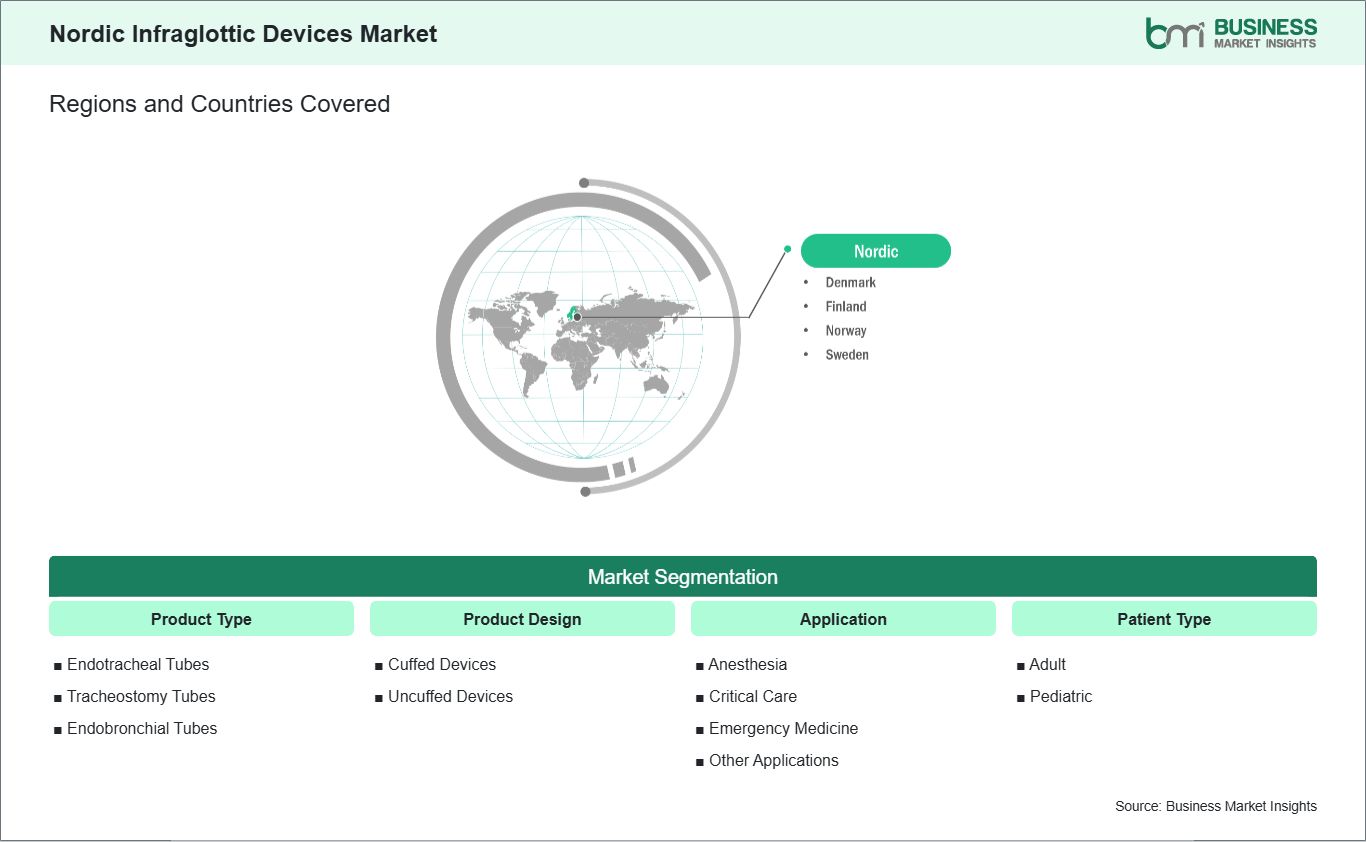
Key segments that contributed to the derivation of the North America infraglottic devices market analysis are product type, product design, application, patient type, and end user.
The Nordic market for infraglottic equipment can be attributed to the increasing number of cases of respiratory disorders among an ever-aging population. For example, Denmark and Sweden continue to have significant incidences of Chronic Obstructive Pulmonary Disease (COPD). The high prevalence of COPD is partially caused by lifestyle practices and environmental stimuli present in these regions historically. Also, there is an elevated admission of patients into hospitals in the Nordic region with cases of pneumonia, which requires intensive care units to facilitate their recovery. In this case, a need emerges for the provision of high-end endotracheal tubes and special tracheostomy devices, which require constant procurement through a universal healthcare approach adopted in the Nordic region.
In addition to chronic disease conditions, the rising trend of advanced specialization in the region increases the need for effective airway management. Nordic countries have made huge advancements in sophisticated procedures related to thoracic and cardiovascular operations, where infra-glottic access becomes very crucial to maintaining stability among patients during procedures. Governments of both Finland and Norway are fully dedicated to bringing advancement in the rural healthcare scenario through “super hospitals,” which serve as a strong base for the market. Such facilities are fitted with all the state-of-the-art facilities related to respiratory care that allow for advanced airway management even among people residing in rural settings.
The Nordic market represents a substantial growth area for the implementation of next-generation infraglottic devices designed specifically for providing patients with the best experience possible and less invasive operations. Doctors in the Nordic countries are among the first to experiment with soft airway management approaches, trying to avoid throat soreness and lasting injuries to the trachea. In turn, there is now a growing need for devices manufactured from extremely soft silicone and smart cuff pressure detectors, which enable accurate inflation without damaging the mucosa. With a focus on such devices that facilitate a comfortable stay for patients after operations, producers will be able to respond to Nordic priorities regarding holistic health approaches.
Furthermore, the Nordic region’s leadership in medical technology and digitalization provides a unique opening for connected airway solutions. There is a growing interest in infraglottic devices that integrate with hospital-wide monitoring systems to provide real-time data on airway patency and patient synchronization with ventilators. Additionally, the move toward sustainable, high-quality single-use devices is particularly strong in Denmark and Iceland, where healthcare providers seek to balance infection control with environmental responsibility. Manufacturers that offer biodegradable or easily recyclable disposable kits that do not compromise on technical performance are well-positioned for success. This trend toward high-tech, sustainable, and patient-friendly solutions reflects the forward-thinking nature of the Nordic healthcare market and its drive toward more efficient clinical outcomes.
The Nordic infraglottic devices market is experiencing steady growth, with market size and share analysis reflecting evolving treatment preferences and competitive dynamics among key players. The report evaluates important subsegments categorized within product type, product design, application, patient type, and end user, highlighting their respective contributions to overall market performance.
By product type, the endotracheal tubes subsegment dominated the market in 2025 due to their widespread use in airway management during surgeries, critical care, and emergency settings, offering reliable ventilation support and ease of insertion across diverse clinical scenarios.
Among product design, the cuffed devices subsegment dominated the market in 2025 due to their ability to provide effective airway sealing, prevent aspiration, and enable controlled ventilation, making them highly preferred in intensive care and surgical procedures requiring precise airway management.
Based on application, the anesthesia subsegment dominated the market in 2025 due to the high volume of surgical procedures requiring airway management, consistent use of endotracheal tubes during general anesthesia, and increasing demand for safe and controlled ventilation in operating rooms.
In terms of patient type, the adult subsegment dominated the market in 2025 due to higher incidence of chronic respiratory diseases, greater number of surgical procedures, and increased hospitalization rates requiring airway management and ventilatory support in adult populations.
By end user, the hospitals subsegment dominated the market in 2025 due to availability of advanced infrastructure, high patient inflow, presence of intensive care units, and continuous requirement for airway management devices during surgeries and emergency treatments.
| Report Attribute | Details |
|---|---|
| Market size in 2025 | US$ 57.1 Million |
| Market Size by 2033 | US$ 85.3 Million |
| CAGR (2026 - 2033) | 5.1% |
| Historical Data | 2022-2024 |
| Forecast period | 2026-2033 |
| Segments Covered | By Product Type
|
|
Regions and Countries Covered
| |
| Nordic | Sweden, Denmark, Norway, Finland |
| Market leaders and key company profiles |
|
The "Nordic Infraglottic Devices Market Size and Forecast (2022–2033)" report provides a detailed analysis of the market covering below areas:
The geographical scope of the Nordic Infraglottic Devices market report is divided into: Sweden, Norway, Denmark, and Finland. Sweden held the largest share in 2025.
Sweden dominates the Nordic infraglottic devices market, driven by its comprehensive healthcare system, advanced hospital network, and strong focus on research and innovation. Major cities such as Stockholm, Gothenburg, and Malmö serve as hubs for specialized medical care, where infraglottic devices are widely used in anesthesia, intensive care, and trauma management. Sweden’s medical technology sector is highly developed, with domestic manufacturers and research institutions collaborating to produce devices that meet international standards.
A unique aspect of Sweden’s leadership is its integration of academic research with clinical practice. Universities and teaching hospitals work closely with medical device companies to develop new technologies, ensuring rapid translation of innovation into patient care. The country also emphasizes professional training, with simulation centers and advanced curricula equipping healthcare professionals to handle complex airway management procedures. Another defining factor is Sweden’s role as an exporter within the Nordic region, supplying neighboring countries with high‑quality devices that align with strict EU and regional standards. This combination of innovation, infrastructure, and sustainability cements Sweden’s position as the dominant market in the Nordics, setting benchmarks for both regional and global adoption of infraglottic devices.

The Nordic Infraglottic Devices market is evaluated by gathering qualitative and quantitative data post primary and secondary research, which includes important corporate publications, association data, and databases. A few of the key developments in the Nordic Infraglottic Devices market are:
The Nordic Infraglottic Devices Market is valued at US$ 57.1 Million in 2025, it is projected to reach US$ 85.3 Million by 2033.
As per our report Nordic Infraglottic Devices Market, the market size is valued at US$ 57.1 Million in 2025, projecting it to reach US$ 85.3 Million by 2033. This translates to a CAGR of approximately 5.1% during the forecast period.
The Nordic Infraglottic Devices Market report typically cover these key segments-
The historic period, base year, and forecast period can vary slightly depending on the specific market research report. However, for the Nordic Infraglottic Devices Market report:
The Nordic Infraglottic Devices Market is populated by several key players, each contributing to its growth and innovation. Some of the major players include:
The Nordic Infraglottic Devices Market report is valuable for diverse stakeholders, including:
Essentially, anyone involved in or considering involvement in the Nordic Infraglottic Devices Market value chain can benefit from the information contained in a comprehensive market report.
Please tell us your area of interest
(Market Segments/ Regions and Countries/ Companies)