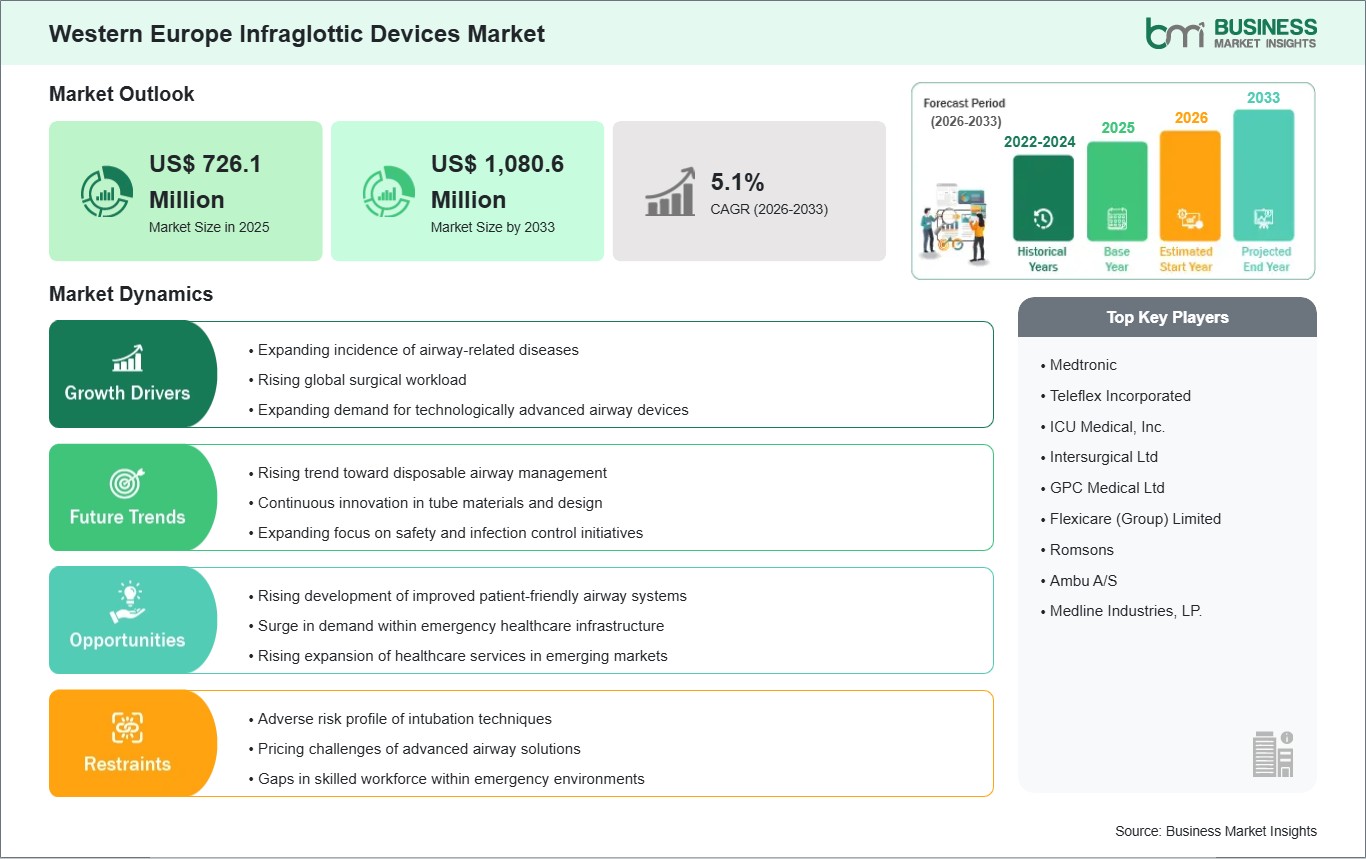
The Western Europe Infraglottic Devices market size is expected to reach US$ 1,080.6 million by 2033 from US$ 726.1 million in 2025. The market is estimated to record a CAGR of 5.1% from 2026 to 2033.
Western Europe features advanced healthcare infrastructures, a high volume of procedures, and stringent guidelines that ensure patient safety. Infraglottic devices such as endotracheal tubes and tracheostomy tubes have become popular across hospitals and dedicated surgical facilities as a means of airway management in anesthesia and critical care scenarios. The increasing number of older people and prevalence of chronic lung disorders are among the major factors behind the growing demand in the region. The presence of qualified anesthesiologists and specialists makes effective use of the device possible.
The focus on quality standards and safety issues has caused the adoption of single-use technology in the market. Cost containment issues in public health care and price pressure from regulatory bodies limit market growth. Environmental issues concerning the disposal of medical waste affect decision-making in the procurement of products in certain countries. Nevertheless, ongoing product innovation in airway management and the availability of health care systems guarantee a steady market in Western Europe.

Key segments that contributed to the derivation of the North America infraglottic devices market analysis are product type, product design, application, patient type, and end user.
Countries such as France, Germany, and Italy are experiencing all types of chronic obstructive pulmonary disease (COPD) and severe asthma due to historical smoking patterns and prolonged urban air pollution. There has been an increase in such diseases from complex upper-level respiratory tract infections, along with those from other chronic comorbid diseases, resulting in older patients being transferred to the intensive care unit. Infraglottic/airway devices are widely used in adult and pediatric patients for prolonged mechanical ventilation and assistance with the management of acute respiratory insufficiency.
Western Europe possesses one of the world's most advanced surgical infrastructures, where a high volume of cardiothoracic, oncological, and neurological surgeries necessitates definitive airway control. The region's well-established emergency response networks have seen a rise in difficult airway cases during trauma interventions. As healthcare systems in nations such as the UK and the Netherlands face pressure from emergency admissions, the procurement of high-quality infraglottic solutions has become a priority to ensure patient safety and improve clinical success rates. This robust demand across elective and emergency care settings stabilizes the regional market.
There is a marked inclination toward "trauma-free" airway management due to strict clinical protocols and an emphasis on hospital-acquired infections. Medical device manufacturers are designing equipment using ultra-flexible, clinically-grade silicone and polymers that fit snugly into the anatomical contours of the patient. It minimizes tracheal mucosal damage and prevents post-extubation pain, two primary considerations for the premium private hospitals and specialized government-run hospitals within the region.
Clinicians are adopting devices equipped with integrated video-assisted sensors and real-time cuff pressure monitoring. These advanced systems provide immediate feedback, ensuring optimal placement and preventing tissue necrosis caused by over-inflation. There is a transition toward high-performance, single-use infraglottic kits that align with the region's strict sustainability and hygiene standards. By offering products that combine technical precision with an ergonomic, patient-first design, companies can cater to a market that values efficiency and individualized treatment. This trend toward "connected" and comfortable devices is redefining the standard of respiratory care across the continent.
The Western Europe infraglottic devices market is experiencing steady growth, with market size and share analysis reflecting evolving treatment preferences and competitive dynamics among key players. The report evaluates important subsegments categorized within product type, product design, application, patient type, and end user, highlighting their respective contributions to overall market performance.
By product type, the endotracheal tubes subsegment dominated the market in 2025 due to their widespread use in airway management during surgeries, critical care, and emergency settings, offering reliable ventilation support and ease of insertion across diverse clinical scenarios.
Among product design, the cuffed devices subsegment dominated the market in 2025 due to their ability to provide effective airway sealing, prevent aspiration, and enable controlled ventilation, making them highly preferred in intensive care and surgical procedures requiring precise airway management.
Based on application, the anesthesia subsegment dominated the market in 2025 due to the high volume of surgical procedures requiring airway management, consistent use of endotracheal tubes during general anesthesia, and increasing demand for safe and controlled ventilation in operating rooms.
In terms of patient type, the adult subsegment dominated the market in 2025 due to higher incidence of chronic respiratory diseases, greater number of surgical procedures, and increased hospitalization rates requiring airway management and ventilatory support in adult populations.
By end user, the hospitals subsegment dominated the market in 2025 due to availability of advanced infrastructure, high patient inflow, presence of intensive care units, and continuous requirement for airway management devices during surgeries and emergency treatments.
| Report Attribute | Details |
|---|---|
| Market size in 2025 | US$ 726.1 Million |
| Market Size by 2033 | US$ 1,080.6 Million |
| CAGR (2026 - 2033) | 5.1% |
| Historical Data | 2022-2024 |
| Forecast period | 2026-2033 |
| Segments Covered | By Product Type
|
|
Regions and Countries Covered
| |
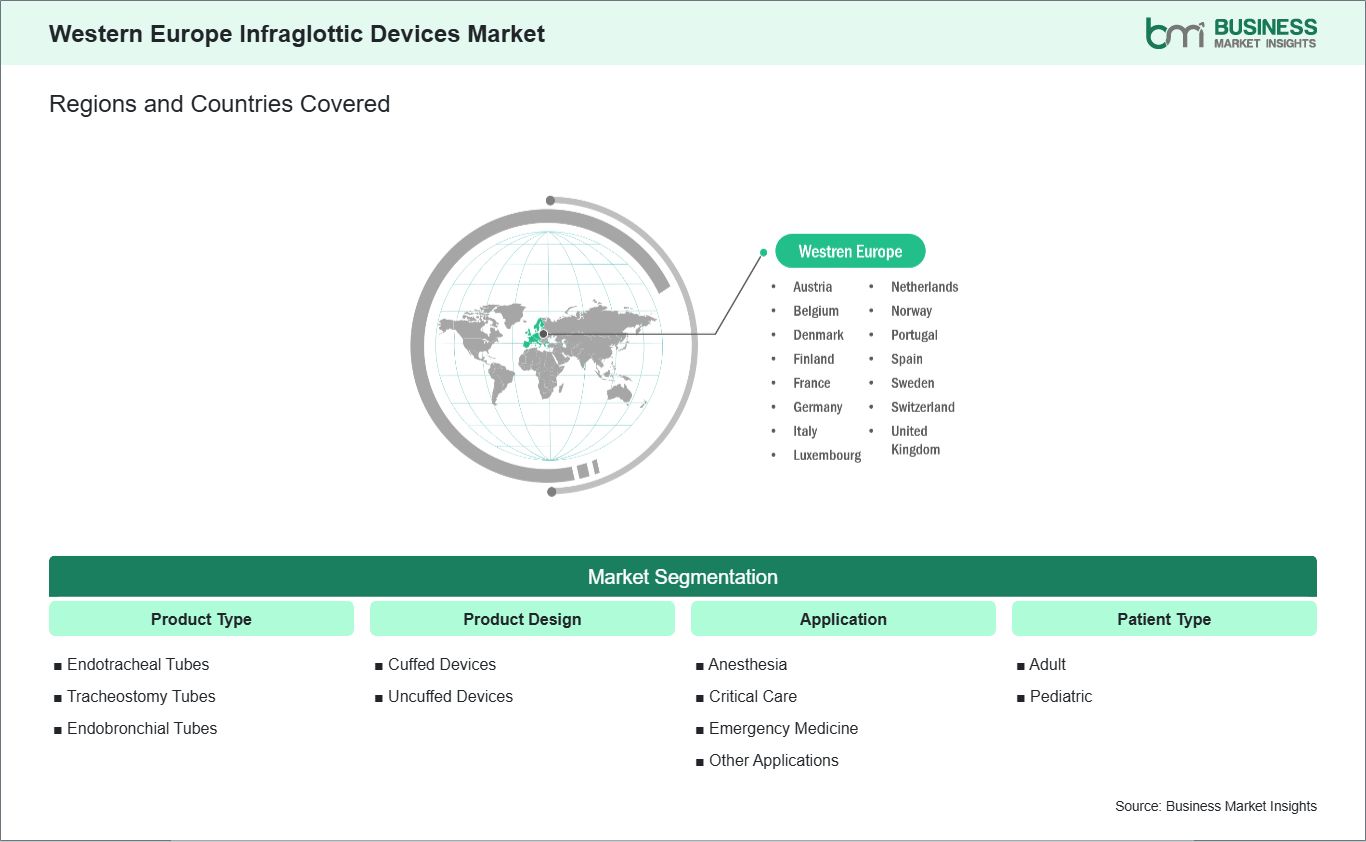
| Western Europe | Belgium, Netherlands, Luxembourg, Germany, France, Italy, Spain, Switzerland, Sweden, Austria, United Kingdom, Denmark, Portugal, Norway, Finland |
| Market leaders and key company profiles |
|
The "Western Europe Infraglottic Devices Market Size and Forecast (2022–2033)" report provides a detailed analysis of the market covering below areas:
The geographical scope of the Western Europe Infraglottic Devices market report is divided into: Belgium, the Netherlands, Luxembourg, Germany, France, Italy, Spain, Switzerland, Sweden, Austria, the UK, Denmark, Portugal, Norway, and Finland. Germany held the largest share in 2025.
Germany’s well-developed tertiary hospitals and intensive care units (ICUs) serve as key centers for advanced airway management, where infraglottic devices are routinely utilized during complex and high-risk surgical procedures. The country benefits from a robust and mature medical device industry, supported by efficient distribution networks that ensure consistent access to technologically advanced and innovative products. Hospitals place a strong emphasis on patient safety, clinical outcomes, and procedural efficiency, which drives the adoption of infraglottic devices with enhanced design, improved sealing capabilities, and ease of use. In addition, continuous professional training programs and simulation-based learning initiatives enable healthcare professionals to effectively use these devices, further supporting market growth. Germany’s strong clinical research environment also contributes to the early adoption of next-generation airway management technologies. However, the market faces challenges such as stringent regulatory requirements under European medical device regulations and increasing cost pressures within the national healthcare reimbursement framework. Budget constraints often influence procurement decisions, particularly in public hospitals. Despite these challenges, ongoing investments in healthcare infrastructure, coupled with a focus on improving surgical outcomes and patient safety, continue to reinforce Germany’s leading position in the Western Europe infraglottic devices market.

The Western Europe Infraglottic Devices market is evaluated by gathering qualitative and quantitative data post primary and secondary research, which includes important corporate publications, association data, and databases. A few of the key developments in the Western Europe Infraglottic Devices market are:
The Western Europe Infraglottic Devices Market is valued at US$ 726.1 Million in 2025, it is projected to reach US$ 1,080.6 Million by 2033.
As per our report Western Europe Infraglottic Devices Market, the market size is valued at US$ 726.1 Million in 2025, projecting it to reach US$ 1,080.6 Million by 2033. This translates to a CAGR of approximately 5.1% during the forecast period.
The Western Europe Infraglottic Devices Market report typically cover these key segments-
The historic period, base year, and forecast period can vary slightly depending on the specific market research report. However, for the Western Europe Infraglottic Devices Market report:
The Western Europe Infraglottic Devices Market is populated by several key players, each contributing to its growth and innovation. Some of the major players include:
The Western Europe Infraglottic Devices Market report is valuable for diverse stakeholders, including:
Essentially, anyone involved in or considering involvement in the Western Europe Infraglottic Devices Market value chain can benefit from the information contained in a comprehensive market report.
Please tell us your area of interest
(Market Segments/ Regions and Countries/ Companies)