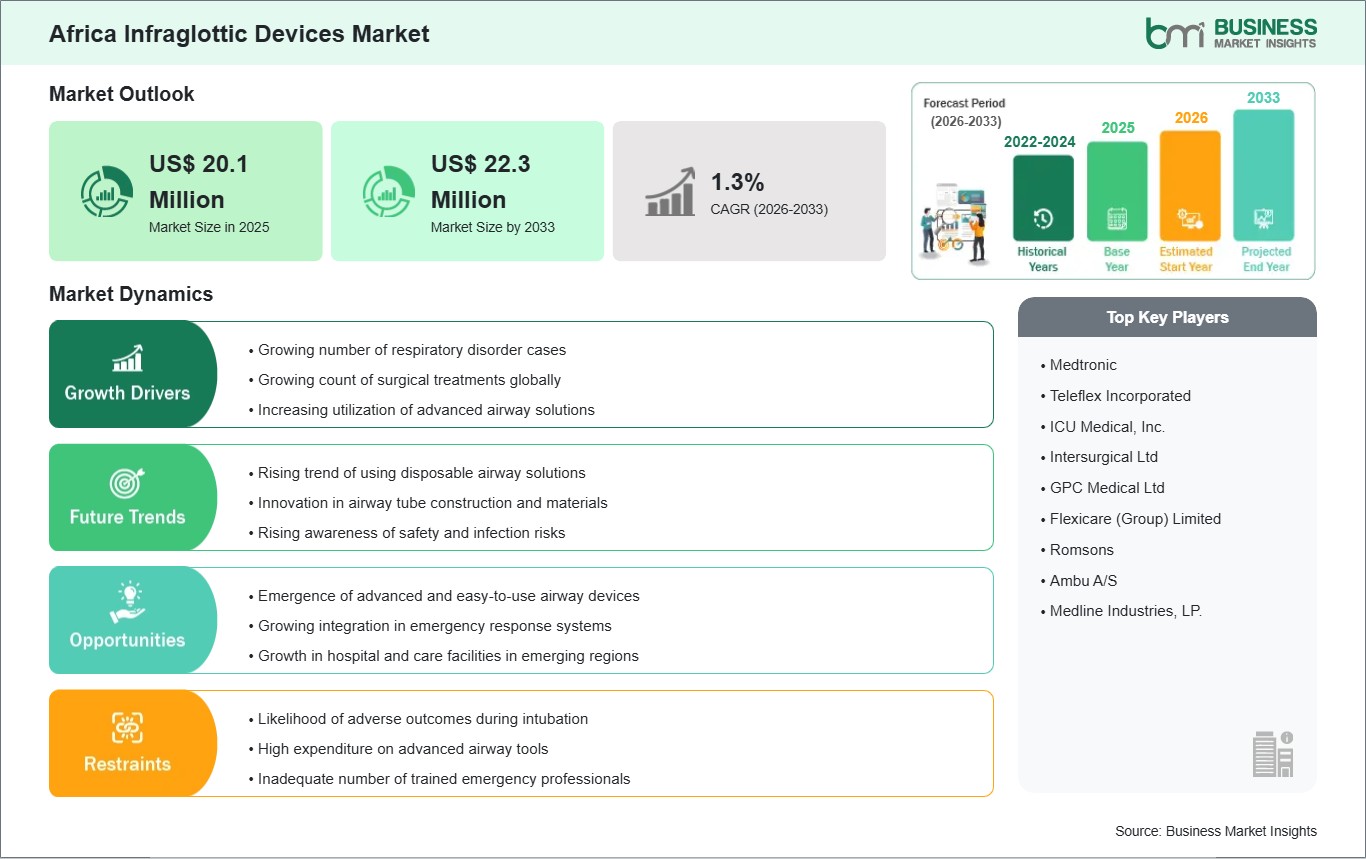
The Africa Infraglottic Devices market size is expected to reach US$ 22.3 million by 2033 from US$ 20.1 million in 2025. The market is estimated to record a CAGR of 1.3% from 2026 to 2033.
Devices such as endotracheal tubes and tracheostomy tubes help manage the airway during surgery, critical care treatment, and emergency medical intervention. One of the factors responsible for the increased use of infraglottic devices in Africa is the prevalence of infections and other chronic diseases affecting the respiratory system. Other factors include the development of hospitals in cities and an increase in the number of surgeries.
Another important factor is the development of emergency medical services and trauma care systems, particularly in economically advancing countries within the region. However, the market faces constraints due to limited healthcare access in rural areas and affordability challenges associated with advanced airway management devices. Inadequate availability of skilled healthcare professionals trained in intubation procedures restricts widespread utilization. Despite these challenges, increasing investments in healthcare modernization and a shift toward better infection control practices support steady market growth across the region.

Key segments that contributed to the derivation of the North America infraglottic devices market analysis are product type, product design, application, patient type, and end user.
Rising rates of respiratory diseases have been observed across Africa as a result of changes in the environment and lifestyle.
Indoor smoke from burning biomass fuels and inadequate ventilation are common, creating problems for people living in rural areas. Rapid urbanization has generated additional sources of outdoor air pollution from traffic and industrial activities. Consequently, patients with asthma, Chronic Obstructive Pulmonary Disease (COPD), and other forms of respiratory disease are prevalent in hospitals, increasing the use of infraglottic devices (e.g., endotracheal and tracheostomy) during the treatment of these patients to facilitate proper airflow through the airway.
Infectious diseases remain a major concern across African countries, causing severe respiratory complications. Conditions such as pneumonia and tuberculosis can quickly affect lung function and lead to breathing difficulties that need urgent intervention. Limited access to early diagnosis worsens patient conditions, increasing the need for emergency airway management. Healthcare providers are relying more on infraglottic devices in critical care and surgical procedures. This growing burden of chronic and infectious respiratory diseases is driving consistent demand for airway management solutions across the healthcare system.
Health institutions are faced with problems such as a lack of skilled staff, a large number of patients, and access to specialty care services. As a result, there is a need for devices that are easy to use and can be quickly deployed. The manufacturers are concentrating their efforts on producing more flexible, easily inserted, and sealable endotracheal and tracheostomy tubes.
There has been increased emphasis placed on the manufacturing of products that will be appropriate for low-resource areas that are in Africa. Manufacturers are producing devices that work in cases where there is limited infrastructure, and medical devices that are portable. The assistance that has been offered by health-related organizations has been able to facilitate greater accessibility to airway management devices through various initiatives aimed at training and distribution. Advanced airway devices are increasingly being adopted in hospitals and rural health facilities. Awareness about efficient airway management is increasing acceptance among health practitioners.
The Africa infraglottic devices market is experiencing steady growth, with market size and share analysis reflecting evolving treatment preferences and competitive dynamics among key players. The report evaluates important subsegments categorized within product type, product design, application, patient type, and end user, highlighting their respective contributions to overall market performance.
By product type, the endotracheal tubes subsegment dominated the market in 2025 due to their widespread use in airway management during surgeries, critical care, and emergency settings, offering reliable ventilation support and ease of insertion across diverse clinical scenarios.
Among product design, the cuffed devices subsegment dominated the market in 2025 due to their ability to provide effective airway sealing, prevent aspiration, and enable controlled ventilation, making them highly preferred in intensive care and surgical procedures requiring precise airway management.
Based on application, the anesthesia subsegment dominated the market in 2025 due to the high volume of surgical procedures requiring airway management, consistent use of endotracheal tubes during general anesthesia, and increasing demand for safe and controlled ventilation in operating rooms.
In terms of patient type, the adult subsegment dominated the market in 2025 due to higher incidence of chronic respiratory diseases, greater number of surgical procedures, and increased hospitalization rates requiring airway management and ventilatory support in adult populations.
By end user, the hospitals subsegment dominated the market in 2025 due to availability of advanced infrastructure, high patient inflow, presence of intensive care units, and continuous requirement for airway management devices during surgeries and emergency treatments.
| Report Attribute | Details |
|---|---|
| Market size in 2025 | US$ 20.1 Million |
| Market Size by 2033 | US$ 22.3 Million |
| CAGR (2026 - 2033) | 1.3% |
| Historical Data | 2022-2024 |
| Forecast period | 2026-2033 |
| Segments Covered | By Product Type
|
|
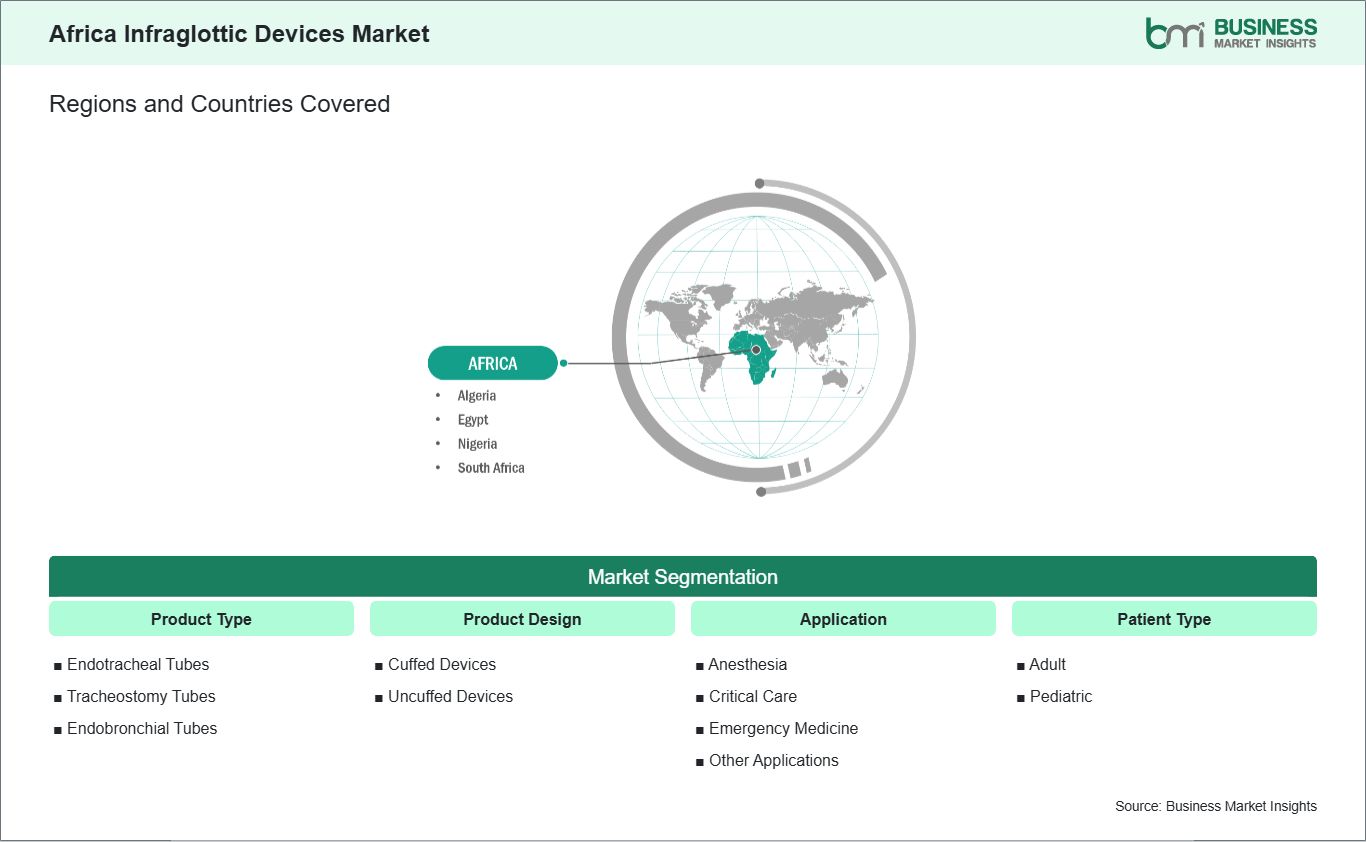
Regions and Countries Covered
| |
| Africa | Egypt, South Africa, Nigeria, Algeria |
| Market leaders and key company profiles |
|
The "Africa Infraglottic Devices Market Size and Forecast (2022–2033)" report provides a detailed analysis of the market covering below areas:
The geographical scope of the Africa Infraglottic Devices market report is divided into: Nigeria, Egypt, South Africa, and Algeria. South Africa held the largest share in 2025.
Numerous hospitals and surgical centers throughout South Africa utilize infraglottic devices for anesthesia purposes or for managing patients in the intensive care unit (ICU). The large number of surgical procedures each month, along with critical care admissions, contributes to the high demand for infraglottic devices.
Access to higher technology has improved because international companies that design, manufacture, and distribute infraglottic devices are either already established in South Africa or are planning on entering the South African market soon. The increased focus on patient safety and the need for infection control increases the percentage of patients who will utilize improved product design, including the disposable version of infraglottic devices. Differences in healthcare access to rural vs. urban settings cause continued variance in acceptance of infraglottic devices throughout South Africa. However, there has been a large use of infraglottic devices, but rural South Africa experiences continuing challenges due to infrastructure capabilities and the number of qualified healthcare professionals. These limitations can restrict the demand for infraglottic devices in South Africa.

The Africa Infraglottic Devices market is evaluated by gathering qualitative and quantitative data post primary and secondary research, which includes important corporate publications, association data, and databases. A few of the key developments in the Africa Infraglottic Devices market are:
The Africa Infraglottic Devices Market is valued at US$ 20.1 Million in 2025, it is projected to reach US$ 22.3 Million by 2033.
As per our report Africa Infraglottic Devices Market, the market size is valued at US$ 20.1 Million in 2025, projecting it to reach US$ 22.3 Million by 2033. This translates to a CAGR of approximately 1.3% during the forecast period.
The Africa Infraglottic Devices Market report typically cover these key segments-
The historic period, base year, and forecast period can vary slightly depending on the specific market research report. However, for the Africa Infraglottic Devices Market report:
The Africa Infraglottic Devices Market is populated by several key players, each contributing to its growth and innovation. Some of the major players include:
The Africa Infraglottic Devices Market report is valuable for diverse stakeholders, including:
Essentially, anyone involved in or considering involvement in the Africa Infraglottic Devices Market value chain can benefit from the information contained in a comprehensive market report.
Please tell us your area of interest
(Market Segments/ Regions and Countries/ Companies)