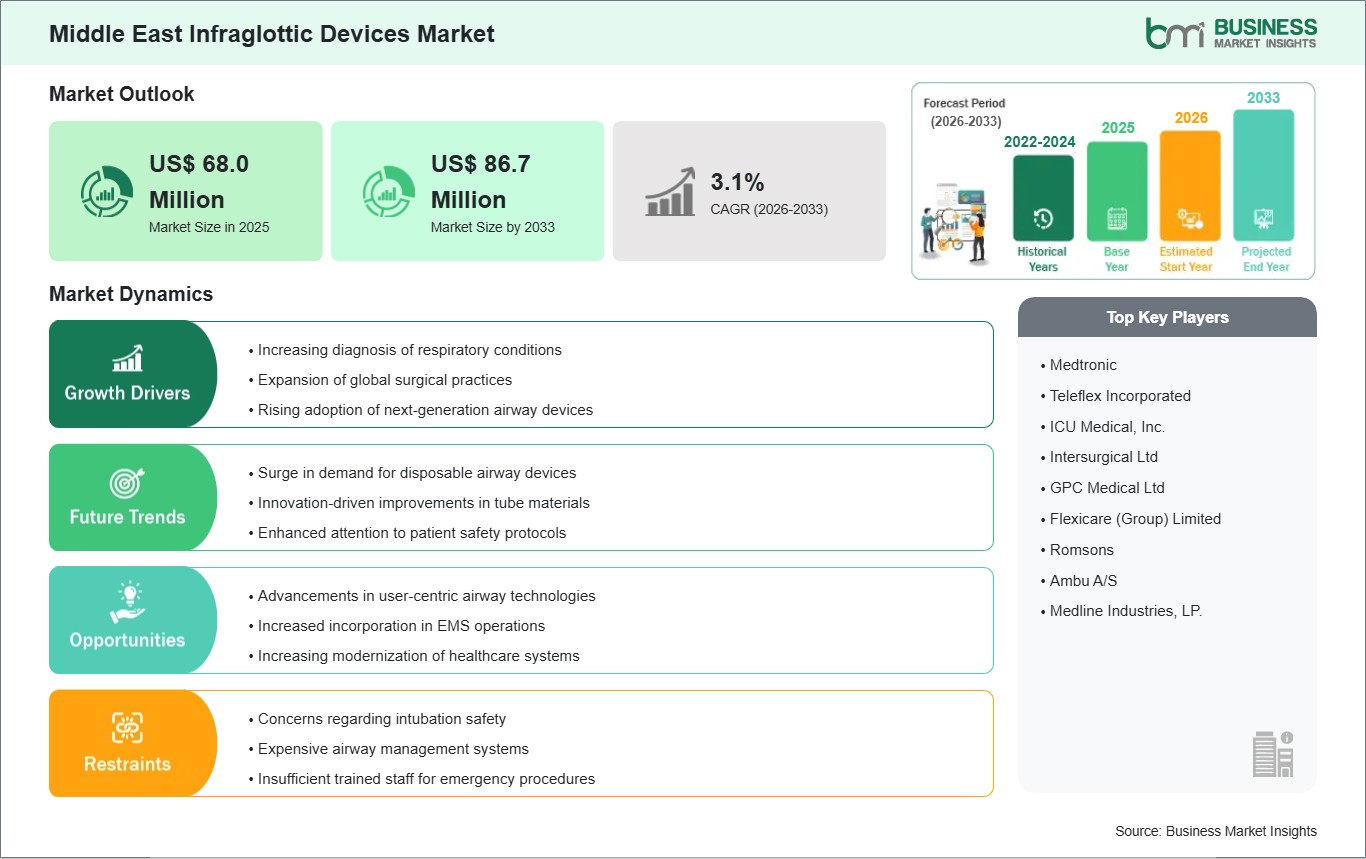
The Middle East Infraglottic Devices market size is expected to reach US$ 86.7 million by 2033 from US$ 68.0 million in 2025. The market is estimated to record a CAGR of 3.1% from 2026 to 2033.
Infraglottic devices in the Middle East are witnessing consistent growth because of increased investments in healthcare development, high numbers of surgical operations, and growing availability of emergency health services. Among the major countries that are playing a significant role in the Middle Eastern market for infraglottic devices are Saudi Arabia, the UAE, and Turkiye; however, Turkiye stands out as being dominant owing to its capabilities in manufacturing medical supplies, highly developed hospitals, and geographical positioning between Europe and Asia. Demand in this region is supported by the occurrence of respiratory conditions, traumas, and airway problems.
One of the distinguishing characteristics of the Middle Eastern market is the presence of local production and partnerships with foreign companies. For instance, Turkey has capitalized on its health technology industry to provide not only for its own needs but also the neighboring states. Meanwhile, the Gulf States concentrate their efforts on importing advanced technologies to facilitate the construction of hospitals. In addition, this area features medical tourism since many foreigners choose to travel to such destinations as Turkey and UAE to receive surgical procedures that use infraglottic airways.

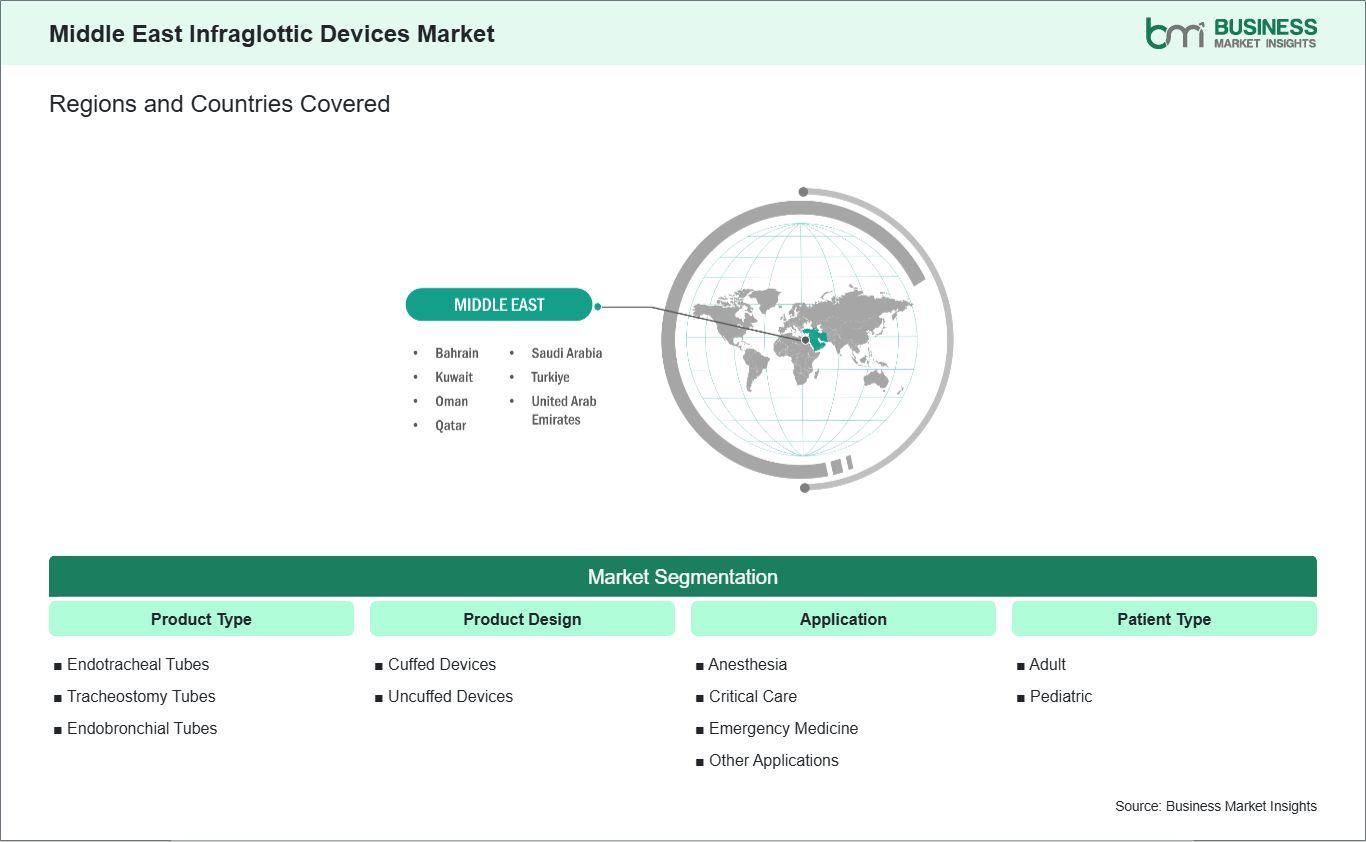
Key segments that contributed to the derivation of the North America infraglottic devices market analysis are product type, product design, application, patient type, and end user.
There has been an increase in the incidence of respiratory problems in the Middle East, and thus, there has been increased demand for infraglottic products in the area. Air pollution, due to the expansion of cities, dust storms, high rates of smoking, and occupations that expose individuals to respiratory hazards lead to respiratory illnesses such as asthma, chronic obstructive pulmonary disease (COPD), and bronchitis. There has been increased efficiency in the healthcare sector, making early detection easy; therefore, many people seek treatment. There has been an increase in operations, where airway management equipment, including endotracheal and tracheostomy products, is used.
At the same time, infectious respiratory illnesses, including pneumonia and seasonal viral infections, continue to impact large portions of the population, especially children and elderly patients. As a result, hospitals and intensive care units are facing increased patient loads that require immediate airway support. The combination of chronic respiratory conditions and recurring infections has expanded the patient pool that needs infraglottic devices. Healthcare providers are focusing on reliable and effective airway management solutions to maintain ventilation and reduce complications during treatment. The rising diagnosis of respiratory disorders across the Middle East is therefore directly driving the demand for infraglottic devices in hospitals, emergency medical services, and surgical centers throughout the region.
The Middle East presents a strong opportunity for infraglottic devices due to advancements in user-centric airway technologies. Healthcare providers in the region are emphasizing patient safety, procedural efficiency, and comfort, driving adoption of devices designed for ease of use. Innovative endotracheal and tracheostomy tubes now feature softer materials, improved flexibility, enhanced sealing mechanisms, and ergonomic designs that reduce patient discomfort and minimize insertion complications. These technologies are especially beneficial in intensive care, emergency, and surgical environments, where quick, reliable, and safe airway access is critical.
Further, the region is observing investments in the development of healthcare infrastructure that uses modern technology and also implements portable health solutions. Hospitals and clinics have implemented easy-to-use technology, which can be easily used even by those who do not have much experience in using it, especially in situations where volume and speed matter. This would result in more applications being made at urban hospitals, specialist facilities, and emergency departments. The need for such patient-focused care would result in a higher need for ergonomic infraglottic devices, creating many possibilities for companies looking to establish themselves in the Middle East market.

The Middle East infraglottic devices market is experiencing steady growth, with market size and share analysis reflecting evolving treatment preferences and competitive dynamics among key players. The report evaluates important subsegments categorized within product type, product design, application, patient type, and end user, highlighting their respective contributions to overall market performance.
By product type, the endotracheal tubes subsegment dominated the market in 2025 due to their widespread use in airway management during surgeries, critical care, and emergency settings, offering reliable ventilation support and ease of insertion across diverse clinical scenarios.
Among product design, the cuffed devices subsegment dominated the market in 2025 due to their ability to provide effective airway sealing, prevent aspiration, and enable controlled ventilation, making them highly preferred in intensive care and surgical procedures requiring precise airway management.
Based on application, the anesthesia subsegment dominated the market in 2025 due to the high volume of surgical procedures requiring airway management, consistent use of endotracheal tubes during general anesthesia, and increasing demand for safe and controlled ventilation in operating rooms.
In terms of patient type, the adult subsegment dominated the market in 2025 due to higher incidence of chronic respiratory diseases, greater number of surgical procedures, and increased hospitalization rates requiring airway management and ventilatory support in adult populations.
By end user, the hospitals subsegment dominated the market in 2025 due to availability of advanced infrastructure, high patient inflow, presence of intensive care units, and continuous requirement for airway management devices during surgeries and emergency treatments.
| Report Attribute | Details |
|---|---|
| Market size in 2025 | US$ 68.0 Million |
| Market Size by 2033 | US$ 86.7 Million |
| CAGR (2026 - 2033) | 3.1% |
| Historical Data | 2022-2024 |
| Forecast period | 2026-2033 |
| Segments Covered | By Product Type
|
|
Regions and Countries Covered
| |
| Middle East | UAE, Saudi Arabia, Bahrain, Oman, Kuwait, Qatar, Turkiye |
| Market leaders and key company profiles |
|
The "Middle East Infraglottic Devices Market Size and Forecast (2022–2033)" report provides a detailed analysis of the market covering below areas:
The geographical scope of the Middle East Infraglottic Devices market report is divided into: the UAE, Saudi Arabia, Bahrain, Oman, Kuwait, Qatar, and Turkiye. Turkiye held the largest share in 2025.
Infraglottic devices are largely controlled by Turkiye in the Middle East region owing to the strength of its health care system, manufacturing capacity, and increasing importance as a regional center for medical services. The cities of Istanbul, Ankara, and Izmir have state-of-the-art hospitals and clinics that use infraglottic devices extensively for purposes of anesthesia and critical care. Turkiye has a strong medical technology industry, allowing it to produce medical devices of international quality.
A unique aspect of Turkiye’s leadership is its integration of healthcare modernization with medical tourism. The nation attracts patients from across the Middle East, Europe, and Central Asia, creating demand for advanced airway management solutions in private hospitals catering to international patients. At the same time, government initiatives have focused on expanding public healthcare facilities and training medical professionals, ensuring widespread adoption of modern devices. Turkiye’s dual role as both a producer and a destination for medical care sets it apart from other regional players. This combination of industrial strength, healthcare accessibility, and international appeal cements Turkiye’s position as the dominant market in the Middle East for infraglottic devices.

The Middle East Infraglottic Devices market is evaluated by gathering qualitative and quantitative data post primary and secondary research, which includes important corporate publications, association data, and databases. A few of the key developments in the Middle East Infraglottic Devices market are:
The Middle East Infraglottic Devices Market is valued at US$ 68.0 Million in 2025, it is projected to reach US$ 86.7 Million by 2033.
As per our report Middle East Infraglottic Devices Market, the market size is valued at US$ 68.0 Million in 2025, projecting it to reach US$ 86.7 Million by 2033. This translates to a CAGR of approximately 3.1% during the forecast period.
The Middle East Infraglottic Devices Market report typically cover these key segments-
The historic period, base year, and forecast period can vary slightly depending on the specific market research report. However, for the Middle East Infraglottic Devices Market report:
The Middle East Infraglottic Devices Market is populated by several key players, each contributing to its growth and innovation. Some of the major players include:
The Middle East Infraglottic Devices Market report is valuable for diverse stakeholders, including:
Essentially, anyone involved in or considering involvement in the Middle East Infraglottic Devices Market value chain can benefit from the information contained in a comprehensive market report.
Please tell us your area of interest
(Market Segments/ Regions and Countries/ Companies)