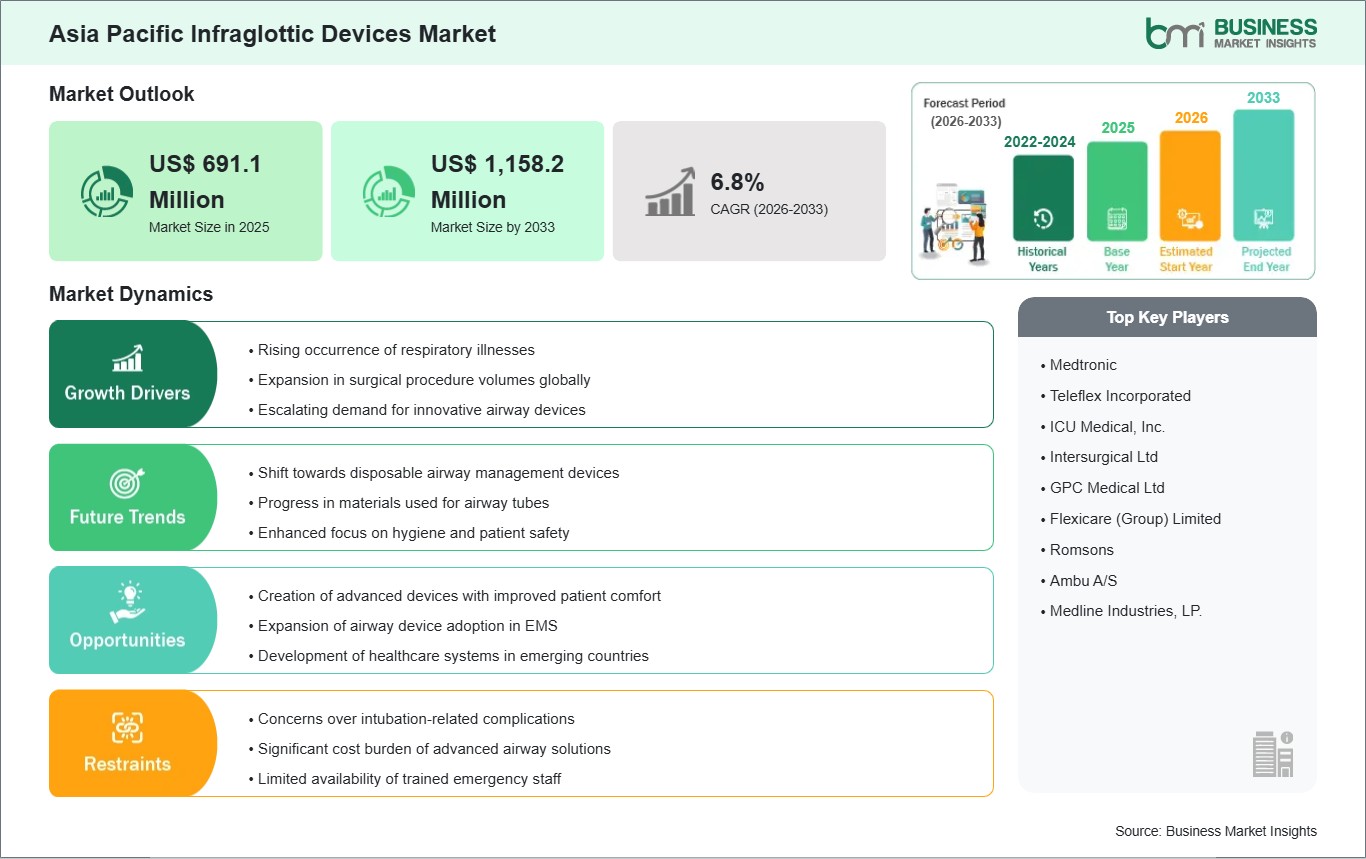
The Asia Pacific Infraglottic Devices market size is expected to reach US$ 1,158.2 million by 2033 from US$ 691.1 million in 2025. The market is estimated to record a CAGR of 6.8% from 2026 to 2033.
The Asia Pacific infraglottic devices market is evolving rapidly, shaped by diverse healthcare systems, rising surgical volumes, and increasing investments in critical care infrastructure. The region benefits from strong government initiatives to modernize hospitals, growing awareness of advanced airway management, and the presence of both global and domestic manufacturers. Unlike other regions, Asia Pacific is unique in its dual role as a major consumer and a global supplier of medical technologies. Countries such as Japan and South Korea contribute through innovation and R&D, while Southeast Asian nations are adopting cost‑effective solutions sourced from regional hubs.
A distinctive feature of this market is the integration of affordability with innovation. Asia Pacific is not only absorbing advanced technologies but also shaping global trends by exporting devices and setting new standards in design and safety. The combination of large patient populations, rapid urbanization, and expanding healthcare infrastructure makes the region a strategic driver of global growth in infraglottic devices.

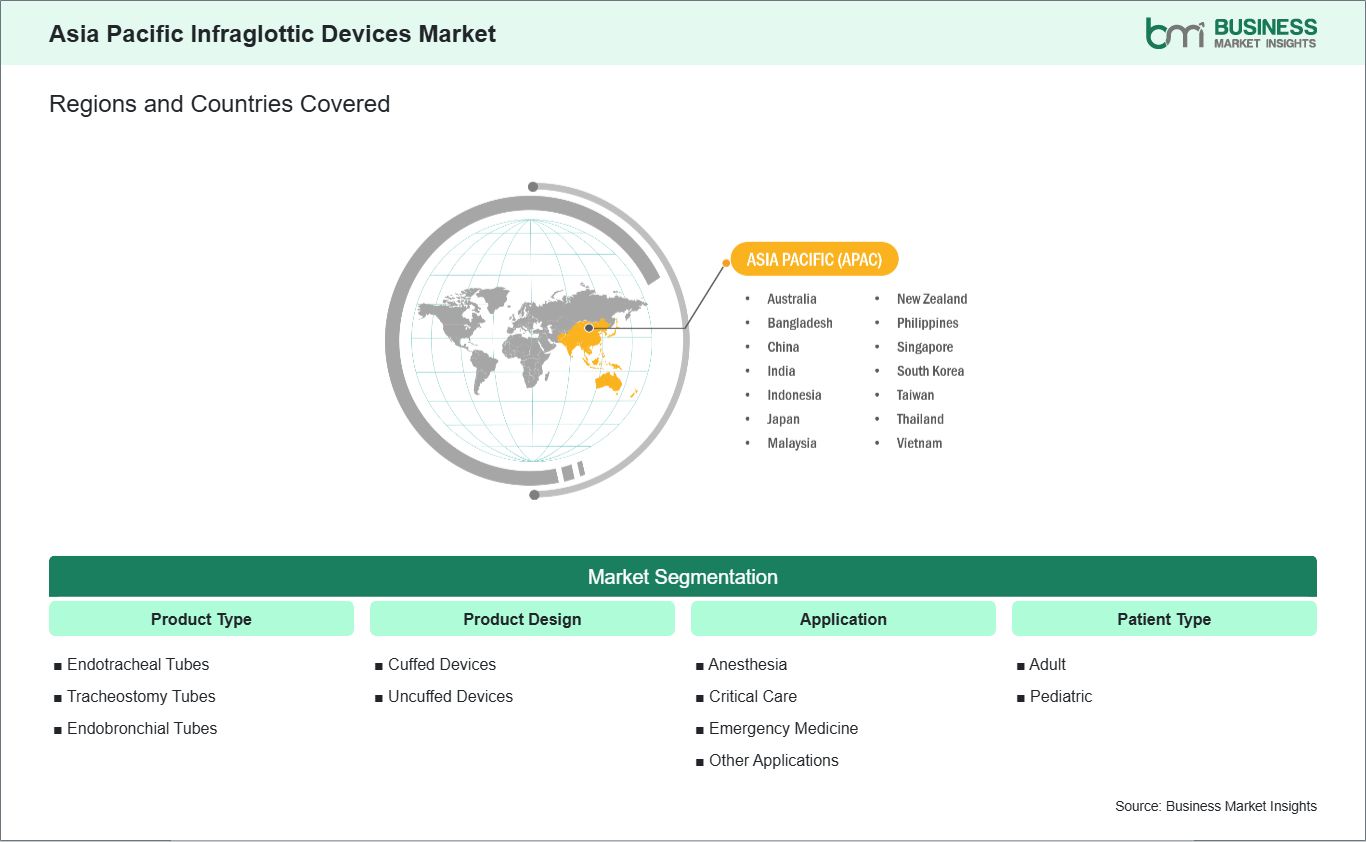
Key segments that contributed to the derivation of the North America infraglottic devices market analysis are product type, product design, application, patient type, and end user.
The infalgottic devices market in the Asia Pacific has seen strong growth due to the dramatic growth in respiratory illnesses throughout the region. Chronic obstructive pulmonary disease (COPD) and severe asthma have soared in nations experiencing rapid development, such as China and India, largely due to high levels of air and industrial pollution. Increases in respiratory illness have also been attributed to the significant increase in the aged population in Japan and South Korea, with hospital-acquired pneumonia and other age-related respiratory diseases occurring at an unprecedented rate among elderly citizens. Because of these factors, clinical centers have seen a rise in the number of patients admitted to intensive care and requiring infraglottic devices (i.e., endotracheal tubes) to provide lifesaving mechanical ventilation and prolonged airway support.
Apart from the chronic disorders, growth in infrastructure development within the healthcare sector, alongside an increase in the number of surgeries performed in the area, will also play into demand factors. Many governments in APAC are currently spending on the establishment of tertiary centers as well as trauma units to address the rising emergency cases, particularly those that involve road traffic accidents and infections. There will be an increased number of uses for the more technologically advanced tracheostomy tubes in the area due to the increased number of people seeking medical attention in Central and Southeast Asia.
The development of sophisticated infraglottic devices designed specifically to enhance patient comfort represents a major opportunity for manufacturers in the Asia-Pacific market. Traditional airway management often involves rigid materials that can cause discomfort, mucosal injury, or long-term complications for the patient. In response, there is an emerging trend toward the use of medical-grade silicone and ultra-soft, biocompatible polymers that better fit the varied anatomical structures of the APAC population. These materials minimize friction and pressure during insertion, significantly reducing the physical stress on patients during both short-term surgeries and extended hospital stays. This focus on gentle airway management is highly valued in the region's expanding private healthcare sectors, where patient satisfaction and quality of life are key differentiators.
Furthermore, the integration of smart technology into infraglottic devices provides a strategic opening for innovation. New devices equipped with precise cuff pressure monitoring systems and integrated sensors allow for real-time adjustments, preventing tissue damage caused by over-inflation. There is also a notable shift toward high-performance disposable infraglottic solutions as hospitals in Australia, Singapore, and India seek to streamline infection control and reduce the logistical burden of sterilization. By offering products that combine ergonomic design with the highest safety standards, companies can cater to the modernizing needs of APAC hospitals. This evolution toward patient-centric, high-tech devices not only improves clinical outcomes but also aligns with the regional push for more efficient and humane healthcare delivery.
The Asia Pacific infraglottic devices market is experiencing steady growth, with market size and share analysis reflecting evolving treatment preferences and competitive dynamics among key players. The report evaluates important subsegments categorized within product type, product design, application, patient type, and end user, highlighting their respective contributions to overall market performance.
By product type, the endotracheal tubes subsegment dominated the market in 2025 due to their widespread use in airway management during surgeries, critical care, and emergency settings, offering reliable ventilation support and ease of insertion across diverse clinical scenarios.
Among product design, the cuffed devices subsegment dominated the market in 2025 due to their ability to provide effective airway sealing, prevent aspiration, and enable controlled ventilation, making them highly preferred in intensive care and surgical procedures requiring precise airway management.
Based on application, the anesthesia subsegment dominated the market in 2025 due to the high volume of surgical procedures requiring airway management, consistent use of endotracheal tubes during general anesthesia, and increasing demand for safe and controlled ventilation in operating rooms.
In terms of patient type, the adult subsegment dominated the market in 2025 due to higher incidence of chronic respiratory diseases, greater number of surgical procedures, and increased hospitalization rates requiring airway management and ventilatory support in adult populations.
By end user, the hospitals subsegment dominated the market in 2025 due to availability of advanced infrastructure, high patient inflow, presence of intensive care units, and continuous requirement for airway management devices during surgeries and emergency treatments.
| Report Attribute | Details |
|---|---|
| Market size in 2025 | US$ 691.1 Million |
| Market Size by 2033 | US$ 1,158.2 Million |
| CAGR (2026 - 2033) | 6.8% |
| Historical Data | 2022-2024 |
| Forecast period | 2026-2033 |
| Segments Covered | By Product Type
|
|
Regions and Countries Covered
| |
| Asia Pacific | China, Japan, South Korea, India, Australia, New Zealand, Indonesia, Malaysia, Philippines, Singapore, Thailand, Vietnam, Taiwan, Bangladesh |
| Market leaders and key company profiles |
|
The "Asia Pacific Infraglottic Devices Market Size and Forecast (2022–2033)" report provides a detailed analysis of the market covering below areas:
The geographical scope of the Asia Pacific Infraglottic Devices market report is divided into: China, Japan, South Korea, India, Australia, New Zealand, Indonesia, Malaysia, the Philippines, Singapore, Thailand, Vietnam, Taiwan, Bangladesh, and Rest of Asia. China held the largest share in 2025.
The dominant market in the Asia Pacific is China, owing to its large patient pool, domestic production capability, and governmental healthcare reforms. The urban cities of Beijing, Shanghai, and Shenzhen have taken the lead, utilizing sophisticated airway management systems in anesthesia, ICU, and emergency trauma. While many countries depend on imports for their medical devices, China has managed to foster an indigenous medical device industry, making it possible to offer products at low costs and rapid implementation.
Another unique aspect of China’s leadership is the emphasis on training and digital integration. Simulation centers and specialized programs are equipping medical professionals with the skills to use advanced devices effectively, while AI‑driven platforms are beginning to support airway management practices. This proactive approach highlights China’s role not only as the largest market in Asia Pacific but also as a trendsetter in shaping the future of infraglottic device adoption worldwide.

The Asia Pacific Infraglottic Devices market is evaluated by gathering qualitative and quantitative data post primary and secondary research, which includes important corporate publications, association data, and databases. A few of the key developments in the Asia Pacific infraglottic devices market are:
The Asia Pacific Infraglottic Devices Market is valued at US$ 691.1 Million in 2025, it is projected to reach US$ 1,158.2 Million by 2033.
As per our report Asia Pacific Infraglottic Devices Market, the market size is valued at US$ 691.1 Million in 2025, projecting it to reach US$ 1,158.2 Million by 2033. This translates to a CAGR of approximately 6.8% during the forecast period.
The Asia Pacific Infraglottic Devices Market report typically cover these key segments-
The historic period, base year, and forecast period can vary slightly depending on the specific market research report. However, for the Asia Pacific Infraglottic Devices Market report:
The Asia Pacific Infraglottic Devices Market is populated by several key players, each contributing to its growth and innovation. Some of the major players include:
The Asia Pacific Infraglottic Devices Market report is valuable for diverse stakeholders, including:
Essentially, anyone involved in or considering involvement in the Asia Pacific Infraglottic Devices Market value chain can benefit from the information contained in a comprehensive market report.
Please tell us your area of interest
(Market Segments/ Regions and Countries/ Companies)