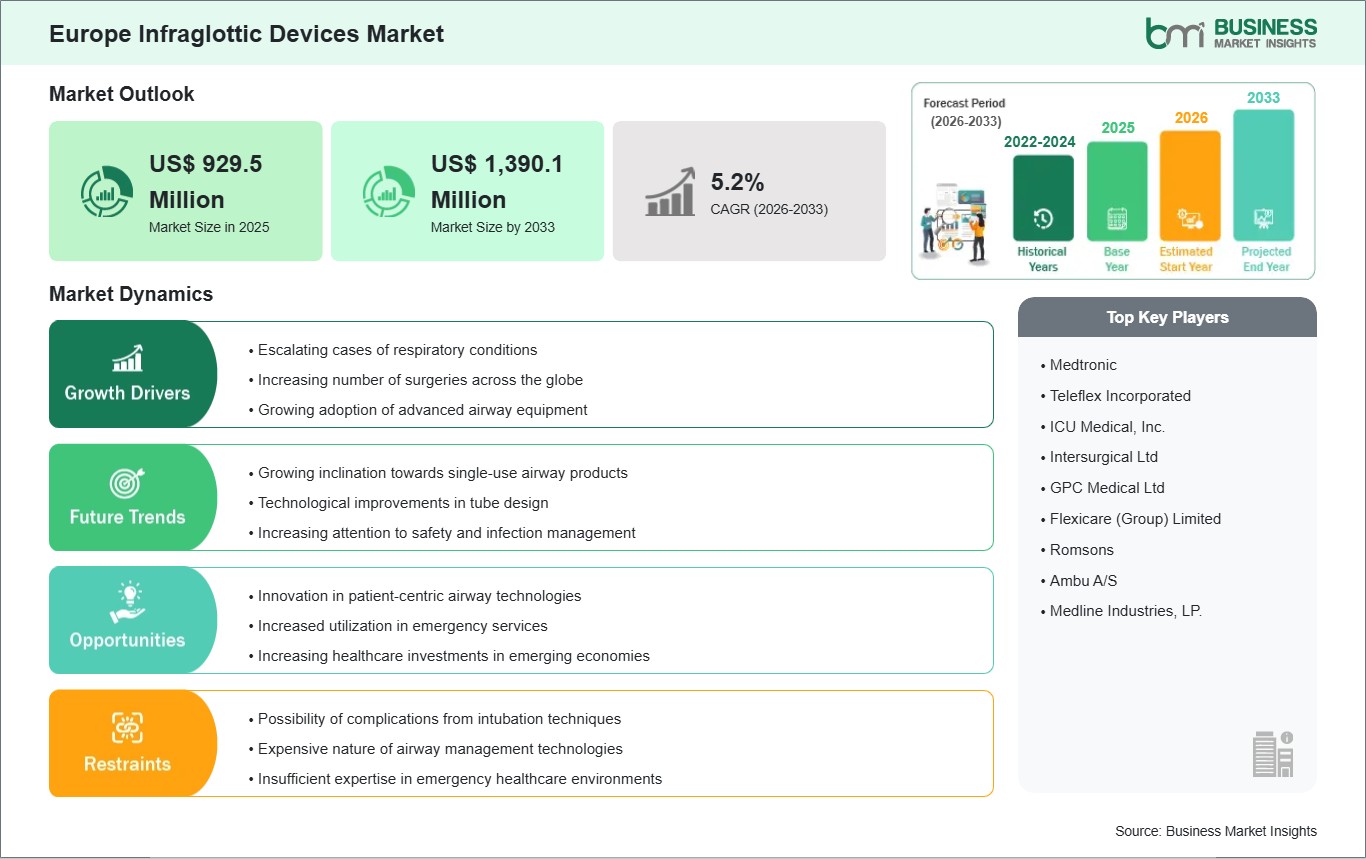
The Europe Infraglottic Devices market size is expected to reach US$ 1,390.1 million by 2033 from US$ 929.5 million in 2025. The market is estimated to record a CAGR of 5.2% from 2026 to 2033.
The European infraglottic devices market is characterized by sophisticated health care facilities, efficient regulation processes, and wide acceptance of new medical device technology. The market is greatly aided by a number of surgery cases, established emergency services, and well-developed infrastructure for critical care. Some of the key players in this market include Germany, France, and the United Kingdom, with Germany emerging as dominant due to a good hospital facility, domestic production capability, and medical innovations.
A distinct feature of the European market includes harmonization and patient safety. The regulatory framework of the European Union has made sure that quality remains constant within member countries, thus attracting many international and domestic producers of infraglottic devices. Furthermore, research and partnerships among universities, hospitals, and businesses have enabled continuous innovation in the field of airway management. Although the use of infraglottic devices is widespread throughout the continent, another important factor influencing market dynamics includes demographics, as aging populations mean that more people require operations and procedures that use this equipment.

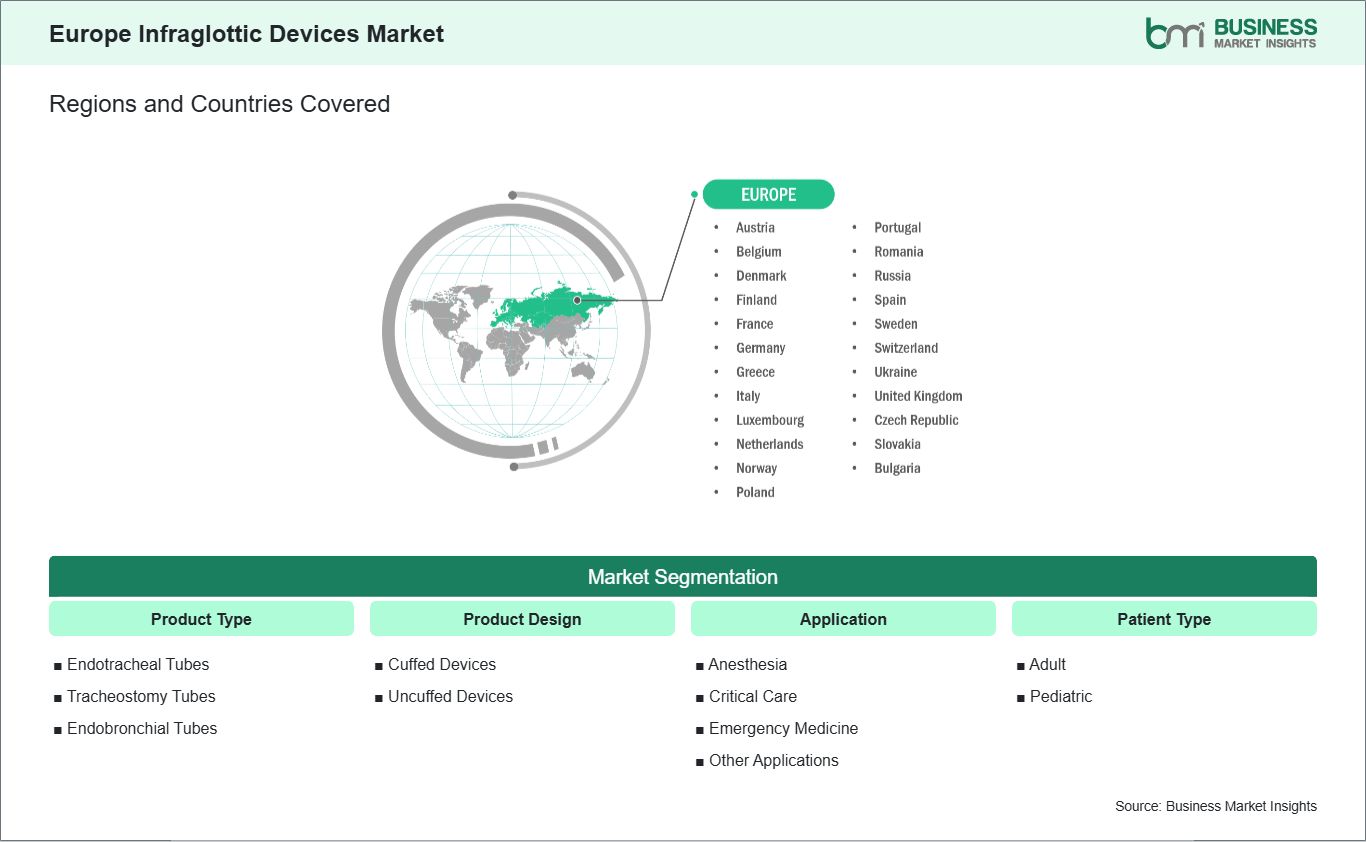
Key segments that contributed to the derivation of the North America infraglottic devices market analysis are product type, product design, application, patient type, and end user.
The European infraglottic devices market is being propelled by a significant rise in chronic and acute respiratory illnesses across the continent’s mature healthcare systems. Western European nations, including Germany, France, and the United Kingdom, are facing a substantial burden from Chronic Obstructive Pulmonary Disease (COPD) and severe asthma, largely attributed to an aging demographic and historical patterns of tobacco use. Additionally, the region has seen a persistent increase in hospital-acquired pneumonia and post-viral respiratory complications, which frequently require intensive care intervention. This high clinical demand necessitates the consistent use of high-quality endotracheal and tracheostomy tubes to manage patients in critical care units and specialized respiratory centers, ensuring long-term airway stability and effective mechanical ventilation.
Furthermore, the expansion of emergency medical infrastructure in Eastern and Central Europe is contributing to the steady growth of this market. Countries such as Poland and Romania are significantly upgrading their trauma care networks and ambulance fleets to improve response times for acute medical emergencies and road accidents. As these regions adopt standardized advanced life support protocols, the procurement of reliable infraglottic solutions has become a priority for frontline healthcare providers. The integration of these devices into standard emergency kits, combined with a sophisticated reimbursement framework across the European Union, ensures that healthcare facilities remain well-equipped to handle the growing volume of respiratory distress cases, thereby stabilizing the market's foundational demand.
An important advantage of marketing our product in Europe is the fast-growing trend towards next-generation infraglottic devices, which stress comfort and safety of the patient. In view of an emphasis within EU regulation on decreasing the risk of hospital infection and trauma caused by procedures, there are many new developments concerning innovative devices produced from novel, biocompatible materials. Our airway solutions are gentle and consist of ultra-flexible silicone tubes and cuff systems, ensuring no tracheal mucosa damage and post-extubation problems for the patient. This is especially applicable in the private segment of medicine and high-class specialized hospitals, where reducing patients’ treatment period and increasing quality of stay are vital parameters.
Apart from the improvement in the quality of materials used, integrating modern technological capabilities into the airway devices also opens up another major growth prospect. Currently, the market in Europe is experiencing a tendency towards greater adoption of infraglottic devices that incorporate advanced sensor and video technology, which makes the task of inserting and placing them into the right position much easier. This allows for tracking cuff pressure and airway positioning in real time, thus minimizing the chances of displacements or any possible complications. Another important direction in the development of the industry in Europe involves the incorporation of special single-use packages to address the issue of sustainability.
The Europe infraglottic devices market is experiencing steady growth, with market size and share analysis reflecting evolving treatment preferences and competitive dynamics among key players. The report evaluates important subsegments categorized within product type, product design, application, patient type, and end user, highlighting their respective contributions to overall market performance.
By product type, the endotracheal tubes subsegment dominated the market in 2025 due to their widespread use in airway management during surgeries, critical care, and emergency settings, offering reliable ventilation support and ease of insertion across diverse clinical scenarios.
Among product design, the cuffed devices subsegment dominated the market in 2025 due to their ability to provide effective airway sealing, prevent aspiration, and enable controlled ventilation, making them highly preferred in intensive care and surgical procedures requiring precise airway management.
Based on application, the anesthesia subsegment dominated the market in 2025 due to the high volume of surgical procedures requiring airway management, consistent use of endotracheal tubes during general anesthesia, and increasing demand for safe and controlled ventilation in operating rooms.
In terms of patient type, the adult subsegment dominated the market in 2025 due to higher incidence of chronic respiratory diseases, greater number of surgical procedures, and increased hospitalization rates requiring airway management and ventilatory support in adult populations.
By end user, the hospitals subsegment dominated the market in 2025 due to availability of advanced infrastructure, high patient inflow, presence of intensive care units, and continuous requirement for airway management devices during surgeries and emergency treatments.
| Report Attribute | Details |
|---|---|
| Market size in 2025 | US$ 929.5 Million |
| Market Size by 2033 | US$ 1,390.1 Million |
| CAGR (2026 - 2033) | 5.2% |
| Historical Data | 2022-2024 |
| Forecast period | 2026-2033 |
| Segments Covered | By Product Type
|
|
Regions and Countries Covered
| |
| Europe | Germany, Italy, France, U.K., Spain, Belgium, Netherlands, Luxembourg, Norway, Finland, Denmark, Sweden, Switzerland, Austria, Greece, Portugal, Russia, Poland, Romania, Czech Republic, Ukraine, Slovakia, Bulgaria |
| Market leaders and key company profiles |
|
The "Europe Infraglottic Devices Market Size and Forecast (2022–2033)" report provides a detailed analysis of the market covering below areas:
The geographical scope of the Europe Infraglottic Devices market report is divided into: Germany, Italy, France, the UK, Spain, Belgium, the Netherlands, Luxembourg, Norway, Finland, Denmark, Sweden, Austria, Switzerland, Russia, Romania, Greece, the Czech Republic, Portugal, Ukraine, Poland, Slovakia, and Bulgaria. Germany held the largest share in 2025.
Germany dominates the European infraglottic devices market, driven by its comprehensive healthcare system, strong domestic production capabilities, and leadership in medical innovation. The country’s extensive hospital network, particularly in cities such as Berlin, Munich, and Hamburg, ensures widespread use of advanced airway management devices in anesthesia, intensive care, and trauma medicine. Germany’s medical technology sector is highly developed, with domestic manufacturers playing a central role in supplying both local and international markets.
A distinctive feature of Germany’s leadership is its integration of research and clinical practice. Universities and teaching hospitals collaborate closely with manufacturers to develop and refine device technologies, ensuring that innovations are rapidly translated into clinical use. The country also places strong emphasis on training and certification, equipping healthcare professionals with the expertise to handle complex airway management procedures. Another defining factor is Germany’s role as an exporter within Europe, supplying neighboring countries with high‑quality devices that meet stringent EU standards. This combination of innovation, infrastructure, and export strength makes Germany not only the dominant market within Europe but also a key influencer in shaping global standards for infraglottic device adoption.

The Europe Infraglottic Devices market is evaluated by gathering qualitative and quantitative data post primary and secondary research, which includes important corporate publications, association data, and databases. A few of the key developments in the Europe Infraglottic Devices market are:
The Europe Infraglottic Devices Market is valued at US$ 929.5 Million in 2025, it is projected to reach US$ 1,390.1 Million by 2033.
As per our report Europe Infraglottic Devices Market, the market size is valued at US$ 929.5 Million in 2025, projecting it to reach US$ 1,390.1 Million by 2033. This translates to a CAGR of approximately 5.2% during the forecast period.
The Europe Infraglottic Devices Market report typically cover these key segments-
The historic period, base year, and forecast period can vary slightly depending on the specific market research report. However, for the Europe Infraglottic Devices Market report:
The Europe Infraglottic Devices Market is populated by several key players, each contributing to its growth and innovation. Some of the major players include:
The Europe Infraglottic Devices Market report is valuable for diverse stakeholders, including:
Essentially, anyone involved in or considering involvement in the Europe Infraglottic Devices Market value chain can benefit from the information contained in a comprehensive market report.
Please tell us your area of interest
(Market Segments/ Regions and Countries/ Companies)