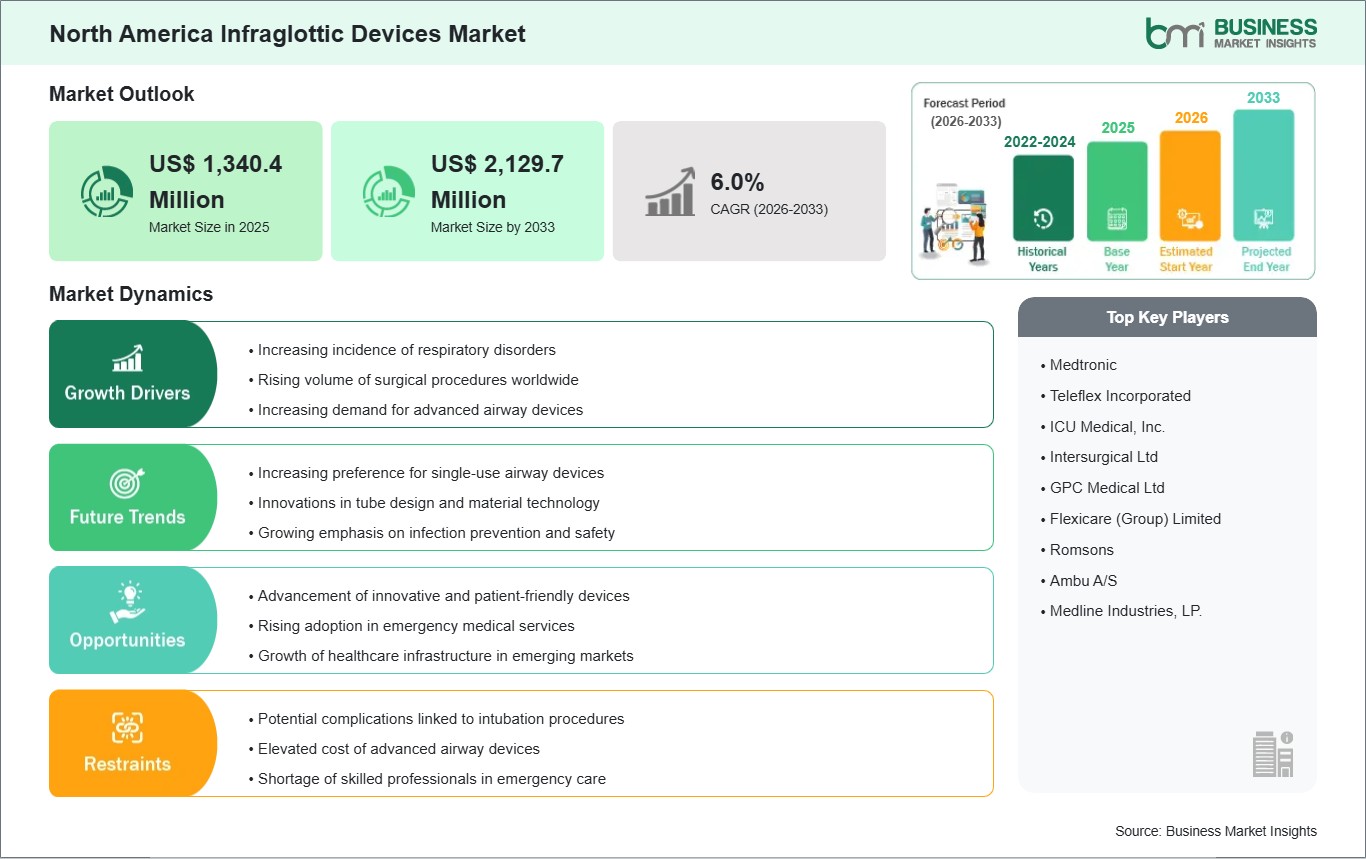
The North America Infraglottic Devices market size is expected to reach US$ 2,129.7 million by 2033 from US$ 1,340.4 million in 2025. The market is estimated to record a CAGR of 11.1% from 2026 to 2033.
The market of North American infraglottic devices is highly matured and technically advanced, owing to the growing number of surgeries, critical care needs, and the incidence of chronic respiratory disorders. Various kinds of infraglottic devices, such as endotracheal and tracheostomy tubes, are extensively utilized within hospitals, ambulatory surgical centers, and EMSs. The focus on patient safety, infection control measures, and the following of strict clinical protocols in the region makes it conducive to the use of advanced airway management devices that are also disposable. Moreover, rising awareness regarding the need for early intervention in case of respiratory distress and airway management in emergencies has increased the market demand as well.
In spite of extensive implementation, there are certain issues that limit market growth, including the expensive nature of modern airway devices and the increasing requirement to equip healthcare practitioners with up-to-date intubation skills. Nonetheless, sustained R&D efforts along with the involvement of prominent homegrown and foreign players in the industry guarantee consistent innovations and access to cutting-edge infraglottic equipment. The backing of governments, via healthcare schemes and insurance plans for surgical and critical care operations, further aids in improving accessibility and fueling constant demand within North America.

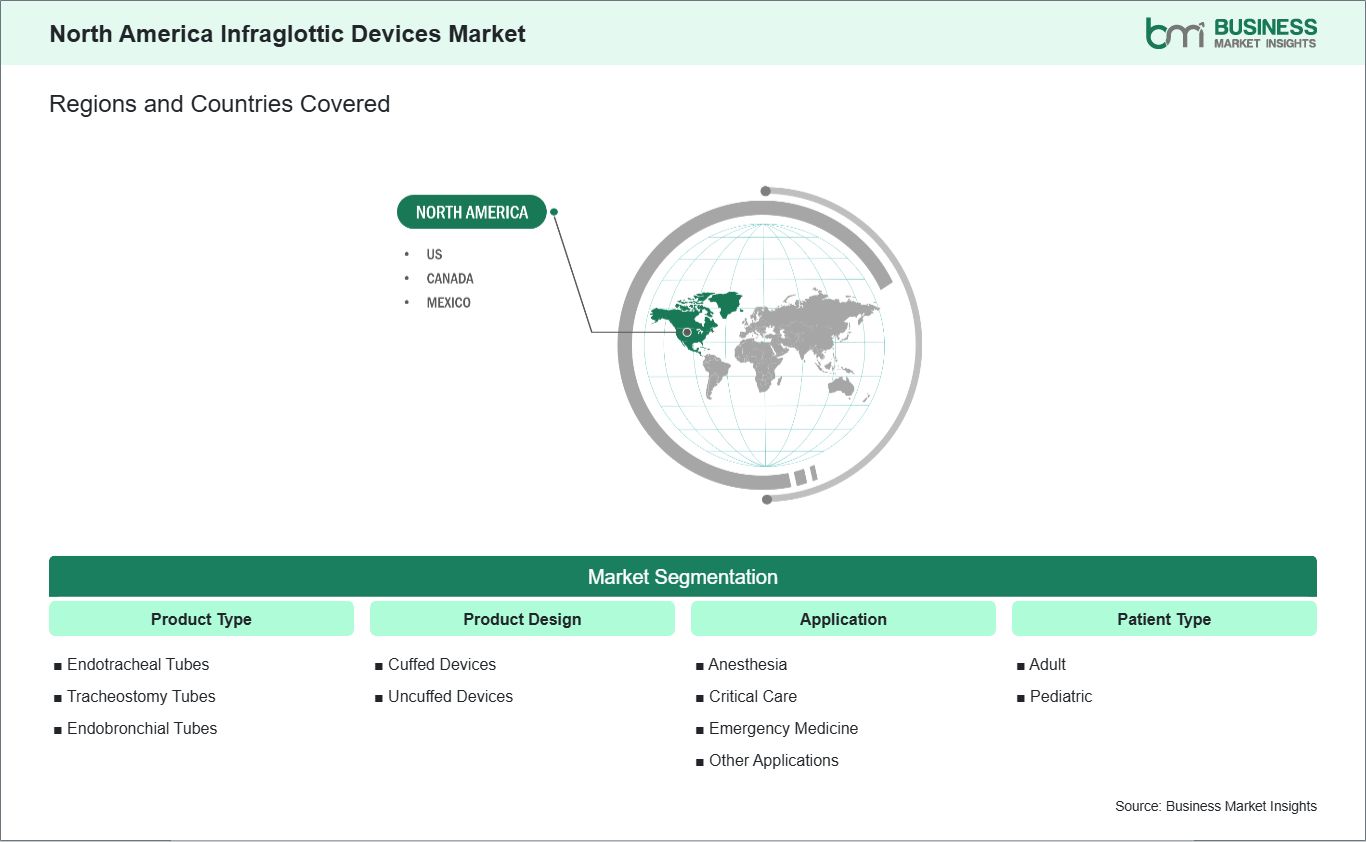
Key segments that contributed to the derivation of the North America infraglottic devices market analysis are product type, product design, application, patient type, and end user.
The North America infraglottic devices market is primarily driven by the high and rising prevalence of chronic and acute respiratory illnesses across a heavily aging population. In the United States and Canada, Chronic Obstructive Pulmonary Disease (COPD) remains a leading cause of disability, fueled by decades of tobacco use and increasing environmental triggers in urban centers. Furthermore, the region is seeing a significant uptick in acute respiratory distress cases and severe pneumonia, which frequently require intensive care admissions and prolonged mechanical ventilation. As hospitals in this region maintain some of the highest intensive care unit (ICU) capacities globally, the demand for reliable infraglottic tools—specifically endotracheal and tracheostomy tubes—remains a fundamental necessity for managing these critically ill patients and ensuring airway stability.
In addition to chronic conditions, the growth is heavily supported by the volume of complex surgical procedures and a robust emergency medical services (EMS) infrastructure. North America leads the world in advanced cardiothoracic and neurological surgeries, all of which necessitate sophisticated airway management during and after the operation. The high incidence of trauma-related emergencies, such as road traffic accidents and acute cardiac events, also places a constant demand on first responders and emergency departments for rapid-insertion infraglottic solutions. With a well-established reimbursement framework and high healthcare spending, providers are empowered to maintain high inventory levels of these life-saving devices, ensuring that respiratory health remains a top priority in the regional clinical landscape.
The North American market offers a substantial opportunity for the deployment of next-generation infraglottic devices that prioritize both clinical precision and patient comfort. There is an aggressive shift toward devices manufactured from advanced, biocompatible materials like medical-grade silicone and specialized polyurethanes, which are designed to reduce the risk of tracheal mucosal injury and long-term scarring. These innovations are particularly relevant in the United States, where there is a strong emphasis on reducing hospital-acquired infections, such as Ventilator-Associated Pneumonia (VAP). By introducing features like subglottic suction lumens and ultra-soft cuffs, manufacturers can cater to high-end medical facilities that are focused on improving patient outcomes and shortening hospital stays through “gentler” airway management.
Furthermore, the integration of digital technology and artificial intelligence into airway management tools represents a major technological frontier in the region. North America is at the forefront of adopting smart infraglottic devices equipped with integrated sensors and video-assisted capabilities that allow for real-time monitoring of tube placement and cuff pressure. These advancements are highly attractive to large hospital networks looking to minimize human error and enhance procedural safety. Additionally, the growing trend toward specialized single-use and portable infraglottic kits provides a strategic opening in the expanding home-care and ambulatory surgery markets. Companies that focus on developing intuitive, high-performance devices that align with the region's push for "value-based" healthcare will find significant opportunities for long-term growth and market leadership.
The North America infraglottic devices market is experiencing steady growth, with market size and share analysis reflecting evolving treatment preferences and competitive dynamics among key players. The report evaluates important subsegments categorized within product type, product design, application, patient type, and end user, highlighting their respective contributions to overall market performance.
By product type, the endotracheal tubes subsegment dominated the market in 2025 due to their widespread use in airway management during surgeries, critical care, and emergency settings, offering reliable ventilation support and ease of insertion across diverse clinical scenarios.
Among product design, the cuffed devices subsegment dominated the market in 2025 due to their ability to provide effective airway sealing, prevent aspiration, and enable controlled ventilation, making them highly preferred in intensive care and surgical procedures requiring precise airway management.
Based on application, the anesthesia subsegment dominated the market in 2025 due to the high volume of surgical procedures requiring airway management, consistent use of endotracheal tubes during general anesthesia, and increasing demand for safe and controlled ventilation in operating rooms.
In terms of patient type, the adult subsegment dominated the market in 2025 due to higher incidence of chronic respiratory diseases, greater number of surgical procedures, and increased hospitalization rates requiring airway management and ventilatory support in adult populations.
By end user, the hospitals subsegment dominated the market in 2025 due to availability of advanced infrastructure, high patient inflow, presence of intensive care units, and continuous requirement for airway management devices during surgeries and emergency treatments.
| Report Attribute | Details |
|---|---|
| Market size in 2025 | US$ 1,340.4 Million |
| Market Size by 2033 | US$ 2,129.7 Million |
| CAGR (2026 - 2033) | 6.0% |
| Historical Data | 2022-2024 |
| Forecast period | 2026-2033 |
| Segments Covered | By Product Type
|
|
Regions and Countries Covered
| |
| North America | US, Canada, Mexico |
| Market leaders and key company profiles |
|
The "North America Infraglottic Devices Market Size and Forecast (2022–2033)" report provides a detailed analysis of the market covering below areas:
The geographical scope of the North America Infraglottic Devices market report is divided into: The US, Canada, and Mexico. The US held the largest share in 2025.
The United States dominates the North America infraglottic devices market due to its large, technologically advanced healthcare system, extensive network of hospitals, and high surgical volumes. Infraglottic devices are integral in anesthesia, intensive care, and emergency medicine, with hospitals emphasizing both patient safety and procedural efficiency. Rising cases of chronic respiratory conditions, trauma, and critical care admissions contribute to sustained demand for advanced airway management devices.
The country benefits from a mature medical device industry and a robust supply chain, allowing access to cutting-edge and disposable infraglottic products. Training programs for anesthesiologists and critical care professionals further improve device utilization across hospital and pre-hospital settings. While the high cost of innovative devices can limit adoption in smaller healthcare facilities, strong government healthcare initiatives, insurance coverage, and hospital investment in modern ICUs ensure widespread access. Ongoing technological innovation, focus on minimally invasive airway management techniques, and emphasis on patient safety position the United States as the dominant contributor to the North America infraglottic devices market.

The North America Infraglottic Devices market is evaluated by gathering qualitative and quantitative data post primary and secondary research, which includes important corporate publications, association data, and databases. A few of the key developments in the North America Infraglottic Devices market are:
The North America Infraglottic Devices Market is valued at US$ 1,340.4 Million in 2025, it is projected to reach US$ 2,129.7 Million by 2033.
As per our report North America Infraglottic Devices Market, the market size is valued at US$ 1,340.4 Million in 2025, projecting it to reach US$ 2,129.7 Million by 2033. This translates to a CAGR of approximately 6.0% during the forecast period.
The North America Infraglottic Devices Market report typically cover these key segments-
The historic period, base year, and forecast period can vary slightly depending on the specific market research report. However, for the North America Infraglottic Devices Market report:
The North America Infraglottic Devices Market is populated by several key players, each contributing to its growth and innovation. Some of the major players include:
The North America Infraglottic Devices Market report is valuable for diverse stakeholders, including:
Essentially, anyone involved in or considering involvement in the North America Infraglottic Devices Market value chain can benefit from the information contained in a comprehensive market report.
Please tell us your area of interest
(Market Segments/ Regions and Countries/ Companies)