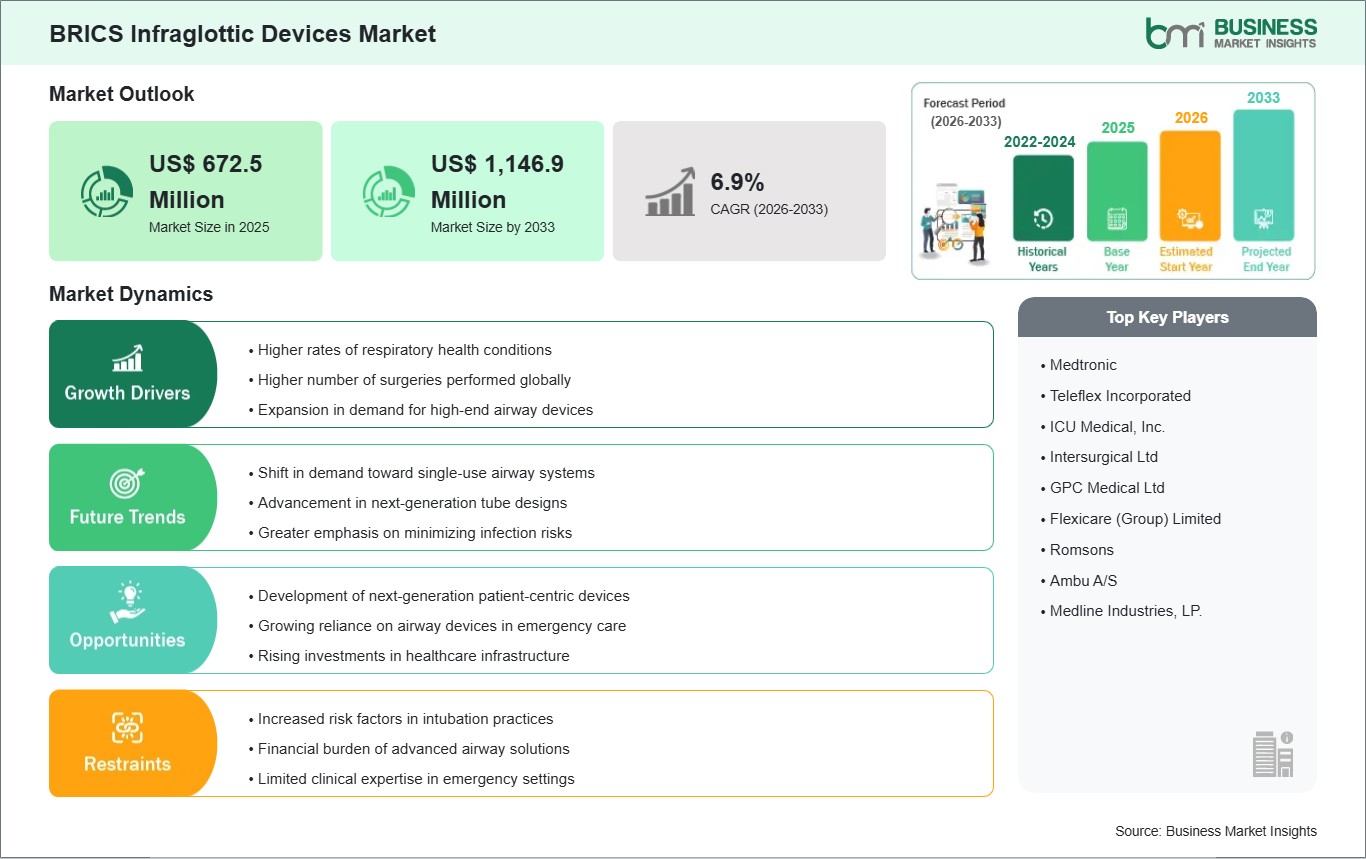
The BRICS Infraglottic Devices market size is expected to reach US$ 1,146.9 million by 2033 from US$ 672.5 million in 2025. The market is estimated to record a CAGR of 6.9% from 2026 to 2033.
The infraglottic devices market within BRICS comprises of countries that have unique healthcare systems and different rates of technology adoption. All countries in the group have a big population and an increase in surgeries being carried out, hence making up a considerable part of the global infraglottic devices market. The country that leads in the group is China due to its large number of patients, as well as its advanced infrastructure for manufacturing infraglottic devices, hence being able to satisfy the internal and external demand for the devices.
One of the unique aspects of the BRICS market is the relationship that exists between developed and developing healthcare services. As China and India make efforts towards building extensive hospital infrastructure with modernized airway management systems, countries like Brazil and South Africa aim to address the issue of providing critical care in remote areas. On its part, Russia aims at local manufacturing of equipment along with procurement schemes backed by the government. This creates a vibrant market space characterized by innovation, cost-effectiveness, and availability. The BRICS nations are now viewed as a group influencing the development of medical devices across the globe, led by China.

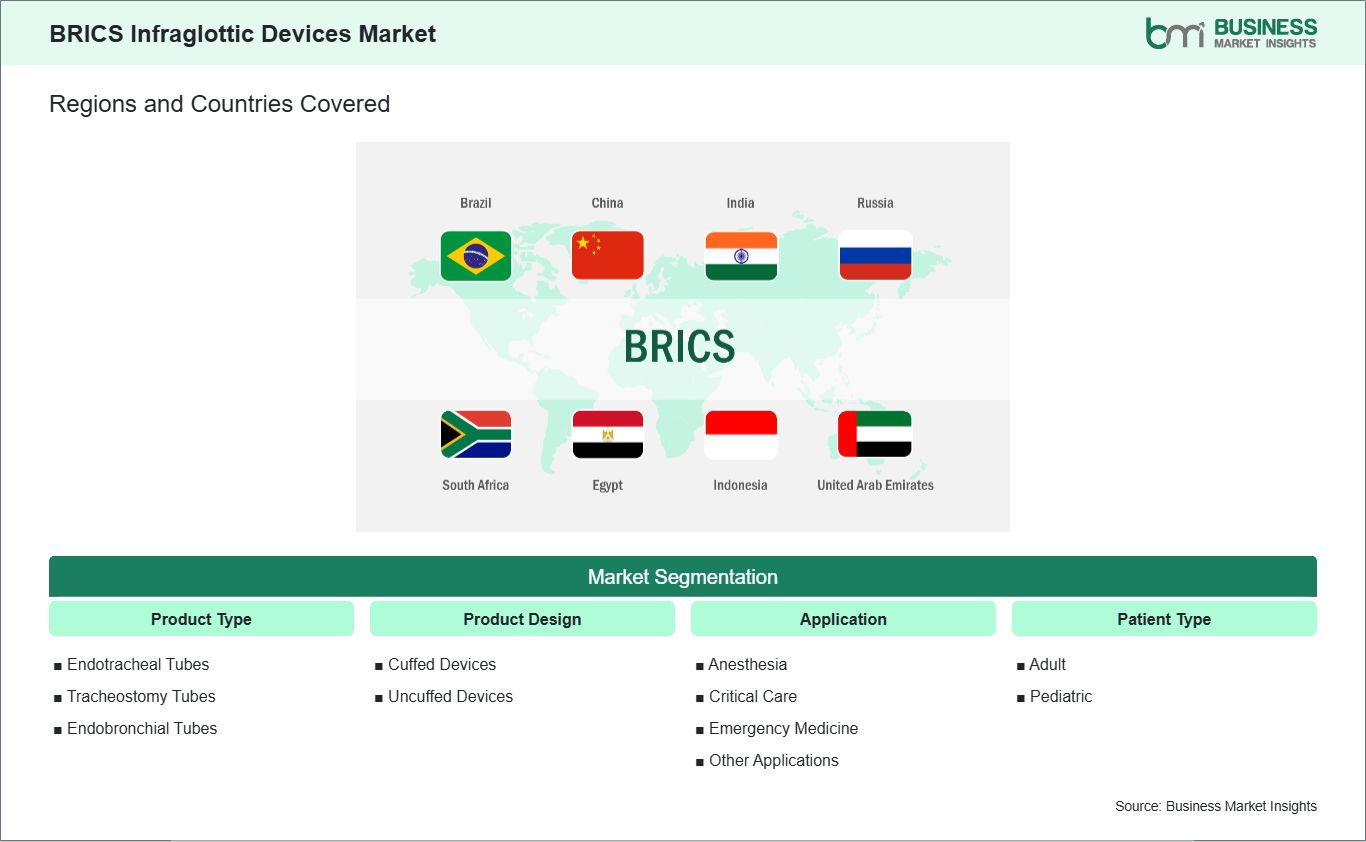
Key segments that contributed to the derivation of the North America infraglottic devices market analysis are product type, product design, application, patient type, and end user.
The BRICS market for infraglottic devices is seeing steady growth due to the prevalence of respiratory disorders within these varied regions. In industrialized nations such as China and India, the presence of ongoing problems with air pollution as well as excessive tobacco usage among citizens, is resulting in record numbers of patients being diagnosed with COPD and bronchitis. At the same time, the medical system in Brazil and South Africa is struggling to cope with large numbers of acute respiratory infections, which often arise due to infection with communicable diseases such as tuberculosis. These cases typically involve respiratory failure, thereby requiring the usage of infraglottic devices, including endotracheal and tracheostomy tubes in ICUs. As these countries continue to increase the capacity of their hospitals in order to cater to millions of people, the need for airway management solutions is also on the rise.
Furthermore, the demographic shift toward an aging population in Russia and China is creating a long-term demand for respiratory support. Elderly patients are more susceptible to pneumonia and other conditions that require prolonged mechanical ventilation. To address this, governments within the BRICS bloc are prioritizing the modernization of public health infrastructure and increasing the number of critical care beds. The rise in surgical volumes, particularly for cardiovascular and thoracic procedures in newly developed medical hubs, also contributes to the steady consumption of infraglottic devices. By strengthening their emergency medical services and rural health networks, these countries are ensuring that life-saving airway interventions are accessible beyond major metropolitan centers, reinforcing the device market’s stability across the entire economic bloc.
There is a huge market for the latest infraglottic devices in the BRICS countries, with a focus on the health and well-being of the patient. Previously, the majority of the hospitals in these parts used regular devices that were known to cause tracheal injury or infection in some cases. But now, a huge change is taking place in terms of smart infraglottic devices made up of ultra-soft materials and fitted with sensors. They help in monitoring and controlling the cuff pressure, which is critical for avoiding necrosis and making the entire process more comfortable for the patient. In countries such as India and the UAE, where the medical tourism industry is booming, there is a lot of motivation to spend money on such high-end devices that make the treatment better, and the patient leaves the hospital much faster.
Additionally, the emergence of high-quality, single-use infraglottic kits offers a strategic opportunity to address infection control in high-traffic public hospitals. Many BRICS nations are moving away from complex sterilization processes in favor of disposable solutions that minimize the risk of cross-contamination and hospital-acquired infections. This trend is being supported by local manufacturing initiatives and partnerships that aim to produce affordable, high-tech devices within the region. Furthermore, the integration of digital tracking and tele-monitoring capabilities into tracheostomy tubes is opening new doors for home-care respiratory management, particularly in Russia and Brazil. Manufacturers that can provide cost-effective yet innovative devices tailored to the specific anatomical and economic needs of these emerging markets will find significant room for expansion and long-term partnership.
The BRICS infraglottic devices market is experiencing steady growth, with market size and share analysis reflecting evolving treatment preferences and competitive dynamics among key players. The report evaluates important subsegments categorized within product type, product design, application, patient type, and end user, highlighting their respective contributions to overall market performance.
By product type, the endotracheal tubes subsegment dominated the market in 2025 due to their widespread use in airway management during surgeries, critical care, and emergency settings, offering reliable ventilation support and ease of insertion across diverse clinical scenarios.
Among product design, the cuffed devices subsegment dominated the market in 2025 due to their ability to provide effective airway sealing, prevent aspiration, and enable controlled ventilation, making them highly preferred in intensive care and surgical procedures requiring precise airway management.
Based on application, the anesthesia subsegment dominated the market in 2025 due to the high volume of surgical procedures requiring airway management, consistent use of endotracheal tubes during general anesthesia, and increasing demand for safe and controlled ventilation in operating rooms.
In terms of patient type, the adult subsegment dominated the market in 2025 due to higher incidence of chronic respiratory diseases, greater number of surgical procedures, and increased hospitalization rates requiring airway management and ventilatory support in adult populations.
By end user, the hospitals subsegment dominated the market in 2025 due to availability of advanced infrastructure, high patient inflow, presence of intensive care units, and continuous requirement for airway management devices during surgeries and emergency treatments.
| Report Attribute | Details |
|---|---|
| Market size in 2025 | US$ 672.5 Million |
| Market Size by 2033 | US$ 1,146.9 Million |
| CAGR (2026 - 2033) | 6.9% |
| Historical Data | 2022-2024 |
| Forecast period | 2026-2033 |
| Segments Covered | By Product Type
|
|
Regions and Countries Covered
| |
| BRICS | Russia, Brazil, South Africa, India, China, Egypt, Indonesia, Saudi Arabia, United Arab Emirates |
| Market leaders and key company profiles |
|
The "BRICS Infraglottic Devices Market Size and Forecast (2022–2033)" report provides a detailed analysis of the market covering below areas:
The geographical scope of the BRICS Infraglottic Devices market report is divided into: Russia, Brazil, South Africa, India, China, Egypt, Indonesia, Saudi Arabia, and the UAE. China held the largest share in 2025.
China’s dominance in the BRICS infraglottic devices market stems from its unique combination of scale, policy support, and industrial strength. The government’s healthcare reforms have prioritized critical care infrastructure, while domestic manufacturers have leveraged economies of scale to produce devices at competitive prices. This dual advantage enables China to meet its own vast demand while also supplying affordable solutions to other BRICS nations.
Urban centers such as Beijing, Shanghai, and Shenzhen are leading hubs where advanced airway management practices are integrated into surgical and emergency care. China’s medical ecosystem is distinctive for its collaboration between hospitals, universities, and local manufacturers, fostering innovation tailored to regional needs. Another defining factor is the rapid adoption of training programs and simulation centers, ensuring that medical professionals are equipped to use advanced devices effectively. Beyond meeting domestic needs, China’s role as an exporter strengthens its influence within BRICS, positioning it as both a market leader and a technology provider. This proactive approach highlights China’s central role in shaping the future of infraglottic device adoption across the bloc, making it the benchmark for other BRICS nations.

The BRICS Infraglottic Devices market is evaluated by gathering qualitative and quantitative data post primary and secondary research, which includes important corporate publications, association data, and databases. A few of the key developments in the BRICS Infraglottic Devices market are:
The BRICS Infraglottic Devices Market is valued at US$ 672.5 Million in 2025, it is projected to reach US$ 1,146.9 Million by 2033.
As per our report BRICS Infraglottic Devices Market, the market size is valued at US$ 672.5 Million in 2025, projecting it to reach US$ 1,146.9 Million by 2033. This translates to a CAGR of approximately 6.9% during the forecast period.
The BRICS Infraglottic Devices Market report typically cover these key segments-
The historic period, base year, and forecast period can vary slightly depending on the specific market research report. However, for the BRICS Infraglottic Devices Market report:
The BRICS Infraglottic Devices Market is populated by several key players, each contributing to its growth and innovation. Some of the major players include:
The BRICS Infraglottic Devices Market report is valuable for diverse stakeholders, including:
Essentially, anyone involved in or considering involvement in the BRICS Infraglottic Devices Market value chain can benefit from the information contained in a comprehensive market report.
Please tell us your area of interest
(Market Segments/ Regions and Countries/ Companies)