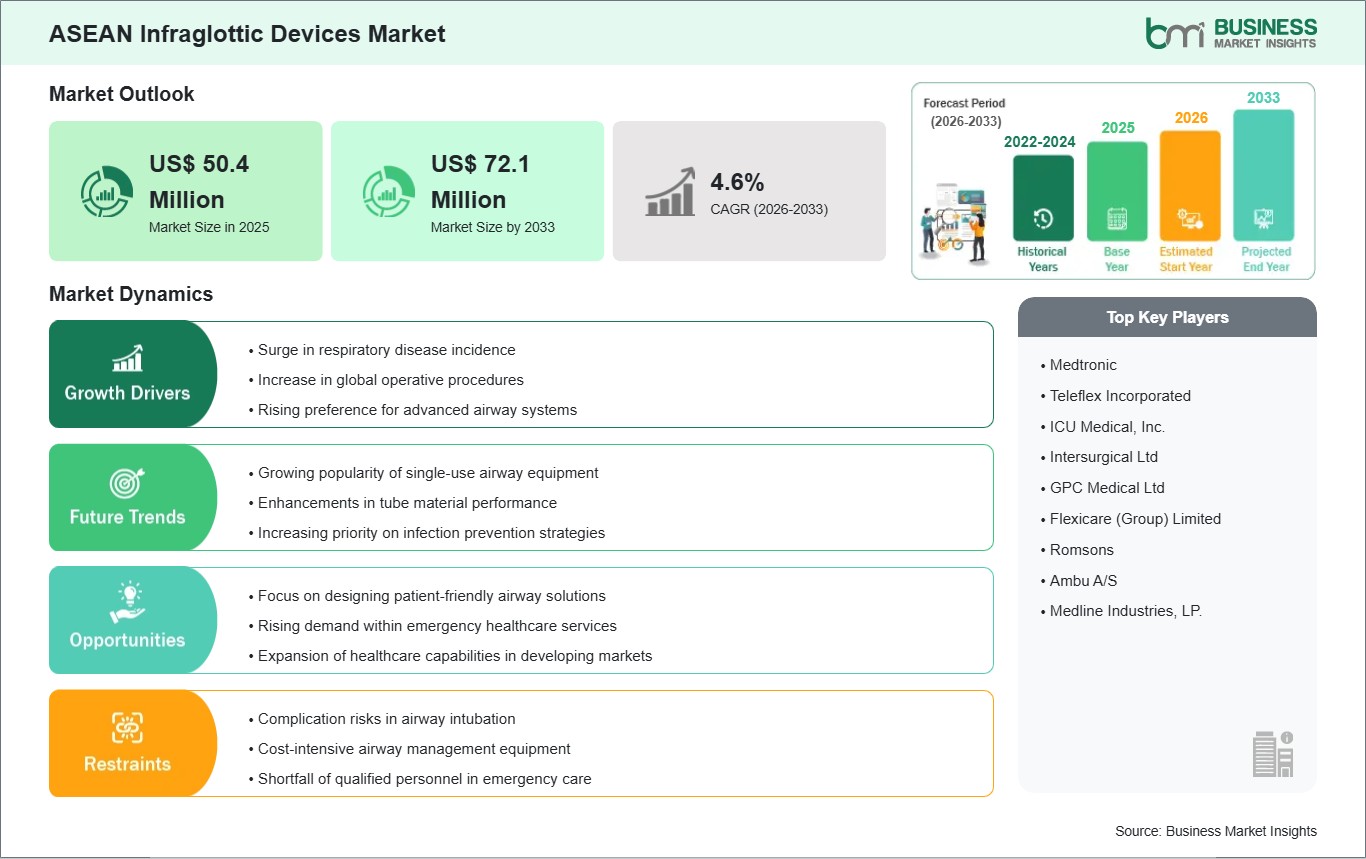
The ASEAN Infraglottic Devices market size is expected to reach US$ 72.1 million by 2033 from US$ 50.4 million in 2025. The market is estimated to record a CAGR of 4.6% from 2026 to 2033.
A gradual increase in the use of infraglottic devices has been observed in the ASEAN region owing to improvements in the health care sector, increased surgery rates, and awareness regarding new airway management strategies. Although countries like Indonesia, Thailand, and Malaysia have made considerable investments in critical care units, Indonesia appears to be the leading country owing to its large demographic size and the introduction of various health care programs led by the government.
On the other hand, the restraints are the disparities in resource allocation within urban and rural regions, the lack of skilled personnel, and reliance on foreign-made devices. The regulatory challenges faced by ASEAN countries are an impediment to the speed at which medical devices are adopted, since standardizing regulations is difficult. However, the cooperation between international manufacturers and regional distributors, in addition to regional efforts to improve their emergency response system, will propel the market further. The ASEAN region is fast becoming the gateway for expansion within the medical devices industry, with Indonesia leading the way.

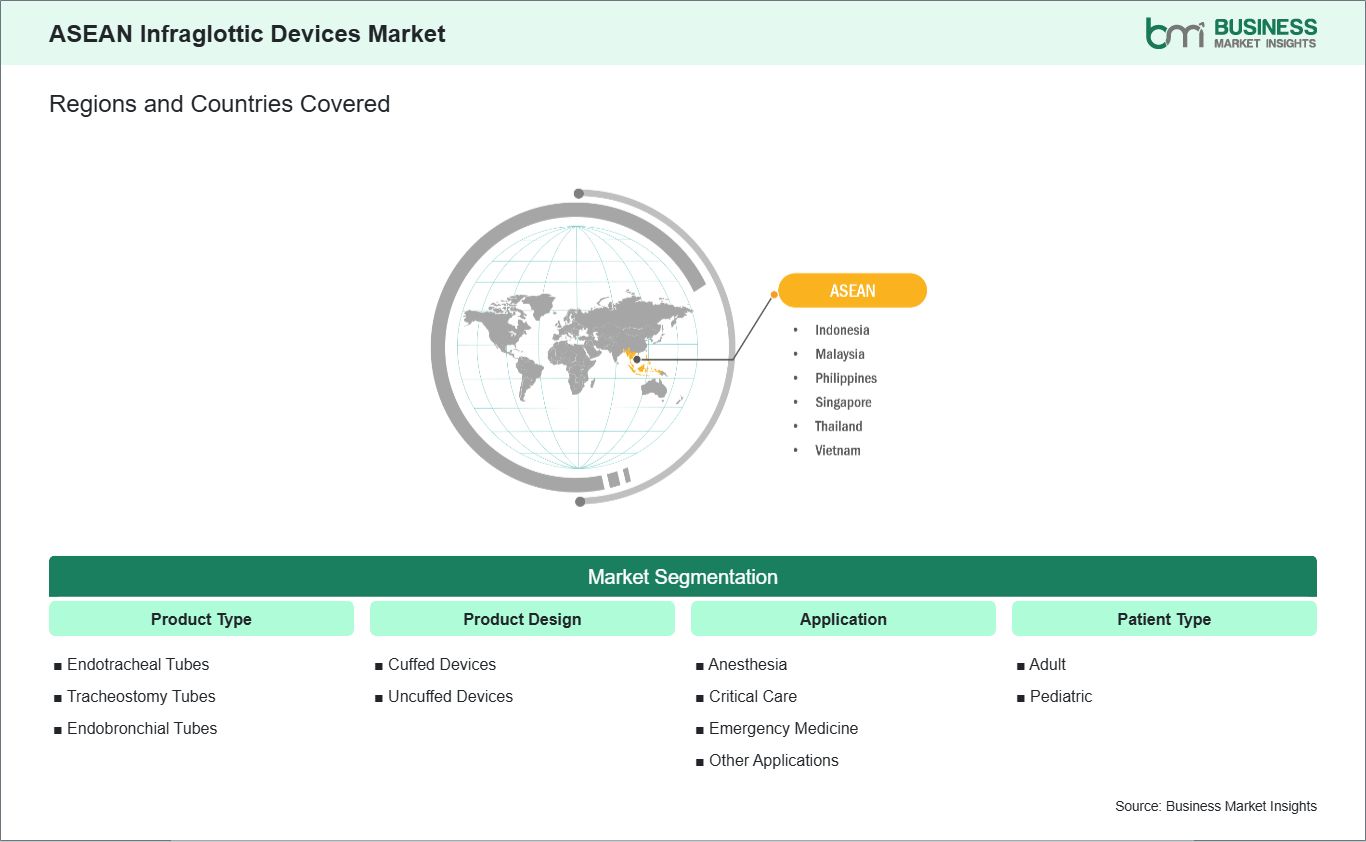
Key segments that contributed to the derivation of the North America infraglottic devices market analysis are product type, product design, application, patient type, and end user.
There has been a tremendous growth in the ASEAN infraglottic devices market due to the increased number of acute and chronic respiratory illnesses in Southeast Asia. The increasing urbanization and industrialization in Southeast Asian countries like Vietnam, Indonesia, and Thailand have resulted in poor air quality, leading to an increase in cases of COPD and asthma attacks. In addition, the elderly population in the region is more vulnerable to respiratory failure and hospital-acquired pneumonia, resulting in intubation and the need for tracheostomy tubes. Such a high burden of disease has put great strain on ICU units, where infraglottic devices help maintain air passage in patients who require prolonged mechanical ventilation.
Aside from chronic disorders, the region’s distinctive clinical setting features a relatively high prevalence of infectious respiratory illnesses and traumatic injuries. Repeated occurrences of seasonal flu and other viruses frequently cause ARDS, creating a need for premium-quality endotracheal tubes all year round. Furthermore, the prevalence of road traffic collisions within the ASEAN region, particularly in its urban cities, has led to an escalation in the development of emergency care services. Increasing numbers of investments made by governments towards the development of trauma centers and ambulance services have created the demand for these life-saving devices in sufficient quantities for immediate use.
A significant opportunity in the ASEAN market lies in the shift toward "patient-centric" design, which prioritizes comfort and the reduction of post-procedural complications. Traditional infraglottic procedures can often lead to tracheal mucosal injury or long-term scarring, which are major concerns for patients and clinicians alike. In response, manufacturers are introducing advanced devices made from ultra-soft, biocompatible materials like medical-grade silicone that conform more naturally to the human anatomy. These innovations are particularly relevant in the ASEAN region, where there is a growing demand for "minimally invasive" approaches in private healthcare facilities in Malaysia and Singapore. By minimizing trauma during insertion and maintenance, these patient-friendly solutions help reduce recovery times and improve the overall quality of care.
Furthermore, the emergence of smart and ergonomic infraglottic kits represents a major leap forward for regional healthcare providers. These devices are increasingly designed with integrated sensors and better cuff pressure management systems that allow for precise monitoring, preventing over-inflation and subsequent tissue damage. In many ASEAN countries where there is a push to modernize hospital infrastructure, such technology-driven, easy-to-manage solutions are highly favored. There is also a notable transition toward single-use, patient-specific devices to combat the risk of cross-infection in high-traffic public hospitals. This trend provides a fertile ground for companies to introduce specialized, disposable infraglottic ranges that offer the dual benefits of enhanced patient safety and simplified clinical workflows.
The ASEAN infraglottic devices market is experiencing steady growth, with market size and share analysis reflecting evolving treatment preferences and competitive dynamics among key players. The report evaluates important subsegments categorized within product type, product design, application, patient type, and end user, highlighting their respective contributions to overall market performance.
By product type, the endotracheal tubes subsegment dominated the market in 2025 due to their widespread use in airway management during surgeries, critical care, and emergency settings, offering reliable ventilation support and ease of insertion across diverse clinical scenarios.
Among product design, the cuffed devices subsegment dominated the market in 2025 due to their ability to provide effective airway sealing, prevent aspiration, and enable controlled ventilation, making them highly preferred in intensive care and surgical procedures requiring precise airway management.
Based on application, the anesthesia subsegment dominated the market in 2025 due to the high volume of surgical procedures requiring airway management, consistent use of endotracheal tubes during general anesthesia, and increasing demand for safe and controlled ventilation in operating rooms.
In terms of patient type, the adult subsegment dominated the market in 2025 due to higher incidence of chronic respiratory diseases, greater number of surgical procedures, and increased hospitalization rates requiring airway management and ventilatory support in adult populations.
By end user, the hospitals subsegment dominated the market in 2025 due to availability of advanced infrastructure, high patient inflow, presence of intensive care units, and continuous requirement for airway management devices during surgeries and emergency treatments.
| Report Attribute | Details |
|---|---|
| Market size in 2025 | US$ 50.4 Million |
| Market Size by 2033 | US$ 72.1 Million |
| CAGR (2026 - 2033) | 4.6% |
| Historical Data | 2022-2024 |
| Forecast period | 2026-2033 |
| Segments Covered | By Product Type
|
|
Regions and Countries Covered
| |
| ASEAN | Indonesia, Malaysia, Philippines, Singapore, Thailand, Vietnam |
| Market leaders and key company profiles |
|
The "ASEAN Infraglottic Devices Market Size and Forecast (2022–2033)" report provides a detailed analysis of the market covering below areas:
The geographical scope of the ASEAN Infraglottic Devices market report is divided into: Indonesia, Malaysia, the Philippines, Singapore, Thailand, and Vietnam. Indonesia held the largest share in 2025.
Indonesia dominates the ASEAN infraglottic devices market, primarily due to its large patient population, expanding hospital network, and government focus on improving healthcare accessibility. The country has made significant strides in strengthening its emergency care and surgical infrastructure, particularly in urban centers such as Jakarta, Surabaya, and Bandung. These cities serve as focal points for advanced medical procedures, where infraglottic devices are widely used in anesthesia, intensive care, and trauma management.
A major driver for Indonesia’s leadership is the high incidence of respiratory diseases and road traffic accidents, which necessitate reliable airway management solutions. The government’s push to modernize healthcare facilities and encourage private sector participation has further accelerated adoption. However, challenges persist in rural and remote areas, where hospitals often lack access to advanced devices and trained specialists. Another restraint is the reliance on imported equipment, which exposes the market to supply chain disruptions and cost fluctuations. Despite these issues, Indonesia continues to lead the ASEAN region by setting benchmarks in healthcare modernization, making it the most influential market for infraglottic devices in Southeast Asia.

The ASEAN Infraglottic Devices market is evaluated by gathering qualitative and quantitative data post primary and secondary research, which includes important corporate publications, association data, and databases. A few of the key developments in the ASEAN infraglottic devices market are:
The ASEAN Infraglottic Devices Market is valued at US$ 50.4 Million in 2025, it is projected to reach US$ 72.1 Million by 2033.
As per our report ASEAN Infraglottic Devices Market, the market size is valued at US$ 50.4 Million in 2025, projecting it to reach US$ 72.1 Million by 2033. This translates to a CAGR of approximately 4.6% during the forecast period.
The ASEAN Infraglottic Devices Market report typically cover these key segments-
The historic period, base year, and forecast period can vary slightly depending on the specific market research report. However, for the ASEAN Infraglottic Devices Market report:
The ASEAN Infraglottic Devices Market is populated by several key players, each contributing to its growth and innovation. Some of the major players include:
The ASEAN Infraglottic Devices Market report is valuable for diverse stakeholders, including:
Essentially, anyone involved in or considering involvement in the ASEAN Infraglottic Devices Market value chain can benefit from the information contained in a comprehensive market report.
Please tell us your area of interest
(Market Segments/ Regions and Countries/ Companies)