Western Europe Wood Vinegar Market Outlook: Size, Share, Trends, Growth Analysis, Competitive Landscape & Forecast, 2022-2033

Historic Data: 2022-2024   |   Base Year: 2025   |   Forecast Period: 2026-2033
Report Content: Market Scope, Market Segmentation, Market Dynamics, and Competitive Analysis

Report Coverage:
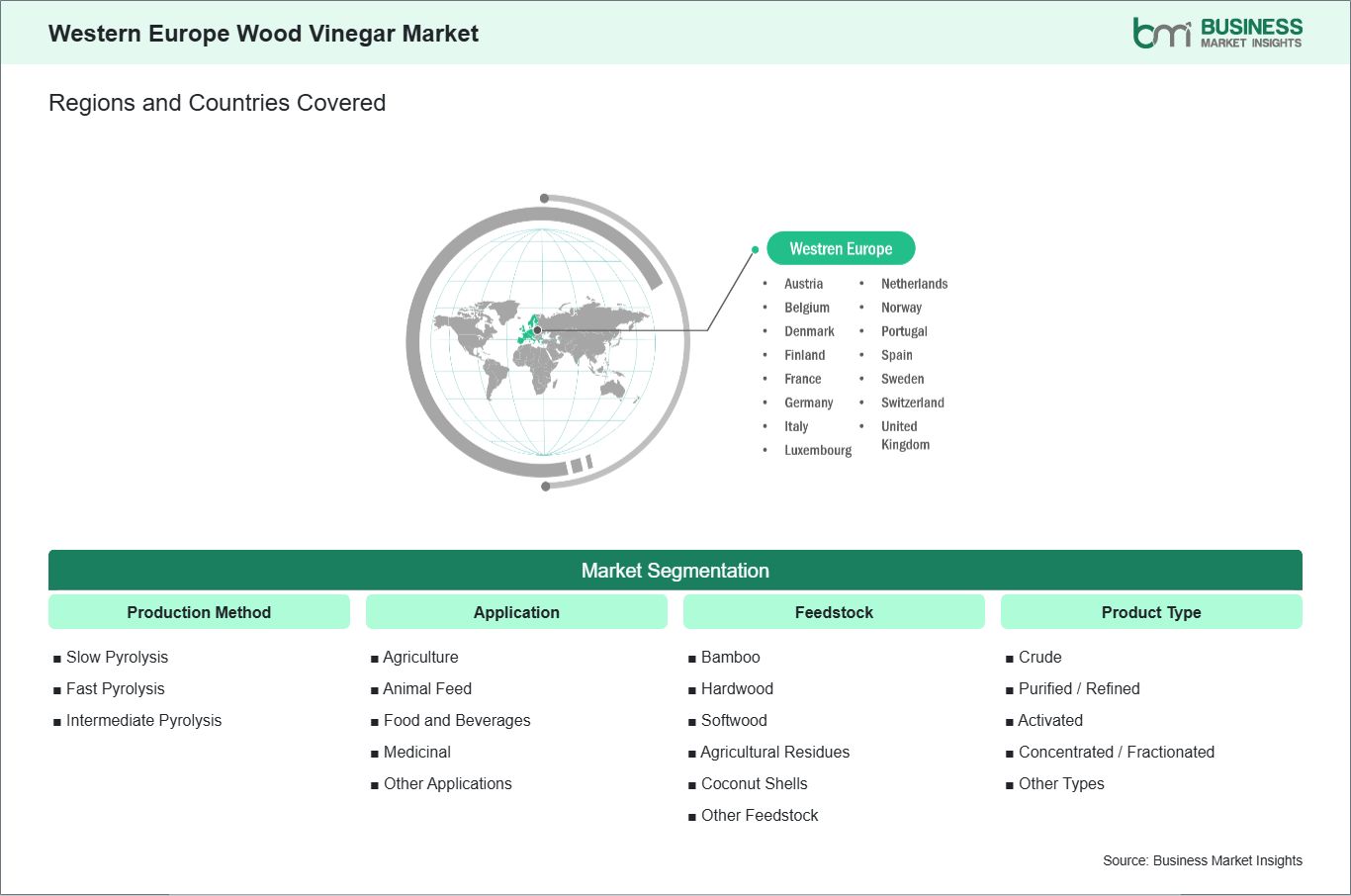
  • Production Method (Slow Pyrolysis, Fast Pyrolysis, Intermediate Pyrolysis)
  • Application (Agriculture, Animal Feed, Food and Beverages, Medicinal, Other Applications)
  • Feedstock (Bamboo, Hardwood, Softwood, Agricultural Residues, Coconut Shells, Other Feedstock)
  • Product Type (Crude, Purified / Refined, Activated, Concentrated / Fractionated, Other Types)

No. of Pages: 150
Report Code: BMIPUB00035844
Category: Chemicals and Materials
Western Europe Wood Vinegar Market

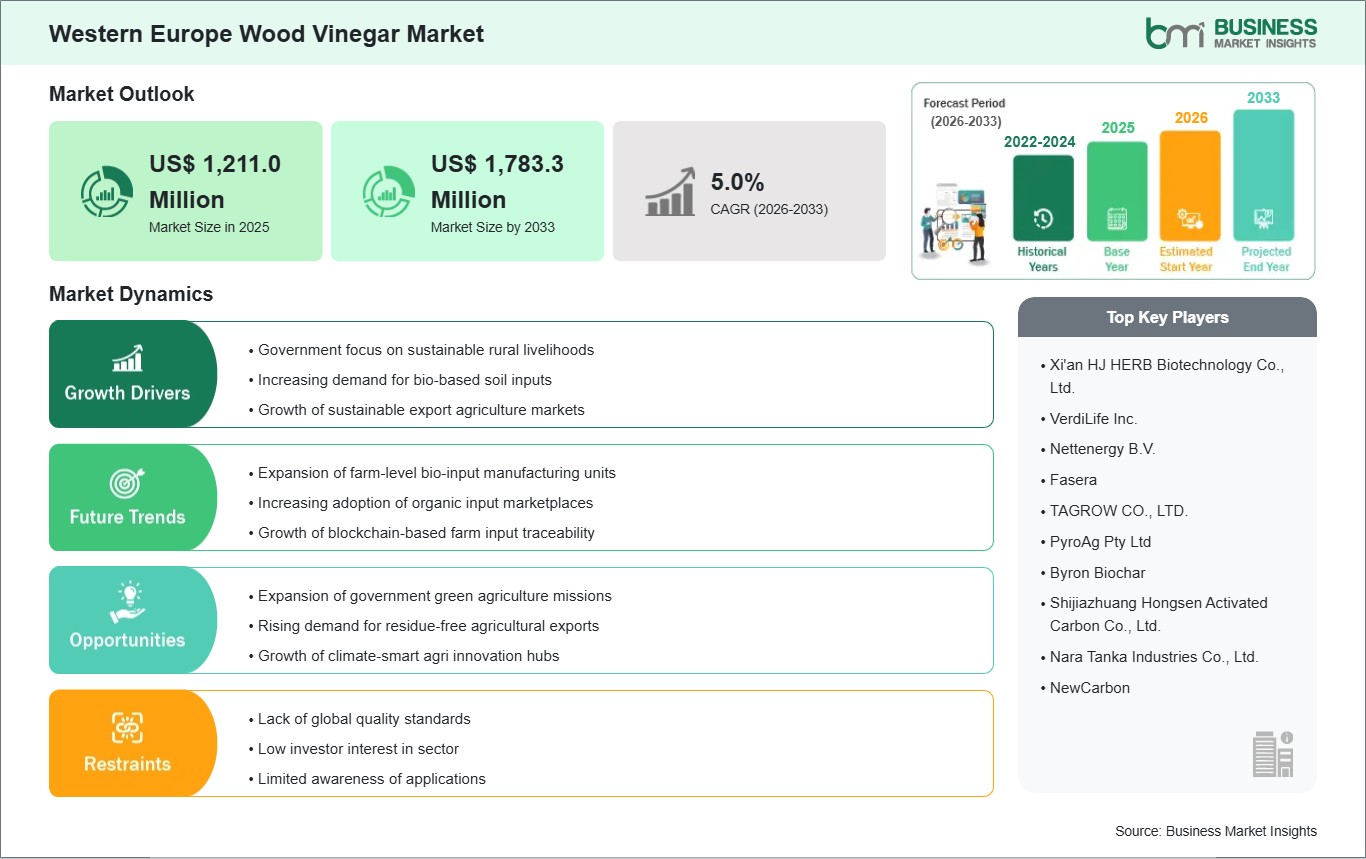
The Western Europe wood vinegar market size is expected to reach US$ 1,783.3 million by 2033 from US$ 1,211.0 million in 2025. The market is estimated to register a CAGR of 5.0% from 2026 to 2033.

Executive Summary and Western Europe Wood Vinegar Market Analysis:

The Western Europe wood vinegar market is evolving with the shift toward regenerative agriculture and lower carbon farming methods, and a circular bioeconomy. Made from condensing gases during biomass pyrolysis, wood vinegar is becoming popular as a natural way to boost plant growth and improve soil health. This is gaining major attraction in Western Europe, iowing to strict environmental rules, the growing desire for chemicals-free farming, and the need to cut back on synthetic stuff. The key drivers for growth are an advanced organic farming system and policies aligned with sustainability. Farmers are focusing on bio-based options to help restore soil health, boost microbial activity, and make composting work better. Wood vinegar is gaining attraction, especially in specialty horticulture and greenhouse farming. People are testing it for controlling inputs in high-value crops and using it for managing odors and treating organic waste in small-scale projects. However, the mainstream awareness is low, and unclear regulations about whether wood vinegar is a fertilizer, biostimulant, or just an input hold things back.Inconsistencies in product quality owing to differing feedstocks and production methods slow down its wider acceptance. Western Europe shows long-term potential, driven by innovation in sustainable farming tech and growing interest in bio-based soil enhancers. This market will evolve through research and the adoption of new methods, especially at pilot scale, within certified organic and regenerative farming systems.

Western Europe Wood Vinegar Market - Strategic Insights:

global-market-strategic-framework
Get more information on this report

Western Europe Wood Vinegar Market Segmentation Analysis:

Key segments that contributed to the derivation of the Western Europe wood vinegar market analysis are pyrolysis method, application, feedstock, type, and purity.

  • By pyrolysis method, the wood vinegar market is segmented into slow pyrolysis, fast pyrolysis, and intermediate pyrolysis. The slow pyrolysis wood segment dominated the market in 2025.
  • Based on applications, the wood vinegar market is segmented into agriculture, animal feed, food and beverages, medicinal/ pharmaceuticals, and other applications. The agriculture segment dominated the market in 2025.
  • On the basis of feedstock, the wood vinegar market is classified as bamboo, hardwood, softwood, agricultural residues, coconut shells, and other feedstocks. The hardwood segment dominated the market in 2025.
  • In terms of type, the wood vinegar market is segmented into crude, purified/refined, activated, concentrated/fractionated, and other types. The crude segment dominated the market in 2025.
  • By purity, the wood vinegar market is segmented into low, medium, and high. The low-purity segment dominated the market in 2025.

Western Europe Wood Vinegar Market Drivers and Opportunities:

Government Focus on Sustainable Rural Livelihoods

In many parts of Africa, governments are boosting support for eco-friendly farming practices in rural areas. Smallholder farms drive these efforts, but they face soil fertility loss and high input costs. To tackle these problems, authorities in places such as Kenya, Ghana, and Rwanda back affordable, local soil-improvement methods that boost farm output and ease the farmers' bills. One such method is using wood vinegar, which comes from biomass waste and can help make soils healthier without breaking the bank.

Rural development groups are adding soil health fixes to their poverty reduction plans. In East Africa's highland farms and West Africa's savannahs, soil degradation has hit crop yields hard, raising food insecurity. To combat this, extension services are showing farmers how to use bio-based inputs through training. Since wood vinegar can be made from easy-to-find farm waste, it is becoming popular, and it fits well into localized production for rural spots.

Community farming groups are boosting adoption by helping farmers learn from each other and show off new techniques. They usually zero in on growing better maize, cassava, and veggies, which suffer from soil fatigue. Adding wood vinegar to their soils makes the earth healthier and plants stronger. At the grass-roots level, this supports the government's push for eco-friendly farming that makes rural living stronger.

Expansion of Government Green Agriculture Missions

The expansion of government-led green agriculture missions in Africa offers a big chance for the wood vinegar market. Many countries are putting national strategies in place for climate-smart farming, soil repair, and cutting down chemical use. These aim to boost food security while tackling environmental damage, which creates a great setting for bio-based stuff such as wood vinegar in agriculture.

In North and Sub-Saharan Africa, big land restoration projects and programs promoting sustainable farming are popping up. These efforts, in collaboration with international groups, focus on fixing damaged farmland, especially in places such as the Sahel. They push the use of organic materials to enhance soil health. One substance gaining attention is wood vinegar; it helps in composting and boosts beneficial soil bacteria with no nasty leftovers.

There is a growing integration of green agriculture goals into export-oriented farming policies. Countries such as Morocco and Egypt are boosting sustainability requirements for their horticultural exports. At the same time, East African nations are getting in line with global organic certification standards. This move presents an opportunity for standardized wood vinegar products to be added to approved input lists for certified farms. As green agriculture initiatives spread across the continent, they will likely speed up awareness, acceptance, and organized use of wood vinegar in both subsistence and commercial farming.

Western Europe Wood Vinegar Market Size and Share Analysis:

The Western Europe wood vinegar market is experiencing steady growth, with market size and share analysis reflecting evolving treatment preferences and competitive dynamics among key players. The report evaluates important subsegments categorized within the pyrolysis method, application, feedstock, type, and purity, highlighting their respective contributions to overall market performance.

By pyrolysis method, the slow pyrolysis wood subsegment dominated the market in 2025, due to its ability to maximize wood vinegar yield while maintaining low production costs. Slow pyrolysis is the most widely used production method. It enables efficient recovery of condensable compounds and is suitable for large-scale operations. Its proven reliability and economic advantages support its market dominance.

Based on applications, the agriculture subsegment dominated the market in 2025 as wood vinegar is extensively used as a natural fertilizer enhancer, soil conditioner, and biopesticide in agriculture, which remains the leading application segment. Growing interest in sustainable farming practices has further increased its adoption. Its versatility across various crops continues to drive demand.

In terms of feedstock, the hardwood subsegment dominated the market in 2025, due to its high density and favorable chemical composition. Hardwood produces wood vinegar with consistent quality and desirable properties. It generates a rich concentration of organic compounds beneficial for agricultural use. Its widespread availability also supports its dominance as a feedstock.

In terms of type, the crude subsegment dominated the market in 2025, as crude wood vinegar requires minimal processing and offers a cost-effective solution for end users; it holds the largest market share. It is widely accepted for agricultural applications where extensive purification is unnecessary. This affordability and practicality drive its continued dominance.

By purity, the low-purity subsegment dominated the market in 2025, due to its lower manufacturing costs and suitability for bulk agricultural applications. Low-purity wood vinegar leads the market. Farmers often prefer it as high purification levels are not required for soil and crop treatment.

Western Europe Wood Vinegar Market Report Highlights:

Report Attribute Details
Market size in 2025 US$ 1,211.0 Million
Market Size by 2033 US$ 1,783.3 Million
CAGR (2026 - 2033)5.0%
Historical Data 2022-2024
Forecast period 2026-2033
Segments Covered By Production Method
  • Slow Pyrolysis
  • Fast Pyrolysis
  • Intermediate Pyrolysis
By Application
  • Agriculture
  • Animal Feed
  • Food and Beverages
  • Medicinal
  • Other Applications
By Feedstock
  • Bamboo
  • Hardwood
  • Softwood
  • Agricultural Residues
  • Coconut Shells
  • Other Feedstock
By Product Type
  • Crude
  • Purified / Refined
  • Activated
  • Concentrated / Fractionated
  • Other Types
Regions and Countries Covered
Western Europe Belgium, Netherlands, Luxembourg, Germany, France, Italy, Spain, Switzerland, Sweden, Austria, United Kingdom, Denmark, Portugal, Norway, Finland
Market leaders and key company profiles
  • Xi'an HJ HERB Biotechnology Co., Ltd.
  • VerdiLife Inc.
  • Nettenergy B.V.
  • Fasera
  • TAGROW CO., LTD.
  • PyroAg Pty Ltd
  • Byron Biochar
  • Shijiazhuang Hongsen Activated Carbon Co., Ltd.
  • Nara Tanka Industries Co., Ltd.
  • NewCarbon
Get more information on this report

Western Europe Wood Vinegar Market Report Coverage and Deliverables:

The "Western Europe Wood Vinegar Market Size and Forecast (2022-2033)" report provides a detailed analysis of the market covering below areas:

  • Market size and forecast at the regional and country levels for segments covered under the scope.
  • Market trends, as well as drivers, restraints, and opportunities.
  • Market analysis covering key trends, regional framework, major players, regulations, and recent developments.
  • Market concentration, heat map analysis, prominent players, and recent developments for the market.
  • Detailed company profiles, including SWOT analysis.

Western Europe Wood Vinegar Market Geographic Insights:

The geographical scope of the Western Europe wood vinegar market report is divided into: Belgium, the Netherlands, Luxembourg, Germany, France, Italy, Spain, Switzerland, Sweden, Austria, the UK, Denmark, Portugal, Norway, and Finland. Germany held the largest share in 2025.

In Western Europe, Germany leads the market for wood vinegar. This is due to their commitment to sustainable farming, solid green policies, and an organized organic farming scene. Their agriculture, especially in horticulture and viticulture, really suits bio-based products. These fit well with the tough environmental rules and residue controls in place. The use of wood vinegar in Germany is owing to its ability to revitalize soil and improve integrated crop management. Farmers and agritech folks are looking into it more for boosting compost efficiency, maintaining soil microbe health, and increasing plant toughness with less chemical help. It is getting tested in greenhouses, where exact input control and meeting sustainability rules are super important. Germany's robust research setup drives the market too. Universities, agriculture institutes, and bio-startups are busy checking out pyrolysis products such as wood vinegar. They want to see how effective these are and figure out the best ways to use them. This research helps as more commercial farms, especially those that are organic certified, start using these products. Biomass from forestry, green waste, and farm leftovers can really boost Germany's ability to make stuff locally. The market faces challenges such as a lack of standard rules and varied product quality. Germany is becoming a big innovator for bio-inputs in Western Europe. As they line up with climate-friendly farming goals and meet the rising need for eco-friendly soil care, wood vinegar should start finding more uses in specific ag areas.

global-market-geography
Get more information on this report

Western Europe Wood Vinegar Market Research Report Guidance:

  • The report includes qualitative and quantitative data in the Western Europe Wood vinegar market pyrolysis method, application, feedstock, type, purity, and geography.
  • The report starts with the key takeaways (chapter 2), highlighting the key trends and outlook of the Western Europe Wood vinegar market.
  • Chapter 3 focuses on the research methodology of the study.
  • Chapter 4 includes ecosystem analysis.
  • Chapter 5 highlights the major industry dynamics in the Western Europe Wood vinegar market, including factors that are driving the market, prevailing deterrents, potential opportunities, as well as future trends. Impact analysis of these drivers and restraints is also covered in this section.
  • Chapter 6 discusses the Western Europe Wood vinegar market scenario, in terms of historical market revenues, and forecast till the year 2033.
  • Chapters 7 to 12 cover the Western Europe wood vinegar market segments by pyrolysis method, application, feedstock, type, and purity, and geography across Belgium, the Netherlands, Luxembourg, Germany, France, Italy, Spain, Switzerland, Sweden, Austria, the UK, Denmark, Portugal, Norway, and Finland. They cover the market revenue, forecast, and factors driving the market.
  • Chapter 13 describes the competitive analysis along with the heat map analysis for the key players operating in the market.
  • Chapter 14 describes the industry landscape analysis. It provides detailed descriptions of business activities such as market initiatives, new developments, mergers, and joint ventures globally, along with a competitive landscape.
  • Chapter 15 provides detailed profiles of the major companies operating in the Western Europe Wood vinegar market. Companies have been profiled on the basis of their key facts, business descriptions, products, financial overview, SWOT analysis, and key developments.
  • Chapter 16, i.e., the appendix, is inclusive of a brief overview of the company, list of abbreviations, and disclaimer.

Western Europe Wood Vinegar Market News and Key Development:

The Western Europe wood vinegar market is evaluated by gathering qualitative and quantitative data post primary and secondary research, which includes important corporate publications, association data, and databases. A few of the key developments in the Western Europe wood vinegar market are:

  • In September 2023, Pyrolux (Netherlands) announced the launch of a refined bamboo-based wood vinegar product line targeted at cosmetic and pharmaceutical applications in Benelux. The company emphasized improving purification and consistency of pyroligneous acid to meet stricter quality requirements for non-agricultural end uses.
  • In 2023, Nettenergy B.V. (Netherlands) continued scaling its advanced pyrolysis operations and highlighted increased production and export of wood vinegar as part of its broader biochar and circular carbon solutions portfolio. The company focused on improving yield efficiency and supplying agricultural users across Europe with standardized pyrolysis liquid products.

Key Sources Referred:

Food and Agriculture Organization (FAO)United Nations Environment Programme (UNEP)International Union of Forest Research OrganizationsInternational Bamboo and Rattan OrganizationEnvironmental Protection Agency (EPA)Occupational Safety and Health Administration (OSHA)Organisation for Economic Co-operation and DevelopmentUnited States Department of AgricultureMinistry of Agriculture and Farmers WelfareJapan Biochar AssociationAsian Productivity OrganizationEuropean Chemicals AgencyCompany WebsitesCompany Annual ReportsCompany Investor Presentation
The List of Companies - Western Europe Wood Vinegar Market
  • Xi'an HJ HERB Biotechnology Co., Ltd.
  • VerdiLife Inc.
  • Nettenergy B.V.
  • Fasera
  • TAGROW CO., LTD.
  • PyroAg Pty Ltd
  • Byron Biochar
  • Shijiazhuang Hongsen Activated Carbon Co., Ltd.
  • Nara Tanka Industries Co., Ltd.
  • NewCarbon
About Author — Chemicals and Materials Research Team
Suraj Sajeev
Associate Manager, Research & Consulting
View Profile

Suraj Sajeev is a market research and consulting professional with nearly 10 years of experience across Life Sciences, Consumer Goods, Food & Beverages, Materials & Chemicals, and Automotive industries. Throughout his career, he has successfully managed and delivered custom market research and consulting engagements, enabling clients to make informed strategic decisions through actionable market intelligence.

Suraj has extensive expertise in end-to-end project management, including proposal development, market assessment, competitive intelligence, opportunity analysis, market sizing and forecasting, strategic recommendation.. Show More

Frequently Asked Questions
How big is the Western Europe Wood Vinegar Market?

The Western Europe Wood Vinegar Market is valued at US$ 1,211.0 Million in 2025, it is projected to reach US$ 1,783.3 Million by 2033.

What is the CAGR for Western Europe Wood Vinegar Market by (2026 - 2033)?

As per our report Western Europe Wood Vinegar Market, the market size is valued at US$ 1,211.0 Million in 2025, projecting it to reach US$ 1,783.3 Million by 2033. This translates to a CAGR of approximately 5.0% during the forecast period.

What segments are covered in this report?

The Western Europe Wood Vinegar Market report typically cover these key segments-

  • Production Method (Slow Pyrolysis, Fast Pyrolysis, Intermediate Pyrolysis)
  • Application (Agriculture, Animal Feed, Food and Beverages, Medicinal, Other Applications)
  • Feedstock (Bamboo, Hardwood, Softwood, Agricultural Residues, Coconut Shells, Other Feedstock)
  • Product Type (Crude, Purified / Refined, Activated, Concentrated / Fractionated, Other Types)

What is the historic period, base year, and forecast period taken for Western Europe Wood Vinegar Market?

The historic period, base year, and forecast period can vary slightly depending on the specific market research report. However, for the Western Europe Wood Vinegar Market report:

  • Historic Period : 2022-2024
  • Base Year : 2025
  • Forecast Period : 2026-2033
  • Who are the major players in Western Europe Wood Vinegar Market?

    The Western Europe Wood Vinegar Market is populated by several key players, each contributing to its growth and innovation. Some of the major players include:

  • Xi'an HJ HERB Biotechnology Co., Ltd.
  • VerdiLife Inc.
  • Nettenergy B.V.
  • Fasera
  • TAGROW CO., LTD.
  • PyroAg Pty Ltd
  • Byron Biochar
  • Shijiazhuang Hongsen Activated Carbon Co., Ltd.
  • Nara Tanka Industries Co., Ltd.
  • NewCarbon
  • Who should buy this report?

    The Western Europe Wood Vinegar Market report is valuable for diverse stakeholders, including:

    • Investors: Provides insights for investment decisions pertaining to market growth, companies, or industry insights. Helps assess market attractiveness and potential returns.
    • Industry Players: Offers competitive intelligence, market sizing, and trend analysis to inform strategic planning, product development, and sales strategies.
    • Suppliers and Manufacturers: Helps understand market demand for components, materials, and services related to concerned industry.
    • Researchers and Consultants: Provides data and analysis for academic research, consulting projects, and market studies.
    • Financial Institutions: Helps assess risks and opportunities associated with financing or investing in the concerned market.

    Essentially, anyone involved in or considering involvement in the Western Europe Wood Vinegar Market value chain can benefit from the information contained in a comprehensive market report.

    Available Report Formats

    pdf-format excel-format pptx-format
    Buy Now
    Sales Assistance
    +1 646 791 7070 (US & UK)
    Customization Form

    Please tell us your area of interest
    (Market Segments/ Regions and Countries/ Companies)