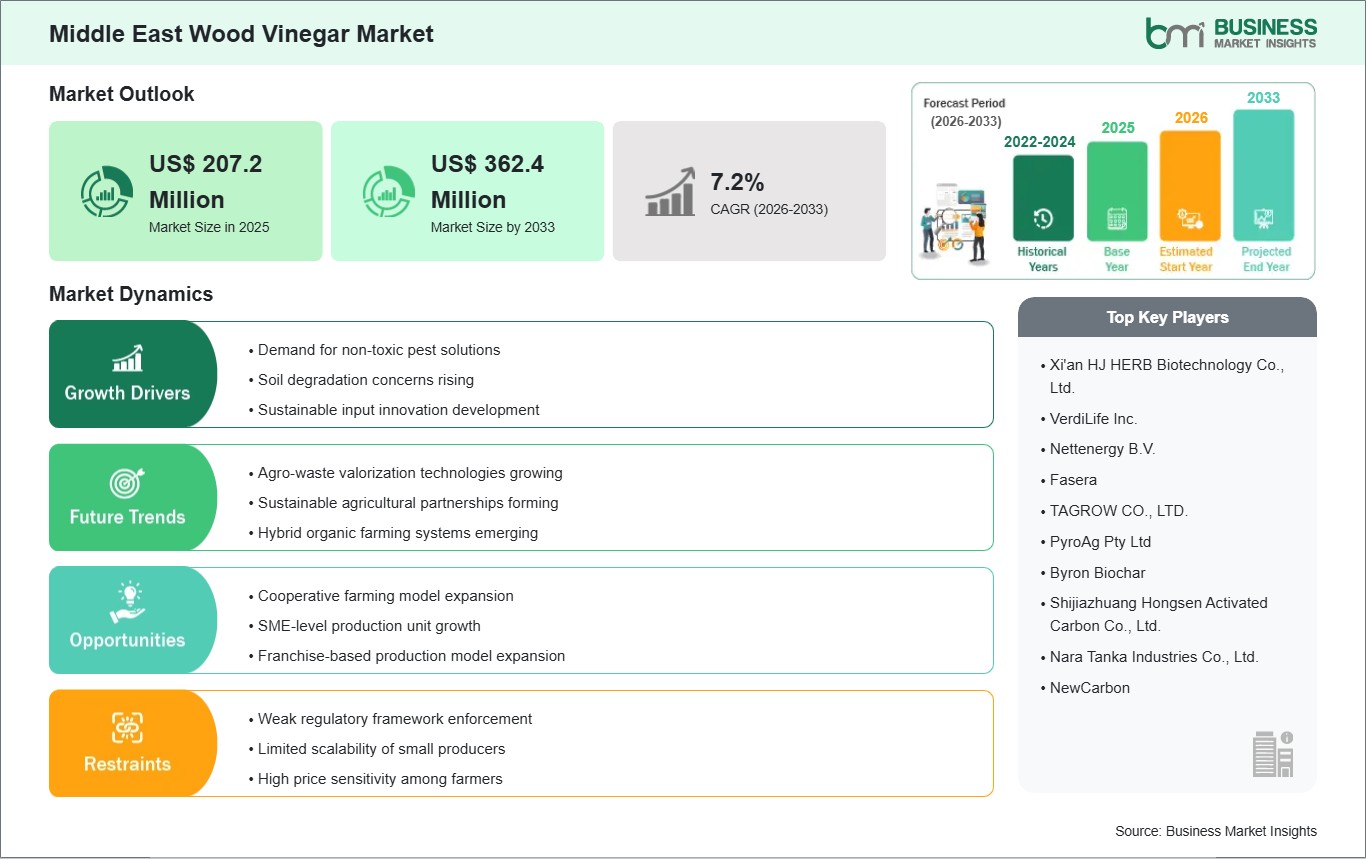
The Middle East wood vinegar market size is expected to reach US$ 362.4 million by 2033 from US$ 207.2 million in 2025. The market is estimated to record a CAGR of 7.2% from 2026 to 2033.
The Middle East wood vinegar market is gradually emerging as part of the region's broader transition toward sustainable agriculture, climate-resilient farming systems, and circular economy adoption. Wood vinegar, a bio-based liquid produced through the pyrolysis of agricultural and forestry biomass, is gaining attention for its potential applications in soil conditioning, pest management, compost enhancement, and environmentally friendly crop production. In a region defined by arid climates, water scarcity, and soil degradation challenges, the demand for solutions that improve soil efficiency and reduce chemical dependency is creating a supportive environment for bio-based agricultural inputs.
A key driver of market interest is the increasing focus on food security and agricultural self-sufficiency across Middle Eastern countries. Governments and agricultural stakeholders are investing in advanced farming systems such as greenhouse cultivation, hydroponics, and precision irrigation technologies. Within these controlled environments, wood vinegar is being explored as a complementary input to support plant health, improve soil microbial activity, and enhance nutrient utilization efficiency. Additionally, growing emphasis on sustainable land management and desert agriculture development is encouraging experimentation with organic soil enhancers.
However, the market remains at an early stage of development. Limited availability of biomass feedstock in arid environments restricts large-scale local production, making supply chains dependent on imports or externally sourced materials. Awareness of wood vinegar among traditional farming communities remains relatively low, and its adoption is largely confined to pilot projects and specialized agricultural operations. The absence of standardized usage practices and limited commercial distribution infrastructure further slows widespread market penetration.

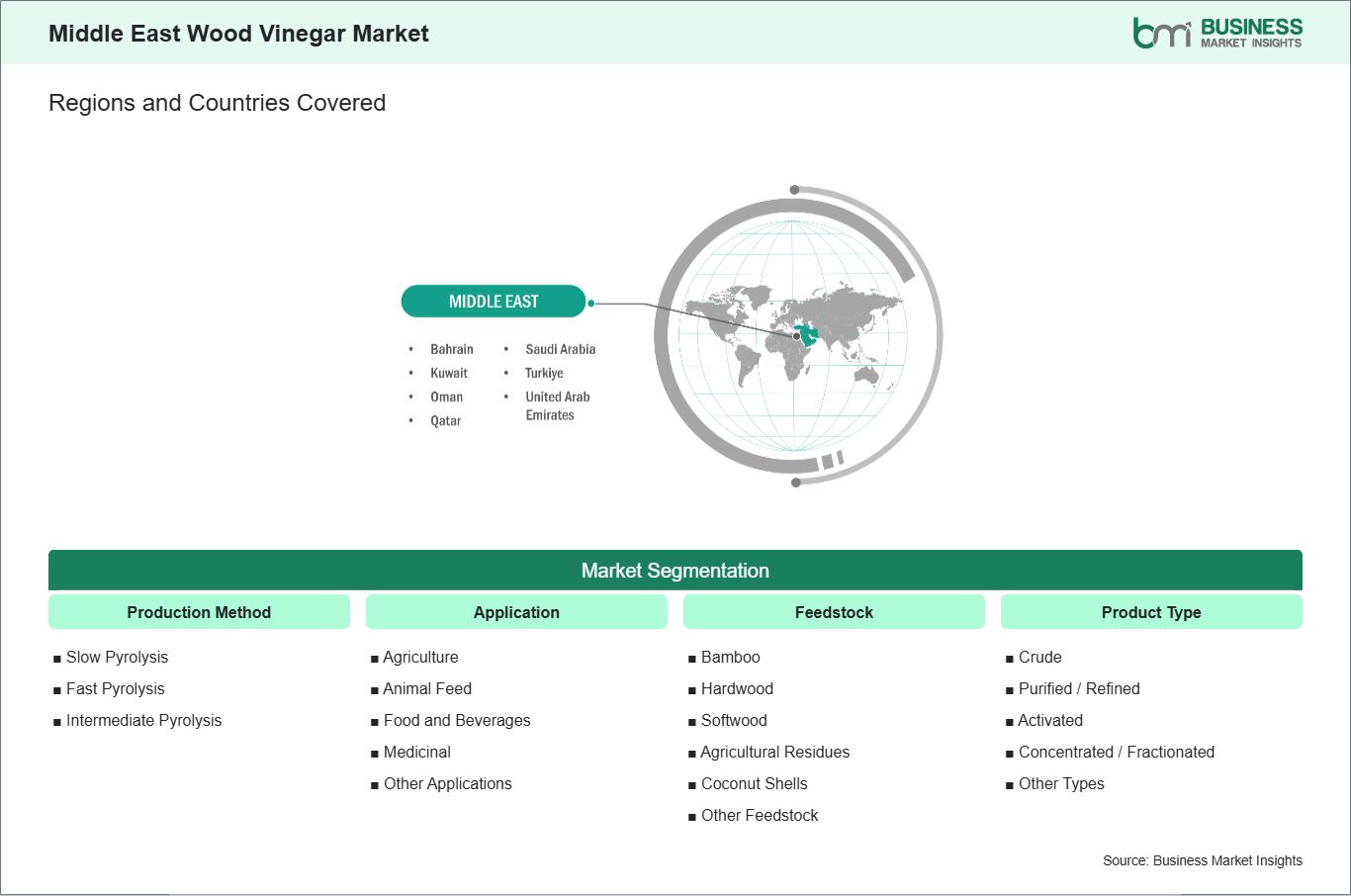
Key segments that contributed to the derivation of the Middle East wood vinegar market analysis pyrolysis method, application, feedstock, type, and purity.
The Middle East wood vinegar market is being driven by rising demand for non-toxic pest control solutions as agricultural systems increasingly shift toward safer and more sustainable production practices. Agricultural authorities and individual producers in the area have been increasingly focusing on minimizing the amount of pesticides left on products grown, especially for expensive crops under protection. Wood vinegar, produced from biomass via pyrolysis, has become an option to consider because of its pest-repellent properties and other health benefits for plants.
In countries such as Saudi Arabia, the UAE, and Oman, greenhouse farming and hydroponic cultivation are expanding rapidly to ensure year-round food supply in arid climates. The Controlled Environment Agriculture systems provide a source of fresh vegetables to the cities and hotels, where there is growing awareness about food safety. The farmers using this system have found the use of wood vinegar as one of the bio-inputs that can be incorporated into their pest management system, especially for vegetable crops like tomato, cucumber, peppers, and leafy greens.
The driver is further reinforced by government efforts to enhance domestic food production and reduce reliance on imported produce. Strategies of national food security have focused on better techniques and lower environmental effects. In desert agriculture regions, the difficult soils and higher pest pressure in greenhouses require innovative means of managing pests. As awareness of sustainable agriculture increases among producers and regulators, wood vinegar is expected to gain broader acceptance as a non-toxic, environmentally aligned input in Middle Eastern farming systems.
The expansion of cooperative farming models presents a significant opportunity for the Middle East wood vinegar market. Governments and agencies responsible for agriculture in the region have been encouraging farmers to form cooperatives as a means of increasing efficiency, maximizing resource utilization, and sustaining agricultural production under difficult climate conditions. Cooperatives will enable collective access to resources, technology, and information that would ease the integration of bio-solutions like wood vinegar into agricultural production systems.
In Egypt, Jordan, and parts of the Gulf region, cooperative farming initiatives are being strengthened to support small and medium-scale farmers involved in vegetable cultivation, date palm production, and forage crops. These cooperatives often operate centralized procurement systems, allowing them to adopt new agricultural inputs more efficiently. Wood vinegar can be integrated into cooperative supply chains as a cost-effective, natural product for soil conditioning and pest management, particularly in regions where chemical input costs are high or environmentally restricted.
The opportunity is further supported by sustainability-focused agricultural policies and rural development programs aimed at improving food security and resource efficiency. The cooperative approach facilitates knowledge sharing and learning that is vital in introducing new inputs in agriculture, like wood vinegar. Cooperative approaches have been used in desert-edge agricultural areas and irrigated agricultural areas to experiment with integrated organic farming practices. As these models continue to expand, wood vinegar is expected to gain traction as a shared, scalable solution that supports sustainable crop production and enhances resilience in water- and soil-limited environments across the Middle East.

The Middle East wood vinegar market is experiencing steady growth, with market size and share analysis reflecting evolving treatment preferences and competitive dynamics among key players. The report evaluates important subsegments categorized within pyrolysis method, application, feedstock, type, and purity, highlighting their respective contributions to overall market performance.
By the pyrolysis method, the slow pyrolysis wood subsegment dominated the market in 2025, due to its ability to maximize wood vinegar yield while maintaining low production costs. Slow pyrolysis is the most widely used production method. It enables efficient recovery of condensable compounds and is suitable for large-scale operations.
Based on applications, the agriculture subsegment dominated the market in 2025 because wood vinegar is extensively used as a natural fertilizer enhancer, soil conditioner, and biopesticide in agriculture, which remains the leading application segment. Growing interest in sustainable farming practices has increased its adoption. Its versatility across crops continues to drive demand.
On the basis of feedstock, the hardwood subsegment dominated the market in 2025, due to its high density and favorable chemical composition. Hardwood produces wood vinegar with consistent quality and desirable properties. It generates a rich concentration of organic compounds beneficial for agricultural use. Its widespread availability supports its dominance as a feedstock.
In terms of type, the crude subsegment dominated the market in 2025, because crude wood vinegar requires minimal processing and offers a cost-effective solution for end users, and it holds the largest market share. It is widely accepted for agricultural applications where extensive purification is unnecessary.
By purity, the low-purity subsegment dominated the market in 2025, due to its lower manufacturing costs and suitability for bulk agricultural applications. Farmers prefer it because high purification levels are not required for soil and crop treatment.
| Report Attribute | Details |
|---|---|
| Market size in 2025 | US$ 207.2 Million |
| Market Size by 2033 | US$ 362.4 Million |
| CAGR (2026 - 2033) | 7.2% |
| Historical Data | 2022-2024 |
| Forecast period | 2026-2033 |
| Segments Covered | By Production Method
|
|
Regions and Countries Covered
| |
| Middle East | UAE, Saudi Arabia, Bahrain, Oman, Kuwait, Qatar, Turkiye |
| Market leaders and key company profiles |
|
The "Middle East Wood Vinegar Market Size and Forecast (2022-2033)" report provides a detailed analysis of the market covering below areas:
The geographical scope of the Middle East wood vinegar market report is divided into: the UAE, Saudi Arabia, Bahrain, Oman, Kuwait, Qatar, and Turkiye. Turkiye held the largest share in 2025.
Turkiye represents the dominant market for wood vinegar within the broader Middle East region due to its strong agricultural base, diverse agro-climatic conditions, and growing adoption of sustainable farming practices. The country benefits from a well-developed agricultural sector that spans fruit cultivation, vegetable farming, cereals, olives, and greenhouse production, all of which generate significant agricultural residues suitable for biomass-based value addition. The presence of various types of biomass like orchard waste, forestry residues, and crop residues creates an ideal starting point to facilitate wood vinegar production. This not only helps with small-scale experimentation but also with growing interest in using bio-fertilizers commercially. The agriculture sector in Turkiye is now more interested in increasing soil fertility without chemicals, which offers good prospects for wood vinegar. However, the adherence of Turkiye to European agricultural trends and its involvement in agricultural modernization programs for sustainability purposes is yet another factor that facilitates market growth. The research organizations and agricultural extension services are becoming more involved in finding alternative ways through bio-based products, such as wood vinegar.

The Middle East Wood vinegar market is evaluated by gathering qualitative and quantitative data post primary and secondary research, which includes important corporate publications, association data, and databases. A few of the key developments in the Middle East Wood vinegar market are:
The Middle East Wood Vinegar Market is valued at US$ 207.2 Million in 2025, it is projected to reach US$ 362.4 Million by 2033.
As per our report Middle East Wood Vinegar Market, the market size is valued at US$ 207.2 Million in 2025, projecting it to reach US$ 362.4 Million by 2033. This translates to a CAGR of approximately 7.2% during the forecast period.
The Middle East Wood Vinegar Market report typically cover these key segments-
The historic period, base year, and forecast period can vary slightly depending on the specific market research report. However, for the Middle East Wood Vinegar Market report:
The Middle East Wood Vinegar Market is populated by several key players, each contributing to its growth and innovation. Some of the major players include:
The Middle East Wood Vinegar Market report is valuable for diverse stakeholders, including:
Essentially, anyone involved in or considering involvement in the Middle East Wood Vinegar Market value chain can benefit from the information contained in a comprehensive market report.
Please tell us your area of interest
(Market Segments/ Regions and Countries/ Companies)