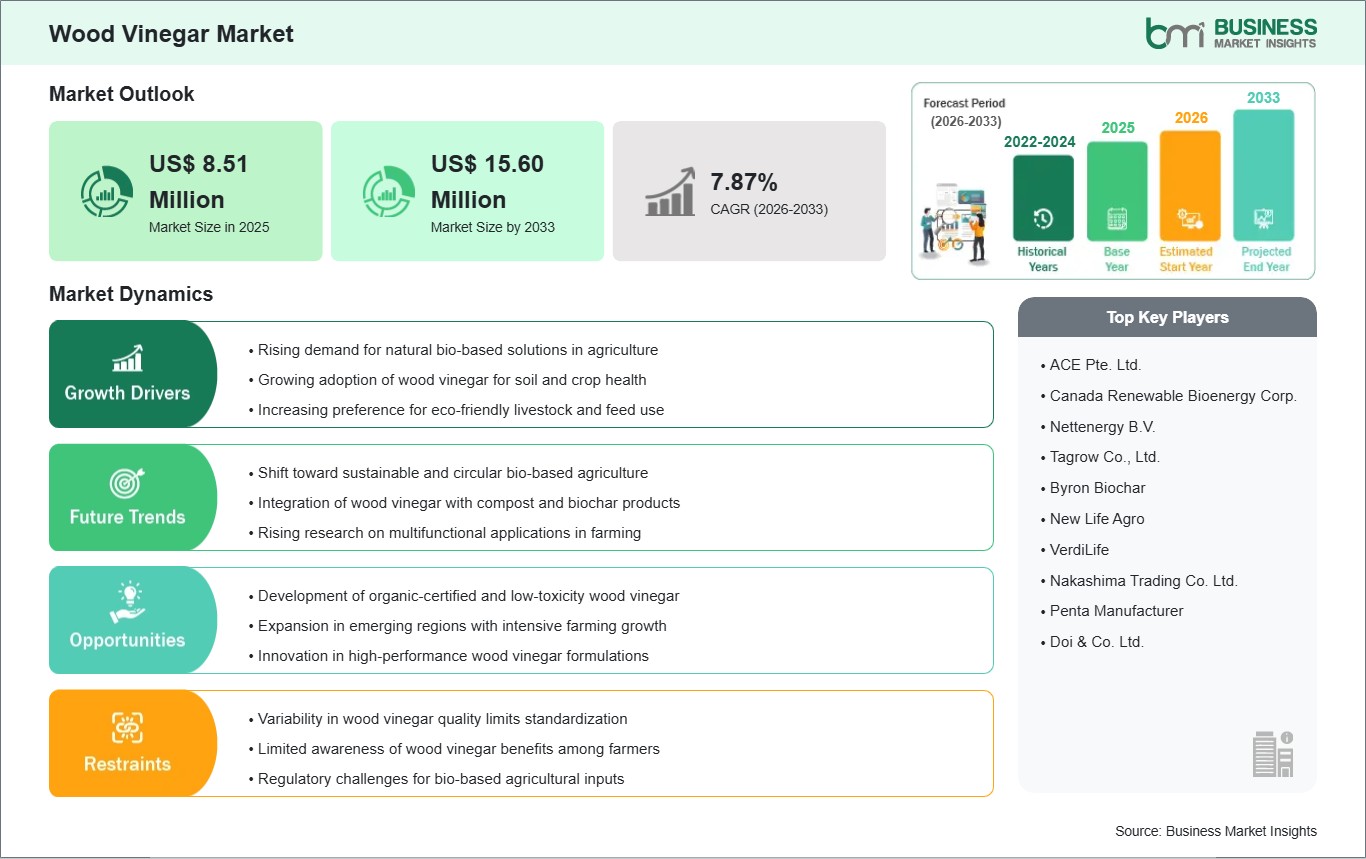
The Wood Vinegar Market size is expected to reach US$ 15.6 million by 2033 from US$ 8.51 million in 2025. The market is estimated to record a CAGR of 7.87% from 2026 to 2033.
The global wood vinegar market is centered around a niche but rapidly growing segment of bio‑based chemicals derived from the pyrolysis of wood and other biomass sources. Wood vinegar, also known as pyroligneous acid, is a dark liquid by‑product that results from the charcoal and biochar production process. The substance includes various organic acids together with phenolic compounds and other bioactive materials, which create agricultural, environmental and industrial beneficial effects. The multifunctional properties of wood vinegar provide four different functions because it acts as a soil enhancer, pest deterrent, animal growth promoter and odor suppressor. This product serves as an environmentally friendly solution to synthetic chemicals because it meets the demand for sustainable solutions that support environmental protection, organic farming and circular economy methods. People need wood vinegar because sustainable agriculture and organic crop production have become more important at the global level, according to the current market trends.
Farmers increasingly use wood vinegar as a pest management solution because they believe it has less environmental impact due to its natural origin. The application of wood vinegar exists in livestock management, which uses the substance to enhance animal welfare, eliminate odors from animal housing, and improve feed utilization. The environmental applications of the product extend to wastewater treatment and composting odor control, and it serves as a biochar additive that improves nutrient retention and microbial activity. The market experiences significant limitations because of its current restrictions. The primary challenge arises from the inconsistent product quality and different chemical makeup of wood vinegar, which varies according to the type of feedstock, the pyrolysis method and the subsequent processing steps.
The process creates difficulties because it prevents standardized testing and certification procedures from progressing, while people need to comply with strict agricultural input regulations in specific markets. The knowledge and acceptance of wood vinegar products show different patterns in various regions because developed agricultural regions move faster than traditional farming systems that lack the resources to learn about wood vinegar's advantages. The market development process experiences various effects from supply chain restrictions and uneven production levels, and the competition between established synthetic chemicals and wood vinegar. The production technology developments and the environmental advocacy increase, and the agricultural institutions' endorsement growth provide positive support for market growth.
The rising demand for environmentally friendly solutions creates opportunities for wood vinegar to become an essential bio-based ingredient that will transform agricultural and environmental practices around the world.

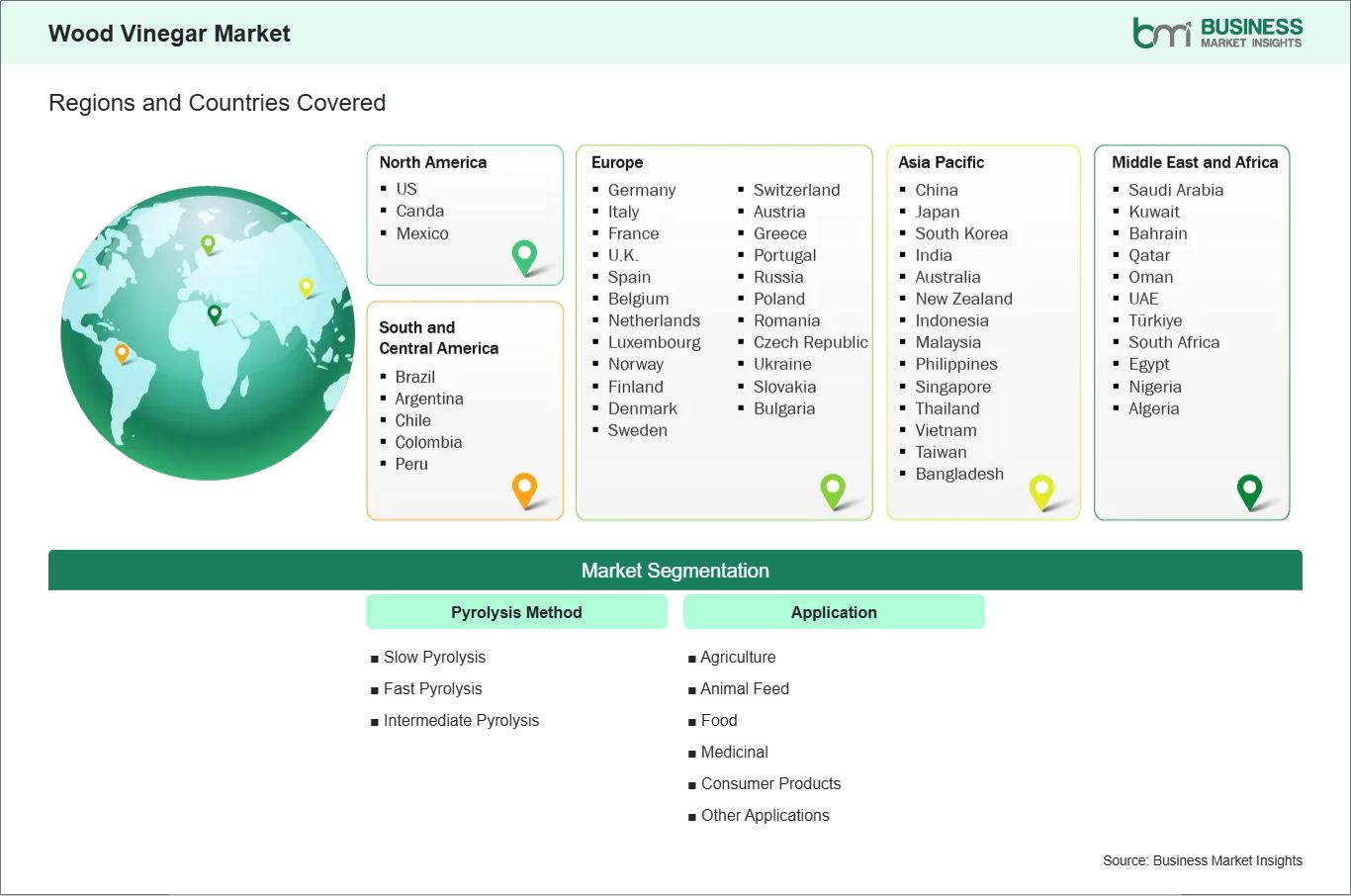
Key segments that contributed to the derivation of the wood vinegar market analysis are pyrolysis method and application.
The global wood vinegar market exists because agricultural workers and livestock handlers need sustainable solutions that use natural, bio-based products. Wood vinegar exists as a biomass pyrolysis by-product, which contains organic acids and phenols and bioactive compounds that help plants grow, boost soil microbial activity and provide natural pest control. North American farmers use wood vinegar to boost organic crop production through its root development benefits, which also help plants absorb nutrients while decreasing their need for synthetic fertilizers. European countries implement strict environmental laws and sustainability requirements, which drive farmers to use eco-friendly products and make wood vinegar an appealing choice for conventional and organic agricultural operations.
Countries such as Germany, France and the U.K. use it in vineyards and horticultural operations and high-value vegetable cultivation to maintain soil fertility and minimize chemical exposure. Agricultural extension programs and field demonstrations have built farmer trust, which helps the practice become a standard method. Intensive agriculture and urbanization are driving both the Asia Pacific and South America to become high-potential regions that are searching for affordable, environmentally friendly solutions. Wood vinegar serves composting, pest control and livestock feed enhancement purposes in China, India and Brazil to boost crop yields and animal health. The increasing understanding of sustainable bio-based solutions demonstrates how wood vinegar supports environmentally friendly farming methods, which enhance crop yields and protect soil health.
The development of organic-certified and low-toxicity wood vinegar represents a significant global opportunity, aligning with increasing consumer demand for environmentally friendly agricultural products. Manufacturers are innovating formulations that reduce heavy metals and other potentially harmful components, producing consistent, high-quality wood vinegar suitable for certified organic applications. In North America, regulatory compliance and organic certification drive the adoption of these safer, bio-based solutions, supporting both crop protection and soil enhancement strategies.
Europe remains a front-runner in adopting low-toxicity wood vinegar, influenced by EU regulations that govern chemical inputs in agriculture. Farmers and growers use organic-certified wood vinegar to achieve sustainability certifications while maintaining crop performance and soil health. Collaboration between research institutions and commercial suppliers has facilitated product standardization, field trials, and application guidance, ensuring predictable outcomes and building confidence among users.
Emerging markets in Asia Pacific and South & Central America are also witnessing increased interest in organic-certified wood vinegar as agricultural intensification grows. Farmers adopt these products to enhance soil fertility, improve compost quality, and integrate pest management with minimal environmental impact. By addressing safety, efficacy, and certification requirements, low-toxicity wood vinegar solutions enable global adoption, positioning the market for growth while meeting evolving sustainability and regulatory expectations worldwide.
The wood vinegar market demonstrates steady growth, with size and share analysis highlighting evolving trends and competitive dynamics among key players. The report examines subsegments categorized within pyrolysis method and application, offering insights into their contribution to overall market performance.
By pyrolysis method, the slow pyrolysis subsegment dominated the market in 2025, driven by its ability to produce higher-quality wood vinegar with better yield and consistency.
In terms of application, the agriculture subsegment dominated the market in 2025, driven by strong demand for organic soil conditioners, pest control, and sustainable farming practices.
| Report Attribute | Details |
|---|---|
| Market size in 2025 | US$ 8.51 Million |
| Market Size by 2033 | US$ 15.60 Million |
| Global CAGR (2026 - 2033) | 7.87% |
| Historical Data | 2022-2024 |
| Forecast period | 2026-2033 |
| Segments Covered | By Pyrolysis Method
|
|
Regions and Countries Covered
| |
| North America | US, Canada, Mexico |
| Europe | Belgium, Austria, Finland, Denmark, Greece, Poland, Romania, Russia, Ukraine, Czech Republic, Slovakia, Bulgaria, Italy, Luxembourg, Germany, Switzerland, France, Netherlands, Norway, Portugal, Spain, Sweden, United Kingdom |
| Asia-Pacific | Australia, China, India, Japan, South Korea, Indonesia, Malaysia, Philippines, Singapore, Thailand, Vietnam, Bangladesh, New Zealand, Taiwan |
| South and Central America | Brazil, Argentina, Peru, Chile, Colombia |
| Middle East and Africa | Bahrain, Kuwait, Oman, Qatar, Saudi Arabia, United Arab Emirates, Turkiye, South Africa, Egypt, Algeria, Nigeria |
| Market leaders and key company profiles |
|
The "Wood Vinegar Market Size and Forecast (2022 - 2033)" report provides a detailed analysis of the market covering below areas:
The geographical scope of the Wood Vinegar Market report is divided into North America, Asia Pacific, Europe, Middle East & Africa, and South & Central America. North America held the largest share in 2025.
North America leads the global wood vinegar market because of its high adoption rate of sustainable agricultural practices, its institutional backing of environmentally friendly bioinputs and its ongoing research efforts to improve soil and crop health.
The United States and Canada operate established farming and livestock industries, which now use wood vinegar to enhance their soil quality, control pests, manage odors and provide animal feed supplements. Agricultural research institutions work together with private manufacturers and extension services to educate farmers about the advantages of their products, which improve crop yield and soil health, and enhance livestock health.
European markets operate as established systems that use regulatory controls and sustainability requirements to determine wood vinegar applications. The farming systems in Germany, France and the U.K. use bio-based solutions as their primary method for agricultural operations, while wood vinegar serves as a soil improvement tool that supports nutrient cycling and helps farmers meet EU agricultural input regulations.
The demand for wood vinegar in the Asia Pacific region is expanding rapidly because urban development, modern farming practices and rising consumer interest in organic products drive growth in China, India, Japan and Southeast Asia.
Farmers in these regions use wood vinegar for crop protection, growth promotion, and compost enhancement to address high humidity, pest pressures, and soil degradation issues. The Middle East and Africa market shows gradual development because agricultural and horticultural practices grow, while wood vinegar provides natural pest control and soil improvement benefits. The South and Central America region, which includes Brazil, Mexico and Argentina, develops through commercial crop farming and livestock operations and rising demand for sustainable farming methods. The region uses affordable wood vinegar products, which local producers make to boost crop yields and control pests through organic methods and to enhance soil health.
The research activities of North America lead to better adoption and regulatory compliance, but other regions show potential for growth because urbanization, agricultural expansion, environmental concerns and wood vinegar use in sustainable farming, livestock and horticulture methods increase.

The Wood Vinegar Market is evaluated by gathering qualitative and quantitative data post primary and secondary research, which includes important corporate publications, association data, and databases. A few of the key developments in the wood vinegar market are:
The Wood Vinegar Market is valued at US$ 8.51 Million in 2025, it is projected to reach US$ 15.60 Million by 2033.
As per our report Wood Vinegar Market, the market size is valued at US$ 8.51 Million in 2025, projecting it to reach US$ 15.60 Million by 2033. This translates to a CAGR of approximately 7.87% during the forecast period.
The Wood Vinegar Market report typically cover these key segments-
The historic period, base year, and forecast period can vary slightly depending on the specific market research report. However, for the Wood Vinegar Market report:
The Wood Vinegar Market is populated by several key players, each contributing to its growth and innovation. Some of the major players include:
The Wood Vinegar Market report is valuable for diverse stakeholders, including:
Essentially, anyone involved in or considering involvement in the Wood Vinegar Market value chain can benefit from the information contained in a comprehensive market report.
Please tell us your area of interest
(Market Segments/ Regions and Countries/ Companies)