Middle East And Africa Wood Vinegar Market Outlook: Size, Share, Trends, Growth Analysis, Competitive Landscape & Forecast, 2022-2033

Historic Data: 2022-2024   |   Base Year: 2025   |   Forecast Period: 2026-2033
Report Content: Market Scope, Market Segmentation, Market Dynamics, and Competitive Analysis

Report Coverage:
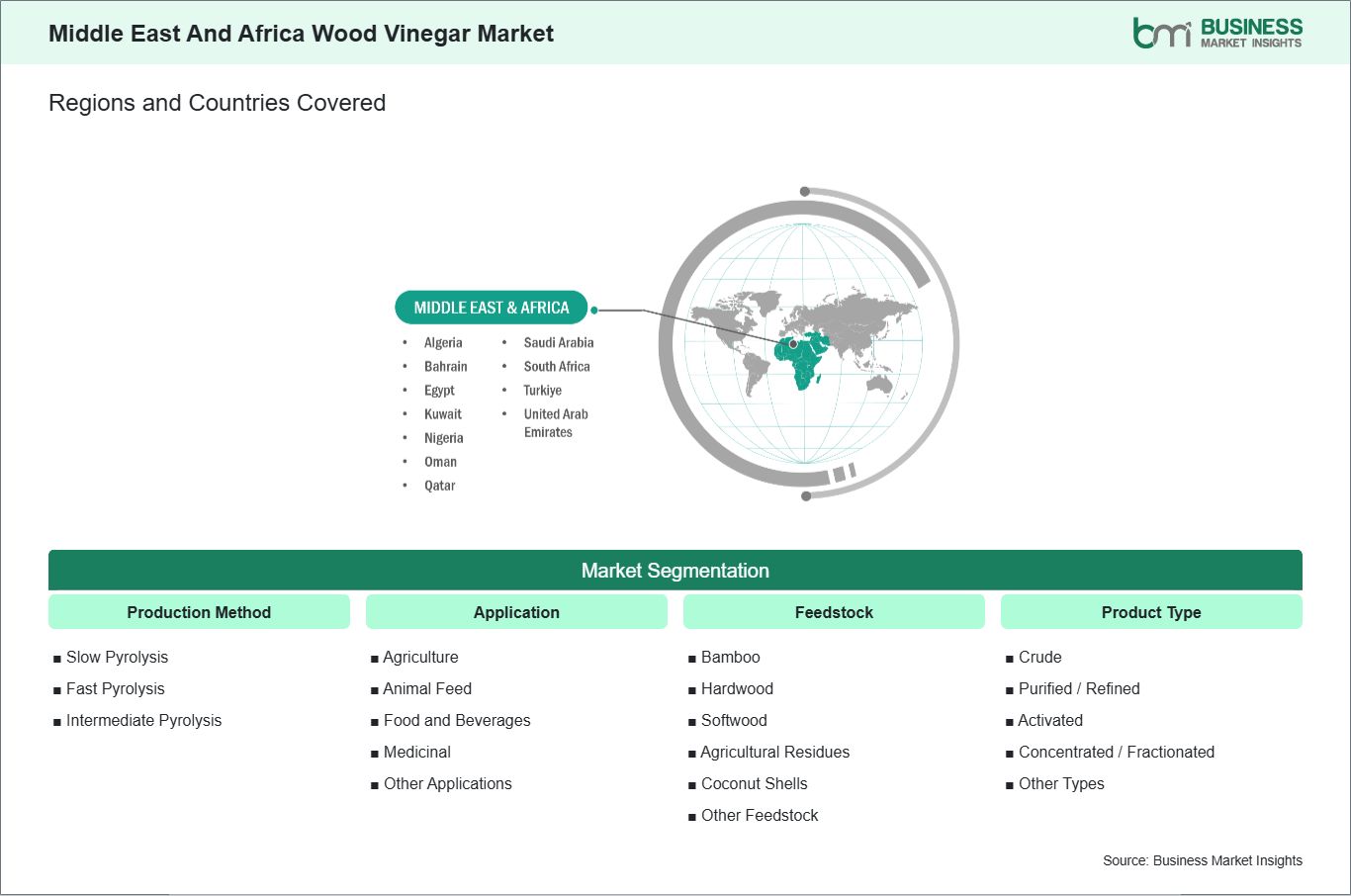
  • Production Method (Slow Pyrolysis, Fast Pyrolysis, Intermediate Pyrolysis)
  • Application (Agriculture, Animal Feed, Food and Beverages, Medicinal, Other Applications)
  • Feedstock (Bamboo, Hardwood, Softwood, Agricultural Residues, Coconut Shells, Other Feedstock)
  • Product Type (Crude, Purified / Refined, Activated, Concentrated / Fractionated, Other Types)

No. of Pages: 150
Report Code: BMIPUB00035834
Category: Chemicals and Materials
Middle East And Africa Wood Vinegar Market

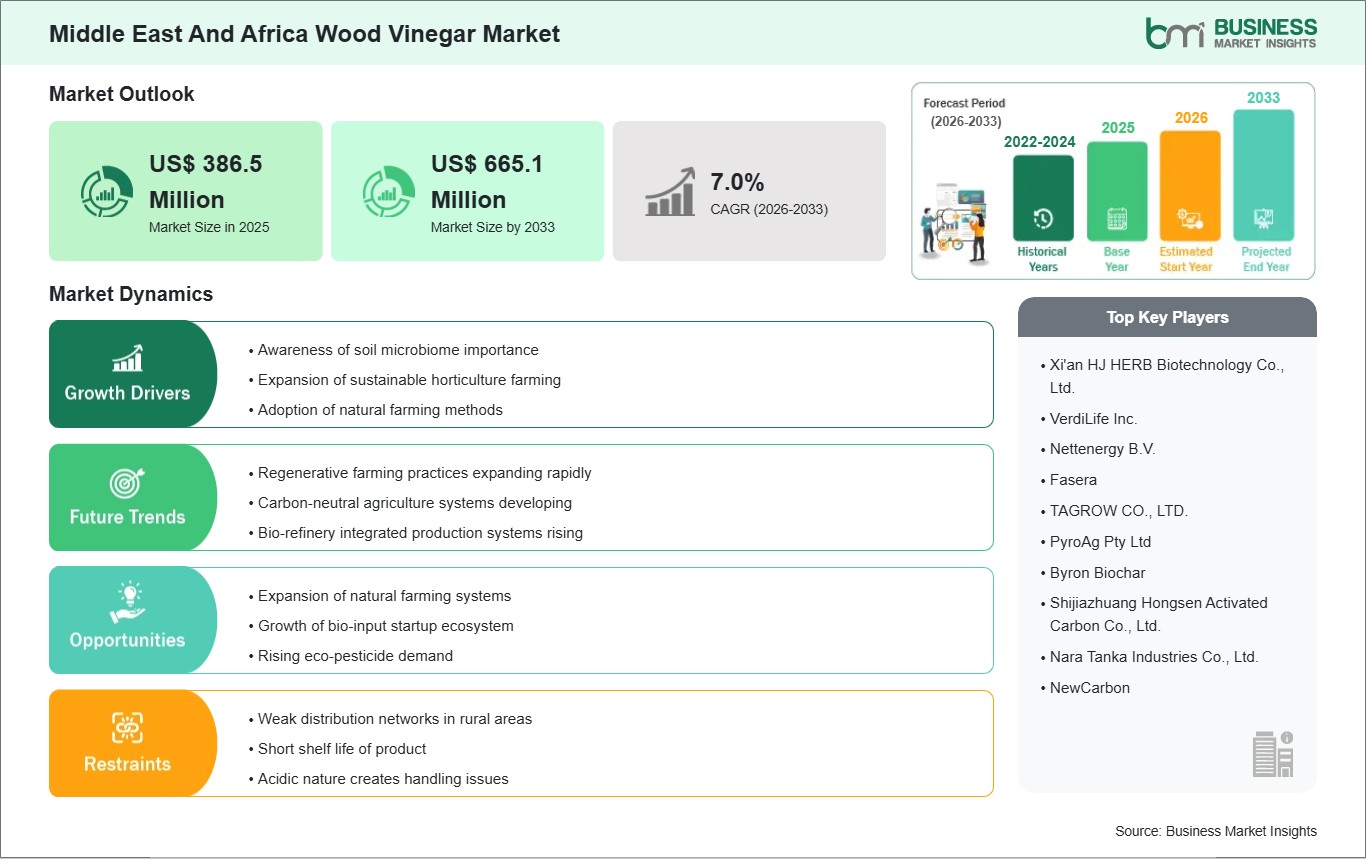
The Middle East and Africa wood vinegar market size is expected to reach US$ 665.1 million by 2033 from US$ 386.5 million in 2025. The market is estimated to record a CAGR of 7.0% from 2026 to 2033.

Executive Summary and Middle East And Africa Wood Vinegar Market Analysis:

The Middle East and Africa wood vinegar market is still at an early but steadily evolving stage, shaped by increasing interest in sustainable agriculture, desert farming technologies, and waste-to-resource initiatives. Wood vinegar is increasingly seen as a versatile bio-based product useful for soil care, bug repelling, boosting compost, and managing smells. In the region, where it's really dry and soils are worn out, folks are exploring organic options like this. These can help make soil richer and improve how water works in it.

A key driver of the market is the growing focus on agricultural modernization and food security, especially in countries facing limited arable land and harsh climatic conditions. Governments and private groups are getting more into sustainable farming, controlled-environment agriculture, and organic growing methods. This creates a great setting for using wood vinegar too. Also, there's plenty of biomass from stuff like agricultural leftovers, date palm scraps, and forestry extras in certain areas. This can be used to make wood vinegar locally.

However, the market faces notable restraints, including limited awareness of wood vinegar among traditional farming communities, lack of established distribution networks, and minimal localized production infrastructure. Dependence on imports in several countries also affects accessibility and product affordability. Despite these challenges, the region shows promising long-term potential, driven by increasing sustainability initiatives, gradual adoption of bio-based agricultural inputs, and growing interest in circular economy practices that convert waste biomass into value-added products.

Middle East And Africa Wood Vinegar Market - Strategic Insights:

global-market-strategic-framework
Get more information on this report

Middle East And Africa Wood Vinegar Market Segmentation Analysis:

Key segments that contributed to the derivation of the Middle East and Africa wood vinegar market analysis pyrolysis method, application, feedstock, type, and purity.

  • By pyrolysis method, the wood vinegar market is segmented into slow pyrolysis, fast pyrolysis, and intermediate pyrolysis. The slow pyrolysis wood segment dominated the market in 2025.
  • Based on applications, the wood vinegar market is segmented into agriculture, animal feed, food and beverages, medicinal/ pharmaceuticals, and other applications. The agriculture segment dominated the market in 2025.
  • On the basis of feedstock, the wood vinegar market is classified as bamboo, hardwood, softwood, agricultural residues, coconut shells, and other feedstocks. The hardwood segment dominated the market in 2025.
  • In terms of type, the wood vinegar market is segmented into crude, purified/refined, activated, concentrated/fractionated, and other types. The crude segment dominated the market in 2025.
  • By purity, the wood vinegar market is segmented into low, medium, and high. The low-purity segment dominated the market in 2025.

Middle East And Africa Wood Vinegar Market Drivers and Opportunities:

Awareness of Soil Microbiome Importance

The Middle East and Africa wood vinegar market is increasingly influenced by growing awareness of soil microbiome health and its role in agricultural productivity. In arid and semi-arid regions such as Saudi Arabia, Morocco, and Namibia, soil fertility constraints have pushed agronomists and farmers to explore biological solutions that go beyond traditional fertilization. Wood vinegar, with its organic acids and bioactive compounds, is being recognized for its ability to stimulate microbial activity and improve nutrient cycling in degraded soils. This shift is particularly relevant in regions where soil organic matter is naturally low and irrigation-dependent farming dominates.

Agricultural universities, as well as research and extension services, have also been adding their input to create awareness. In some parts of Eastern Africa, such as Kenya and Ethiopia, programs aimed at enhancing the health of soils through restoration of microbial balance in the soil are encouraging the use of organic material. Wood vinegar has gained more attention in demonstrations on maize, coffee, and horticulture, especially where microbial regeneration of the soil becomes a prerequisite for sustainable yields. These programs are helping bridge knowledge gaps and encouraging trial-based adoption among farmers who traditionally rely on chemical fertilizers.

Commercial agriculture is also responding to global sustainability pressures, particularly in export-oriented horticulture sectors. South African and Egyptian countries that export fruits, vegetables, and cut flowers to Europe are being urged to minimize chemical contamination as well as to sustain the health of their soils. As a result, growers are exploring microbial-friendly inputs like wood vinegar to enhance soil biology and maintain long-term productivity. This growing focus on soil microbiome health is steadily driving interest and adoption across the region.

Expansion of Natural Farming Systems

A significant opportunity for the Middle East and Africa wood vinegar market lies in the expansion of natural farming systems, particularly those designed to reduce dependence on synthetic agricultural chemicals. For many countries in Africa, smallholder farmers have embraced the practice of using low-input and organic farming practices because of the high cost of fertilizers and agrochemicals. Wood vinegar has potential use in such systems, as it is a versatile agent for improving soil conditions and pest management based on biomass feedstock.

Government and NGO-led agricultural transformation programs are also supporting this shift. Countries like Tanzania, Ghana, and Uganda have started implementing programs to promote climate-smart agriculture which encourage organic soil amendments and crop protection techniques. The application of wood vinegar is currently being investigated in mixed agriculture, agroforestry, and peri-urban agriculture systems where access to chemical fertilizers is either more difficult or cost-prohibitive. In turn, such programs provide a platform for commercializing and adopting bio-fertilizers in general.

In the Middle East, the push toward food security and sustainable desert agriculture is opening new pathways for natural farming systems. Hydroponic and greenhouse farms in the UAE and Israel have been trying to use more bio-based products to enhance root growth without chemicals. As hydroponics and greenhouses continue to spread throughout the region, wood vinegar will definitely have its place as one of the natural elements used in the process.This expanding ecosystem of natural and semi-organic farming practices presents a strong long-term growth opportunity for the wood vinegar market across both Middle Eastern and African agricultural landscapes.

Middle East And Africa Wood Vinegar Market Size and Share Analysis:

The Middle East and Africa wood vinegar market is experiencing steady growth, with market size and share analysis reflecting evolving treatment preferences and competitive dynamics among key players. The report evaluates important subsegments categorized within pyrolysis method, application, feedstock, type, and purity, highlighting their respective contributions to overall market performance.

By the pyrolysis method, the slow pyrolysis wood subsegment dominated the market in 2025, due to its ability to maximize wood vinegar yield while maintaining low production costs. Slow pyrolysis is the most widely used production method. It enables efficient recovery of condensable compounds and is suitable for large-scale operations.

Based on applications, the agriculture subsegment dominated the market in 2025 because wood vinegar is extensively used as a natural fertilizer enhancer, soil conditioner, and biopesticide in agriculture, which remains the leading application segment. Growing interest in sustainable farming practices has increased its adoption. Its versatility across crops continues to drive demand.

On the basis of feedstock, the hardwood subsegment dominated the market in 2025, due to its high density and favorable chemical composition. Hardwood produces wood vinegar with consistent quality and desirable properties. It generates a rich concentration of organic compounds beneficial for agricultural use. Its widespread availability supports its dominance as a feedstock.

In terms of type, the crude subsegment dominated the market in 2025, because crude wood vinegar requires minimal processing and offers a cost-effective solution for end users, and it holds the largest market share. It is widely accepted for agricultural applications where extensive purification is unnecessary.

By purity, the low-purity subsegment dominated the market in 2025, due to its lower manufacturing costs and suitability for bulk agricultural applications. Farmers prefer it because high purification levels are not required for soil and crop treatment.

Middle East And Africa Wood Vinegar Market Report Highlights:

Report Attribute Details
Market size in 2025 US$ 386.5 Million
Market Size by 2033 US$ 665.1 Million
CAGR (2026 - 2033)7.0%
Historical Data 2022-2024
Forecast period 2026-2033
Segments Covered By Production Method
  • Slow Pyrolysis
  • Fast Pyrolysis
  • Intermediate Pyrolysis
By Application
  • Agriculture
  • Animal Feed
  • Food and Beverages
  • Medicinal
  • Other Applications
By Feedstock
  • Bamboo
  • Hardwood
  • Softwood
  • Agricultural Residues
  • Coconut Shells
  • Other Feedstock
By Product Type
  • Crude
  • Purified / Refined
  • Activated
  • Concentrated / Fractionated
  • Other Types
Regions and Countries Covered
Middle East and Africa Saudi Arabia, United Arab Emirates, Kuwait, Bahrain, Qatar, Oman, Turkiye, South Africa, Egypt, Nigeria, Algeria
Market leaders and key company profiles
  • Xi'an HJ HERB Biotechnology Co., Ltd.
  • VerdiLife Inc.
  • Nettenergy B.V.
  • Fasera
  • TAGROW CO., LTD.
  • PyroAg Pty Ltd
  • Byron Biochar
  • Shijiazhuang Hongsen Activated Carbon Co., Ltd.
  • Nara Tanka Industries Co., Ltd.
  • NewCarbon
Get more information on this report

Middle East And Africa Wood Vinegar Market Report Coverage and Deliverables:

The "Middle East and Africa Wood Vinegar Market Size and Forecast (2022-2033)" report provides a detailed analysis of the market covering below areas:

  • Market size and forecast at the regional and country levels for market segments covered under the scope
  • Market trends, as well as drivers, restraints, and opportunities
  • Market analysis covering key trends, regional framework, major players, regulations, and recent developments
  • Market concentration, heat map analysis, prominent players, and recent developments for the Market
  • Detailed company profiles, including SWOT analysis

Middle East And Africa Wood Vinegar Market Geographic Insights:

The geographical scope of the Middle East and Africa Wood vinegar market report is divided into: Saudi Arabia, the United Arab Emirates, Kuwait, Bahrain, Qatar, Oman, Turkey, South Africa, Egypt, Nigeria, Algeria, and the Rest of MEA. Turkiye held the largest share in 2025.

The wood vinegar market in Turkiye is gradually developing, supported by the country's strong agricultural base, diverse agro-climatic conditions, and increasing shift toward sustainable farming practices. Positioned at the intersection of Europe and Asia, Turkiye is a nation that has an established economy based on agriculture, which involves crop cultivation, horticultural operations, and livestock management. In such an environment, wood vinegar has emerged as a biological agent in agriculture that can be applied to manage soil, act as a pest repellent, activate compost, and others.

A key driver of the market is the rising awareness of environmentally friendly farming inputs as producers seek alternatives to chemical fertilizers and pesticides. Turkish farmers, especially those who are cultivating fruits, vegetables, and greenhouse crops, are gradually turning towards natural and organic ways to ensure soil fertility. Turkiye also has a well-established greenhouse agricultural sector that offers a suitable ground to use wood vinegar in a controlled manner.

However, the market is still constrained by limited awareness among conventional farmers, lack of standardized product formulations, and relatively early-stage commercialization infrastructure. Distribution networks for bio-based agricultural inputs are still developing, which can limit accessibility in rural areas. Despite these challenges, Turkiye shows promising potential as an emerging market in the European wood vinegar landscape, driven by its strong agricultural diversity and increasing alignment with sustainable farming and circular economy principles.

global-market-geography
Get more information on this report

Middle East And Africa Wood Vinegar Market Research Report Guidance:

  • The report includes qualitative and quantitative data in the Middle East and Africa wood vinegar market across pyrolysis method, application, feedstock, type, and purity, and geography.
  • The report starts with the key takeaways (chapter 2), highlighting the key trends and outlook of the Middle East and Africa Wood vinegar market.
  • Chapter 3 focuses on the research methodology of the study.
  • Chapter 4 includes ecosystem analysis.
  • Chapter 5 highlights the major industry dynamics in the Middle East and Africa wood vinegar market, including factors that are driving the market, prevailing deterrents, potential opportunities, as well as future trends. Impact analysis of these drivers and restraints is also covered in this section.
  • Chapter 6 discusses the Middle East and Africa wood vinegar market scenario, in terms of historical market revenues, and forecast till the year 2033.
  • Chapters 7 to 12 cover the Middle East and Africa wood vinegar market segments by pyrolysis method, application, feedstock, type, and purity, and geography across Saudi Arabia, the UAE, Kuwait, Bahrain, Qatar, Oman, Turkiye, South Africa, Egypt, Nigeria, Algeria, and the Rest of MEA. They cover the market revenue, forecast, and factors driving the market.
  • Chapter 13 describes the competitive analysis along with the heat map analysis for the key players operating in the market.
  • Chapter 14 describes the industry landscape analysis. It provides detailed descriptions of business activities such as market initiatives, new developments, mergers, and joint ventures globally, along with a competitive landscape.
  • Chapter 15 provides detailed profiles of the major companies operating in the Middle East and Africa wood vinegar market. Companies have been profiled on the basis of their key facts, business descriptions, products, financial overview, SWOT analysis, and key developments.
  • Chapter 16, i.e., the appendix, is inclusive of a brief overview of the company, list of abbreviations, and disclaimer.

Middle East And Africa Wood Vinegar Market News and Key Development:

The Middle East and Africa wood vinegar market is evaluated by gathering qualitative and quantitative data post primary and secondary research, which includes important corporate publications, association data, and databases. A few of the key developments in the Middle East and Africa wood vinegar market are:

  • In June 2022, agricultural engineers in the Gaza Strip (Palestinian territories) announced pilot-scale production of wood vinegar as part of a soil rehabilitation initiative, where local teams demonstrated its use to improve saline and degraded soils and support organic farming practices in controlled field trials in northern Gaza.
  • In December 2022, BEEAH Group (UAE), together with Chinook Sciences and Air Water, announced a consortium project for a waste-to-hydrogen plant in Sharjah, where waste wood is processed through pyrolysis-based technology-an industrial route that generates by-products including wood vinegar alongside syngas and bio-oil fractions in circular biomass systems.

Key Sources Referred:

Food and Agriculture Organization (FAO)United Nations Environment Programme (UNEP)International Bamboo and Rattan OrganizationEnvironmental Protection Agency (EPA)Occupational Safety and Health Administration (OSHA)United States Department of AgricultureMinistry of Agriculture and Farmers WelfareJapan Biochar AssociationAsian Productivity OrganizationEuropean Chemicals AgencyCompany WebsitesCompany Annual ReportsCompany Investor Presentation
The List of Companies - Middle East And Africa Wood Vinegar Market
  • Xi'an HJ HERB Biotechnology Co., Ltd.
  • VerdiLife Inc.
  • Nettenergy B.V.
  • Fasera
  • TAGROW CO., LTD.
  • PyroAg Pty Ltd
  • Byron Biochar
  • Shijiazhuang Hongsen Activated Carbon Co., Ltd.
  • Nara Tanka Industries Co., Ltd.
  • NewCarbon
About Author — Chemicals and Materials Research Team
Suraj Sajeev
Associate Manager, Research & Consulting
View Profile

Suraj Sajeev is a market research and consulting professional with nearly 10 years of experience across Life Sciences, Consumer Goods, Food & Beverages, Materials & Chemicals, and Automotive industries. Throughout his career, he has successfully managed and delivered custom market research and consulting engagements, enabling clients to make informed strategic decisions through actionable market intelligence.

Suraj has extensive expertise in end-to-end project management, including proposal development, market assessment, competitive intelligence, opportunity analysis, market sizing and forecasting, strategic recommendation.. Show More

Frequently Asked Questions
How big is the Middle East And Africa Wood Vinegar Market?

The Middle East And Africa Wood Vinegar Market is valued at US$ 386.5 Million in 2025, it is projected to reach US$ 665.1 Million by 2033.

What is the CAGR for Middle East And Africa Wood Vinegar Market by (2026 - 2033)?

As per our report Middle East And Africa Wood Vinegar Market, the market size is valued at US$ 386.5 Million in 2025, projecting it to reach US$ 665.1 Million by 2033. This translates to a CAGR of approximately 7.0% during the forecast period.

What segments are covered in this report?

The Middle East And Africa Wood Vinegar Market report typically cover these key segments-

  • Production Method (Slow Pyrolysis, Fast Pyrolysis, Intermediate Pyrolysis)
  • Application (Agriculture, Animal Feed, Food and Beverages, Medicinal, Other Applications)
  • Feedstock (Bamboo, Hardwood, Softwood, Agricultural Residues, Coconut Shells, Other Feedstock)
  • Product Type (Crude, Purified / Refined, Activated, Concentrated / Fractionated, Other Types)

What is the historic period, base year, and forecast period taken for Middle East And Africa Wood Vinegar Market?

The historic period, base year, and forecast period can vary slightly depending on the specific market research report. However, for the Middle East And Africa Wood Vinegar Market report:

  • Historic Period : 2022-2024
  • Base Year : 2025
  • Forecast Period : 2026-2033
  • Who are the major players in Middle East And Africa Wood Vinegar Market?

    The Middle East And Africa Wood Vinegar Market is populated by several key players, each contributing to its growth and innovation. Some of the major players include:

  • Xi'an HJ HERB Biotechnology Co., Ltd.
  • VerdiLife Inc.
  • Nettenergy B.V.
  • Fasera
  • TAGROW CO., LTD.
  • PyroAg Pty Ltd
  • Byron Biochar
  • Shijiazhuang Hongsen Activated Carbon Co., Ltd.
  • Nara Tanka Industries Co., Ltd.
  • NewCarbon
  • Who should buy this report?

    The Middle East And Africa Wood Vinegar Market report is valuable for diverse stakeholders, including:

    • Investors: Provides insights for investment decisions pertaining to market growth, companies, or industry insights. Helps assess market attractiveness and potential returns.
    • Industry Players: Offers competitive intelligence, market sizing, and trend analysis to inform strategic planning, product development, and sales strategies.
    • Suppliers and Manufacturers: Helps understand market demand for components, materials, and services related to concerned industry.
    • Researchers and Consultants: Provides data and analysis for academic research, consulting projects, and market studies.
    • Financial Institutions: Helps assess risks and opportunities associated with financing or investing in the concerned market.

    Essentially, anyone involved in or considering involvement in the Middle East And Africa Wood Vinegar Market value chain can benefit from the information contained in a comprehensive market report.

    Available Report Formats

    pdf-format excel-format pptx-format
    Buy Now
    Sales Assistance
    +1 646 791 7070 (US & UK)
    Customization Form

    Please tell us your area of interest
    (Market Segments/ Regions and Countries/ Companies)