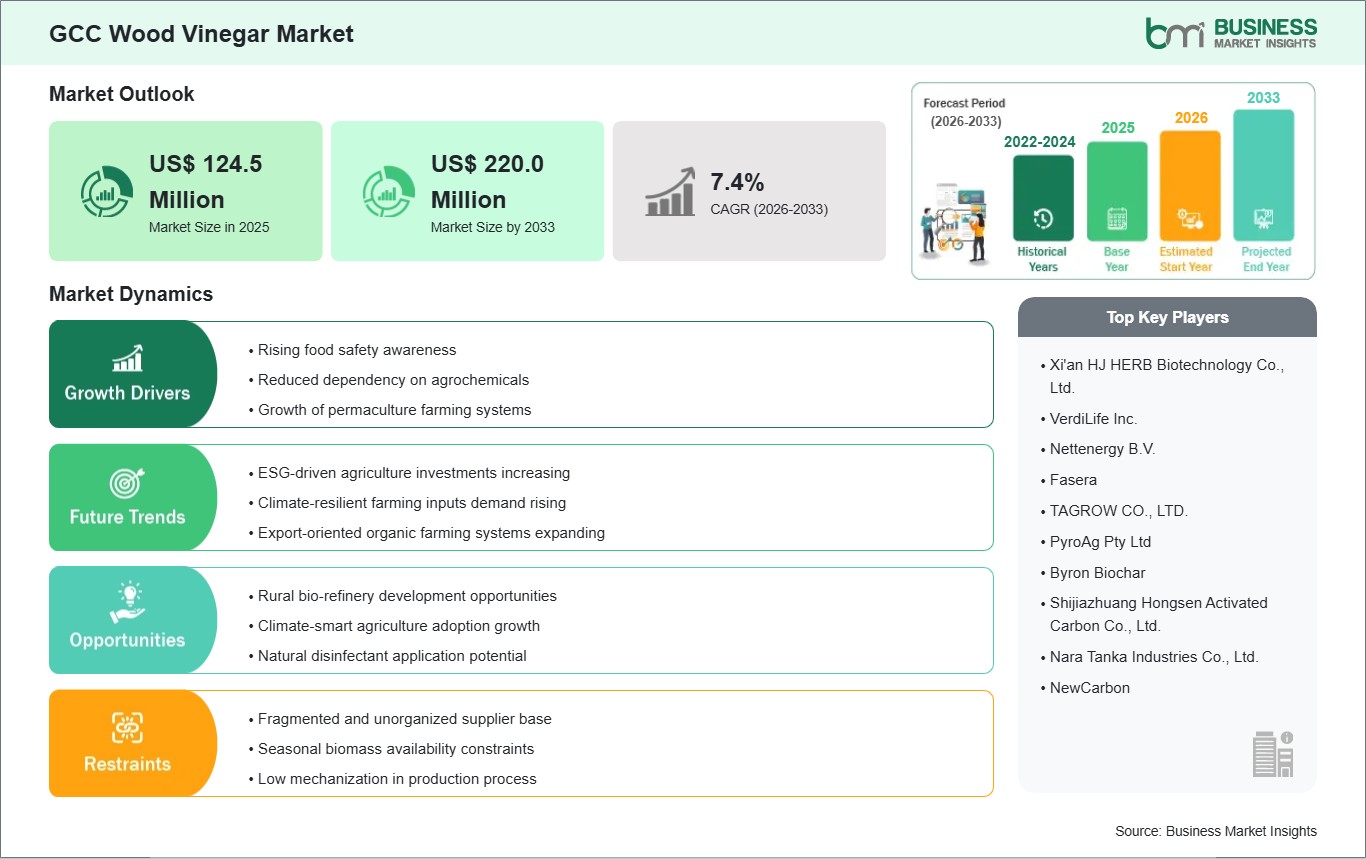
The GCC wood vinegar market size is expected to reach US$ 220.0 million by 2033 from US$ 124.5 million in 2025. The market is estimated to record a CAGR of 7.4% from 2026 to 2033.
The GCC wood vinegar market is emerging as a niche but steadily developing segment within the region's broader shift toward sustainable agriculture, desert reclamation, and resource-efficient farming practices. Wood vinegar, a bio-based liquid derived from biomass pyrolysis, is gaining attention for its potential applications in soil conditioning, pest deterrence, compost enhancement, and integrated crop management systems. In a region characterized by arid climatic conditions and limited arable land, the emphasis on improving soil fertility and optimizing water and nutrient efficiency is creating a supportive environment for alternative agricultural inputs.
A key driver of the market is the increasing adoption of modern agricultural technologies in controlled environments such as hydroponics, greenhouse farming, and precision agriculture. GCC countries are investing heavily in food security initiatives, which has led to experimentation with bio-based inputs that can enhance crop resilience and reduce dependency on chemical fertilizers. Wood vinegar is also being explored for its role in improving soil microbial activity and supporting sustainable cultivation in challenging desert ecosystems. Additionally, growing interest in circular economy models is encouraging the utilization of organic waste and biomass residues for value-added product development.
However, the market remains constrained by several structural challenges. Limited availability of biomass feedstock within arid environments restricts large-scale local production, making the market dependent on imported or externally produced wood vinegar. Awareness among traditional farming communities is still relatively low, and adoption is primarily concentrated in pilot projects and specialized agricultural operations. The absence of standardized application guidelines and limited commercial distribution networks further slows market penetration.

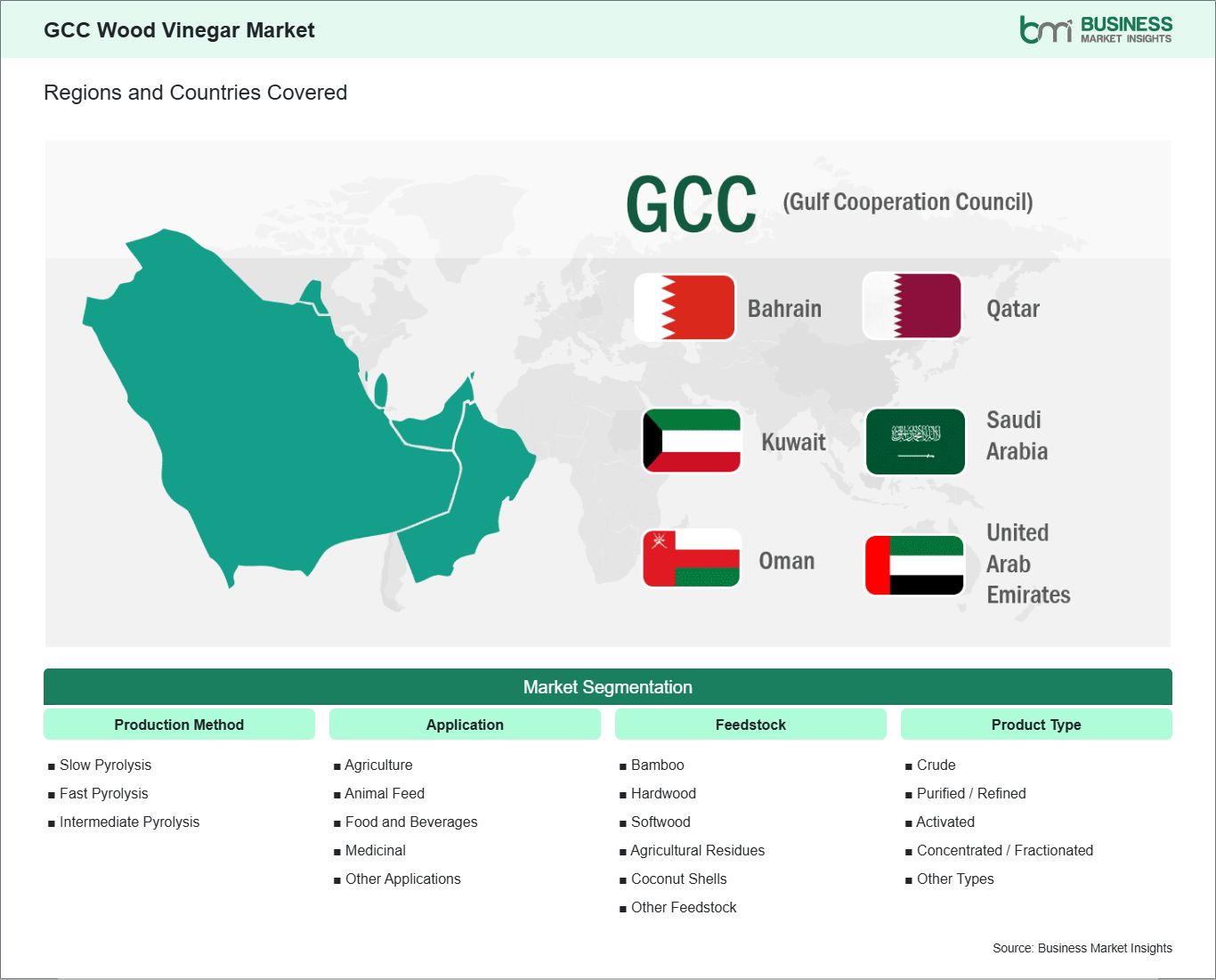
Key segments that contributed to the derivation of the GCC wood vinegar market analysis are pyrolysis method, application, feedstock, type, and purity.
The GCC wood vinegar market is being driven by increasing food safety awareness among consumers, regulators, and food supply chain stakeholders across the Gulf region. The governments of countries like Saudi Arabia, the United Arab Emirates, and Qatar have been working towards improving the food safety system in order to limit pesticide residue, provide traceability, and comply with import conditions. The increased government pressure has forced farmers and greenhouse owners to use low-residue agro-inputs, making wood vinegar an option in the process.
In high-tech agricultural systems such as hydroponic farms in the UAE and controlled-environment greenhouses in Saudi Arabia, producers are under pressure to meet strict food safety and quality benchmarks. These systems are increasingly used to supply vegetables and herbs for sale in urban retail and hospitality outlets, where there is growing consumer demand for products without residual pesticide contamination. Wood vinegar is now being considered for inclusion as a component of IPM programs, especially for leafy vegetables, tomatoes, and cucumbers grown under protected cultivation systems.
The driver is further reinforced by import dependency in the GCC, where a large share of fresh produce is sourced from international suppliers. TThis has resulted in stricter regulation and more focus on improving the standards of food production within the country. Governments have been investing in agricultural development projects to improve local production levels, yet at the same time ensuring compliance with food safety standards. As awareness about the benefits of growing without chemicals, it is expected that wood vinegar will grow in popularity among growers in the GCC region.
The development of rural bio-refinery systems presents a significant opportunity for the GCC wood vinegar market. Despite the region being known for dryland farming, governments are now focusing on developing sustainable approaches to ensure efficient use of resources and local agriculture. There is growing interest in bio-refineries that can produce multiple useful products from biomass wastes, including wood vinegar, through circular economic methods as per the sustainability vision of the country.
In Saudi Arabia and the UAE, agricultural expansion projects and date palm cultivation generate substantial volumes of biomass residues such as fronds, trunks, and pruning waste. These substances have been gaining attention with regard to their possible use in the production of bioenergy and agricultural products using pyrolysis technology. Some pilot project carried out in deserts, where farming is practiced, are attempting to use decentralized processing plants capable of producing wood vinegar along with biochar.
The opportunity is further supported by government-led sustainability agendas such as Saudi Vision 2030 and the UAE Net Zero strategy, which emphasize renewable resource utilization and waste reduction. There are programs being conducted on rural development in which private industry involvement is encouraged in environmentally friendly technologies that increase efficiency and productivity in agriculture without harming the environment. With increasing developments in bio-refining technology, wood vinegar could serve as an added by-product that can be used in improving the quality of soil and agricultural crops.

The GCC wood vinegar market is experiencing steady growth, with market size and share analysis reflecting evolving treatment preferences and competitive dynamics among key players. The report evaluates important subsegments categorized within pyrolysis method, application, feedstock, type, and purity, highlighting their respective contributions to overall market performance.
By the pyrolysis method, the slow pyrolysis wood subsegment dominated the market in 2025, due to its ability to maximize wood vinegar yield while maintaining low production costs. Slow pyrolysis is the most widely used production method. It enables efficient recovery of condensable compounds and is suitable for large-scale operations.
Based on applications, the agriculture subsegment dominated the market in 2025 because wood vinegar is extensively used as a natural fertilizer enhancer, soil conditioner, and biopesticide in agriculture, which remains the leading application segment. Growing interest in sustainable farming practices has increased its adoption. Its versatility across crops continues to drive demand.
On the basis of feedstock, the hardwood subsegment dominated the market in 2025, due to its high density and favorable chemical composition. Hardwood produces wood vinegar with consistent quality and desirable properties. It generates a rich concentration of organic compounds beneficial for agricultural use. Its widespread availability supports its dominance as a feedstock.
In terms of type, the crude subsegment dominated the market in 2025, because crude wood vinegar requires minimal processing and offers a cost-effective solution for end users, and it holds the largest market share. It is widely accepted for agricultural applications where extensive purification is unnecessary.
By purity, the low-purity subsegment dominated the market in 2025, due to its lower manufacturing costs and suitability for bulk agricultural applications. Farmers prefer it because high purification levels are not required for soil and crop treatment.
| Report Attribute | Details |
|---|---|
| Market size in 2025 | US$ 124.5 Million |
| Market Size by 2033 | US$ 220.0 Million |
| CAGR (2026 - 2033) | 7.4% |
| Historical Data | 2022-2024 |
| Forecast period | 2026-2033 |
| Segments Covered | By Production Method
|
|
Regions and Countries Covered
| |
| GCC | UAE, Bahrain, Saudi Arabia, Oman, Qatar, Kuwait |
| Market leaders and key company profiles |
|
The "GCC Wood Vinegar Market Size and Forecast (2022-2033)" report provides a detailed analysis of the market covering below areas:
The geographical scope of the GCC Wood vinegar market report is divided into: Saudi Arabia, the UAE, Qatar, Kuwait, Bahrain, and Oman. Saudi Arabia held the largest share in 2025.
Saudi Arabia represents the leading market for wood vinegar within the GCC due to its large-scale agricultural modernization programs, strong food security agenda, and rapid expansion of controlled-environment farming systems. The country has been actively investing in advanced agricultural technologies to overcome climatic constraints and improve domestic food production capacity. Within this context, wood vinegar is gaining attention as a complementary bio-based input that can support soil health improvement and sustainable crop management. The agricultural landscape in Saudi Arabia is increasingly shifting toward greenhouse cultivation, drip irrigation systems, and precision farming techniques. These controlled systems provide an ideal environment for testing and integrating biological inputs such as wood vinegar, particularly in applications related to pest management, root development enhancement, and soil conditioning. The emphasis on reducing chemical dependency and improving long-term soil sustainability aligns well with the functional attributes of wood vinegar. Saudi Arabia's broader sustainability and circular economy initiatives also support interest in biomass-derived products. Efforts to utilize organic waste streams and explore alternative resource recovery pathways are creating opportunities for bio-based agricultural solutions. Research institutions and agricultural development programs are actively evaluating methods to enhance soil productivity in arid regions, where wood vinegar is being studied for its potential role in improving soil biological activity.

The GCC wood vinegar market is evaluated by gathering qualitative and quantitative data post primary and secondary research, which includes important corporate publications, association data, and databases. A few of the key developments in the GCC wood vinegar market are:
The GCC Wood Vinegar Market is valued at US$ 124.5 Million in 2025, it is projected to reach US$ 220.0 Million by 2033.
As per our report GCC Wood Vinegar Market, the market size is valued at US$ 124.5 Million in 2025, projecting it to reach US$ 220.0 Million by 2033. This translates to a CAGR of approximately 7.4% during the forecast period.
The GCC Wood Vinegar Market report typically cover these key segments-
The historic period, base year, and forecast period can vary slightly depending on the specific market research report. However, for the GCC Wood Vinegar Market report:
The GCC Wood Vinegar Market is populated by several key players, each contributing to its growth and innovation. Some of the major players include:
The GCC Wood Vinegar Market report is valuable for diverse stakeholders, including:
Essentially, anyone involved in or considering involvement in the GCC Wood Vinegar Market value chain can benefit from the information contained in a comprehensive market report.
Please tell us your area of interest
(Market Segments/ Regions and Countries/ Companies)