Eastern Europe Wood Vinegar Market Outlook: Size, Share, Trends, Growth Analysis, Competitive Landscape & Forecast, 2022-2033

Historic Data: 2022-2024   |   Base Year: 2025   |   Forecast Period: 2026-2033
Report Content: Market Scope, Market Segmentation, Market Dynamics, and Competitive Analysis

Report Coverage:
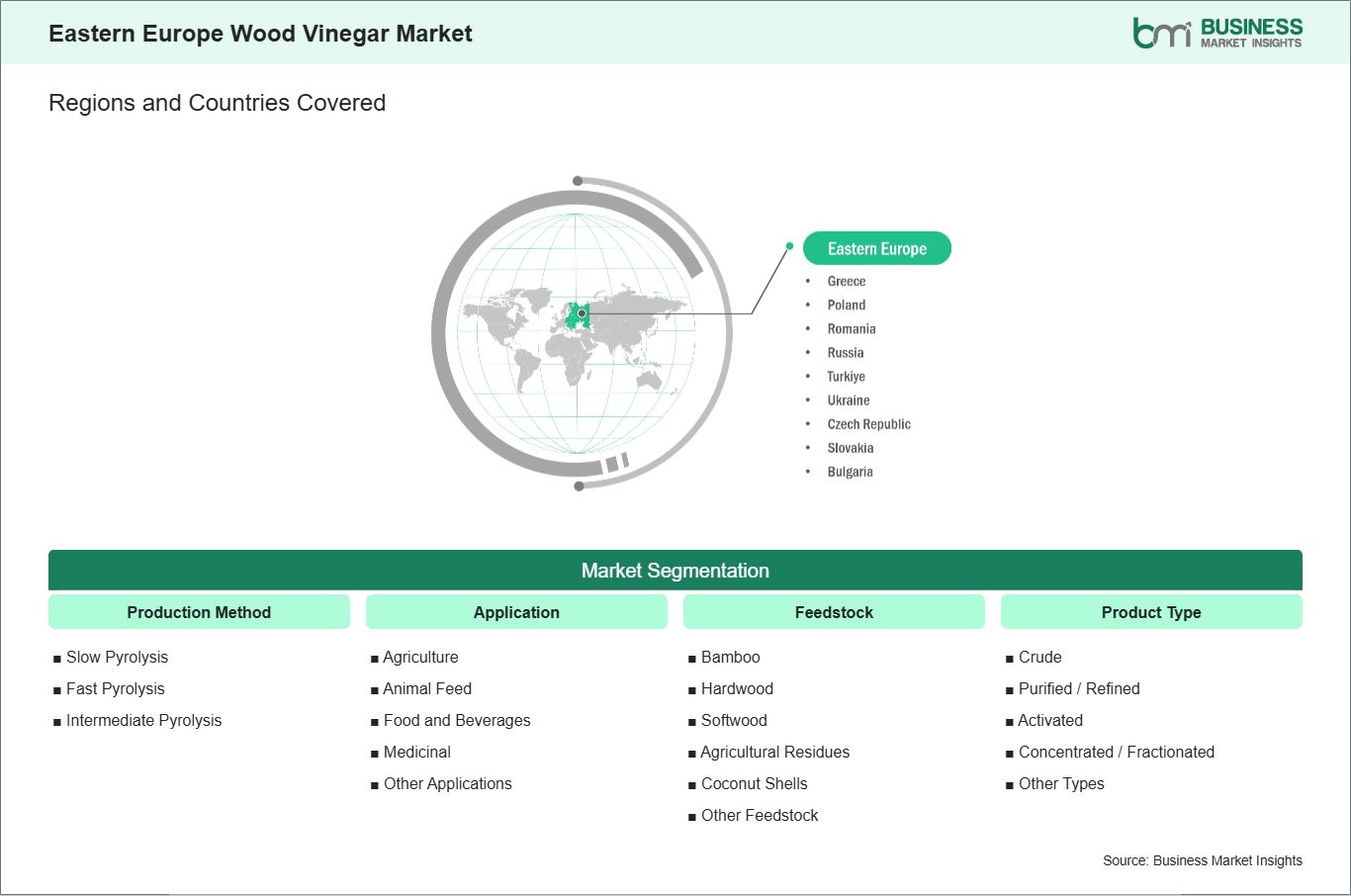
  • Production Method (Slow Pyrolysis, Fast Pyrolysis, Intermediate Pyrolysis)
  • Application (Agriculture, Animal Feed, Food and Beverages, Medicinal, Other Applications)
  • Feedstock (Bamboo, Hardwood, Softwood, Agricultural Residues, Coconut Shells, Other Feedstock)
  • Product Type (Crude, Purified / Refined, Activated, Concentrated / Fractionated, Other Types)

No. of Pages: 150
Report Code: BMIPUB00035839
Category: Chemicals and Materials
Eastern Europe Wood Vinegar Market

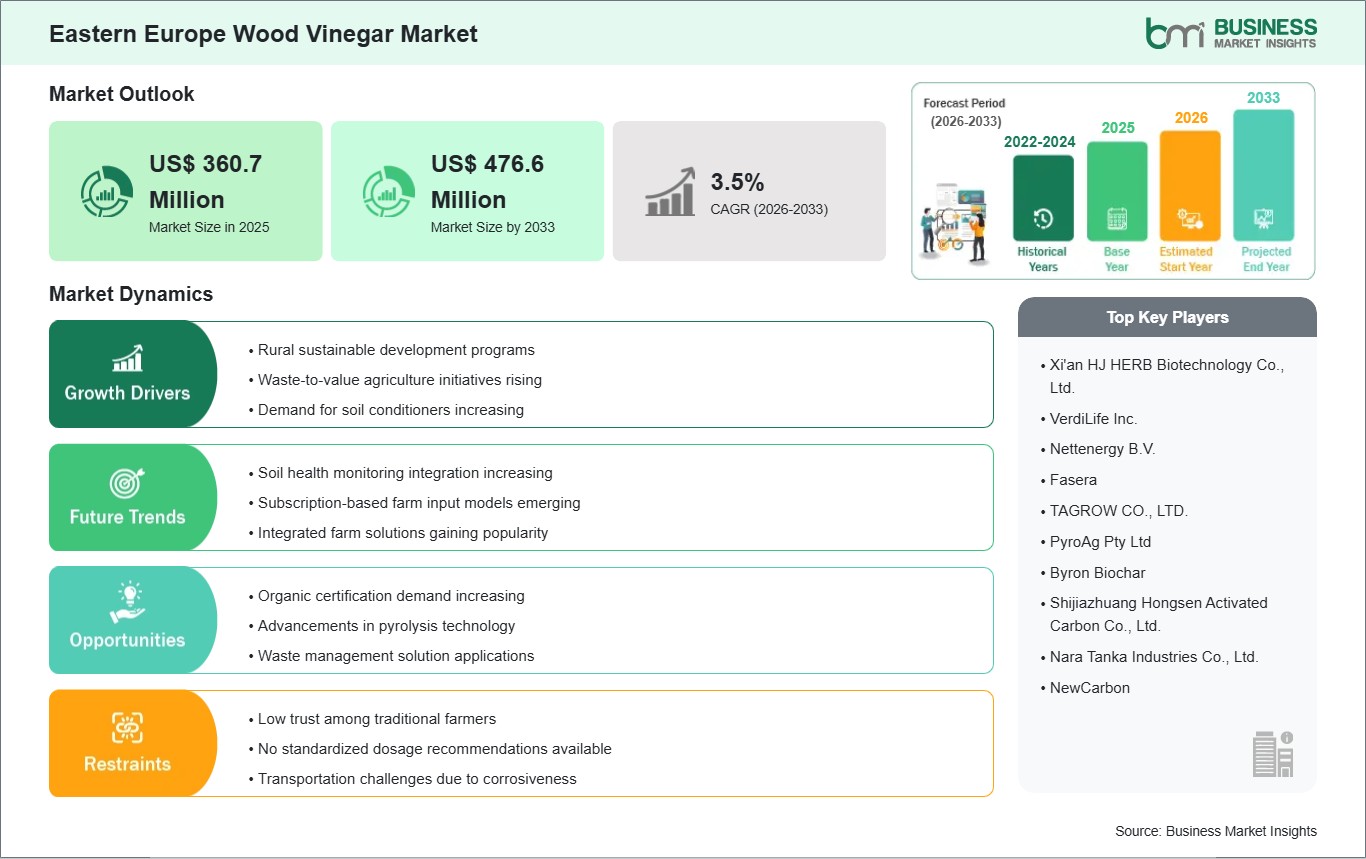
The Eastern Europe Wood vinegar market size is expected to reach US$ 476.6 million by 2033 from US$ 360.7million in 2025. The market is estimated to record a CAGR of 3.5% from 2026 to 2033.

Executive Summary and Eastern Europe Wood Vinegar Market Analysis:

The Eastern Europe wood vinegar market is gradually developing as sustainability-driven agricultural practices, biomass utilization initiatives, and circular economy strategies gain traction across the region. Wood vinegar is increasingly being recognized as a natural bio-based input derived from the pyrolysis of agricultural and forestry residues, with applications spanning soil enhancement, crop protection, composting support, and livestock management. The market is shaped by the region's strong agricultural tradition, extensive arable land, and growing awareness of environmentally responsible farming inputs.

A key driver of market growth is the increasing shift toward reducing chemical-intensive agriculture and improving soil health in response to long-term land degradation concerns. Farmers and agribusinesses are exploring organic and regenerative farming techniques, where wood vinegar is being evaluated as a supplementary input for improving microbial activity and enhancing soil vitality. Additionally, the availability of biomass feedstock from forestry operations, grain production residues, and agro-industrial waste supports localized production potential across several Eastern European countries.

Government-backed environmental initiatives and alignment with broader European sustainability frameworks are also encouraging interest in bio-based agricultural solutions. Research institutions and agricultural innovation centers are increasingly studying the role of pyrolysis-derived liquids in sustainable farming systems. However, the market remains in an early adoption phase, with limited awareness among mainstream farmers and a strong reliance on conventional agrochemical products. Distribution channels are also relatively underdeveloped, restricting wider commercialization.

Eastern Europe Wood Vinegar Market - Strategic Insights:

global-market-strategic-framework
Get more information on this report

Eastern Europe Wood Vinegar Market Segmentation Analysis:

Key segments that contributed to the derivation of the Eastern Europe wood vinegar market analysis are pyrolysis method, application, feedstock, type, and purity.

  • By pyrolysis method, the wood vinegar market is segmented into slow pyrolysis, fast pyrolysis, and intermediate pyrolysis. The slow pyrolysis wood segment dominated the market in 2025.
  • Based on applications, the wood vinegar market is segmented into agriculture, animal feed, food and beverages, medicinal/ pharmaceuticals, and other applications. The agriculture segment dominated the market in 2025.
  • On the basis of feedstock, the wood vinegar market is classified as bamboo, hardwood, softwood, agricultural residues, coconut shells, and other feedstocks. The hardwood segment dominated the market in 2025.
  • In terms of type, the wood vinegar market is segmented into crude, purified/refined, activated, concentrated/fractionated, and other types. The crude segment dominated the market in 2025.
  • By purity, the wood vinegar market is segmented into low, medium, and high. The low-purity segment dominated the market in 2025.

Eastern Europe Wood Vinegar Market Drivers and Opportunities:

Rural Sustainable Development Programs

The Eastern Europe wood vinegar market is expanding due to the increasing influence of rural sustainable development programs aimed at modernizing agriculture while improving environmental performance. Governments within the region are implementing strategies for rural development that include reduction of reliance on chemicals, improved management of soil, and proper utilization of crop residues. The wood vinegar derived from various forms of biomass, including waste from the forest, grains, and orchards, is gaining prominence because of its usefulness in meeting the requirements of rural development.

Countries such as Poland, Romania, and Hungary are investing in programs that promote climate-resilient farming and efficient land use. Such projects involve assistance in developing farm biomass processing facilities in which agricultural waste can be processed to obtain secondary products. For instance, small cooperatives engaged in agriculture in rural Poland have recently been experimenting with pyrolysis equipment to obtain biochar and wood vinegar for application in their fields. Likewise, the Romanian Danube area has undertaken pilot projects aiming at enhancing soil fertility without stubble burning.

The driver is further reinforced by the need to improve farm profitability in rural communities where input costs remain a major concern. Farms are increasingly utilizing cheap, locally-made inputs for agriculture which help to enhance the quality of soil and crops without having to depend on chemical imports too much. Wood vinegar is one of such innovations and can be very helpful in integrated agriculture prevalent in Eastern Europe. As rural development funding continues to prioritize sustainability and resource efficiency, wood vinegar adoption is expected to rise steadily across the region's agricultural landscapes.

Organic Certification Demand Increasing

The rising demand for organic certification presents a strong opportunity for the Eastern Europe wood vinegar market. Europe's consumers are increasingly demanding traceable and chemical-free food products, and this tendency is spreading even to agricultural exports coming from Eastern Europe. For this reason, there is mounting pressure on farmers to use accepted input materials in accordance with organic farming guidelines. Wood vinegar, being a natural product derived from biomass pyrolysis, is gaining recognition as a supportive input in organic-compatible farming systems, particularly for soil conditioning and pest management.

In countries such as Czechia, Slovakia, and Bulgaria, organic farming areas are steadily expanding as producers target premium export markets in Western Europe. Fruit, vegetable, herb, and wine grape growers have been especially proactive in moving towards organic certification. Within these types of operations, there has been an increasing interest in using natural crop enhancement products as substitutes for chemical pesticides and fertilizers. Wood vinegar is being evaluated as part of integrated organic crop management practices, especially in vineyards and horticultural farms where quality standards are strict.

The opportunity is further supported by the strengthening of EU-aligned certification frameworks across Eastern Europe. Compliance with European organic regulations requires careful selection of agricultural inputs, creating demand for verified bio-based alternatives. Poland and Hungary agricultural exporters have been focusing on sustainable farming practices to remain competitive in the EU market.
With the increasing popularity of certification-based agriculture, wood vinegar stands to gain from its advantage of being a product that supports sustainable farming and can be used in the absence of harmful residues

Eastern Europe Wood Vinegar Market Size and Share Analysis:

The Eastern Europe wood vinegar market is experiencing steady growth, with market size and share analysis reflecting evolving treatment preferences and competitive dynamics among key players. The report evaluates important subsegments categorized within are pyrolysis method, application, feedstock, type, and purity, highlighting their respective contributions to overall market performance.

By the pyrolysis method, the slow pyrolysis wood subsegment dominated the market in 2025, due to its ability to maximize wood vinegar yield while maintaining low production costs. Slow pyrolysis is the most widely used production method. It enables efficient recovery of condensable compounds and is suitable for large-scale operations.

Based on applications, the agriculture subsegment dominated the market in 2025 because wood vinegar is extensively used as a natural fertilizer enhancer, soil conditioner, and biopesticide in agriculture, which remains the leading application segment. Growing interest in sustainable farming practices has increased its adoption. Its versatility across crops continues to drive demand.

On the basis of feedstock, the hardwood subsegment dominated the market in 2025, due to its high density and favorable chemical composition. Hardwood produces wood vinegar with consistent quality and desirable properties. It generates a rich concentration of organic compounds beneficial for agricultural use. Its widespread availability supports its dominance as a feedstock.

In terms of type, the crude subsegment dominated the market in 2025, because crude wood vinegar requires minimal processing and offers a cost-effective solution for end users, and it holds the largest market share. It is widely accepted for agricultural applications where extensive purification is unnecessary.

By purity, the low-purity subsegment dominated the market in 2025, due to its lower manufacturing costs and suitability for bulk agricultural applications. Farmers prefer it because high purification levels are not required for soil and crop treatment.

Eastern Europe Wood Vinegar Market Report Highlights:

Report Attribute Details
Market size in 2025 US$ 360.7 Million
Market Size by 2033 US$ 476.6 Million
CAGR (2026 - 2033)3.5%
Historical Data 2022-2024
Forecast period 2026-2033
Segments Covered By Production Method
  • Slow Pyrolysis
  • Fast Pyrolysis
  • Intermediate Pyrolysis
By Application
  • Agriculture
  • Animal Feed
  • Food and Beverages
  • Medicinal
  • Other Applications
By Feedstock
  • Bamboo
  • Hardwood
  • Softwood
  • Agricultural Residues
  • Coconut Shells
  • Other Feedstock
By Product Type
  • Crude
  • Purified / Refined
  • Activated
  • Concentrated / Fractionated
  • Other Types
Regions and Countries Covered
Eastern Europe Russia, Poland, Romania, Czech Republic, Greece, Ukraine, Slovakia, Bulgaria
Market leaders and key company profiles
  • Xi'an HJ HERB Biotechnology Co., Ltd.
  • VerdiLife Inc.
  • Nettenergy B.V.
  • Fasera
  • TAGROW CO., LTD.
  • PyroAg Pty Ltd
  • Byron Biochar
  • Shijiazhuang Hongsen Activated Carbon Co., Ltd.
  • Nara Tanka Industries Co., Ltd.
  • NewCarbon
Get more information on this report

Eastern Europe Wood Vinegar Market Report Coverage and Deliverables:

The "Eastern Europe Wood Vinegar Market Size and Forecast (2022-2033)" report provides a detailed analysis of the market covering below areas:

  • Market size and forecast at the regional and country levels for segments covered under the scope
  • Market trends, as well as drivers, restraints, and opportunities
  • Market analysis covering key trends, regional framework, major players, regulations, and recent developments
  • Market concentration, heat map analysis, prominent players, and recent developments for the Market
  • Detailed company profiles, including SWOT analysis

Eastern Europe Wood Vinegar Market Geographic Insights:

The geographical scope of the Eastern Europe wood vinegar market report is divided into: Russia, Poland, Romania, the Czech Republic, Ukraine, Romania, Greece, Slovakia, and Bulgaria. Russia held the largest share in 2025.

Russia represents the dominant market for wood vinegar within Eastern Europe due to its vast land resources, extensive forestry sector, and significant agricultural output. The country generates large quantities of biomass waste from logging activities, timber processing, grain cultivation, and agricultural residues, creating strong raw material availability for wood vinegar production. This natural advantage supports the development of localized pyrolysis and bio-refining activities, particularly in regions with strong forestry-industrial integration. The agricultural sector in Russia is increasingly exploring sustainable inputs to improve soil productivity and maintain long-term land fertility, especially in areas affected by soil depletion and climatic stress. Wood vinegar is being increasingly seen as an effective source for improving soil health and promoting plant growth in experimental agricultural settings. The use of wood vinegar in aiding organic farming methods and reducing reliance on artificial chemicals is being increasingly realized by forward-thinking farmers. Russia's strong forestry base also contributes significantly to market potential. Wood processing industries generate substantial biomass residues that can be converted into value-added products, supporting circular resource utilization. Additionally, government interest in improving resource efficiency and expanding bio-based industrial applications has created an enabling environment for further exploration of wood vinegar and related pyrolysis products.

global-market-geography
Get more information on this report

Eastern Europe Wood Vinegar Market Research Report Guidance:

  • The report includes qualitative and quantitative data in the Eastern Europe wood vinegar market across pyrolysis method, application, feedstock, type, purity, and geography.
  • The report starts with the key takeaways (chapter 2), highlighting the key trends and outlook of the Eastern Europe wood vinegar market.
  • Chapter 3 focuses on the research methodology of the study.
  • Chapter 4 includes ecosystem analysis.
  • Chapter 5 highlights the major industry dynamics in the Eastern Europe wood vinegar market, including factors that are driving the market, prevailing deterrents, potential opportunities, as well as future trends. Impact analysis of these drivers and restraints is also covered in this section.
  • Chapter 6 discusses the Eastern Europe wood vinegar market scenario, in terms of historical market revenues, and forecast till the year 2033.
  • Chapters 7 to 12 cover Eastern Europe wood vinegar market segments by pyrolysis method, application, feedstock, type, purity, and geography across Russia, Poland, Romania, the Czech Republic, Ukraine, Romania, Greece, Slovakia, and Bulgaria. They cover the market revenue, forecast, and factors driving the market.
  • Chapter 13 describes the competitive analysis along with the heat map analysis for the key players operating in the market.
  • Chapter 14 describes the industry landscape analysis. It provides detailed descriptions of business activities such as market initiatives, new developments, mergers, and joint ventures globally, along with a competitive landscape.
  • Chapter 15 provides detailed profiles of the major companies operating in the Eastern Europe wood vinegar market. Companies have been profiled on the basis of their key facts, business descriptions, products, financial overview, SWOT analysis, and key developments.
  • Chapter 16, i.e., the appendix, is inclusive of a brief overview of the company, list of abbreviations, and disclaimer.

Eastern Europe Wood Vinegar Market News and Key Development:

The Eastern Europe wood vinegar market is evaluated by gathering qualitative and quantitative data post primary and secondary research, which includes important corporate publications, association data, and databases. A few of the key developments in the Eastern Europe wood vinegar market are:

  • In February 2024, Chimcomplex announced a modernization project at its Dej industrial platform in Romania, expanding biomass-based energy production capacity and integrating new chemical processing systems that utilize biomass feedstocks, supporting circular bioeconomy outputs including pyrolysis-derived by-products such as wood vinegar-type condensates.
  • In March 2024, PREOL (Agrofert Group) in the Czech Republic announced the development of a new biochar production technology at its Lovochemie site, designed to convert agricultural residues into biochar while operating a closed pyrolysis process that also generates liquid co-products such as wood vinegar for agricultural applications.

Key Sources Referred:

Food and Agriculture Organization (FAO)United Nations Environment Programme (UNEP)International Bamboo and Rattan OrganizationEnvironmental Protection Agency (EPA)Occupational Safety and Health Administration (OSHA)United States Department of AgricultureMinistry of Agriculture and Farmers WelfareJapan Biochar AssociationAsian Productivity OrganizationEuropean Chemicals AgencyCompany WebsitesCompany Annual ReportsCompany Investor Presentation
The List of Companies - Eastern Europe Wood Vinegar Market
  • Xi'an HJ HERB Biotechnology Co., Ltd.
  • VerdiLife Inc.
  • Nettenergy B.V.
  • Fasera
  • TAGROW CO., LTD.
  • PyroAg Pty Ltd
  • Byron Biochar
  • Shijiazhuang Hongsen Activated Carbon Co., Ltd.
  • Nara Tanka Industries Co., Ltd.
  • NewCarbon
About Author — Chemicals and Materials Research Team
Suraj Sajeev
Associate Manager, Research & Consulting
View Profile

Suraj Sajeev is a market research and consulting professional with nearly 10 years of experience across Life Sciences, Consumer Goods, Food & Beverages, Materials & Chemicals, and Automotive industries. Throughout his career, he has successfully managed and delivered custom market research and consulting engagements, enabling clients to make informed strategic decisions through actionable market intelligence.

Suraj has extensive expertise in end-to-end project management, including proposal development, market assessment, competitive intelligence, opportunity analysis, market sizing and forecasting, strategic recommendation.. Show More

Frequently Asked Questions
How big is the Eastern Europe Wood Vinegar Market?

The Eastern Europe Wood Vinegar Market is valued at US$ 360.7 Million in 2025, it is projected to reach US$ 476.6 Million by 2033.

What is the CAGR for Eastern Europe Wood Vinegar Market by (2026 - 2033)?

As per our report Eastern Europe Wood Vinegar Market, the market size is valued at US$ 360.7 Million in 2025, projecting it to reach US$ 476.6 Million by 2033. This translates to a CAGR of approximately 3.5% during the forecast period.

What segments are covered in this report?

The Eastern Europe Wood Vinegar Market report typically cover these key segments-

  • Production Method (Slow Pyrolysis, Fast Pyrolysis, Intermediate Pyrolysis)
  • Application (Agriculture, Animal Feed, Food and Beverages, Medicinal, Other Applications)
  • Feedstock (Bamboo, Hardwood, Softwood, Agricultural Residues, Coconut Shells, Other Feedstock)
  • Product Type (Crude, Purified / Refined, Activated, Concentrated / Fractionated, Other Types)

What is the historic period, base year, and forecast period taken for Eastern Europe Wood Vinegar Market?

The historic period, base year, and forecast period can vary slightly depending on the specific market research report. However, for the Eastern Europe Wood Vinegar Market report:

  • Historic Period : 2022-2024
  • Base Year : 2025
  • Forecast Period : 2026-2033
  • Who are the major players in Eastern Europe Wood Vinegar Market?

    The Eastern Europe Wood Vinegar Market is populated by several key players, each contributing to its growth and innovation. Some of the major players include:

  • Xi'an HJ HERB Biotechnology Co., Ltd.
  • VerdiLife Inc.
  • Nettenergy B.V.
  • Fasera
  • TAGROW CO., LTD.
  • PyroAg Pty Ltd
  • Byron Biochar
  • Shijiazhuang Hongsen Activated Carbon Co., Ltd.
  • Nara Tanka Industries Co., Ltd.
  • NewCarbon
  • Who should buy this report?

    The Eastern Europe Wood Vinegar Market report is valuable for diverse stakeholders, including:

    • Investors: Provides insights for investment decisions pertaining to market growth, companies, or industry insights. Helps assess market attractiveness and potential returns.
    • Industry Players: Offers competitive intelligence, market sizing, and trend analysis to inform strategic planning, product development, and sales strategies.
    • Suppliers and Manufacturers: Helps understand market demand for components, materials, and services related to concerned industry.
    • Researchers and Consultants: Provides data and analysis for academic research, consulting projects, and market studies.
    • Financial Institutions: Helps assess risks and opportunities associated with financing or investing in the concerned market.

    Essentially, anyone involved in or considering involvement in the Eastern Europe Wood Vinegar Market value chain can benefit from the information contained in a comprehensive market report.

    Available Report Formats

    pdf-format excel-format pptx-format
    Buy Now
    Sales Assistance
    +1 646 791 7070 (US & UK)
    Customization Form

    Please tell us your area of interest
    (Market Segments/ Regions and Countries/ Companies)