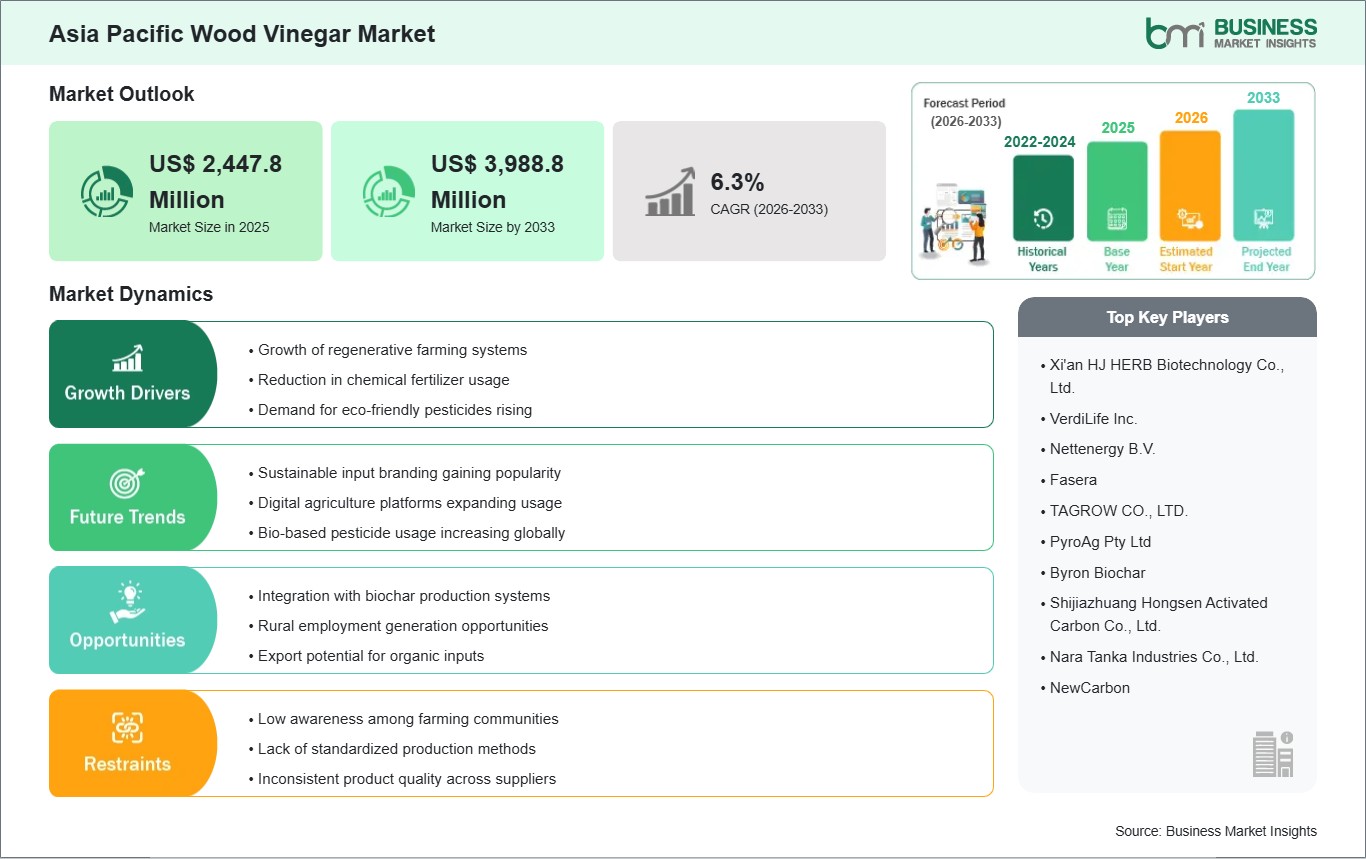
The Asia Pacific wood vinegar market size is expected to reach US$ 3,988.8 million by 2033 from US$ 2,447.8 million in 2025. The market is estimated to record a CAGR of 6.3% from 2026 to 2033.
The Asia Pacific wood vinegar market represents one of the most dynamic regions globally, supported by the strong presence of agricultural economies, abundant biomass resources, and growing interest in sustainable farming practices. Wood vinegar is getting more recognition in the area for crop growing, taking care of animals, composting, and protecting the environment. The market grows because there's plenty of farm leftovers, forest scraps, and more biomass being transformed. This gives a steady basis for both making and selling wood vinegar. The push to cut down on chemically intense farming is really propelling market growth. Farmers in many Asia Pacific countries are checking out bio-based stuff that boosts soil and crop health while keeping land use sustainable too. The government supporting organic farming and ecological agriculture helps too, along with initiatives on biomass use. This makes wood vinegar more accepted. Additionally, with a focus on agricultural sector to integrate the product in various farming systems-from basic crops to high-value horticulture. The market also benefits from expanding awareness of circular economy principles, encouraging the conversion of agricultural and forestry waste into commercially valuable products. There are still challenges with maintaining consistent product quality and standards. Production varies, and not everyone knows how to use the products properly. In some developing markets, limited tech knowledge about application methods holds back wider acceptance.Despite these constraints, the Asia Pacific region continues to offer significant opportunities for wood vinegar producers due to its extensive biomass availability, strong agricultural base, and increasing focus on sustainable resource management.

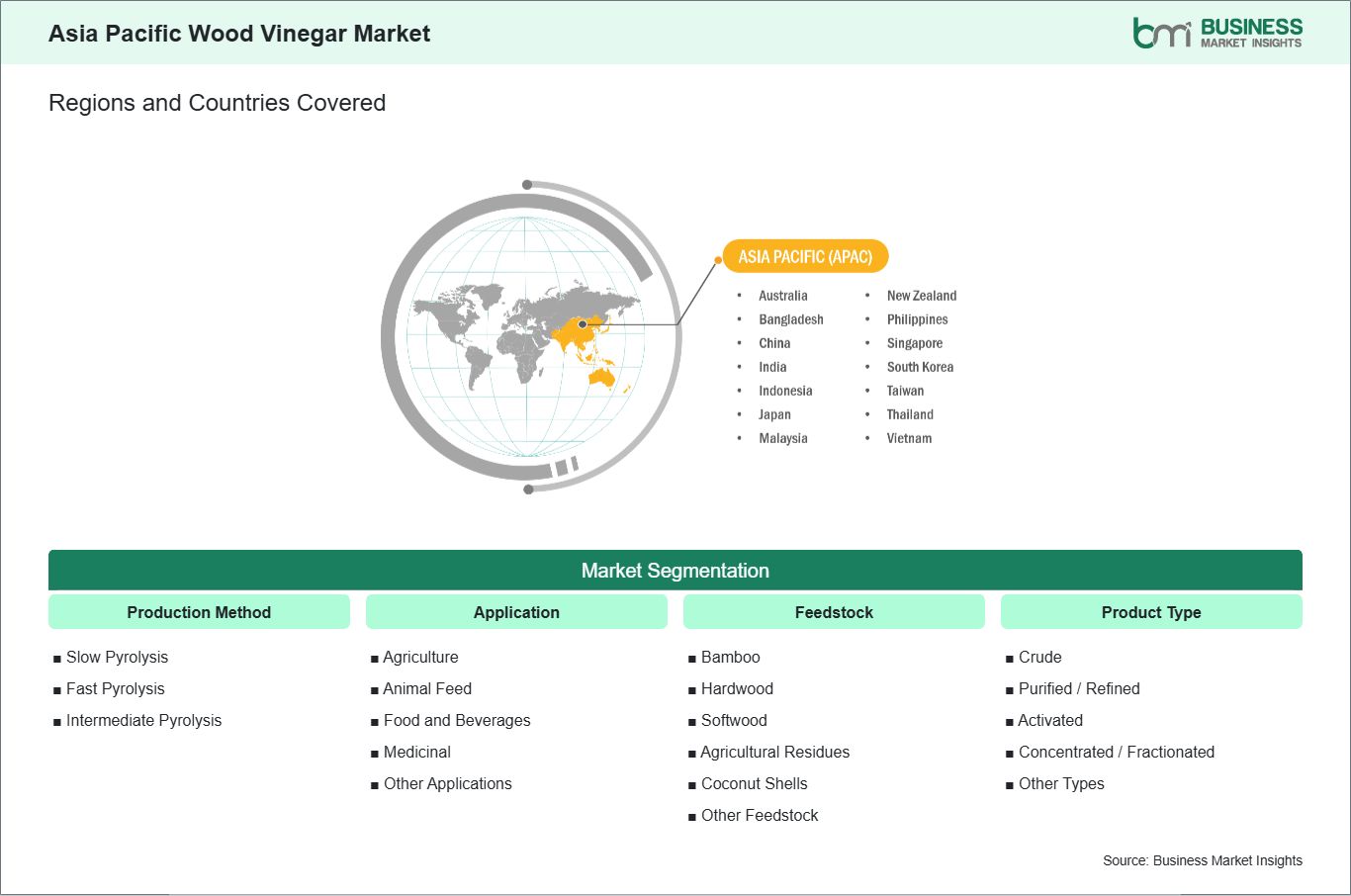
Key segments that contributed to the derivation of the Asia Pacific wood vinegar market analysis pyrolysis method, application, feedstock, type, and purity.
The Asia-Pacific wood vinegar market is benefiting from the rapid adoption of regenerative farming systems aimed at restoring soil fertility and improving long-term agricultural resilience. Across major agriculture regions, farmers are now more focused on boosting soil organic matter and microbe activity, while cutting down on synthetic stuff. Wood vinegar works great in these systems since it helps with nutrient recycling and soil health. This aligns with sustainable farming practices too. In countries where cultivation is really intense, farmers want to boost soil productivity without harming the environment. This creates perfect conditions for using wood vinegar.
The growing concern over soil degradation is another important driver. Large agricultural regions in South and Southeast Asia face challenges related to nutrient depletion, declining soil structure, and reduced water retention capacity. With more support from governments, agricultural cooperatives, and eco-friendly food businesses, regenerative agriculture programs are growing. Wood vinegar is being looked at more for use in growing crops, managing pests naturally, and restoring soil. This is happening a lot in rice, veggie, and fruit farming spots that need to keep their soil healthy for good harvests over time.
The trend is also supported by increasing awareness among commercial growers regarding the economic benefits of regenerative practices. Plantation crops, horticultural farms, and export-oriented ag producers are going greener to meet sustainability demands from international buyers. In markets like Japan, Australia, and parts of Southeast Asia, growers are using wood vinegar in their regenerative farming practices. This transition is expected to contribute significantly to market growth across the region.
A major opportunity for the Asia-Pacific wood vinegar market lies in its integration with expanding biochar production systems. The region generates substantial volumes of agricultural and forestry biomass residues, creating favorable conditions for pyrolysis-based processing facilities. Wood vinegar comes from making biochar, boosting investments in these technologies could make more wood vinegar and help it become more popular. This plan improves resource use by turning farm waste into valuable stuff instead of just trash. So, we get several useful products and solve waste issues at the same time.
Across the region, many countries promote circular economy initiatives to use crop residues, forestry by-products, and organic waste. These biochar projects boost soil carbon and cut waste, helping the climate too. They can also build a helpful supply chain for wood vinegar. Agricultural producers increasingly want to use both biochar and wood vinegar since these products can enhance soil quality, nutrient retention, and biological activity when used together. This combo also ramps up biological activity. As a result, suppliers can market them as a packaged solution for soil improvement rather than standalone products.s
The opportunity is particularly attractive in countries with large biomass resources and growing sustainability investments. Rural processing clusters can make biochar and wood vinegar for local farms, cutting transport costs and boosting accessibility. As industries look to get more value from biomass materials, integrated systems will probably spread throughout the area. This could stabilize supply, grow business uses, and boost the Asia-Pacific wood vinegar market's long-term growth. It'll create a more efficient and sustainable production system, strengthening the global market.

The Asia Pacific wood vinegar market is experiencing steady growth, with market size and share analysis reflecting evolving treatment preferences and competitive dynamics among key players. The report evaluates important subsegments categorized within pyrolysis method, application, feedstock, type, and purity, highlighting their respective contributions to market performance.
By the pyrolysis method, the slow pyrolysis wood subsegment dominated the market in 2025, due to its ability to maximize wood vinegar yield while maintaining low production costs. Slow pyrolysis is the most widely used production method. It enables efficient recovery of condensable compounds and is suitable for large-scale operations.
Based on applications, the agriculture subsegment dominated the market in 2025 because wood vinegar is extensively used as a natural fertilizer enhancer, soil conditioner, and biopesticide in agriculture, which remains the leading application segment. Growing interest in sustainable farming practices has increased its adoption. Its versatility across crops continues to drive demand.
On the basis of feedstock, the hardwood subsegment dominated the market in 2025, due to its high density and favorable chemical composition. Hardwood produces wood vinegar with consistent quality and desirable properties. It generates a rich concentration of organic compounds beneficial for agricultural use. Its widespread availability supports its dominance as a feedstock.
In terms of type, the crude subsegment dominated the market in 2025, because crude wood vinegar requires minimal processing and offers a cost-effective solution for end users, and it holds the largest market share. It is widely accepted for agricultural applications where extensive purification is unnecessary.
By purity, the low-purity subsegment dominated the market in 2025, due to its lower manufacturing costs and suitability for bulk agricultural applications. Farmers prefer it because high purification levels are not required for soil and crop treatment.
| Report Attribute | Details |
|---|---|
| Market size in 2025 | US$ 2,447.8 Million |
| Market Size by 2033 | US$ 3,988.8 Million |
| CAGR (2026 - 2033) | 6.3% |
| Historical Data | 2022-2024 |
| Forecast period | 2026-2033 |
| Segments Covered | By Production Method
|
|
Regions and Countries Covered
| |
| Asia Pacific | China, Japan, South Korea, India, Australia, New Zealand, Indonesia, Malaysia, Philippines, Singapore, Thailand, Vietnam, Taiwan, Bangladesh |
| Market leaders and key company profiles |
|
The "Asia Pacific Wood Vinegar Market Size And Forecast (2022-2033)" report provides a detailed analysis of the market covering below areas:
The geographical scope of the Asia Pacific wood vinegar market report is divided into: China, Japan, South Korea, India, Australia, New Zealand, Indonesia, Malaysia, the Philippines, Singapore, Thailand, Vietnam, Taiwan, Bangladesh, and the Rest of Asia. China held the largest share in 2025.
China dominates the Asia Pacific wood vinegar market, supported by its vast agricultural sector, substantial biomass resources, and well-established biomass pyrolysis industry. The country's leadership stems from its ability to convert large volumes of agricultural residues, forestry waste, and wood-processing by-products into value-added bio-based products. As sustainability becomes an increasingly important component of agricultural and industrial development strategies, wood vinegar has emerged as a practical solution for improving resource efficiency and promoting environmentally responsible production practices.
Agricultural applications remain the primary driver of demand in China. Farmers are increasingly utilizing wood vinegar in crop cultivation, soil improvement programs, and integrated farming systems aimed at reducing reliance on synthetic agricultural inputs. The product is also gaining traction in fruit cultivation, vegetable farming, tea plantations, and specialty crop production, where producers seek natural solutions to support soil vitality and crop performance. In parallel, livestock operators are exploring wood vinegar for odor control and farm management applications.
China's strong manufacturing capabilities and extensive biomass processing infrastructure provide a competitive advantage in both production and commercialization. Numerous enterprises are engaged in biomass carbonization and pyrolysis activities, creating an established supply network for wood vinegar and related by-products. Research institutions and agricultural technology organizations are also actively investigating new applications, helping expand the product's commercial relevance.
The country's ongoing commitment to rural modernization, sustainable agriculture, and biomass resource utilization continues to strengthen market prospects. Supported by abundant feedstock availability and growing environmental awareness, China remains the central hub for wood vinegar production, innovation, and consumption within the Asia Pacific region.

The Asia Pacific wood vinegar market is evaluated by gathering qualitative and quantitative data post primary and secondary research, which includes important corporate publications, association data, and databases. A few of the key developments in the Asia Pacific wood vinegar market are:
The Asia Pacific Wood Vinegar Market is valued at US$ 2,447.8 Million in 2025, it is projected to reach US$ 3,988.8 Million by 2033.
As per our report Asia Pacific Wood Vinegar Market, the market size is valued at US$ 2,447.8 Million in 2025, projecting it to reach US$ 3,988.8 Million by 2033. This translates to a CAGR of approximately 6.3% during the forecast period.
The Asia Pacific Wood Vinegar Market report typically cover these key segments-
The historic period, base year, and forecast period can vary slightly depending on the specific market research report. However, for the Asia Pacific Wood Vinegar Market report:
The Asia Pacific Wood Vinegar Market is populated by several key players, each contributing to its growth and innovation. Some of the major players include:
The Asia Pacific Wood Vinegar Market report is valuable for diverse stakeholders, including:
Essentially, anyone involved in or considering involvement in the Asia Pacific Wood Vinegar Market value chain can benefit from the information contained in a comprehensive market report.
Please tell us your area of interest
(Market Segments/ Regions and Countries/ Companies)