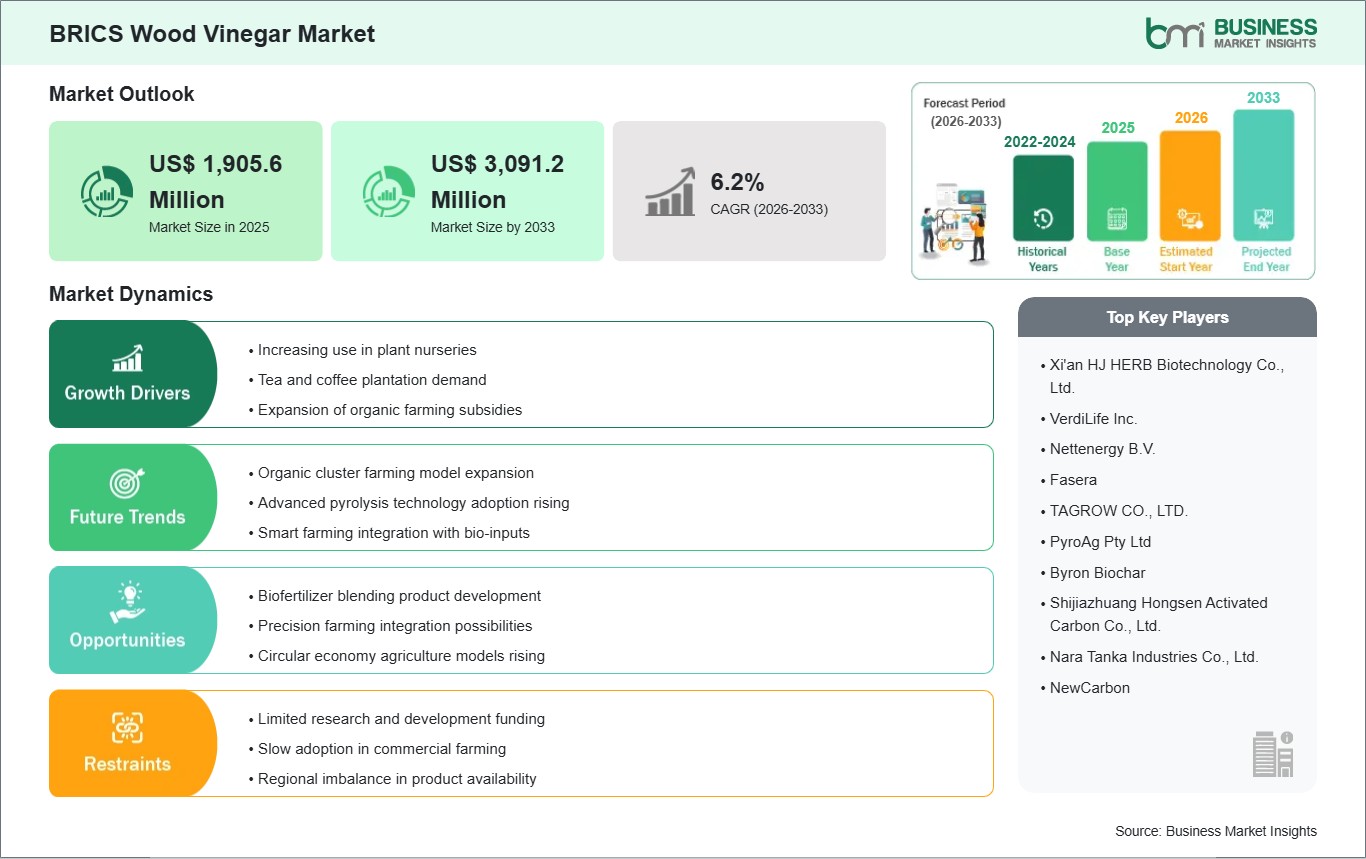
The BRICS wood vinegar market size is expected to reach US$ 3,091.2 million by 2033 from US$ 1,905.6 million in 2025. The market is estimated to record a CAGR of 6.2% from 2026 to 2033.
The BRICS wood vinegar market is experiencing growing momentum due to the increasing emphasis on sustainable agriculture, biomass utilization, and environmentally friendly production practices across member countries. Wood vinegar has gained recognition as a versatile bio-based product with applications in agriculture, livestock management, soil conditioning, compost enhancement, and environmental treatment. The market is being shaped by the abundance of agricultural and forestry residues available throughout BRICS nations, creating favorable conditions for biomass conversion and value-added product development. A key driver of market growth is the rising interest in reducing dependence on synthetic agricultural inputs while improving soil productivity and crop quality. The BRICS nations are witnessing an increasing trend among their respective governments and the agricultural fraternity towards the use of sustainable agriculture practices, circular economies, and converting wastes into resources. As a result, wood vinegar has gained considerable popularity owing to its inherent advantages. Furthermore, there is an increased emphasis on preventing soil degradation and environmental conservation, which is leading to widespread usage amongst commercial farmers and agricultural societies. However, the market faces several challenges. Product standardization remains inconsistent across different countries and production facilities, resulting in varying quality levels and application outcomes. The lack of knowledge among farmers who use traditional methods and the prevalence of existing products in agriculture may also hinder the growth of the market. In addition, regulations that govern biobased agricultural inputs are inconsistent among BRICS countries.

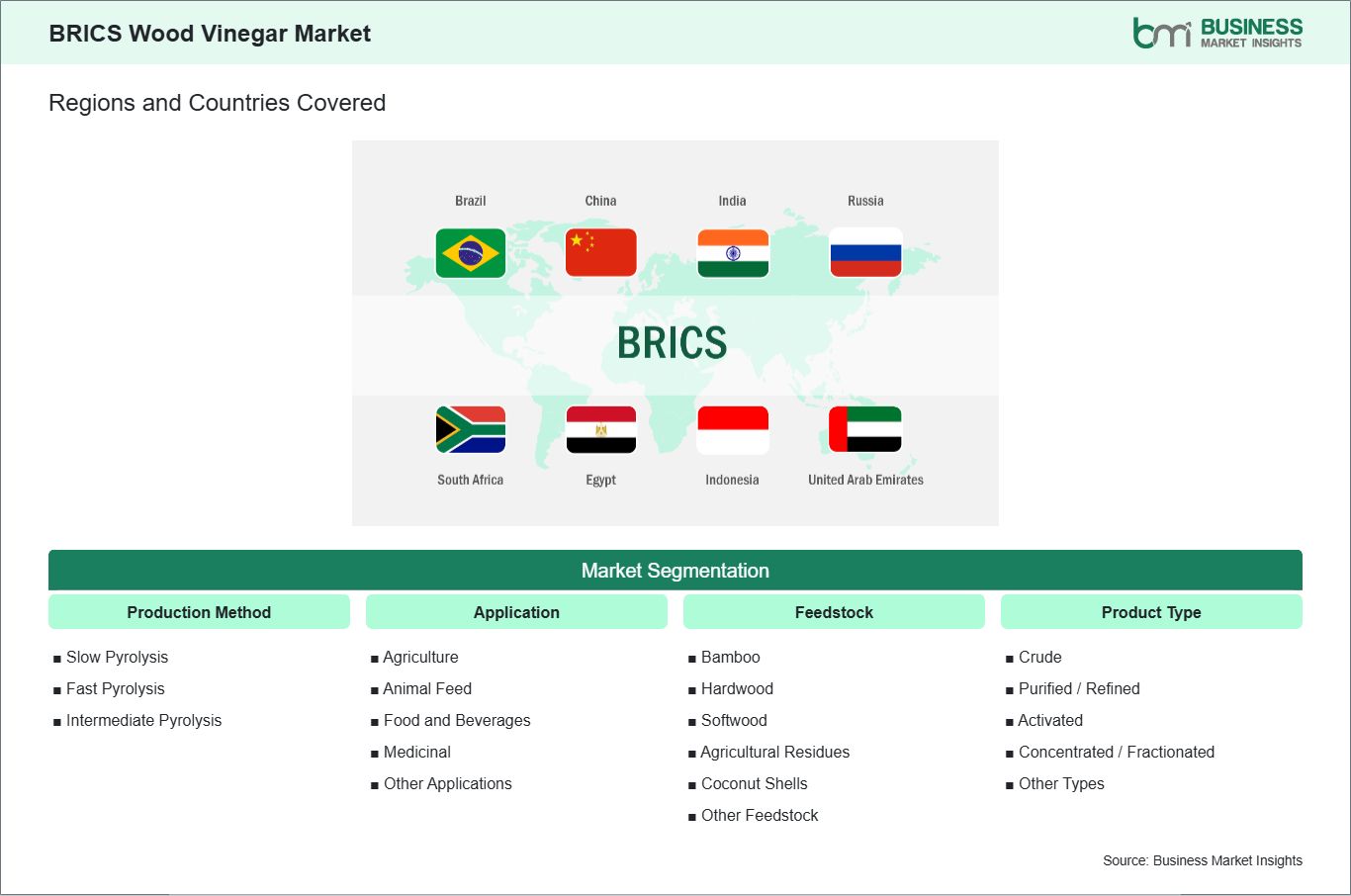
Key segments that contributed to the derivation of the BRICS wood vinegar market analysis are pyrolysis method, application, feedstock, type, and purity.
The BRICS wood vinegar market is experiencing growth due to its increasing use in commercial plant nurseries and seedling production facilities. Across BRICS countries, demand for healthy planting material has risen as governments and private growers invest in reforestation, horticulture, fruit cultivation, and commercial agriculture projects. Nursery owners continue to be attracted to the use of natural inputs that promote root growth, enhance seedling health, and cut down on the use of artificial crop protectants. Wood vinegar has proved to be one such input whose use is becoming common in modern-day nurseries.
In countries such as Brazil, India, and China, large-scale nursery networks play a critical role in supplying seedlings for fruit orchards, plantation crops, urban landscaping, and forestry initiatives. The nursery managers have been studying the use of wood vinegar within the media used for growing crops, irrigation methods, and general plant care. The suitability of the wood vinegar in environmentally friendly agricultural practices makes it suitable for use by nurseries that supply crops to organic farming initiatives. This trend is strengthening demand across both public and private nursery operations.
The driver is also supported by increasing awareness of sustainable agriculture throughout the BRICS region. Governments are encouraging the adoption of environmentally responsible cultivation methods, while growers seek solutions that improve plant establishment rates and overall crop performance. As nursery owners focus on producing healthier plants and making better use of resources, wood vinegar is gaining importance as part of propagation systems. The growing application of wood vinegar in nurseries will play a major role in contributing to market growth within the diverse agricultural environment of the BRICS countries.
The development of blended biofertilizer products represents a major opportunity for the BRICS wood vinegar market. The agricultural systems in the BRICS countries are shifting to an integrated nutrient management system using organic materials along with biological ones in order to enhance soil fertility without being overly dependent on fertilizers. Wood vinegar has gained importance because of its possible role in biofertilizers. This creates opportunities for manufacturers to develop differentiated products tailored to regional crop requirements.
China and India are witnessing growing investment in biofertilizer innovation as policymakers promote sustainable farming and soil restoration initiatives. Companies are currently considering the development of formulations that integrate various positive effects of beneficial microbes, organic materials, bio-char, and wood vinegar. This combination is intended to solve soil degradation issues while ensuring sustained agricultural production levels. A similar trend is evident in Brazil, where biologic-based inputs are currently being embraced by farmers growing soybeans, sugarcane, coffee, and other horticulture crops.
The opportunity extends beyond crop nutrition into broader regenerative agriculture programs being adopted across BRICS countries. There is currently a trend for farmers who look for fertilizers that offer multiple agronomic benefits with one application. These biofertilizers that incorporate wood vinegar in their formulation can be helpful in satisfying such a need. As the research organizations and manufacturers continue developing new formulations, wood vinegar is predicted to emerge as a key ingredient in the growing market of biofertilizers in the BRICS countries.

The BRICS wood vinegar market is experiencing steady growth, with market size and share analysis reflecting evolving treatment preferences and competitive dynamics among key players. The report evaluates important subsegments categorized pyrolysis method, application, feedstock, type, and purity, highlighting their respective contributions to overall market performance.
By the pyrolysis method, the slow pyrolysis wood subsegment dominated the market in 2025, due to its ability to maximize wood vinegar yield while maintaining low production costs. Slow pyrolysis is the most widely used production method. It enables efficient recovery of condensable compounds and is suitable for large-scale operations.
Based on applications, the agriculture subsegment dominated the market in 2025 because wood vinegar is extensively used as a natural fertilizer enhancer, soil conditioner, and biopesticide in agriculture, which remains the leading application segment. Growing interest in sustainable farming practices has increased its adoption. Its versatility across crops continues to drive demand.
On the basis of feedstock, the hardwood subsegment dominated the market in 2025, due to its high density and favorable chemical composition. Hardwood produces wood vinegar with consistent quality and desirable properties. It generates a rich concentration of organic compounds beneficial for agricultural use. Its widespread availability supports its dominance as a feedstock.
In terms of type, the crude subsegment dominated the market in 2025, because crude wood vinegar requires minimal processing and offers a cost-effective solution for end users, and it holds the largest market share. It is widely accepted for agricultural applications where extensive purification is unnecessary.
By purity, the low-purity subsegment dominated the market in 2025, due to its lower manufacturing costs and suitability for bulk agricultural applications. Farmers prefer it because high purification levels are not required for soil and crop treatment.
| Report Attribute | Details |
|---|---|
| Market size in 2025 | US$ 1,905.6 Million |
| Market Size by 2033 | US$ 3,091.2 Million |
| CAGR (2026 - 2033) | 6.2% |
| Historical Data | 2022-2024 |
| Forecast period | 2026-2033 |
| Segments Covered | By Production Method
|
|
Regions and Countries Covered
| |
| BRICS | Russia, Brazil, South Africa, India, China, Egypt, Indonesia, Saudi Arabia, United Arab Emirates |
| Market leaders and key company profiles |
|
The "BRICS Wood Vinegar Market Size and Forecast (2022-2033)" report provides a detailed analysis of the market covering below areas:
The geographical scope of the BRICS wood vinegar market report is divided into: Russia, Brazil, South Africa, India, China, Egypt, Indonesia, Saudi Arabia, and the UAE. China held the largest share in 2025.
China dominates the BRICS wood vinegar market due to its extensive agricultural sector, large-scale biomass availability, advanced pyrolysis industry, and strong governmental focus on sustainable resource utilization. The nation produces huge amounts of crop residue, forestry residue, bamboo residue, and other forms of biomass feedstock. The abundant source of raw materials in the nation has contributed to the establishment of an advanced system of production compared to other BRICS nations. The agricultural sector serves as the primary demand center for wood vinegar in China. In an effort to promote more sustainable agriculture practices that help enhance soil fertility while at the same time promoting plant growth, farmers have begun embracing biological and environmentally friendly inputs for these purposes. Wood vinegar is among such biological inputs that have been embraced because of their contribution towards sustainable agriculture management. The country's expanding organic farming sector has further contributed to demand for natural agricultural solutions. China's commitment to circular economy principles and rural sustainability initiatives has also strengthened market development. Numerous biomass conversion projects focus on maximizing the value of agricultural and forestry waste streams, creating opportunities for integrated production of biochar, wood vinegar, and related products. Research institutions and agricultural technology organizations continue to explore new applications for wood vinegar in crop production, environmental management, and industrial processes.

The BRICS wood vinegar market is evaluated by gathering qualitative and quantitative data post primary and secondary research, which includes important corporate publications, association data, and databases. A few of the key developments in the BRICS wood vinegar market are:
The BRICS Wood Vinegar Market is valued at US$ 1,905.6 Million in 2025, it is projected to reach US$ 3,091.2 Million by 2033.
As per our report BRICS Wood Vinegar Market, the market size is valued at US$ 1,905.6 Million in 2025, projecting it to reach US$ 3,091.2 Million by 2033. This translates to a CAGR of approximately 6.2% during the forecast period.
The BRICS Wood Vinegar Market report typically cover these key segments-
The historic period, base year, and forecast period can vary slightly depending on the specific market research report. However, for the BRICS Wood Vinegar Market report:
The BRICS Wood Vinegar Market is populated by several key players, each contributing to its growth and innovation. Some of the major players include:
The BRICS Wood Vinegar Market report is valuable for diverse stakeholders, including:
Essentially, anyone involved in or considering involvement in the BRICS Wood Vinegar Market value chain can benefit from the information contained in a comprehensive market report.
Please tell us your area of interest
(Market Segments/ Regions and Countries/ Companies)