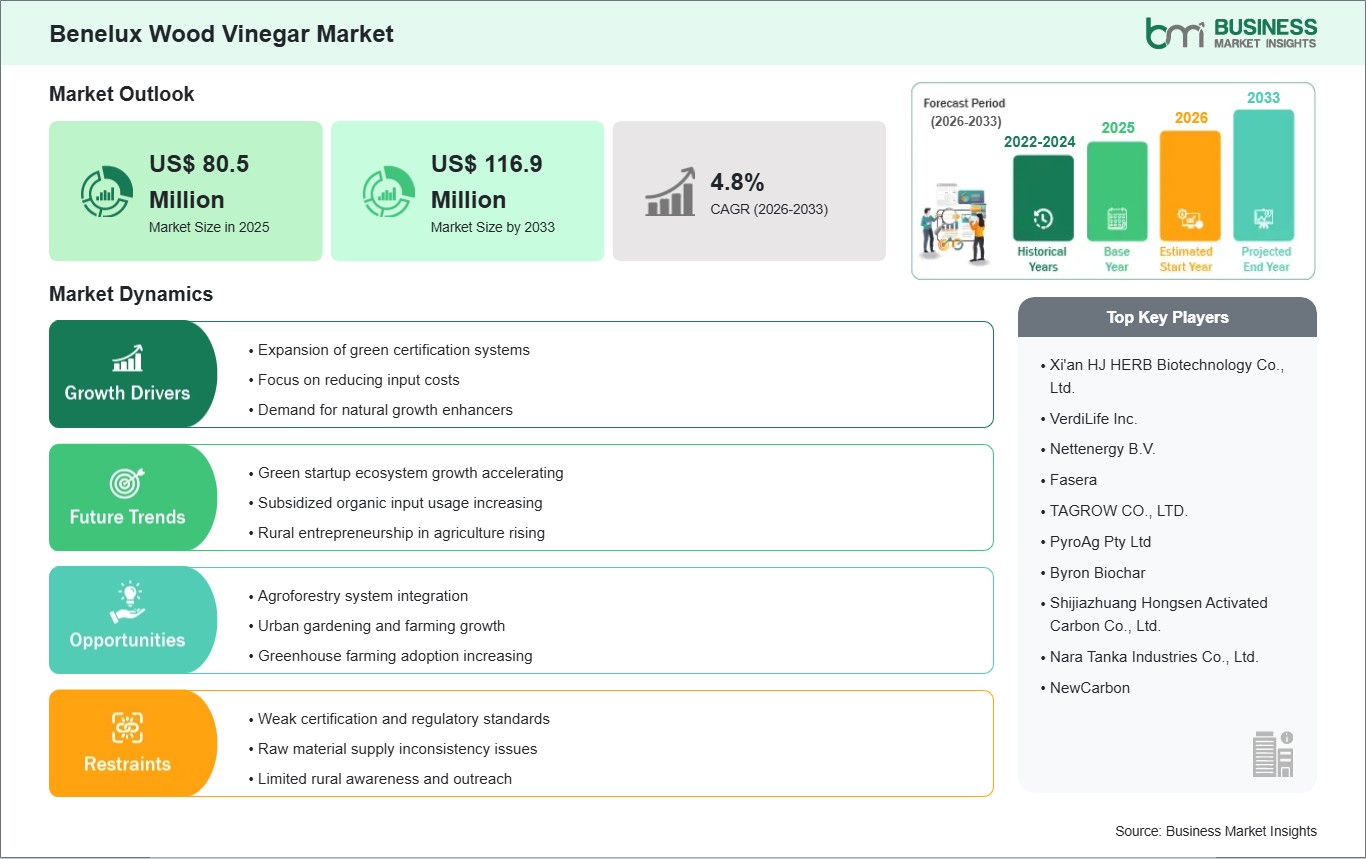
The Benelux wood vinegar market size is expected to reach US$ 116.9 million by 2033 from US$ 80.5 million in 2025. The market is estimated to record a CAGR of 4.8% from 2026 to 2033.
The Benelux wood vinegar market is evolving as sustainability initiatives, circular economy practices, and environmentally responsible agricultural solutions gain greater importance across the region. Wood vinegar is increasingly recognized as a bio-based product that aligns with regional goals related to waste valorization, reduced chemical dependency, and sustainable land management. The market benefits from growing interest in natural agricultural inputs, particularly among organic growers, greenhouse operators, and horticultural producers seeking alternatives to conventional crop protection and soil enhancement products.
The region's advanced environmental policies and strong focus on resource efficiency have created favorable conditions for the adoption of biomass-derived products. Wood vinegar is attracting attention for its applications in agriculture, compost enhancement, livestock management, and environmental treatment processes. The promotion of regenerative farming and sustainability in food production is expected to drive greater awareness and acceptance of the product. Moreover, institutions of research and innovation related to agriculture within the Benelux region are expected to continue exploring bio-based technologies that could enable climate-resilient farming.
Even with favorable market dynamics, there are still some issues that need to be addressed. Low commercialization level among ordinary agricultural producers, coupled with existing traditional competition in the industry, may serve as barriers for further market development. Differences in quality and application requirements by various manufacturers can also affect decision-making. Furthermore, the niche nature of the market means that distribution networks remain relatively specialized. Nevertheless, the region's commitment to sustainability, bioeconomy development, and environmentally friendly agricultural practices is expected to support continued interest in wood vinegar applications across the Benelux countries.

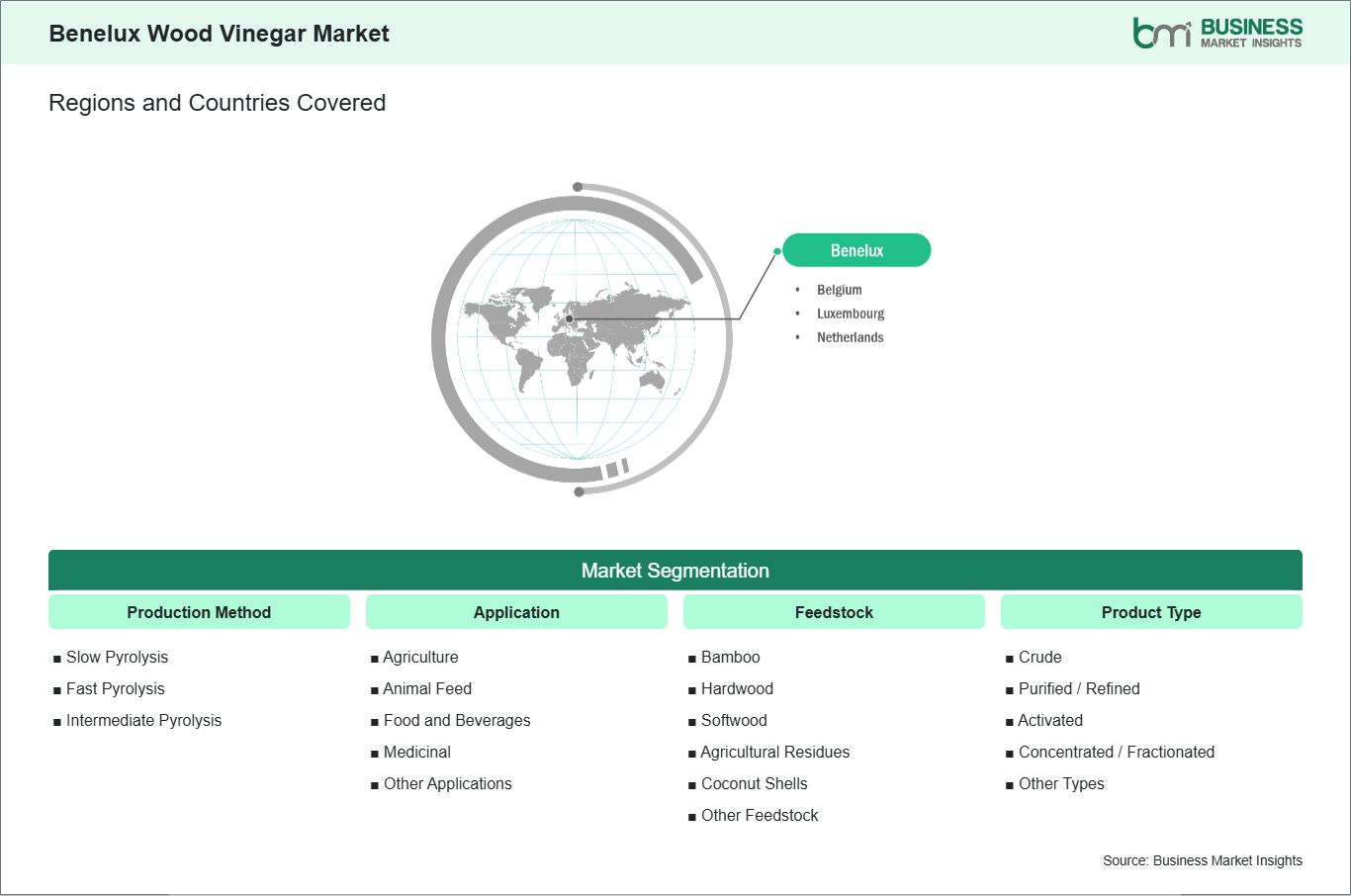
Key segments that contributed to the derivation of the Benelux wood vinegar marketanalysis are pyrolysis method, application, feedstock, type, and purity.
The Benelux wood vinegar market is being supported by the growing adoption of green certification systems across agriculture, horticulture, and forestry sectors. Producers are increasingly required to to show their environmentally friendly activities as retailers, food processors, and foreign buyers become more interested in sustainable practices. Wood vinegar is a good choice for such criteria since it is produced from biomass and contributes to the decrease in the use of artificial chemical agents in agriculture. Its compatibility with environmentally conscious farming practices is encouraging wider consideration among growers seeking certification compliance.
The Netherlands has become a prominent market for sustainable cultivation standards, particularly within greenhouse farming and high-value horticultural production. Growers have been experiencing more pressure to adhere to environmental standards regarding soil quality and efficient crop management. Wood vinegar is gaining popularity as a natural element that may be used to meet these demands. Similar developments are also taking place in Belgium, where accredited producers of fruit and vegetables are exploring new ways that conform to changing environmental standards.
The expansion of green certification programs is also influencing supply chains beyond primary agriculture. Sustainability considerations are becoming increasingly important for food companies, retail chains, and farming cooperatives when deciding on procurement methods, thus pressuring farmers to engage in activities that enhance their environmental performance. With the development of certifications within purchasing and manufacturing models in the Benelux countries, there is likely to be increased demand for bio-products like wood vinegar. This trend positions wood vinegar as a valuable component of sustainable farming systems and circular resource management initiatives.
The integration of agroforestry systems presents a significant opportunity for the Benelux wood vinegar market. Policymakers and agricultural agencies within the region have been promoting the integration of tree planting into farm environments as a strategy for enhancing biodiversity, carbon storage, and improved water management. These kinds of systems generate considerable quantities of wood and pruning wastes, which can be utilized for making wood vinegar through pyrolysis. This helps in creating a cycle of value creation, whereby byproducts from agroforestry are converted into inputs, which can be utilized back in the production system.
In the Netherlands and Belgium, agroforestry adoption has accelerated among livestock farms and mixed agricultural operations seeking greater environmental performance. Farmers have been increasingly planting tree strips, hedges, and adopting silvopasture for their farms as they look to adapt to climate change in addition to diversifying land uses. The rate at which agroforestry land is growing has been projected at 8-10% annually based on agricultural development in the Benelux countries. This growth increases the availability of woody feedstock while simultaneously creating demand for sustainable crop-support products such as wood vinegar.
Luxembourg is also promoting landscape restoration and biodiversity-focused farming practices that support wider agroforestry deployment. As farmers introduce tree cultivation alongside arable and grazing activities, there is growing interest in soil amendment and natural remedies for plants. One way that wood vinegar can contribute to this objective is by promoting regenerative agriculture practices and better resource use. With governments offering incentives for carbon-friendly land management and ecosystem restoration, agroforestry development is expected to create long-term opportunities for wood vinegar producers across the Benelux market.

The Benelux wood vinegar marketis experiencing steady growth, with market size and share analysis reflecting evolving treatment preferences and competitive dynamics among key players. The report evaluates important subsegments categorized within pyrolysis method, application, feedstock, type, and purity, highlighting their respective contributions to overall market performance.
By the pyrolysis method, the slow pyrolysis wood subsegment dominated the market in 2025, due to its ability to maximize wood vinegar yield while maintaining low production costs. Slow pyrolysis is the most widely used production method. It enables efficient recovery of condensable compounds and is suitable for large-scale operations.
Based on applications, the agriculture subsegment dominated the market in 2025 because wood vinegar is extensively used as a natural fertilizer enhancer, soil conditioner, and biopesticide in agriculture, which remains the leading application segment. Growing interest in sustainable farming practices has increased its adoption. Its versatility across crops continues to drive demand.
On the basis of feedstock, the hardwood subsegment dominated the market in 2025, due to its high density and favorable chemical composition. Hardwood produces wood vinegar with consistent quality and desirable properties. It generates a rich concentration of organic compounds beneficial for agricultural use. Its widespread availability supports its dominance as a feedstock.
In terms of type, the crude subsegment dominated the market in 2025, because crude wood vinegar requires minimal processing and offers a cost-effective solution for end users, and it holds the largest market share. It is widely accepted for agricultural applications where extensive purification is unnecessary.
By purity, the low-purity subsegment dominated the market in 2025, due to its lower manufacturing costs and suitability for bulk agricultural applications. Farmers prefer it because high purification levels are not required for soil and crop treatment.
| Report Attribute | Details |
|---|---|
| Market size in 2025 | US$ 80.5 Million |
| Market Size by 2033 | US$ 116.9 Million |
| CAGR (2026 - 2033) | 4.8% |
| Historical Data | 2022-2024 |
| Forecast period | 2026-2033 |
| Segments Covered | By Production Method
|
|
Regions and Countries Covered
| |
| Benelux | Belgium, Netherlands, Luxembourg |
| Market leaders and key company profiles |
|
The "Benelux Wood Vinegar Market Size and Forecast (2022-2033)" report provides a detailed analysis of the market covering below areas:
The geographical scope of the Benelux Wood vinegar market report is divided into: Belgium, the Netherlands, and Luxembourg. The Netherlands held the largest share in 2025.
The Netherlands represents the leading market for wood vinegar within the Benelux region, supported by its highly advanced agricultural sector, strong sustainability framework, and extensive adoption of innovative farming technologies. As one of Europe's most sophisticated agricultural economies, the country has demonstrated growing interest in biological inputs and environmentally responsible cultivation practices, creating favorable conditions for wood vinegar utilization. The Dutch agricultural sector is noted for having intensive horticulture, use of greenhouses, growing specialty crops, and high-value agricultural farming where farmers are always in pursuit of finding ways to improve the health of the soils and plant performances, and lessen their dependency on artificial chemicals. The use of wood vinegar is becoming an area of interest as a solution in sustainable crop management programs. The Netherlands also benefits from a well-developed circular economy ecosystem. The use of biomass and the concept of turning waste into value, along with other bio-innovation projects, have attracted attention to renewable products. Many research institutions, agricultural technology companies, and sustainability ventures are currently looking for alternative biological approaches to meet national environmental goals. This innovation-driven environment supports the development and commercialization of wood vinegar applications beyond traditional agricultural uses.

The Benelux wood vinegar market is evaluated by gathering qualitative and quantitative data post primary and secondary research, which includes important corporate publications, association data, and databases. A few of the key developments in the Benelux wood vinegar market are:
The Benelux Wood Vinegar Market is valued at US$ 80.5 Million in 2025, it is projected to reach US$ 116.9 Million by 2033.
As per our report Benelux Wood Vinegar Market, the market size is valued at US$ 80.5 Million in 2025, projecting it to reach US$ 116.9 Million by 2033. This translates to a CAGR of approximately 4.8% during the forecast period.
The Benelux Wood Vinegar Market report typically cover these key segments-
The historic period, base year, and forecast period can vary slightly depending on the specific market research report. However, for the Benelux Wood Vinegar Market report:
The Benelux Wood Vinegar Market is populated by several key players, each contributing to its growth and innovation. Some of the major players include:
The Benelux Wood Vinegar Market report is valuable for diverse stakeholders, including:
Essentially, anyone involved in or considering involvement in the Benelux Wood Vinegar Market value chain can benefit from the information contained in a comprehensive market report.
Please tell us your area of interest
(Market Segments/ Regions and Countries/ Companies)