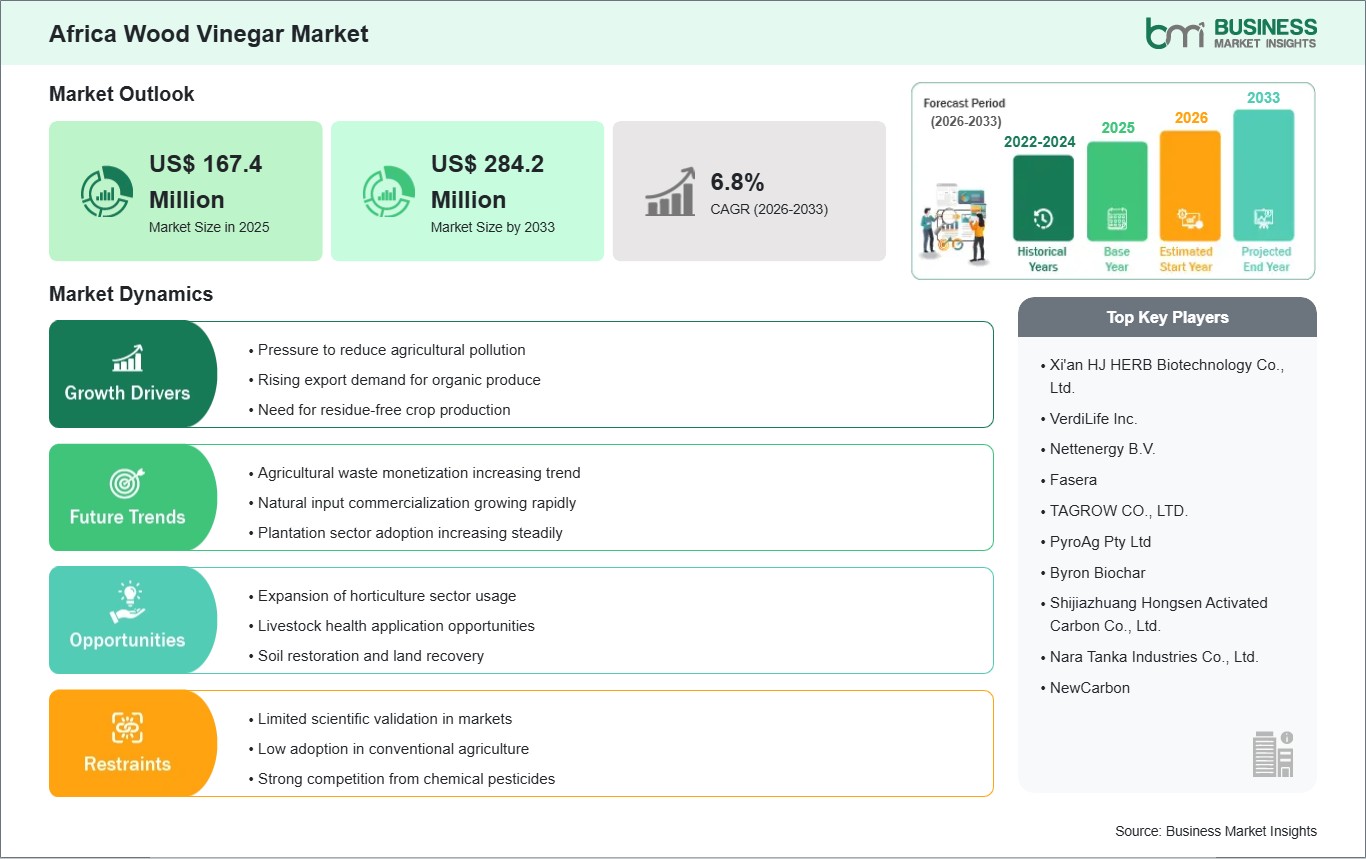
The Africa wood vinegar market size is expected to reach US$ 284.2 million by 2033 from US$ 167.4 million in 2025. The market is estimated to register a CAGR of 6.8% from 2026 to 2033.
The Africa wood vinegar market is growing, shift toward sustainable agriculture and a circular bioeconomy on the continent. In Africa, people boost soil health, enhance crop resilience to climate variability, and minimize reliance on expensive chemical inputs through sustainable alternatives. A driver of growth is Africa's large agrarian base, where smallholder farmers are looking for cheap soil conditioners and natural ways to manage pests. Wood vinegar is gaining recognition for its ability to enhance seed germination, accelerate composting, and provide eco-friendly pest management without leaving toxic residues. It is starting to be used in livestock odor control and organic waste management in semi-commercial farming setups. Farmers often have limited knowledge of wood vinegar, and its availability is inconsistent. In addition, the lack of standardized production practices leads to variations in product quality. Many producers are operating on a small or experimental scale. Distribution networks are weak, especially in rural areas where there's the most potential demand. Despite the hurdles, Africa has great long-term potential. It has tons of agricultural leftovers, forestry stuff, and a growing interest in regenerative farming. The market will grow slowly but steadily with increasing awareness and through pilot farming projects, plus more education on bio-based inputs in farming communities.

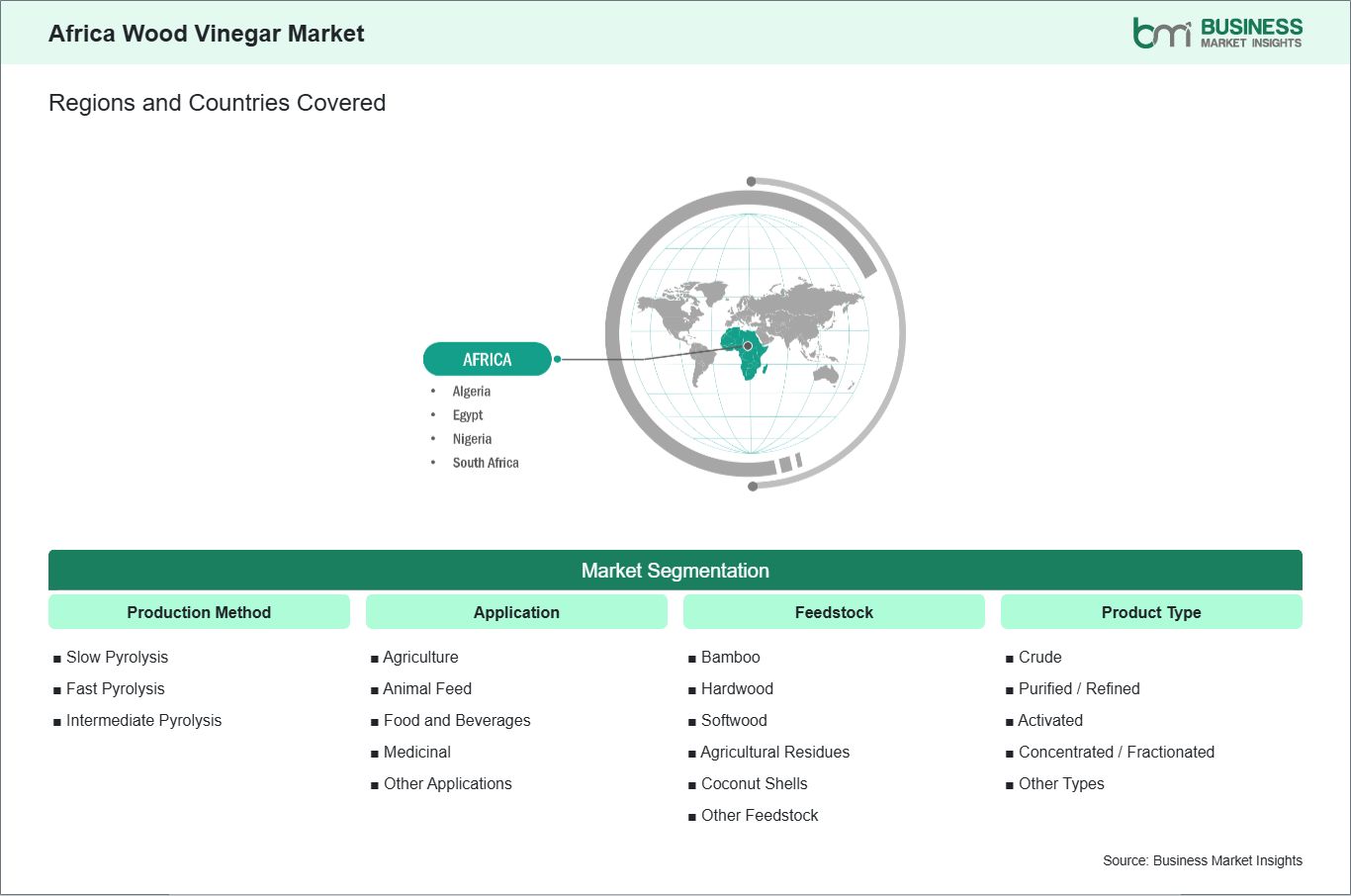
Key segments that contributed to the derivation of the Africa wood vinegar market analysis are pyrolysis method, application, feedstock, type, and purity.
In Africa, the push to cut agricultural pollution is driving the demand for wood vinegar in farming. There are several side effects of synthetic fertilizers and pesticides, which cause soil acidification, water contamination, and less biodiversity. People near the Nile and Niger basins have serious concerns about chemicals flowing into water sources, fueling the demand for wood vinegar.
In Kenya, South Africa, and Nigeria, governments and agricultural groups are pushing for less dependence on chemicals in farming. They do this by promoting sustainable practices, even if the enforced rules differ from country to country. Also, more places align with international standards, particularly in farming for exports. Wood vinegar aids in making compost and curbs the use of synthetic products that stress the environment.
Farmer cooperatives and non-governmental groups are also boosting awareness. They run training sessions on soil regeneration and climate-resilient farming, emphasizing bio-based inputs. In badly hit semi-arid areas, farmers are trying out wood vinegar. It helps with soil microbial activity and cuts down on harmful chemical buildup. As this eco-friendly mindset grows, so does market acceptance.
Africa's horticulture sector is growing, increasing the demand for wood vinegar, especially for high-value crops. Kenya, Ethiopia, and Morocco lead with big export businesses in flowers, veggies, fruits, and herbs. To meet the strict quality requirements of overseas buyers, they need to keep their soil in top shape. This has made them interested in natural products such as wood vinegar.
They're also increasing greenhouse and irrigated farmlands to grow tomatoes, peppers, cucumbers, and leafy greens all year round. In these setups, wood vinegar boosts roots, makes compost better, and helps control diseases in the soil. As it fits well with organic and low-residue farming, it appeals to producers aiming at those pricier markets in Europe and the Middle East.
Smallholder farmers are mixing horticultural crops into their farms to earn extra cash. In areas near cities and spots with irrigation, fruits such as mangoes and citrus, with onions and leafy greens, are becoming big deals. Programs supporting agriculture push for sustainable inputs to boost farm output while keeping soils healthy. With horticulture growing in Africa, wood vinegar is seen as a handy way to amp up soil health and help crops resist stress better.

The wood vinegar market in Africa is experiencing steady growth, with market size and share analysis reflecting evolving treatment preferences and competitive dynamics among key players. The report evaluates important subsegments categorized within the pyrolysis method, application, feedstock, type, and purity, highlighting their respective contributions to market performance.
By pyrolysis method, the slow pyrolysis wood subsegment dominated the market in 2025, due to its ability to maximize wood vinegar yield while maintaining low production costs. Slow pyrolysis enables efficient recovery of condensable compounds and is suitable for large-scale operations. Its proven reliability and economic advantages support its market dominance.
Based on applications, the agriculture subsegment dominated the market in 2025 as wood vinegar is extensively used as a natural fertilizer enhancer, soil conditioner, and biopesticide in agriculture, which remains the leading application segment. Growing interest in sustainable farming practices has increased its adoption. Its versatility across various crops continues to drive demand.
By feedstock, the hardwood subsegment dominated the market in 2025, due to its high density and favorable chemical composition. Hardwood produces wood vinegar with consistent quality and desirable properties. It generates a rich concentration of organic compounds beneficial for agricultural use. Its widespread availability also supports its dominance as a feedstock.
In terms of type, the crude subsegment dominated the market in 2025, as crude wood vinegar requires minimal processing and offers a cost-effective solution for end users, and it holds the largest market share. It is widely accepted for agricultural applications where extensive purification is unnecessary. This affordability and practicality drive its continued dominance.
Based on purity, the low-purity subsegment dominated the market in 2025, due to its lower manufacturing costs and suitability for bulk agricultural applications. Low-purity wood vinegar leads the market. Farmers often prefer it as high purification levels are not required for soil and crop treatment.
| Report Attribute | Details |
|---|---|
| Market size in 2025 | US$ 167.4 Million |
| Market Size by 2033 | US$ 284.2 Million |
| CAGR (2026 - 2033) | 6.8% |
| Historical Data | 2022-2024 |
| Forecast period | 2026-2033 |
| Segments Covered | By Production Method
|
|
Regions and Countries Covered
| |
| Africa | Egypt, South Africa, Nigeria, Algeria |
| Market leaders and key company profiles |
|
The "Africa Wood Vinegar Market Size and Forecast (2022-2033)" report provides a detailed analysis of the market covering below areas:
The geographical scope of the Africa wood vinegar market report is divided into: Nigeria, Egypt, South Africa, and Algeria. South Africa held the largest share in 2025.
Driven by an advanced agricultural infrastructure and a strong emphasis on sustainable practices, South Africa leads the continent in wood vinegar adoption. The nation's commercial agricultural sector-particularly horticulture, viticulture, and forestry plantations-demonstrates a high affinity for bio-based inputs like wood vinegar.The country is ramping up efforts for soil regeneration and managing pests with an integrated approach. This leads to farmers and those in agribusiness starting to use wood vinegar. It helps boost microbial activity in the soil and lessens their reliance on chemicals. They're using wood vinegar in making compost faster, in greenhouse growing, and in organic farming. Leaving no chemical residues is crucial in these areas. The availability of biomass from products such as forestry residue, sugarcane waste, and agricultural by-products drives the market growthhe use of wood vinegar can support local production. Small producers and startup companies are adopting pyrolysis technology to produce wood vinegar for agricultural use. However, larger farms are generally more likely to adopt these products than smaller farms. Many small farmers are not aware of product availabilities and how to get consistent supplies. Since production methods vary, farmers do not trust the results.South Africa is becoming known as a go-to spot for these kinds of eco-friendly farm products. As more folks get into green certifications and better farming practices, wood vinegar will likely become more popular over time among farmers.

The Africa Wood vinegar market is evaluated by gathering qualitative and quantitative data post primary and secondary research, which includes important corporate publications, association data, and databases. A few of the key developments in the Africa Wood vinegar market are:
The Africa Wood Vinegar Market is valued at US$ 167.4 Million in 2025, it is projected to reach US$ 284.2 Million by 2033.
As per our report Africa Wood Vinegar Market, the market size is valued at US$ 167.4 Million in 2025, projecting it to reach US$ 284.2 Million by 2033. This translates to a CAGR of approximately 6.8% during the forecast period.
The Africa Wood Vinegar Market report typically cover these key segments-
The historic period, base year, and forecast period can vary slightly depending on the specific market research report. However, for the Africa Wood Vinegar Market report:
The Africa Wood Vinegar Market is populated by several key players, each contributing to its growth and innovation. Some of the major players include:
The Africa Wood Vinegar Market report is valuable for diverse stakeholders, including:
Essentially, anyone involved in or considering involvement in the Africa Wood Vinegar Market value chain can benefit from the information contained in a comprehensive market report.
Please tell us your area of interest
(Market Segments/ Regions and Countries/ Companies)