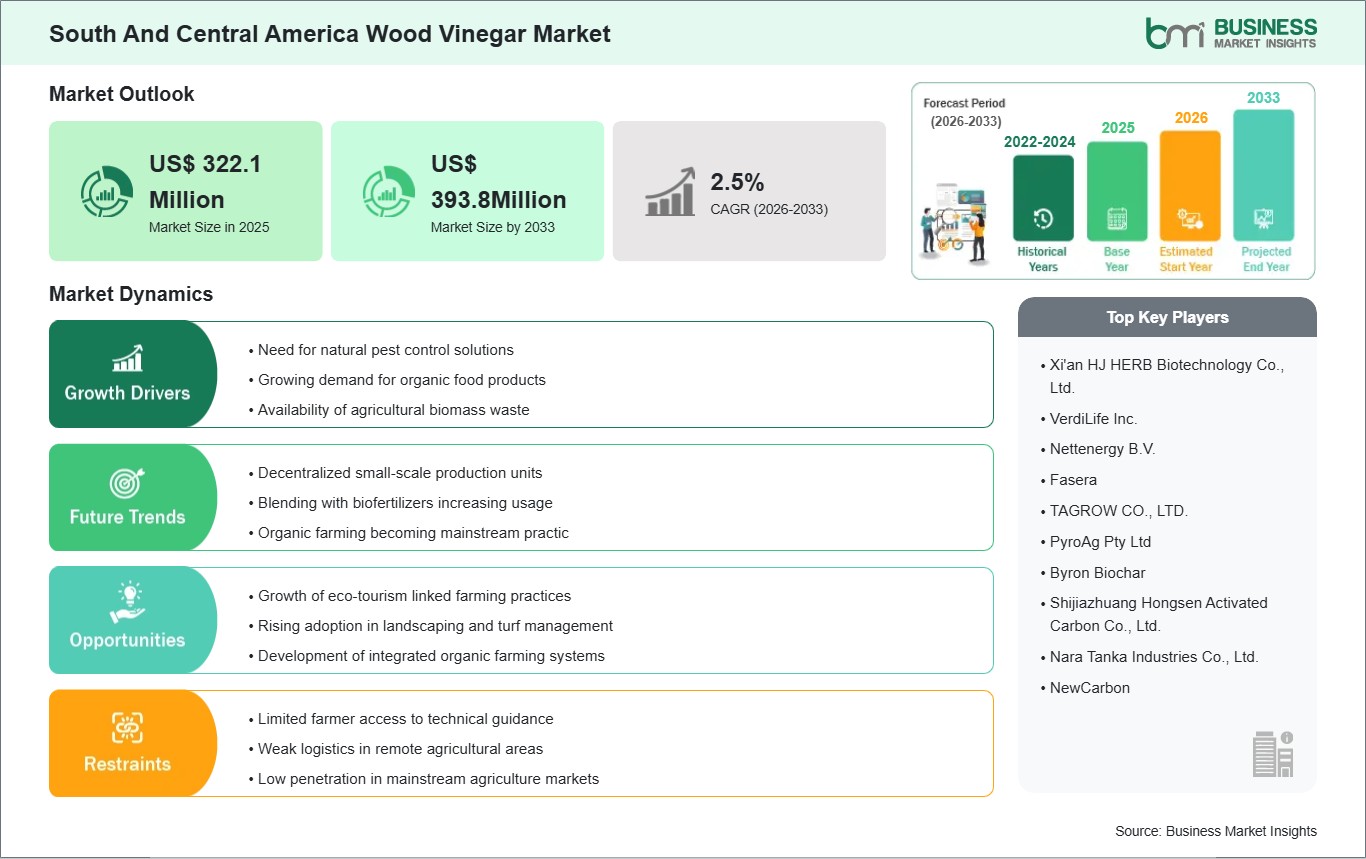
The South and Central America wood vinegar market size is expected to reach US$ 393.8 million by 2033 from US$ 322.1 million in 2025. The market is estimated to record a CAGR of 2.5% from 2026 to 2033.
The South and Central American wood vinegar market is becoming a small but promising part of the region's shift towards sustainable farming. Wood vinegar, which comes from biomass pyrolysis, is gaining notice for improving soil, supporting plant growth, and helping with pest control organically. This product's growth there links to the solid agricultural foundation and the increasing need to boost productivity without relying too much on synthetic chemicals. Growth comes from the region's big push in cash crops and plantation farming, along with a growing interest in regenerative farming. Farmers are looking into wood vinegar because it's cheap and helps with soil health, speeds up composting, and makes crops tougher. It works in livestock farms too, controlling odors, and is useful for managing organic waste in semi-industrial setups. Many small and medium farmers don't know about it, and there aren't standards for product quality. Moreover, getting it to rural areas is tough, which keeps consistent use down. Theoretical demand is high, but these issues slow things down. The market itself is new, with lots of small suppliers and not much made for commercial scale use yet. South and Central America offer a great long-term opportunity because of their abundant agricultural waste, favorable climate for biomass, and growing focus on sustainable land use. This market will develop slowly thanks to pilot projects, agri-innovations, and more education on bio-based inputs.

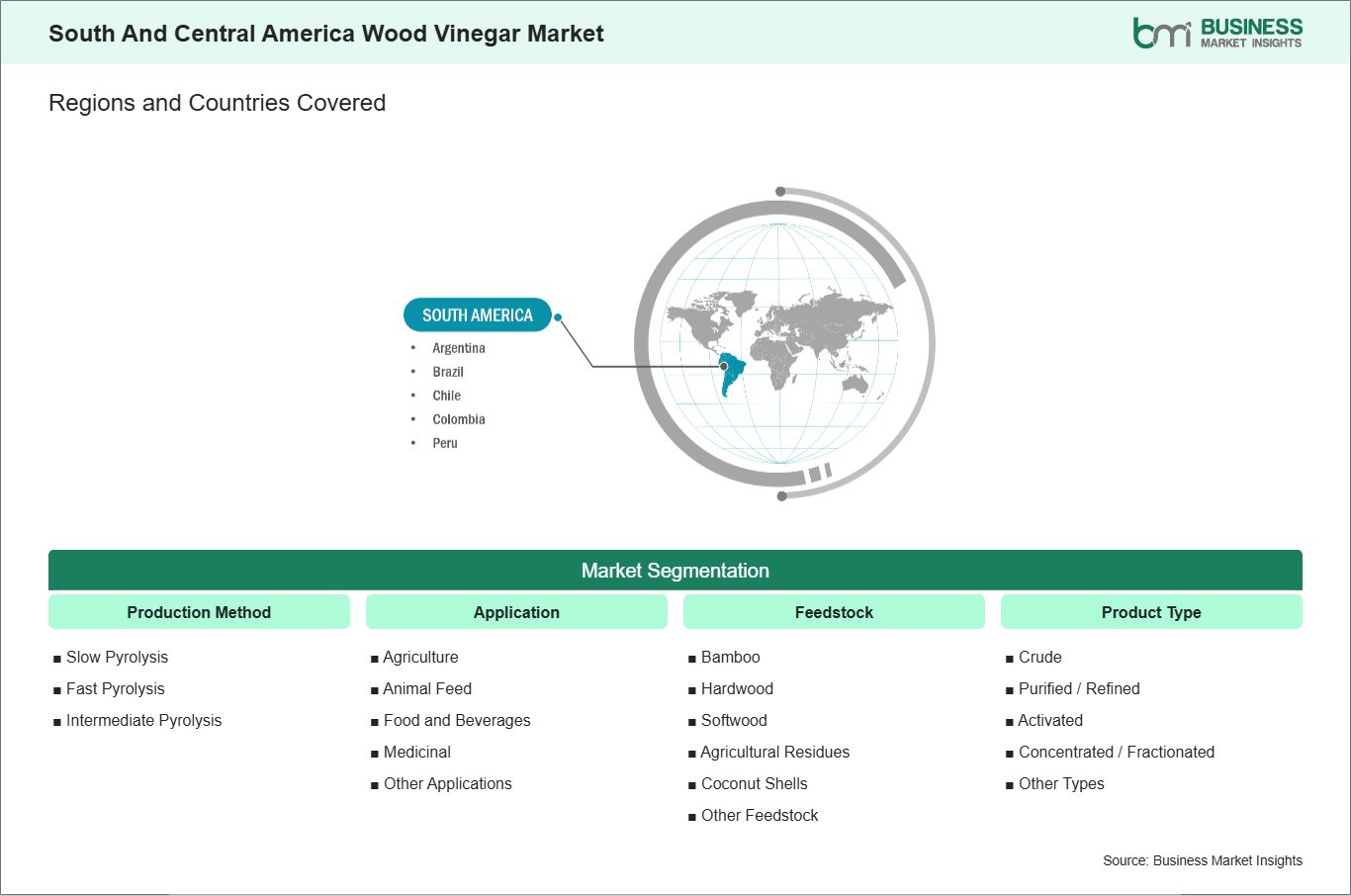
Key segments that contributed to the derivation of the South and Central America wood vinegar market analysis are pyrolysis method, application, feedstock, type, and purity.
The increasing need for natural pest control solutions is emerging as a key driver of the wood vinegar market in South and Central America. Growing awareness of the environmental and health risks associated with synthetic pesticides has encouraged farmers to adopt sustainable alternatives that can effectively protect crops while minimizing ecological impact. Wood vinegar, a natural byproduct of biomass pyrolysis, contains organic acids and bioactive compounds that help repel pests, suppress certain plant diseases, and improve overall crop health. Its eco-friendly profile makes it particularly attractive to producers seeking safer and more sustainable agricultural inputs.
The expansion of organic farming and integrated pest management (IPM) practices across the region is further supporting demand for wood vinegar. Countries with strong agricultural sectors are witnessing increased adoption of biological and naturally derived crop protection products as farmers strive to meet domestic and international requirements for residue-free and environmentally responsible food production. Wood vinegar serves as a multifunctional solution by reducing dependence on chemical pesticides while also promoting plant growth and soil health, enhancing its value proposition for growers.
In addition, rising consumer preference for organically produced fruits, vegetables, coffee, and other agricultural commodities is encouraging producers to implement sustainable farming methods. As governments, agricultural organizations, and export markets continue to promote reduced chemical usage, wood vinegar is gaining recognition as a cost-effective and natural pest control agent. This growing shift toward sustainable agriculture is expected to accelerate wood vinegar adoption and contribute significantly to market growth across South and Central America during the forecast period.
In South and Central America, farms are turning more to natural ways to beat pests, with wood vinegar leading the charge. Warm weather and crops grown all year long make regions in Brazil, Colombia, Peru, and Central America breeding grounds for pests. While chemical pesticides worked before, many bugs now resist these products. Plus, there's growing worry about chemicals damaging the environment. This is pushing farmers towards eco-friendly choices, like wood vinegar.
In Brazil's Sao Paulo state sugarcane belt and Colombia's coffee-growing regions, farmers are looking for ways to cut down on chemicals while keeping their crop yields steady. One thing they're testing out is wood vinegar, which can be used as a spritz or soil treatment to keep pests at bay and help plants deal with stress better. Plus, farmers are using it more in tropical fruits like bananas, pineapples, and citrus, where bugs are always a big problem.
Now, extension services and research places are really pushing low-residue farming techniques. The governments in Peru and Costa Rica, for example, back moves to lower pesticide use in crops meant for export. With the help of demo farms and co-op trials, wood vinegar is becoming a go-to for sustainable bug fighting. Because of all this, wood vinegar is getting a stronger foothold in how they do farming around there.

The South and Central America wood vinegar market is experiencing steady growth, with market size and share analysis reflecting evolving treatment preferences and competitive dynamics among key players. The report evaluates important subsegments categorized within pyrolysis method, application, feedstock, type, and purity, highlighting their respective contributions to overall market performance.
By the pyrolysis method, the slow pyrolysis wood subsegment dominated the market in 2025, due to its ability to maximize wood vinegar yield while maintaining low production costs. Slow pyrolysis is the most widely used production method. It enables efficient recovery of condensable compounds and is suitable for large-scale operations.
Based on applications, the agriculture subsegment dominated the market in 2025 because wood vinegar is extensively used as a natural fertilizer enhancer, soil conditioner, and biopesticide in agriculture, which remains the leading application segment. Growing interest in sustainable farming practices has increased its adoption. Its versatility across crops continues to drive demand.
On the basis of feedstock, the hardwood subsegment dominated the market in 2025, due to its high density and favorable chemical composition. Hardwood produces wood vinegar with consistent quality and desirable properties. It generates a rich concentration of organic compounds beneficial for agricultural use. Its widespread availability supports its dominance as a feedstock.
In terms of type, the crude subsegment dominated the market in 2025, because crude wood vinegar requires minimal processing and offers a cost-effective solution for end users, and it holds the largest market share. It is widely accepted for agricultural applications where extensive purification is unnecessary.
By purity, the low-purity subsegment dominated the market in 2025, due to its lower manufacturing costs and suitability for bulk agricultural applications. Farmers prefer it because high purification levels are not required for soil and crop treatment.
| Report Attribute | Details |
|---|---|
| Market size in 2025 | US$ 322.1 Million |
| Market Size by 2033 | US$ 393.8Million |
| CAGR (2026 - 2033) | 2.5% |
| Historical Data | 2022-2024 |
| Forecast period | 2026-2033 |
| Segments Covered | By Production Method
|
|
Regions and Countries Covered
| |
| South and Central America | Brazil, Argentina, Chile, Colombia, Peru |
| Market leaders and key company profiles |
|
The "South and Central America Wood Vinegar Market Size and Forecast (2022-2033)" report provides a detailed analysis of the market covering below areas:
The geographical scope of the South and Central America wood vinegar market report is divided into: Brazil, Argentina, Chile, Colombia, Peru, and the Rest of South and Central America. Brazil held the largest share in 2025.
Brazil is the leading market for wood vinegar in South and Central America. This is thanks to its huge farmland, plentiful biomass, and bigger push towards eco-friendly farming methods. With massive crop production including soybeans, sugarcane, coffee, and fruit, there's a big need for soil boosters that increase yields. This makes wood vinegar very useful. Farmers in Brazil want to cut down on chemicals and maintain soil health over time. They see wood vinegar as a way to help plants take up nutrients better and kickstart microbial activity in worn-out soils. It speeds up composting too, which benefits both commercial and smaller operations. Plus, it's catching on in organic farming because of its clean reputation in export-driven sectors. Brazil gets a big benefit from its plentiful biomass resources, like sugarcane bagasse, forestry leftovers, and farm waste. These offer good potential for making wood vinegar locally, fitting right in with the nation's solid bioenergy and bio-refining systems. It integrates nicely with their current agricultural supply chains too. Many farmers in far-off areas don't know much about wood vinegar. Additionally, production methods vary, leading to uneven quality. Some rural places also lack proper distribution, slowing down full-scale sales. Even so, Brazil will likely keep growing as the main spot for wood vinegar in the region. The country backs this up with its focus on organic farming and aiming for sustainable land use, adding to that solid base of agricultural exports.

The South and Central America wood vinegar market is evaluated by gathering qualitative and quantitative data post primary and secondary research, which includes important corporate publications, association data, and databases. A few of the key developments in the South and Central America wood vinegar market are:
The South And Central America Wood Vinegar Market is valued at US$ 322.1 Million in 2025, it is projected to reach US$ 393.8Million by 2033.
As per our report South And Central America Wood Vinegar Market, the market size is valued at US$ 322.1 Million in 2025, projecting it to reach US$ 393.8Million by 2033. This translates to a CAGR of approximately 2.5% during the forecast period.
The South And Central America Wood Vinegar Market report typically cover these key segments-
The historic period, base year, and forecast period can vary slightly depending on the specific market research report. However, for the South And Central America Wood Vinegar Market report:
The South And Central America Wood Vinegar Market is populated by several key players, each contributing to its growth and innovation. Some of the major players include:
The South And Central America Wood Vinegar Market report is valuable for diverse stakeholders, including:
Essentially, anyone involved in or considering involvement in the South And Central America Wood Vinegar Market value chain can benefit from the information contained in a comprehensive market report.
Please tell us your area of interest
(Market Segments/ Regions and Countries/ Companies)