Market Summary
Executive Summary and Market Analysis
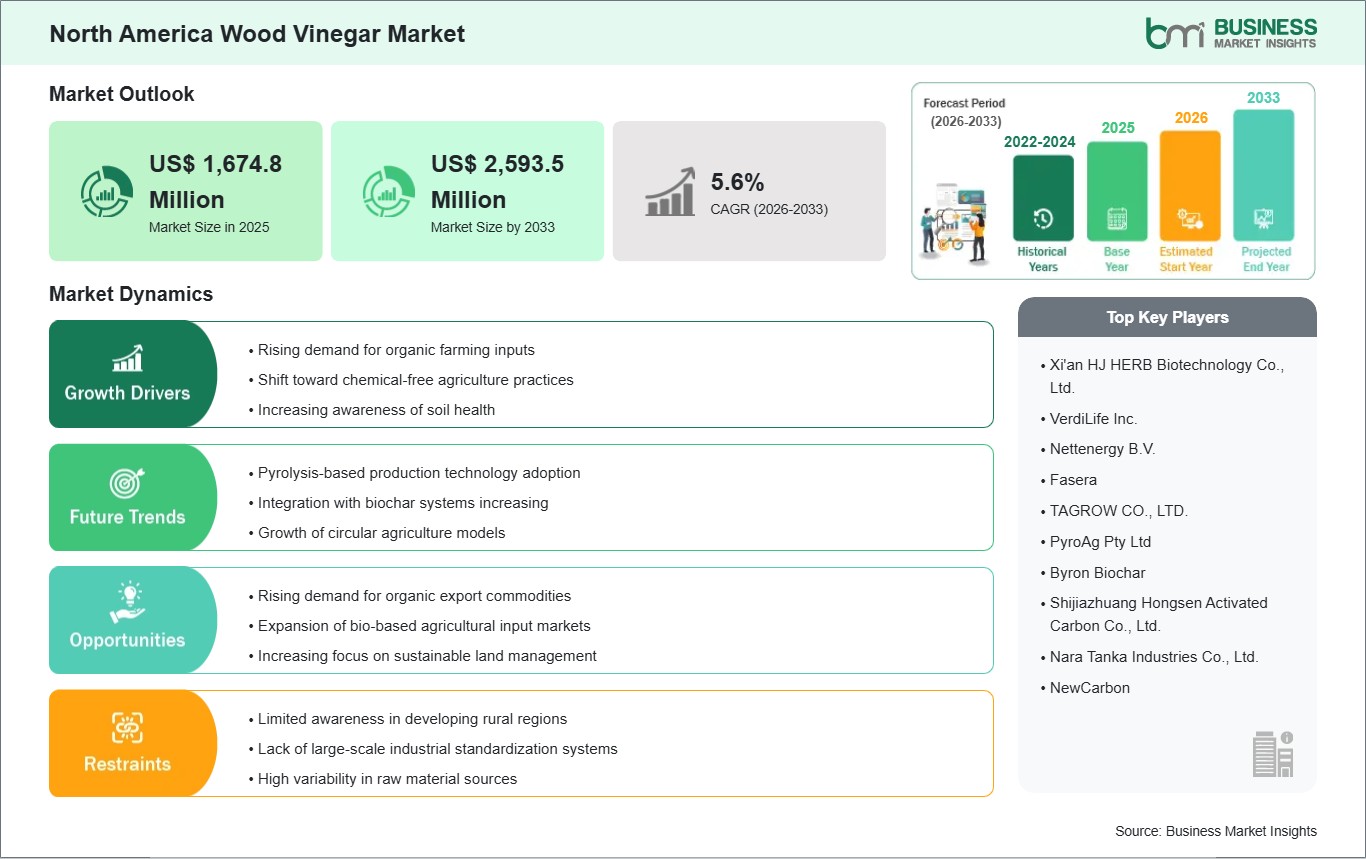
The North America wood vinegar market is growing and fits into the broader move toward regenerative agriculture and greener farming practices. Made by heating wood in the absence of oxygen (a process called biomass pyrolysis), wood vinegar is becoming popular for boosting soil health. More folks in North America are using it due to concerns about soil quality, a desire for organic options, and a preference for eco-friendlier choices over synthetic chemicals. Key drivers include the expanding organic farming sector and a major push for sustainability in agriculture. Farmers and agribusiness people see that wood vinegar can enhance soil microbes, speed up compost decomposition, and bolster crop resilience. It's being tested in greenhouses and with specialty crops, where precise input management is crucial. Additionally, there's budding interest beyond agriculture for odor control, handling animal waste, and even producing eco-friendly cleaning products. The market's growth is hindered by limited mainstream awareness and unclear regulations. Wood vinegar isn't uniformly classified in agricultural input categories, which scares off big companies. Its quality varies due to differing production methods and raw materials, undermining trust and usage. Despite these issues, long-term growth looks promising because of new sustainable farming technologies, increasing investment in bio-based products, and growing research into biomass agricultural solutions. Adoption will likely be gradual, pushed by specific agricultural needs and sustainability test projects.
Segment Analysis
North America Wood Vinegar Market Segmentation
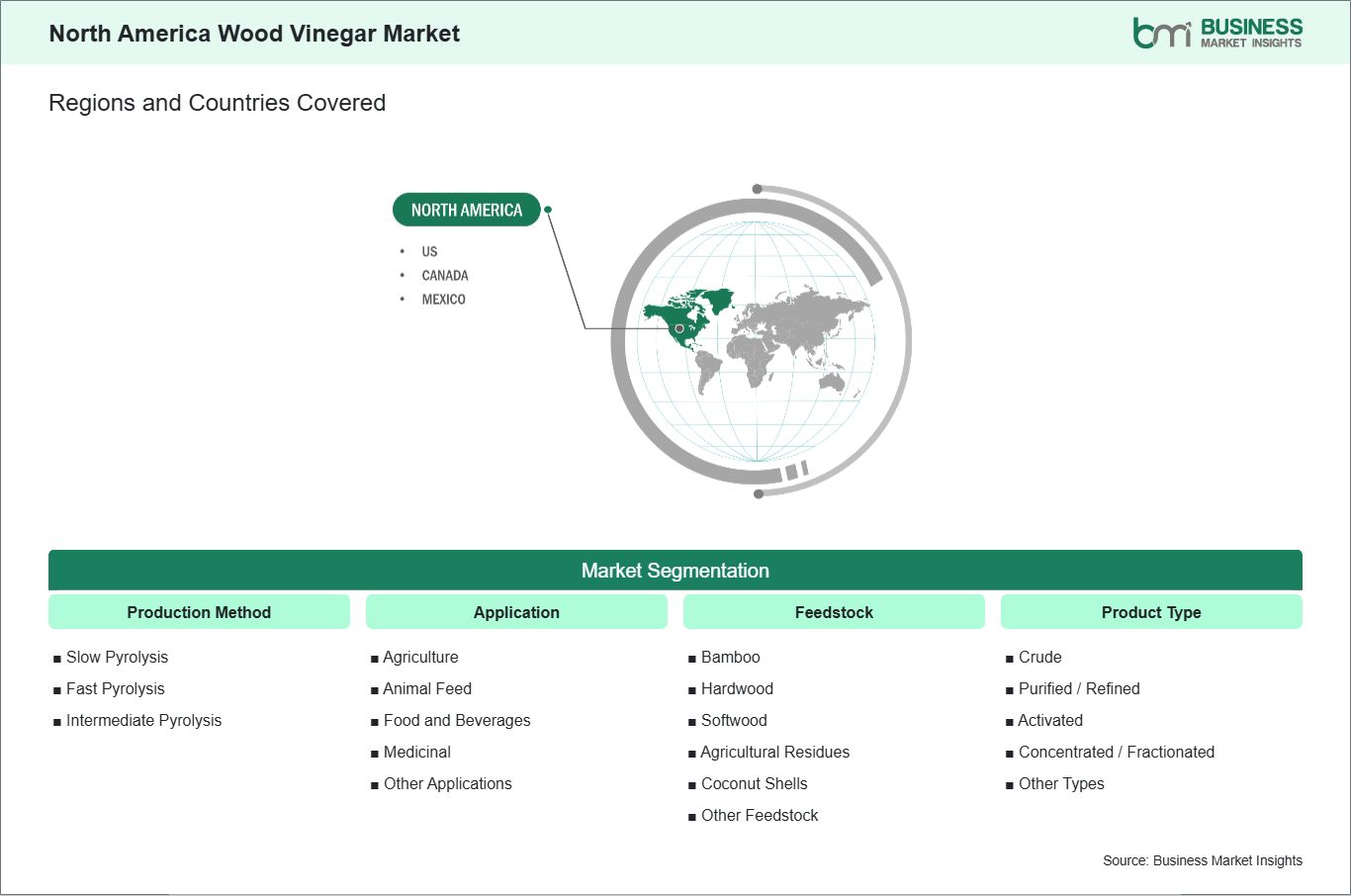
Key segments that contributed to the derivation of the North America wood vinegar market analysis are pyrolysis method, application, feedstock, type, and purity.
- By pyrolysis method, the wood vinegar market is segmented into slow pyrolysis, fast pyrolysis, and intermediate pyrolysis. The slow pyrolysis wood segment dominated the market in 2025.
- Based on applications, the wood vinegar market is segmented into agriculture, animal feed, food and beverages, medicinal/ pharmaceuticals, and other applications. The agriculture segment dominated the market in 2025.
- On the basis of feedstock, the wood vinegar market is classified as bamboo, hardwood, softwood, agricultural residues, coconut shells, and other feedstocks. The hardwood segment dominated the market in 2025.
- In terms of type, the wood vinegar market is segmented into crude, purified/refined, activated, concentrated/fractionated, and other types. The crude segment dominated the market in 2025.
- By purity, the wood vinegar market is segmented into low, medium, and high. The low-purity segment dominated the market in 2025.
Market Forces
North America Wood Vinegar Market Drivers and Opportunities
Rising Demand for Organic Farming Inputs
The move towards organic and regenerative farming in North America is boosting the wood vinegar market. US and Canadian farmers are shifting from synthetic fertilizers and pesticides because of worries about soil erosion, tighter regulations on pesticide residues, and a spike in demand from consumers for chemically simpler foods. Wood vinegar is catching on since it's seen as a natural way to enrich soil and ward off pests, fitting right in with organic farming.
Big organic farming zones like the Central Valley in California, parts of the Midwest, and sections of Ontario are seeing more large-scale tests of bio-based products, including wood vinegar. Farmers there are adding wood vinegar to their compost and applying it directly to plant leaves to boost soil health and help plants weather stresses better. They find it's especially useful for high-value crops like berries, leafy greens, and grapes. For these, having top-notch soil and effective stress management can mean better profits.
Retailers and policy pushes are boosting adoption too. Big food sellers and certifiers in North America pressure suppliers for better sustainability and organic rules. They back programs for regen ag, like improving soil carbon, which cuts chem reliance. So, wood vinegar becomes more useful, aiding both farm output and cert organic requirements.
Rising Demand for Organic Export Commodities
North America's growth in organic exports opens up big chances for the wood vinegar market. The US and Canada ship tons of organic goods like grains and fruits to Europe and Asia. These regions have strict rules about chemical residues, pushing them to use certified organic products instead. So they need stuff like wood vinegar to stay compliant and keep their high production rates.
Organic almonds from California, Washington State apples, and Midwestern soybeans are increasingly farmed using strict input controls. To meet residue-free certifications for exports, many farmers use bio-based soil enhancers. They're also looking at wood vinegar because it fits with organic standards and comes from natural sources.
Trade agreements and global organic certifications are boosting market potential. exporters need to show they use sustainable practices, like good soil management and cutting back on chemicals. In Canada's prairie provinces and the US Pacific Northwest, agricultural co-ops are using regenerative inputs to stay competitive globally. This growing export demand is opening up long-term prospects for standardized wood vinegar products in North American farming.
Size and Share Analysis
North America Wood Vinegar Market Size and Share Analysis
The North America wood vinegar market is experiencing steady growth, with market size and share analysis reflecting evolving treatment preferences and competitive dynamics among key players. The report evaluates important subsegments categorized within pyrolysis method, application, feedstock, type, and purity, highlighting their respective contributions to overall market performance.
By the pyrolysis method, the slow pyrolysis wood subsegment dominated the market in 2025, due to its ability to maximize wood vinegar yield while maintaining low production costs. Slow pyrolysis is the most widely used production method. It enables efficient recovery of condensable compounds and is suitable for large-scale operations.
Based on applications, the agriculture subsegment dominated the market in 2025 because wood vinegar is extensively used as a natural fertilizer enhancer, soil conditioner, and biopesticide in agriculture, which remains the leading application segment. Growing interest in sustainable farming practices has increased its adoption. Its versatility across crops continues to drive demand.
On the basis of feedstock, the hardwood subsegment dominated the market in 2025, due to its high density and favorable chemical composition. Hardwood produces wood vinegar with consistent quality and desirable properties. It generates a rich concentration of organic compounds beneficial for agricultural use. Its widespread availability supports its dominance as a feedstock.
In terms of type, the crude subsegment dominated the market in 2025, because crude wood vinegar requires minimal processing and offers a cost-effective solution for end users, and it holds the largest market share. It is widely accepted for agricultural applications where extensive purification is unnecessary.
By purity, the low-purity subsegment dominated the market in 2025, due to its lower manufacturing costs and suitability for bulk agricultural applications. Farmers prefer it because high purification levels are not required for soil and crop treatment.
Report Coverage
North America Wood Vinegar Market Report Coverage and Deliverables
The "North America Wood Vinegar Market Size and Forecast (2022-2033)" report provides a detailed analysis of the market covering below areas:
- Market size and forecast at regional and country levels for all market segments covered under the scope
- Market trends, as well as drivers, restraints, and opportunities
- Market analysis covering key trends, regional framework, major players, regulations, and recent developments
- Market concentration, heat map analysis, prominent players, and recent developments for the Market
- Detailed company profiles, including SWOT analysis
Geographic Insights
North America Wood Vinegar Market Geographic Insights
The geographical scope of the North America wood vinegar market report is divided into: The US, Canada, and Mexico. The US held the largest share in 2025.
In North America, the US leads the wood vinegar market thanks to its top-notch agricultural systems, robust research infrastructure, and focus on sustainability. Large-scale agri-businesses in the States, especially those focused on valuable crops like fruits and veggies, create a perfect setup for integrating eco-friendly soil and crop care products, including wood vinegar. Farmers in the US are looking more and more to cut down on chemicals and boost soil health for the long run. They see wood vinegar as a handy tool that promotes healthy soil microbes, speeds up composting, and helps plants handle stress better. Plus, growers in controlled-environment setups like greenhouses and hydroponics are experimenting with it because precision and sustainability matter a ton in their fields. The US market really benefits from its strong innovation ecosystem. Agricultural universities, private agritech firms, and eco-focused startups are digging into wood vinegar too. They're studying this stuff to make sure it actually works and to figure out the best ways to use it. Their research is making farmers take notice, especially those in niche markets. There's also a good supply of raw materials like forestry leftovers and urban green trash. This lets places with the right setup produce wood vinegar locally. But there's a catch regulations aren't clear about how wood vinegar fits into existing categories for fertilizers or soil treatments. This confusion keeps big buyers at bay. The U.S. will probably stay as the main hub for wood vinegar innovation in North America. Its growth aligns with carbon-smart farming and a rise in circular bioeconomy solutions. This should support a steady expansion in specialized ag and environmental uses, gradually but surely.
Industry Activity
Recent Developments
The North America wood vinegar market is evaluated by gathering qualitative and quantitative data post primary and secondary research, which includes important corporate publications, association data, and databases. A few of the key developments in the North America Wood vinegar market are:
- In March 2024, Cool Planet Technologies (United States) announced continued scale-up of its modular pyrolysis systems in California, designed to convert agricultural residues into biochar while capturing co-products such as wood vinegar for soil enhancement applications. The company highlighted increasing pilot deployments with farms seeking low-cost bio-based inputs for regenerative agriculture.
- In July 2023, Pacific Biochar (United States) expanded its production operations in Oregon, increasing output of biochar and associated pyroligneous acid (wood vinegar) recovered during wood waste pyrolysis. The company positioned wood vinegar as a secondary product for composting support and organic soil conditioning across West Coast agricultural users.
Trust & Transparency
Research Methodology
The market analysis combines proprietary research with secondary data from government agencies, company disclosures, regulatory filings, industry databases and expert interviews. Market estimates are validated through data triangulation, cross-market benchmarking and analyst
review.
View Full Research Methodology
Key Sources Referred:
Food and Agriculture Organization (FAO)United Nations Environment Programme (UNEP)International Union of Forest Research OrganizationsInternational Bamboo and Rattan OrganizationEnvironmental Protection Agency (EPA)Occupational Safety and Health Administration (OSHA)Organisation for Economic Co-operation and DevelopmentUnited States Department of AgricultureMinistry of Agriculture and Farmers WelfareJapan Biochar AssociationAsian Productivity OrganizationEuropean Chemicals AgencyCompany WebsitesCompany Annual ReportsCompany Investor Presentation