Market Summary
Executive Summary and Market Analysis
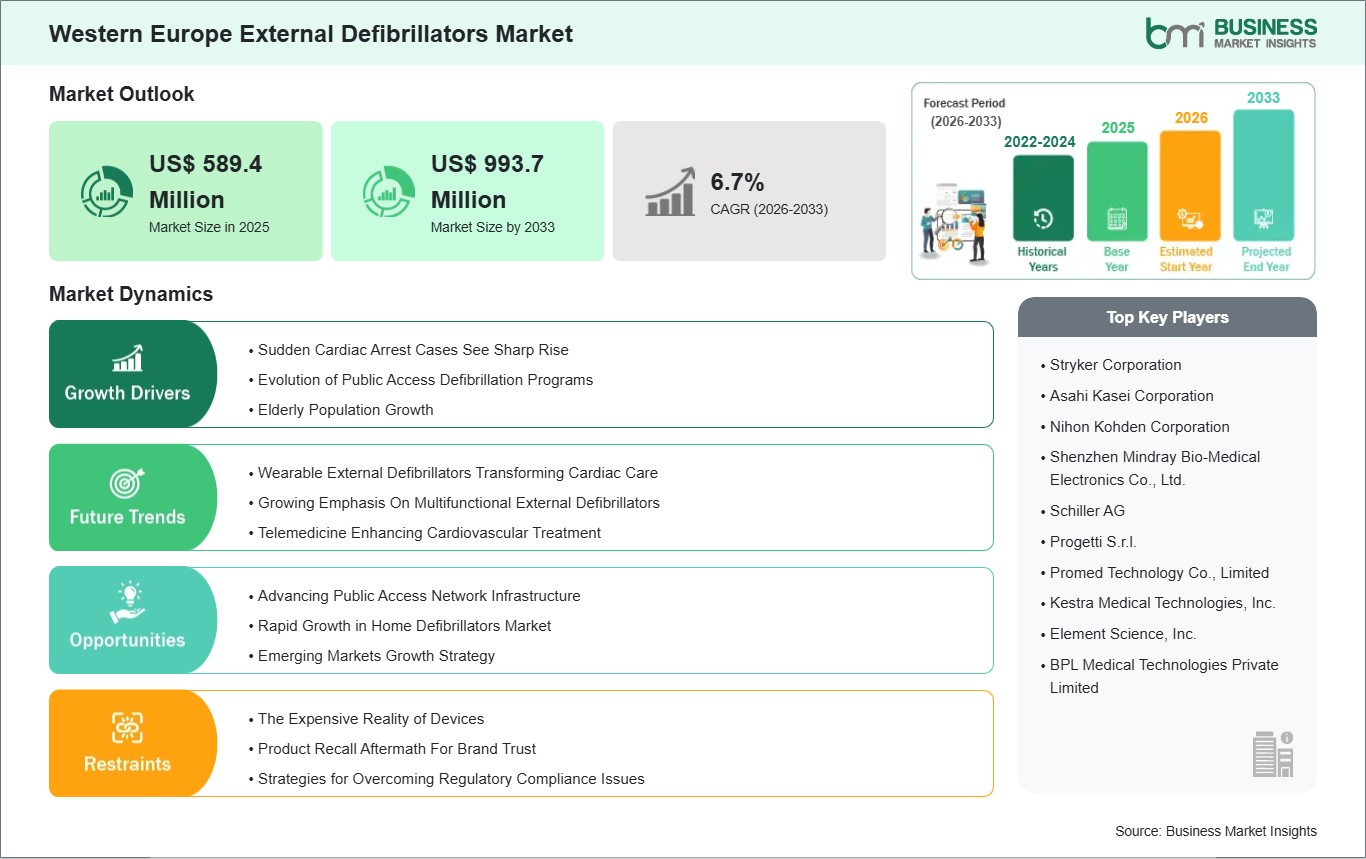
The Western Europe external defibrillators market is marked by high healthcare standards and proactive public health policies emphasizing rapid response to cardiac emergencies. Widespread recognition of the benefits of automated external defibrillators (AEDs) has led to strategic deployment across public venues, corporate spaces, educational institutions, and transportation hubs. A strong network of emergency medical services, combined with supportive government initiatives promoting community access to defibrillation, has bolstered adoption. In several countries, legislative frameworks encourage or mandate AED presence in specific categories of public buildings, which enhances overall market penetration and awareness among end users. Additionally, training programs in CPR and AED usage are integrated into first aid certification courses, strengthening the confidence of the general population to engage with these life-saving devices.
Despite these positive drivers, the market also navigates challenges related to varied regulatory environments across countries within Western Europe. Differing certification requirements and compliance protocols for medical devices can complicate cross-border product distribution. Furthermore, public funding constraints in certain regions may limit the pace at which AEDs are adopted in smaller municipalities and lower-resource settings. Ongoing investment in smart connectivity features and remote monitoring capabilities demonstrates a continued focus on innovation and value-added services within the region.
Segment Analysis
Western Europe External Defibrillators Market Segmentation
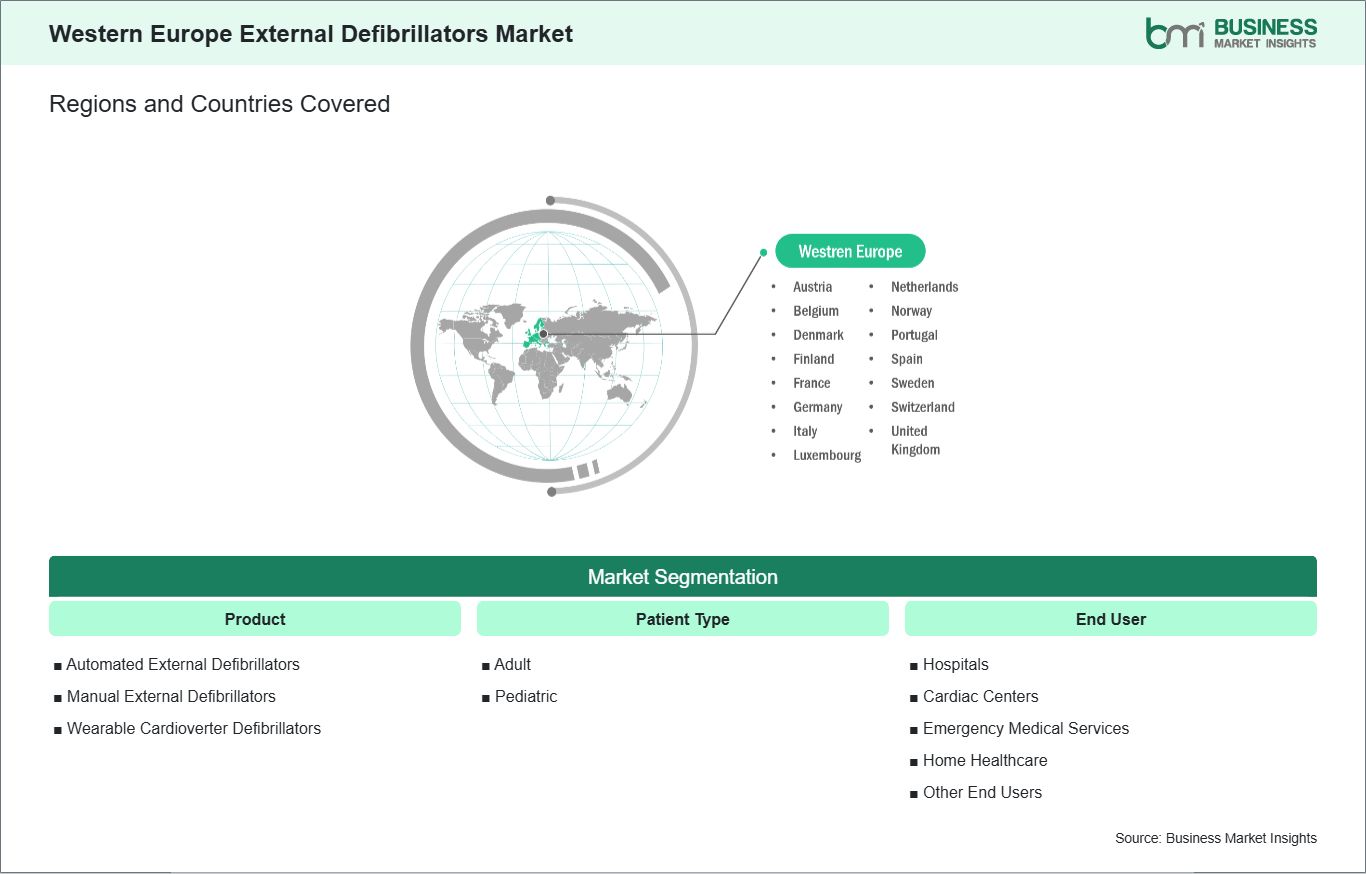
Key segments that contributed to the derivation of the Western Europe external defibrillators market analysis are product type, patient type, and end user.
- By product type, the external defibrillators market is segmented into automated external defibrillators, manual external defibrillators, and wearable cardioverter defibrillators. The automated external defibrillators segment dominated the market in 2025.
- Based on patient type, the external defibrillators market is classified into adult and pediatric. The adults segment dominated the market in 2025.
- In terms of end user, the external defibrillators market is categorized into hospitals, cardiac centers, emergency medical services, home healthcare, and others. The hospitals segment dominated the market in 2025.
Market Forces
Western Europe External Defibrillators Market Drivers and Opportunities
Sudden Cardiac Arrest Cases See Sharp Rise
Western Europe continues to face a rising incidence of sudden cardiac arrest (SCA), influenced by an aging population and persistent cardiovascular risk factors. Longer life expectancy across the region has increased the proportion of elderly individuals who are more susceptible to cardiac events. Lifestyle-related conditions such as obesity, diabetes, and hypertension remain prevalent, contributing to the growing demand for rapid-response cardiac care solutions.
A substantial number of cardiac arrest cases occur outside hospital settings, often in residential areas, workplaces, or public environments. This reality has intensified the focus on early defibrillation as a critical determinant of survival. Emergency medical systems in Western Europe are well-developed, yet even short response times may not be sufficient without immediate access to automated external defibrillators (AEDs). Healthcare authorities are prioritizing broader availability of external defibrillation devices.
Public awareness campaigns and professional training programs have highlighted the importance of early intervention. Greater recognition of warning signs and emergency response procedures is driving acceptance of AED use among nonmedical individuals. This shift in mindset, combined with healthcare policy emphasis on reducing cardiovascular mortality, is sustaining steady growth in the Western Europe external defibrillators market.
Advancing Public Access Network Infrastructure
Western Europe has made significant progress in developing structured public access defibrillation networks. AEDs are installed in transportation systems, commercial complexes, sports arenas, corporate offices, and educational institutions. The focus is not only on device placement but also on strategic positioning in high-footfall areas where the probability of cardiac emergencies is elevated.
Public access initiatives are supported by coordinated training efforts that encourage bystander intervention. CPR education programs and workplace safety certifications frequently incorporate AED usage modules, fostering confidence among the general population. By integrating training with infrastructure expansion, Western European communities are strengthening their emergency response ecosystem and improving survival prospects in out-of-hospital cardiac arrest scenarios.
Technological advancement is reinforcing public access networks. Modern AEDs feature intuitive interfaces, multilingual voice prompts, and automated diagnostics that simplify operation and maintenance. Some systems are integrated with digital registries and emergency dispatch platforms, ensuring faster identification of nearby devices during emergencies. These enhancements contribute to a more reliable and interconnected public access framework across the region.
Size and Share Analysis
Western Europe External Defibrillators Market Size and Share Analysis
The Western Europe external defibrillators market demonstrates steady growth, with size and share analysis highlighting evolving trends and competitive dynamics among key players. The report evaluates important subsegments categorized within product type, patient type, and end user, highlighting their respective contributions to overall market performance.
By product type, the Automated External Defibrillators (AEDs) subsegment dominated the market in 2025. Their widespread adoption is driven by their ease of use, rapid response capability, and effectiveness in treating sudden cardiac arrest outside clinical settings, making them a vital tool in emergency cardiac care.
In terms of patient type, the adults subsegment dominated the market in 2025. This leadership is attributed to the higher incidence of cardiac events among adults, growing awareness about the importance of immediate defibrillation in cardiac emergencies, and increased accessibility to AEDs in public and healthcare settings.
Based on end user, the hospitals subsegment dominated the market in 2025. Hospitals remain the primary distribution channel due to their established emergency response systems, trained medical personnel, access to advanced cardiac care infrastructure, and the ability to provide prompt, life-saving interventions.
Report Coverage
Western Europe External Defibrillators Market Report Coverage and Deliverables
The "Western Europe External Defibrillators Market Size and Forecast (2022–2033)" report provides a detailed analysis of the market covering below areas:
- Western Europe External Defibrillators market size and forecast at regional and country levels for all market segments covered under the scope
- Western Europe External Defibrillators market trends, as well as drivers, restraints, and opportunities
- Western Europe External Defibrillators market analysis covering key trends, regional framework, major players, regulations, and recent developments
- Industry landscape and competition analysis covering market concentration, heat map analysis, prominent players, and recent developments for the Western Europe External Defibrillators market
- Detailed company profiles, including SWOT analysis
Geographic Insights
Western Europe External Defibrillators Market Geographic Insights
The geographical scope of the Western Europe External Defibrillators market report is divided into: Belgium, the Netherlands, Luxembourg, Germany, France, Italy, Spain, Switzerland, Sweden, Austria, the UK, Denmark, Portugal, Norway, and Finland. Germany held the largest share in 2025.
Germany stands out as the dominant market for external defibrillators in Western Europe due to its robust healthcare delivery systems and strong emphasis on preventive emergency care. There is widespread civic engagement in first-responder training, with numerous initiatives aimed at equipping local communities and workplaces with both AEDs and the skills to use them effectively. Major urban centers see organized placements of defibrillators in public transit stations, shopping districts, sports facilities, and cultural venues, reflecting the country's proactive approach to reducing mortality from sudden cardiac events.
German medical device distributors and manufacturers play a key role in ensuring a diverse product range is accessible, catering to both institutional buyers and smaller organizations. Partnerships between health agencies and private firms also facilitate awareness campaigns that educate the public about the importance of quick defibrillation. However, regulatory complexity at both federal and federal-state levels can prolong procurement processes for some institutions, especially smaller clinics and community centers. Additionally, ensuring uniform access in rural regions remains an area of focus for policymakers and healthcare stakeholders, even as Germany continues to reinforce its status as the primary external defibrillators market within Western Europe.
Industry Activity
Recent Developments
The Western Europe External Defibrillators market is evaluated by gathering qualitative and quantitative data post primary and secondary research, which includes important corporate publications, association data, and databases. A few of the key developments in the Western Europe external defibrillators market are:
- In October 2024, ZOLL Medical Corporation announced that its ZOLL AED Plus automated external defibrillator also received CE marking under the EU MDR, strengthening its certified AED product portfolio and supporting broader distribution and use across Western Europe.
- In February 2024, ZOLL Medical Corporation announced that its ZOLL AED 3 automated external defibrillator received approval under the European Union Medical Device Regulation (EU MDR) and obtained CE marking for marketing across the EU, reflecting compliance with the most stringent European regulatory standards for medical devices.
Trust & Transparency
Research Methodology
The market analysis combines proprietary research with secondary data from government agencies, company disclosures, regulatory filings, industry databases and expert interviews. Market estimates are validated through data triangulation, cross-market benchmarking and analyst
review.
View Full Research Methodology
Key Sources Referred:
The World BankWorld Health Organization (WHO)Center for Disease Control and Prevention (CDC)European Database on Medical Devices (EUDAMED)European Society of CardiologyAmerican College of CardiologyAmerican Heart AssociationCompany WebsitesCompany Annual ReportsCompany Investor Presentations