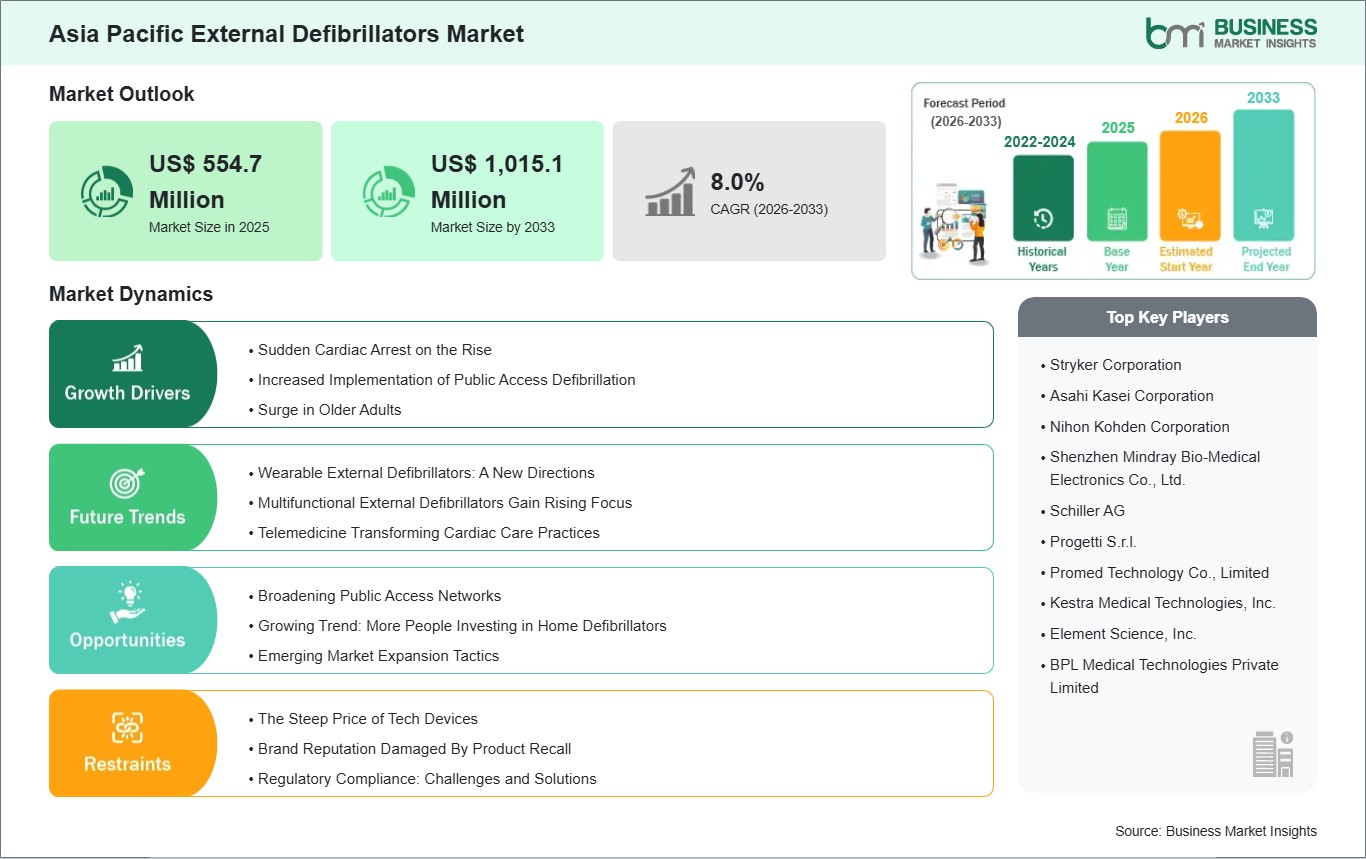
The Asia Pacific external defibrillators market size is expected to reach US$ 1,015.1 million by 2033 from US$ 554.7 million in 2025. The market is estimated to record a CAGR of 8.0% from 2026 to 2033.
The Asia Pacific external defibrillators market is fueled by rising awareness of sudden cardiac arrest (SCA) survival outcomes and the growing institutional focus on strengthening emergency response frameworks. Governments and healthcare authorities across the region are embedding automated external defibrillators (AEDs) within public infrastructure, including airports, railway stations, commercial complexes, and educational institutions, as part of broader public health resilience strategies. Parallel to public deployment initiatives, hospitals and private healthcare networks are enhancing cardiac care capabilities by procuring advanced external defibrillation systems to manage acute cardiac emergencies. Expanding cardiopulmonary resuscitation (CPR) and AED training programs for nonmedical personnel has widened accessibility and improved first-response readiness, reinforcing market penetration beyond traditional clinical settings.
Regional disparities continue to influence market dynamics. Access to trained emergency responders and standardized life-support training remains inconsistent across rural and semi-urban geographies, limiting optimal device utilization. Additionally, regulatory heterogeneity among Asia Pacific countries creates varied approval processes and compliance requirements, which can delay product commercialization and technology diffusion. Despite these structural complexities, the sustained commitment to emergency preparedness, healthcare modernization, and community-based intervention frameworks supports continued qualitative advancement of the Asia Pacific external defibrillators market.

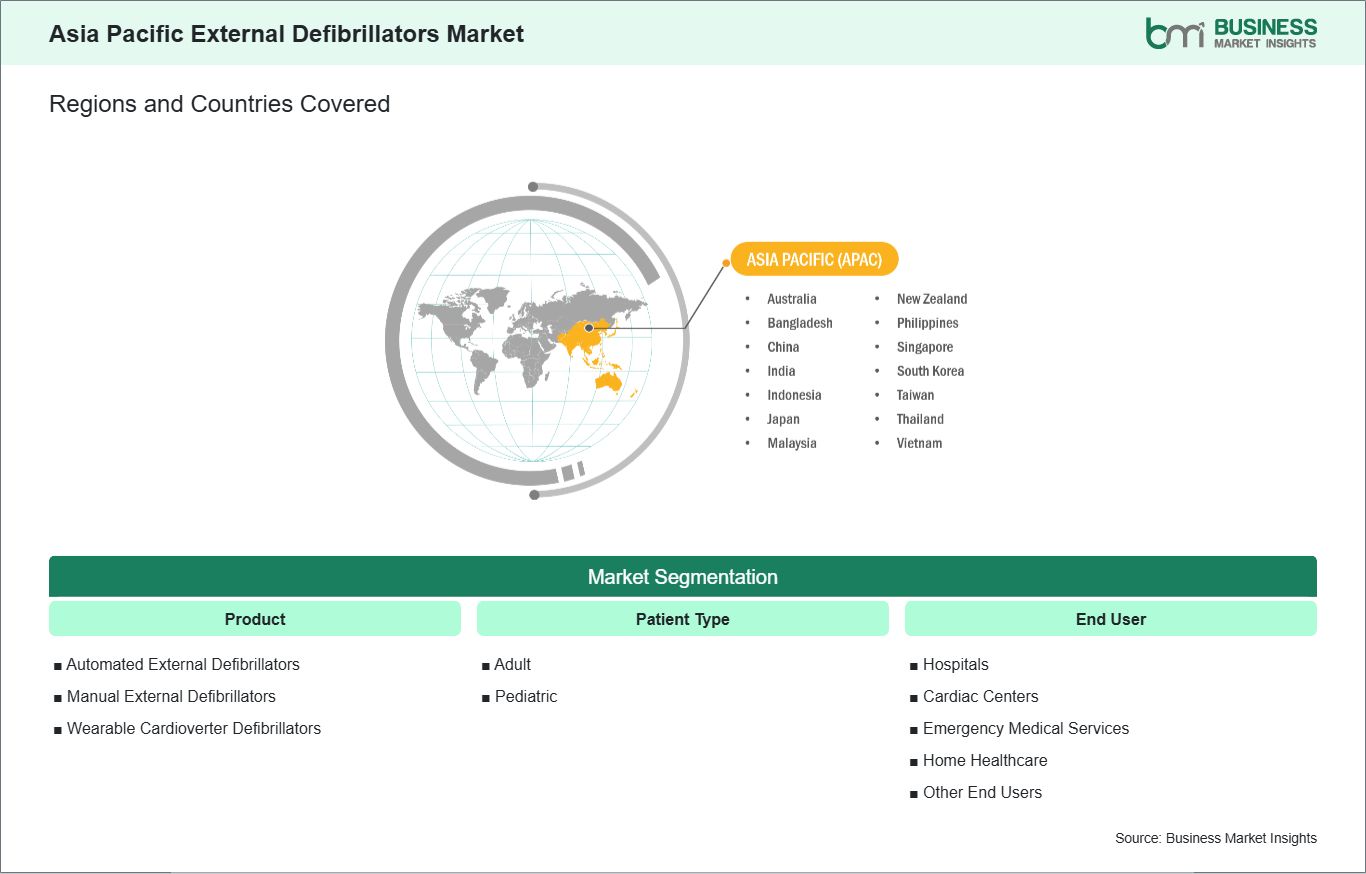
Key segments that contributed to the derivation of the Asia Pacific external defibrillators market analysis are product type, patient type, and end user.
Asia Pacific is experiencing a noticeable increase in sudden cardiac arrest (SCA) cases, largely driven by demographic expansion, aging populations, and a growing prevalence of cardiovascular risk factors. Urbanization, dietary transitions, reduced physical activity, and rising stress levels have contributed to higher incidences of hypertension, diabetes, and coronary artery disease. These health trends are elevating the burden of cardiovascular conditions and creating sustained demand for emergency cardiac care solutions, including external defibrillators.
Healthcare systems across the region are strengthening their response capabilities to address the growing incidence of cardiac emergencies. Hospitals and tertiary care centers are equipping emergency departments, ambulances, and intensive care units with advanced defibrillation devices as part of broader improvements in acute cardiac care infrastructure. Increased adoption of automated external defibrillators (AEDs) reflects a rising emphasis on reducing response times and improving survival outcomes in both in-hospital and out-of-hospital cardiac arrest situations.
Despite these advancements, access to defibrillation equipment remains uneven across the region. While major urban healthcare facilities often maintain adequate emergency response infrastructure, secondary cities and rural communities may face limitations in equipment availability and emergency medical services coverage. Addressing these disparities through expanded device distribution and improved training initiatives remains a key priority for enhancing survival rates from sudden cardiac arrest throughout the region.
Public access defibrillator (PAD) networks are expanding steadily across Asia Pacific as awareness of early defibrillation benefits continues to grow. Governments, healthcare authorities, and private institutions are increasingly placing AEDs in high-traffic public environments such as transportation hubs, commercial centers, educational institutions, and sports facilities. These efforts aim to ensure that life-saving equipment is readily accessible during cardiac emergencies occurring outside hospital settings.
In parallel with equipment deployment, large-scale community training programs are being implemented to build public confidence in CPR and AED usage. Public awareness campaigns emphasize the importance of immediate bystander intervention, particularly during the critical minutes before professional medical help arrives. Integration of AED registries with emergency dispatch systems is also emerging as an important development, allowing responders to identify and direct bystanders to the nearest available device.
However, scaling public access networks across such a geographically and economically diverse region presents ongoing challenges. Funding constraints, device maintenance requirements, and varying levels of regulatory support can slow widespread adoption, particularly in less developed areas. Nevertheless, continued collaboration between public authorities and private stakeholders is gradually strengthening PAD infrastructure. As awareness and accessibility improve, public access networks are expected to play a vital role in reducing mortality associated with sudden cardiac arrest across the region.

The Asia Pacific external defibrillators market demonstrates steady growth, with size and share analysis highlighting evolving trends and competitive dynamics among key players. The report evaluates important subsegments categorized within product type, patient type, and end user, highlighting their respective contributions to overall market performance.
By product type, the Automated External Defibrillators (AEDs) subsegment dominated the market in 2025. Their widespread adoption is driven by their ease of use, rapid response capability, and effectiveness in treating sudden cardiac arrest outside clinical settings, making them a vital tool in emergency cardiac care.
In terms of patient type, the adults subsegment dominated the market in 2025. This leadership is attributed to the higher incidence of cardiac events among adults, growing awareness about the importance of immediate defibrillation in cardiac emergencies, and increased accessibility to AEDs in public and healthcare settings.
Based on end user, the hospitals subsegment dominated the market in 2025. Hospitals remain the primary distribution channel due to their established emergency response systems, trained medical personnel, access to advanced cardiac care infrastructure, and the ability to provide prompt, life-saving interventions.
| Report Attribute | Details |
|---|---|
| Market size in 2025 | US$ 554.7 Million |
| Market Size by 2033 | US$ 1,015.1 Million |
| CAGR (2026 - 2033) | 8.0% |
| Historical Data | 2022-2024 |
| Forecast period | 2026-2033 |
| Segments Covered | By Product
|
|
Regions and Countries Covered
| |
| Asia Pacific | China, Japan, South Korea, India, Australia, New Zealand, Indonesia, Malaysia, Philippines, Singapore, Thailand, Vietnam, Taiwan, Bangladesh |
| Market leaders and key company profiles |
|
The "Asia Pacific External Defibrillators Market Size and Forecast (2022–2033)" report provides a detailed analysis of the market covering below areas:
The geographical scope of the Asia Pacific external defibrillators market report is divided into: China, Japan, South Korea, India, Australia, New Zealand, Indonesia, Malaysia, the Philippines, Singapore, Thailand, Vietnam, Taiwan, Bangladesh, and the Rest of Asia. China held the largest share in 2025.
China represents the dominant market for external defibrillators in Asia Pacific, driven by strong governmental backing for emergency medical preparedness and expanding hospital infrastructure. The country has emphasized improving survival outcomes for sudden cardiac arrest through structured public access defibrillation programs. Deployment of automated external defibrillators has expanded beyond tertiary hospitals into metro stations, airports, corporate buildings, and community centers, reflecting a broader public health strategy. The presence of competitive domestic manufacturers offering technologically advanced yet cost-efficient devices in China has accelerated penetration in mid-tier cities. Additionally, integration of smart monitoring features and digital connectivity within defibrillator systems is gaining traction, aligning with China's broader digital healthcare transformation goals. However, disparities in emergency response training between urban and rural regions remain a challenge, and standardized enforcement of AED placement guidelines continues to evolve. China's proactive policy environment and local manufacturing strength firmly position it as the regional leader in external defibrillator adoption.

The Asia Pacific external defibrillators market is evaluated by gathering qualitative and quantitative data post primary and secondary research, which includes important corporate publications, association data, and databases. A few of the key developments in the Asia Pacific external defibrillators market are:
The Asia Pacific External Defibrillators Market is valued at US$ 554.7 Million in 2025, it is projected to reach US$ 1,015.1 Million by 2033.
As per our report Asia Pacific External Defibrillators Market, the market size is valued at US$ 554.7 Million in 2025, projecting it to reach US$ 1,015.1 Million by 2033. This translates to a CAGR of approximately 8.0% during the forecast period.
The Asia Pacific External Defibrillators Market report typically cover these key segments-
The historic period, base year, and forecast period can vary slightly depending on the specific market research report. However, for the Asia Pacific External Defibrillators Market report:
The Asia Pacific External Defibrillators Market is populated by several key players, each contributing to its growth and innovation. Some of the major players include:
The Asia Pacific External Defibrillators Market report is valuable for diverse stakeholders, including:
Essentially, anyone involved in or considering involvement in the Asia Pacific External Defibrillators Market value chain can benefit from the information contained in a comprehensive market report.
Please tell us your area of interest
(Market Segments/ Regions and Countries/ Companies)