Market Summary
Executive Summary and Market Analysis
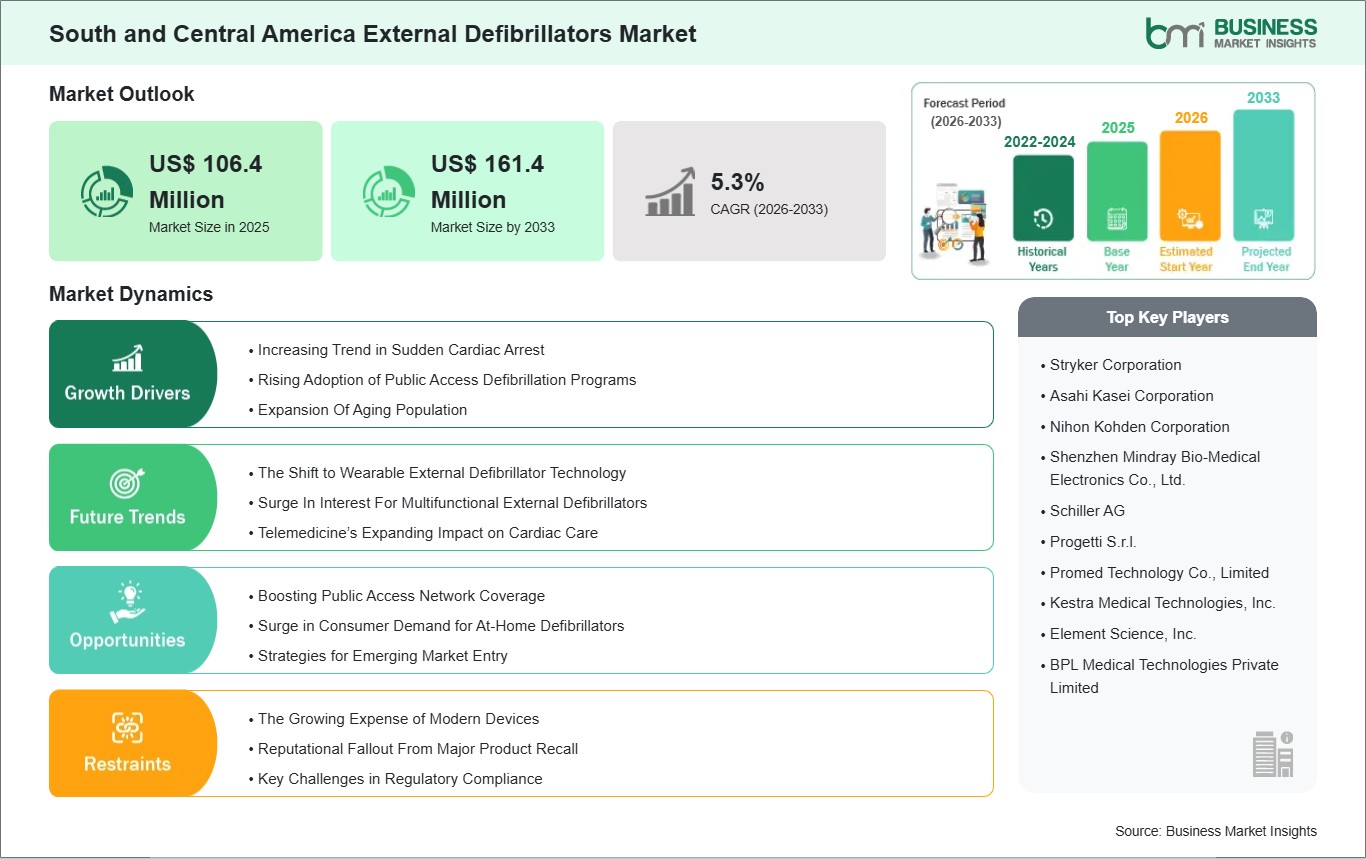
The South and Central America external defibrillators market is steadily evolving, supported by increasing awareness of cardiovascular diseases and gradual improvements in emergency response infrastructure. Urbanization and the expansion of private healthcare networks across major metropolitan areas have contributed to stronger demand for automated external defibrillators (AEDs) in hospitals, ambulatory surgical centers, airports, shopping complexes, and corporate facilities. Public health initiatives aimed at improving survival outcomes from sudden cardiac arrest are encouraging broader adoption of defibrillation devices, particularly in large cities. Additionally, growing medical tourism in select countries is prompting healthcare providers to upgrade emergency care capabilities, supporting market expansion.
However, the market faces structural constraints related to uneven healthcare access between urban and rural regions. Limited funding in public healthcare systems, coupled with inconsistent regulatory enforcement for mandatory AED placement in public areas, restricts widespread deployment. Import dependency for advanced defibrillation technologies also exposes the region to pricing pressures and supply chain disruptions. Despite these challenges, ongoing investments in emergency medical services training and increasing partnerships between device manufacturers and local distributors are strengthening the regional market landscape.
Segment Analysis
South and Central America External Defibrillators Market Segmentation
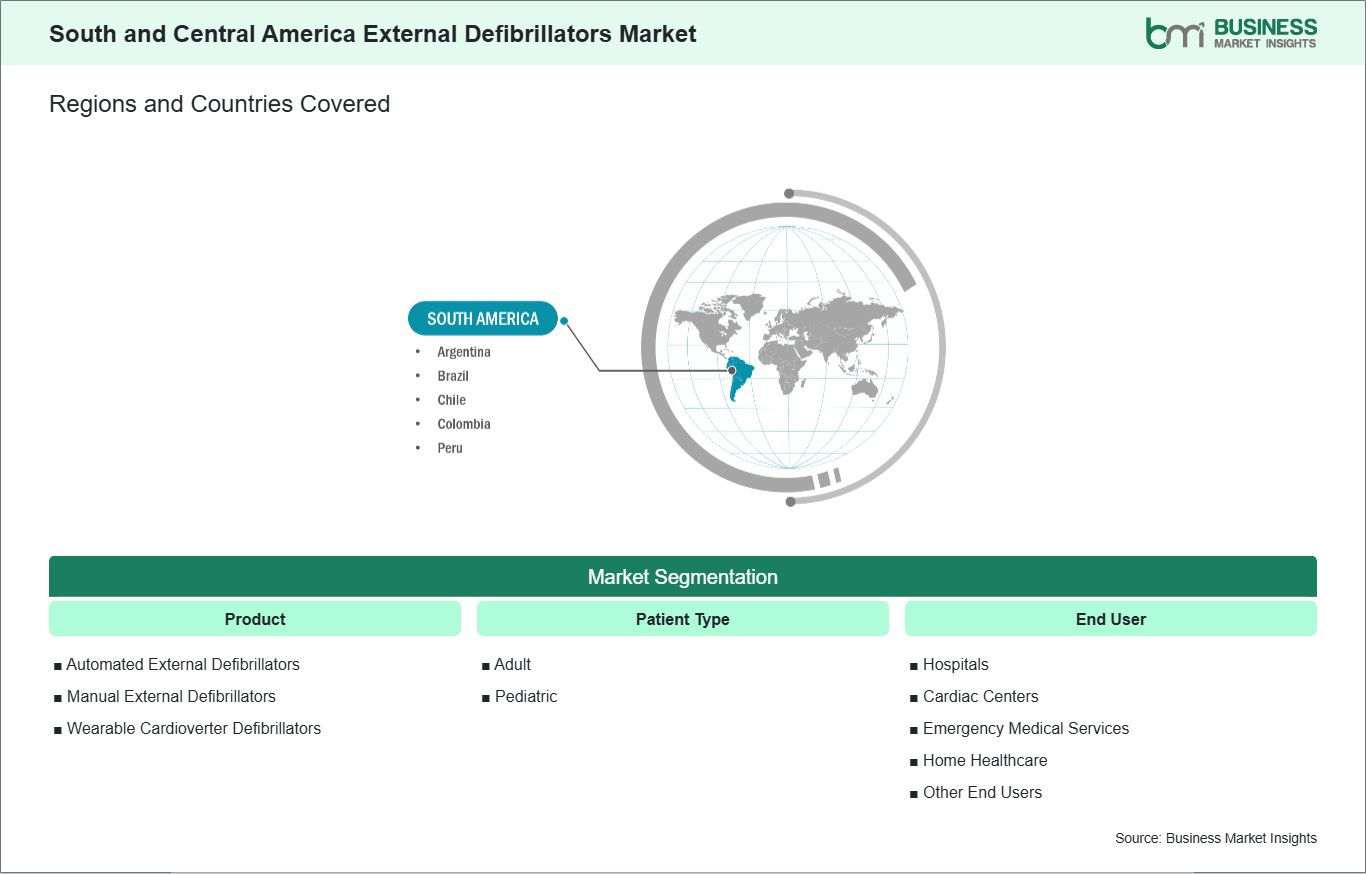
Key segments that contributed to the derivation of the South and Central America external defibrillators market analysis are product type, patient type, and end user.
- By product type, the external defibrillators market is segmented into automated external defibrillators, manual external defibrillators, and wearable cardioverter defibrillators. The automated external defibrillators segment dominated the market in 2025.
- Based on patient type, the external defibrillators market is classified into adult and pediatric. The adults segment dominated the market in 2025.
- In terms of end user, the external defibrillators market is categorized into hospitals, cardiac centers, emergency medical services, home healthcare, and others. The hospitals segment dominated the market in 2025.
Market Forces
South and Central America External Defibrillators Market Drivers and Opportunities
Increasing Trend in Sudden Cardiac Arrest
South and Central America are witnessing a steady rise in sudden cardiac arrest (SCA) incidents, driven by increasing cardiovascular disease prevalence and urban lifestyle transitions. Changing dietary patterns, reduced physical activity, and a growing aging population are contributing to higher cardiac risk across the region. As healthcare systems confront this expanding burden, the importance of rapid defibrillation in emergency response protocols has become more widely recognized.
A significant portion of cardiac arrests in the region occur outside hospital environments, where immediate medical assistance may not always be readily available. This reality has intensified the focus on equipping communities with external defibrillators capable of delivering timely intervention. Emergency medical services are working to shorten response times, but survival outcomes remain highly dependent on the availability of automated external defibrillators (AEDs) within the first few minutes of collapse.
The rising awareness of SCA among healthcare professionals and the general population is supporting gradual market expansion. Training initiatives targeting first responders, workplace staff, and community members are increasing confidence in AED usage. As knowledge spreads regarding the life-saving potential of early defibrillation, demand for reliable and easy-to-operate external defibrillators continues to strengthen across both institutional and public settings.
Boosting Public Access Network Coverage
Efforts to expand public access defibrillation networks are gaining momentum across South and Central America. Authorities and private stakeholders are recognizing the value of placing AEDs in high-traffic environments such as transportation hubs, commercial complexes, and recreational venues. These deployments aim to create a distributed safety network that enables faster intervention during cardiac emergencies occurring outside clinical facilities.
Community-based programs are playing an important role in extending device coverage beyond major urban centers. Partnerships between healthcare providers, civic organizations, and businesses are facilitating wider AED placement while promoting public education campaigns. By pairing infrastructure deployment with hands-on training, the region is = building a culture that encourages bystander intervention in cardiac emergencies.
Technological innovation is also supporting broader public access. Modern AEDs designed with automated voice prompts, visual guidance systems, and minimal operational complexity are particularly well-suited for environments where medical expertise may be limited. As devices become more intuitive and maintenance systems more streamlined, organizations are more inclined to integrate defibrillators into their safety frameworks, further expanding the public access network.
Size and Share Analysis
South and Central America External Defibrillators Market Size and Share Analysis
The South and Central America external defibrillators market demonstrates steady growth, with size and share analysis highlighting evolving trends and competitive dynamics among key players. The report evaluates important subsegments categorized within product type, patient type, and end user, highlighting their respective contributions to overall market performance.
By product type, the Automated External Defibrillators (AEDs) subsegment dominated the market in 2025. Their widespread adoption is driven by their ease of use, rapid response capability, and effectiveness in treating sudden cardiac arrest outside clinical settings, making them a vital tool in emergency cardiac care.
In terms of patient type, the adults subsegment dominated the market in 2025. This leadership is attributed to the higher incidence of cardiac events among adults, growing awareness about the importance of immediate defibrillation in cardiac emergencies, and increased accessibility to AEDs in public and healthcare settings.
Based on end user, the hospitals subsegment dominated the market in 2025. Hospitals remain the primary distribution channel due to their established emergency response systems, trained medical personnel, access to advanced cardiac care infrastructure, and the ability to provide prompt, life-saving interventions.
Report Coverage
South and Central America External Defibrillators Market Report Coverage and Deliverables
The "South and Central America External Defibrillators Market Size and Forecast (2022–2033)" report provides a detailed analysis of the market covering below areas:
- South and Central America External Defibrillators market size and forecast at regional and country levels for all market segments covered under the scope
- South and Central America External Defibrillators market trends, as well as drivers, restraints, and opportunities
- South and Central America External Defibrillators market analysis covering key trends, regional framework, major players, regulations, and recent developments
- Industry landscape and competition analysis covering market concentration, heat map analysis, prominent players, and recent developments for the South and Central America External Defibrillators market
Geographic Insights
South and Central America External Defibrillators Market Geographic Insights
The geographical scope of the South and Central America external defibrillators market report is divided into: Brazil, Argentina, Chile, Colombia, Peru, and the Rest of South and Central America. Brazil held the largest share in 2025.
Brazil dominates the South and Central America external defibrillators market due to its advanced healthcare infrastructure and strong concentration of private hospitals and specialty cardiac centers. Major urban hubs such as São Paulo and Rio de Janeiro have witnessed increasing installation of AEDs in commercial complexes, sports facilities, educational institutions, and transportation terminals. Growing public awareness campaigns around cardiopulmonary resuscitation (CPR) training and emergency preparedness are supporting adoption beyond traditional hospital settings.
The presence of domestic medical device distributors, along with established import channels for international brands, enhances product availability across Brazil's healthcare ecosystem. Private sector investment in occupational health and workplace safety compliance is contributing to steady demand. However, regional disparities remain a challenge, as rural and remote areas experience limited access to advanced emergency equipment. Budget constraints within public hospitals and regulatory variations across states can delay procurement cycles. Nonetheless, Brazil's expanding healthcare modernization efforts and focus on strengthening pre-hospital emergency services continue to position the country as the primary revenue contributor within the regional external defibrillators market.
Industry Activity
Recent Developments
The South and Central America external defibrillators market is evaluated by gathering qualitative and quantitative data post primary and secondary research, which includes important corporate publications, association data, and databases. A few of the key developments in the South and Central America external defibrillators market are:
- In September 2025, Fundacion Venemergencia in Venezuela announced the expansion of its Program of Public Access Defibrillation (Desfibrilacion de Acceso Publico, DAP) with 28 cardioprotected zones and multiple community CPR and AED training events involving hundreds of participants, reinforcing community‑based AED usage and emergency preparedness.
- In August 2023, the Government of Colombia announced that it enacted Decree 1465 to regulate the existing AED law (Law 1831 of 2017), mandating the placement of automated external defibrillators in high‑traffic public spaces such as transport hubs and sports venues, strengthening legal AED deployment requirements across the country, and advancing public access to life‑saving defibrillation devices throughout Colombia
Trust & Transparency
Research Methodology
The market analysis combines proprietary research with secondary data from government agencies, company disclosures, regulatory filings, industry databases and expert interviews. Market estimates are validated through data triangulation, cross-market benchmarking and analyst
review.
View Full Research Methodology
Key Sources Referred:
The World BankWorld Health Organization (WHO)Center for Disease Control and Prevention (CDC)European Database on Medical Devices (EUDAMED)European Society of CardiologyAmerican College of CardiologyAmerican Heart AssociationCompany WebsitesCompany Annual ReportsCompany Investor Presentations