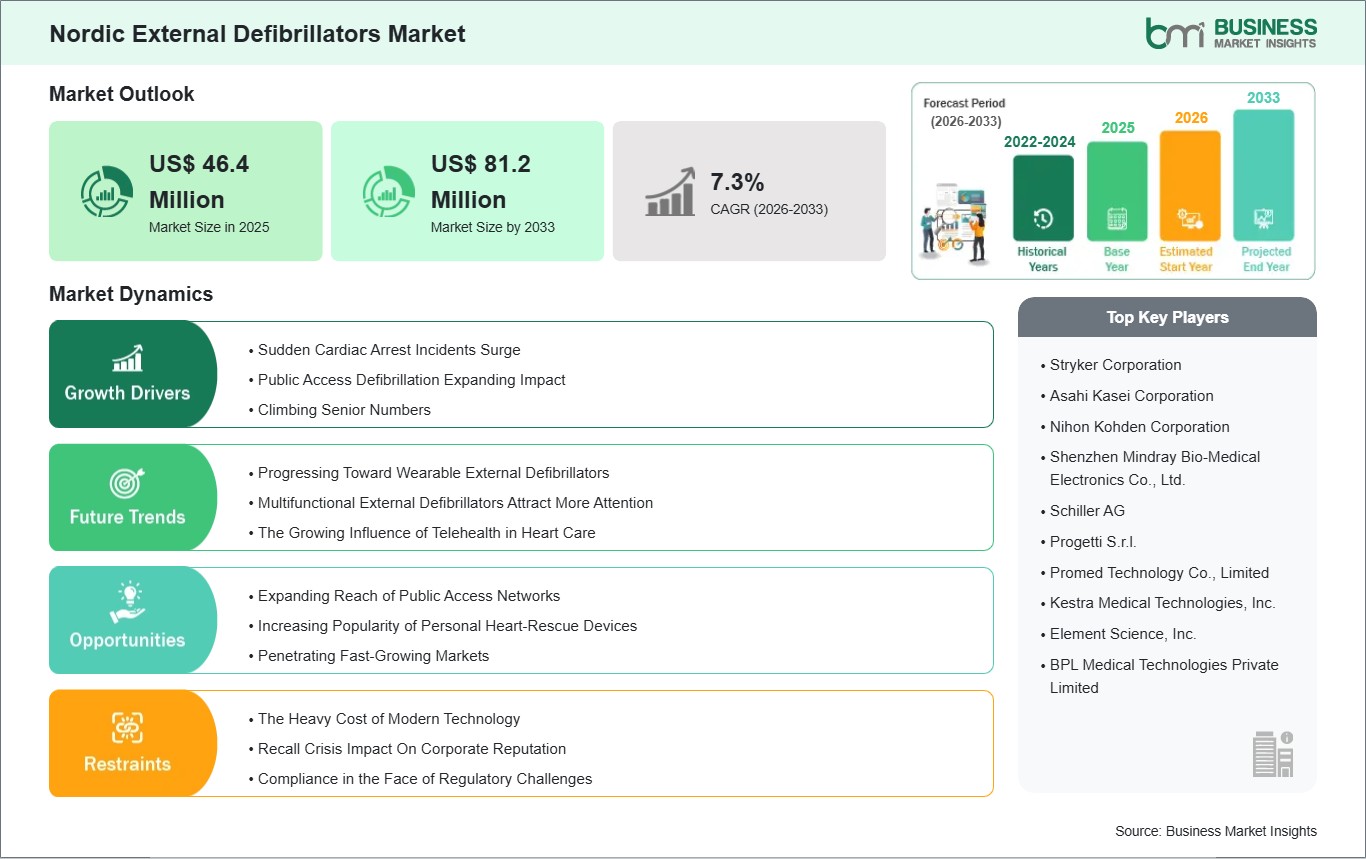
The Nordic external defibrillators market size is expected to reach US$ 81.2 million by 2033 from US$ 46.4 million in 2025. The market is estimated to record a CAGR of 7.3% from 2026 to 2033.
The Nordic external defibrillators market reflects a mature and proactive healthcare landscape where emergency cardiac care is embedded into public health policy and community preparedness. Scandinavian countries emphasize reducing mortality from sudden cardiac arrest through structured public access defibrillation programs, standardized emergency response protocols, and widespread first‑aid training initiatives. The Nordic region's advanced healthcare infrastructure and high public health awareness have driven the integration of automated external defibrillators (AEDs) across urban centers, transportation hubs, sports facilities, and educational institutions. Governments and municipal authorities work closely with nonprofit organizations to ensure strategic AED placement and easy accessibility in densely populated areas.
Public sector leadership and corporate health and safety regulations further encourage AED deployment in workplaces and community venues, reinforcing the region's focus on preparedness. Additionally, the Nordic population's strong engagement in outdoor and fitness activities has underscored the need for robust emergency response mechanisms, positioning AEDs as essential tools in safeguarding public health. However, the market also faces specific challenges. Geographic dispersion of rural and remote communities, particularly in the northern parts of the region, poses logistical hurdles for AED accessibility and maintenance. Moreover, evolving regulatory and procurement procedures—though comprehensive—can lead to variations in device adoption timelines across countries. Nonetheless, strong governmental support and community initiatives underpin continued market momentum.

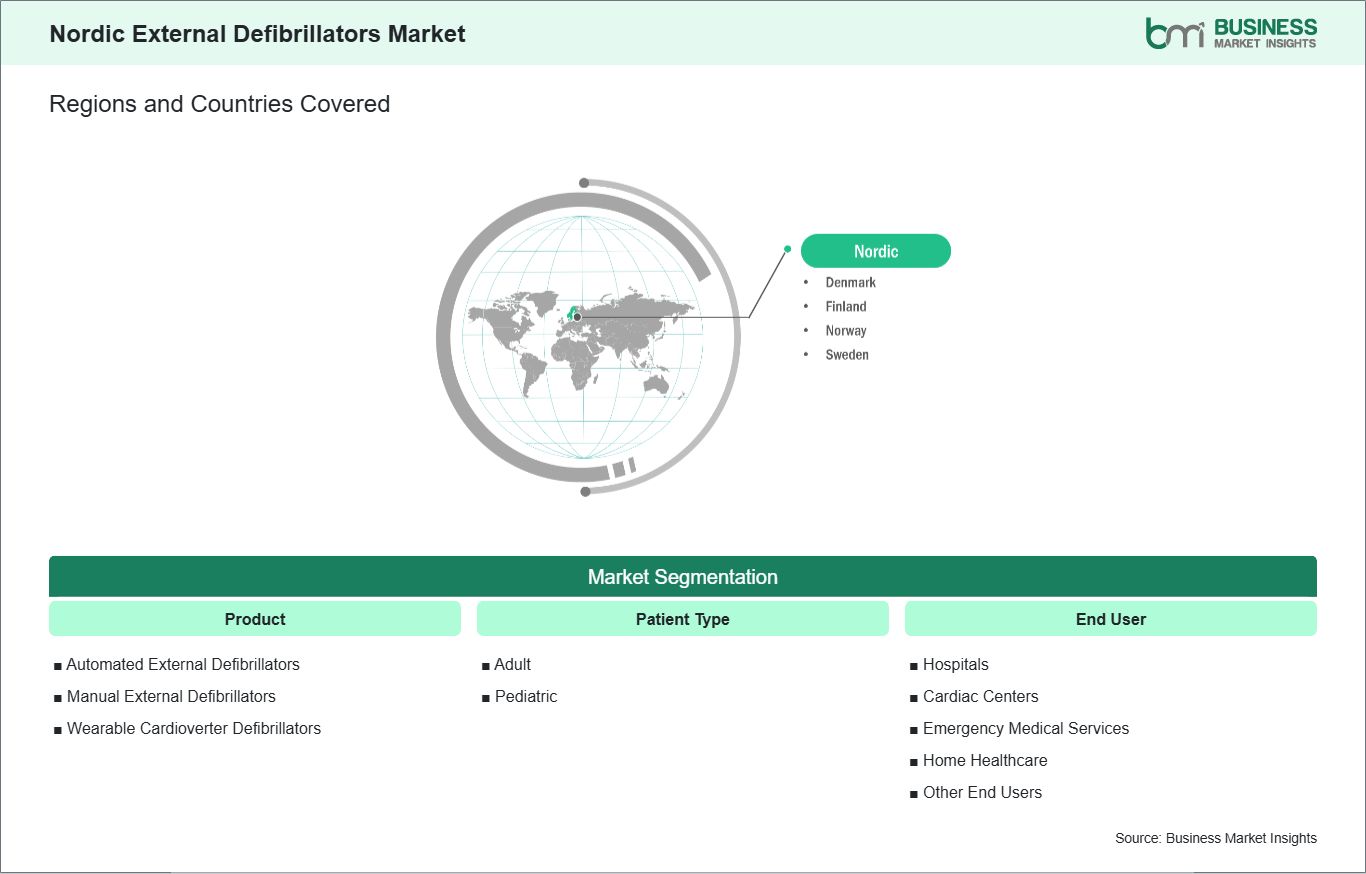
Key segments that contributed to the derivation of the Nordic external defibrillators market analysis are product type, patient type, and end user.
Sudden cardiac arrest (SCA) is an important health concern in the Nordic region. Even with well‑developed healthcare systems, lifestyle changes, stress, and aging populations have contributed to a higher occurrence of cardiac events outside hospitals. This trend has highlighted the need for immediate access to life‑saving solutions, making external defibrillators a critical tool for rapid intervention.
In urban areas, emergency medical services are generally efficient, but delays can occur due to traffic or geographic dispersion. As a result, external defibrillators are being deployed in clinics, workplaces, and public spaces to ensure timely treatment during the crucial minutes following a cardiac event. These devices serve as a bridge until professional responders can arrive.
Demographic patterns in the Nordics, including older population segments and active lifestyles, mean that sudden cardiac events can affect a wide range of communities. Increasing awareness of SCA and its unpredictable nature is encouraging both public institutions and private organizations to invest in automated and semi-automatic external defibrillators as part of broader emergency preparedness strategies.
Public access defibrillation networks are growing in the Nordic countries, reflecting a strong emphasis on community-level emergency preparedness. Efforts are underway to place devices in high-traffic areas such as transit hubs, shopping centres, sports venues, and educational institutions, ensuring that defibrillators are accessible to bystanders who may need to act quickly during a cardiac emergency.
To improve effectiveness, initiatives are focusing on integrating external defibrillators with emergency response systems and community training programs. By educating the public on device use and CPR, these networks increase the likelihood of timely intervention and better outcomes when sudden cardiac arrest occurs.
Although coverage is strong in central urban areas, rural and remote locations still face access challenges. Strategies such as mobile AED units, extended access hours, and targeted community training are helping bridge these gaps. Expanding the reach and visibility of external defibrillators remains a key priority to ensure more equitable emergency response capabilities throughout the region.

The Nordic external defibrillators market demonstrates steady growth, with size and share analysis highlighting evolving trends and competitive dynamics among key players. The report evaluates important subsegments categorized within product type, patient type, and end user, highlighting their respective contributions to overall market performance.
By product type, the Automated External Defibrillators (AEDs) subsegment dominated the market in 2025. Their widespread adoption is driven by their ease of use, rapid response capability, and effectiveness in treating sudden cardiac arrest outside clinical settings, making them a vital tool in emergency cardiac care.
In terms of patient type, the adults subsegment dominated the market in 2025. This leadership is attributed to the higher incidence of cardiac events among adults, growing awareness about the importance of immediate defibrillation in cardiac emergencies, and increased accessibility to AEDs in public and healthcare settings.
Based on end user, the hospitals subsegment dominated the market in 2025. Hospitals remain the primary distribution channel due to their established emergency response systems, trained medical personnel, access to advanced cardiac care infrastructure, and the ability to provide prompt, life-saving interventions.
| Report Attribute | Details |
|---|---|
| Market size in 2025 | US$ 46.4 Million |
| Market Size by 2033 | US$ 81.2 Million |
| CAGR (2026 - 2033) | 7.3% |
| Historical Data | 2022-2024 |
| Forecast period | 2026-2033 |
| Segments Covered | By Product
|
|
Regions and Countries Covered
| |
| Nordic | Sweden, Denmark, Norway, Finland |
| Market leaders and key company profiles |
|
The "Nordic External Defibrillators Market Size and Forecast (2022–2033)" report provides a detailed analysis of the market covering below areas:
The geographical scope of the Nordic External Defibrillators market report is divided into: Sweden, Norway, Denmark, and Finland. Sweden held the largest share in 2025.
Sweden leads the Nordic external defibrillators market, characterized by one of the most integrated public access AED ecosystems in the region. Swedish healthcare authorities have long recognized sudden cardiac arrest as a critical public health concern, resulting in supportive policies that emphasize early defibrillation and community response. The country's emergency medical services are tightly coordinated, with clear guidelines on AED placement in high‑footfall areas such as airports, train stations, shopping districts, and major sporting venues. Sweden's municipalities also actively collaborate with nongovernmental organizations and volunteer networks to map AED locations and promote public awareness campaigns about cardiac emergencies.
Swedish corporate and institutional sectors adopt AEDs as part of comprehensive workplace safety frameworks, especially within industrial zones, corporate campuses, and educational institutions. Local healthcare providers and distributors have established strong training programs to support CPR and AED competency among healthcare workers and the general public. In addition, Sweden's regulatory environment aligns closely with broader European medical device standards, facilitating market entry for both global and domestic players while ensuring device reliability and compliance. Geographic challenges, such as reaching rural archipelagos and northern communities, remain focal points for strategic AED rollout efforts. Despite these considerations, Sweden's concerted public health efforts and community engagement strategies continue to strengthen its leading position in the Nordic external defibrillators market.

The Nordic external defibrillators market is evaluated by gathering qualitative and quantitative data post primary and secondary research, which includes important corporate publications, association data, and databases. A few of the key developments in the Nordic defibrillators market are:
The Nordic External Defibrillators Market is valued at US$ 46.4 Million in 2025, it is projected to reach US$ 81.2 Million by 2033.
As per our report Nordic External Defibrillators Market, the market size is valued at US$ 46.4 Million in 2025, projecting it to reach US$ 81.2 Million by 2033. This translates to a CAGR of approximately 7.3% during the forecast period.
The Nordic External Defibrillators Market report typically cover these key segments-
The historic period, base year, and forecast period can vary slightly depending on the specific market research report. However, for the Nordic External Defibrillators Market report:
The Nordic External Defibrillators Market is populated by several key players, each contributing to its growth and innovation. Some of the major players include:
The Nordic External Defibrillators Market report is valuable for diverse stakeholders, including:
Essentially, anyone involved in or considering involvement in the Nordic External Defibrillators Market value chain can benefit from the information contained in a comprehensive market report.
Please tell us your area of interest
(Market Segments/ Regions and Countries/ Companies)