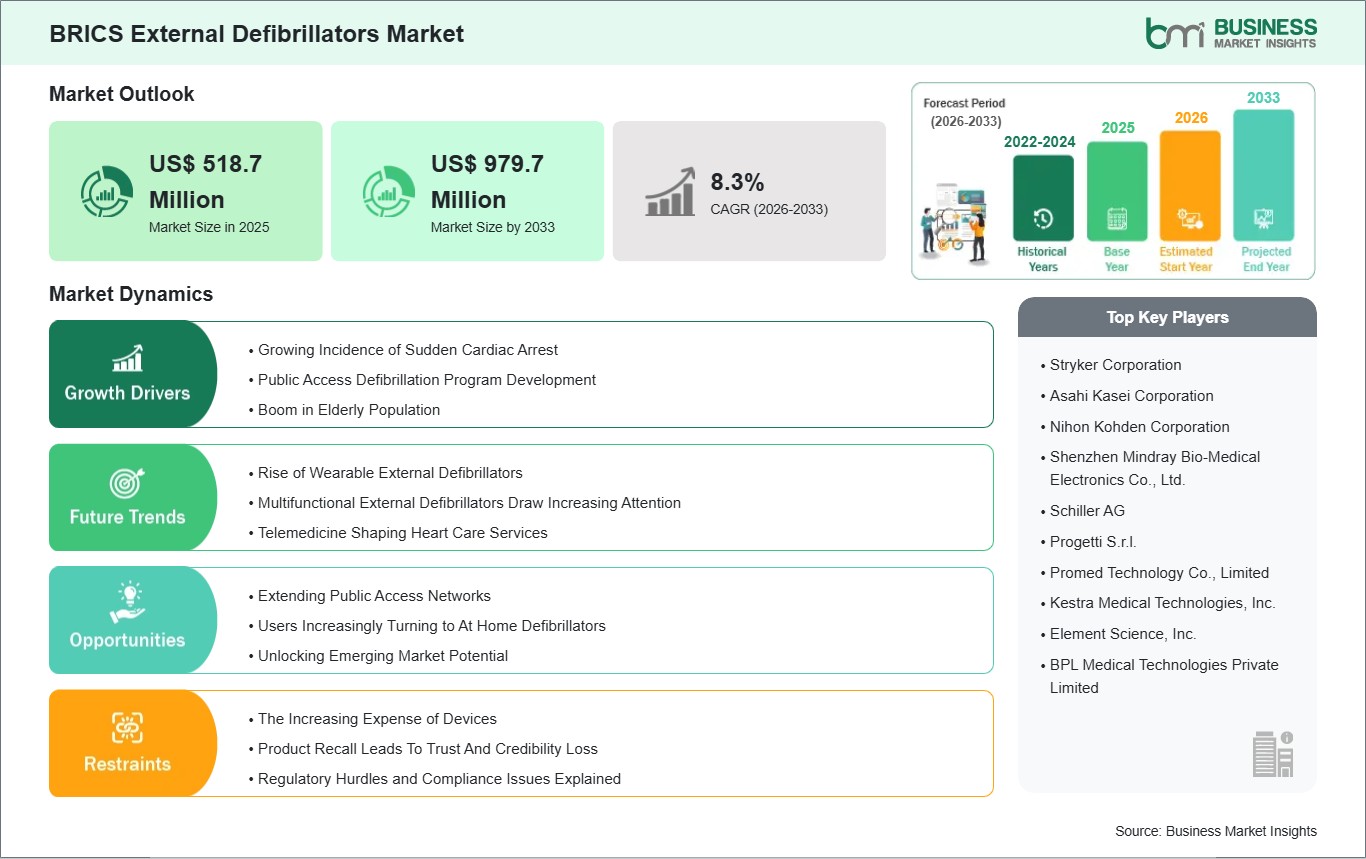
The BRICS external defibrillators market size is expected to reach US$ 979.7 million by 2033 from US$ 518.7 million in 2025. The market is estimated to record a CAGR of 8.3% from 2026 to 2033.
The BRICS external defibrillators market is shaped by the growing emphasis on emergency preparedness and the rising recognition of sudden cardiac events as a critical public health concern. Across the BRICS countries, governments and healthcare organizations are promoting public access defibrillation programs, integrating external defibrillators into first-responder frameworks, and encouraging their presence in public spaces, workplaces, and healthcare facilities. The expanding awareness of cardiac health, combined with supportive policies in some countries, is driving adoption and improving accessibility to these life-saving devices.
Adoption across BRICS faces challenges such as uneven public awareness, disparities in healthcare infrastructure, and variations in regulatory environments. Urban centers tend to have better deployment and training programs, whereas rural areas often experience slower adoption due to logistical and resource constraints. Despite these challenges, collaborative efforts between government bodies, healthcare providers, and NGOs are strengthening the focus on cardiac emergency management, positioning the BRICS market as a region with increasing emphasis on proactive life-saving solutions.

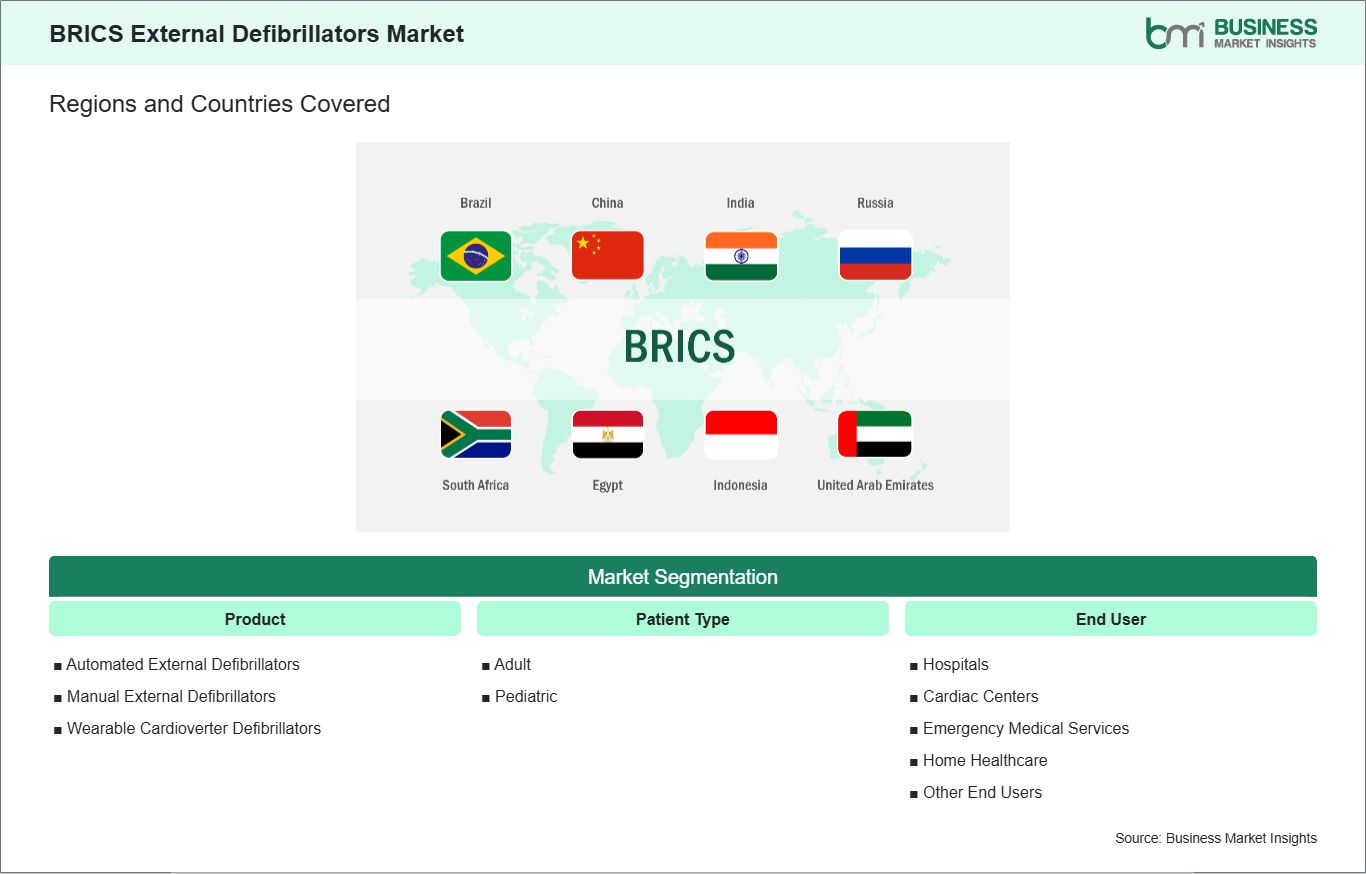
Key segments that contributed to the derivation of the BRICS external defibrillators market analysis are product type, patient type, and end user.
The BRICS region is facing a rising incidence of sudden cardiac arrest (SCA) due to rapid urbanization, aging populations, and increasing prevalence of cardiovascular risk factors such as hypertension, diabetes, and obesity. Shifts toward sedentary lifestyles, high-calorie diets, and elevated stress levels have contributed to the growing burden of heart disease. As a result, demand for timely and effective emergency cardiac interventions, including automated external defibrillators (AEDs), is becoming increasingly critical across both urban and semi-urban areas.
Healthcare systems across the region are enhancing emergency response infrastructure to cope with the growing SCA burden. Hospitals and specialized cardiac centers are equipping emergency departments and intensive care units with defibrillation devices while expanding staff training in advanced cardiac life support. The emphasis on rapid intervention reflects the recognition that early defibrillation significantly improves survival outcomes in both in-hospital and out-of-hospital cardiac emergencies.
Despite improvements in hospital capabilities, access to defibrillation remains uneven, particularly in rural and remote communities. Limited availability of AEDs outside healthcare facilities and delayed emergency response times can impede immediate treatment for cardiac events. Initiatives to train first responders, equip ambulances with portable devices, and raise community awareness are emerging as key strategies to address these gaps and ensure more equitable access to life-saving interventions throughout BRICS.
Public access defibrillator (PAD) networks are expanding steadily across the BRICS region as authorities and healthcare organizations recognize the critical role of early defibrillation in saving lives. AEDs are installed in high-traffic public areas such as transport hubs, commercial centers, workplaces, and educational institutions. These networks aim to ensure that bystanders can act quickly during cardiac emergencies, bridging the time before professional emergency services arrive.
In parallel with equipment deployment, community training programs are enhancing the effectiveness of PAD networks. Large-scale campaigns are raising awareness about CPR and AED usage, helping residents and employees gain confidence in responding to sudden cardiac events. Integration of AED registries with emergency response systems also supports rapid guidance, allowing individuals to locate the nearest device efficiently and improve survival rates.
Challenges remain in achieving uniform coverage across the diverse BRICS landscape. Variations in infrastructure, regulatory frameworks, and funding can limit widespread adoption, particularly in less developed or remote areas. Nevertheless, continued collaboration between government bodies, healthcare providers, and private stakeholders is gradually strengthening public access networks. As accessibility and awareness improve, these networks are expected to play a central role in reducing mortality from sudden cardiac arrest across the region.

The BRICS external defibrillators market demonstrates steady growth, with size and share analysis highlighting evolving trends and competitive dynamics among key players. The report evaluates important subsegments categorized within product type, patient type, and end user, highlighting their respective contributions to overall market performance.
By product type, the Automated External Defibrillators (AEDs) subsegment dominated the market in 2025. Their widespread adoption is driven by their ease of use, rapid response capability, and effectiveness in treating sudden cardiac arrest outside clinical settings, making them a vital tool in emergency cardiac care.
In terms of patient type, the adults subsegment dominated the market in 2025. This leadership is attributed to the higher incidence of cardiac events among adults, growing awareness about the importance of immediate defibrillation in cardiac emergencies, and increased accessibility to AEDs in public and healthcare settings.
Based on end user, the hospitals subsegment dominated the market in 2025. Hospitals remain the primary distribution channel due to their established emergency response systems, trained medical personnel, access to advanced cardiac care infrastructure, and the ability to provide prompt, life-saving interventions.
| Report Attribute | Details |
|---|---|
| Market size in 2025 | US$ 518.7 Million |
| Market Size by 2033 | US$ 979.7 Million |
| CAGR (2026 - 2033) | 8.3% |
| Historical Data | 2022-2024 |
| Forecast period | 2026-2033 |
| Segments Covered | By Product
|
|
Regions and Countries Covered
| |
| BRICS | Russia, Brazil, South Africa, India, China, Egypt, Indonesia, Saudi Arabia, United Arab Emirates |
| Market leaders and key company profiles |
|
The "BRICS External Defibrillators Market Size and Forecast (2022–2033)" report provides a detailed analysis of the market covering below areas:
The geographical scope of the BRICS External Defibrillators market report is divided into: Russia, Brazil, South Africa, India, China, Egypt, Indonesia, Saudi Arabia, and the UAE. China held the largest share in 2025.
China dominates the BRICS external defibrillators market due to its strong emphasis on building comprehensive emergency response systems. Urban centers have become central hubs for AED placement, supported by city health authorities that coordinate accessibility and integration into emergency services. Public campaigns and educational initiatives have played a major role in encouraging bystander readiness, promoting awareness of how external defibrillators can save lives, and normalizing their presence in public spaces such as transport hubs, offices, and residential complexes.
Hospitals and clinics in key cities prioritize advanced external defibrillators as part of routine emergency care, reflecting a focus on both preparedness and technology adoption. While rural regions face challenges with coverage and public familiarity, nationwide efforts aim to expand awareness and accessibility, creating a more unified approach to cardiac emergency management. China's combination of policy support, public education, and healthcare system modernization positions it as the leading driver of growth within the BRICS external defibrillators market.

The BRICS external defibrillators market is evaluated by gathering qualitative and quantitative data post primary and secondary research, which includes important corporate publications, association data, and databases. A few of the key developments in the BRICS external defibrillators market are:
The BRICS External Defibrillators Market is valued at US$ 518.7 Million in 2025, it is projected to reach US$ 979.7 Million by 2033.
As per our report BRICS External Defibrillators Market, the market size is valued at US$ 518.7 Million in 2025, projecting it to reach US$ 979.7 Million by 2033. This translates to a CAGR of approximately 8.3% during the forecast period.
The BRICS External Defibrillators Market report typically cover these key segments-
The historic period, base year, and forecast period can vary slightly depending on the specific market research report. However, for the BRICS External Defibrillators Market report:
The BRICS External Defibrillators Market is populated by several key players, each contributing to its growth and innovation. Some of the major players include:
The BRICS External Defibrillators Market report is valuable for diverse stakeholders, including:
Essentially, anyone involved in or considering involvement in the BRICS External Defibrillators Market value chain can benefit from the information contained in a comprehensive market report.
Please tell us your area of interest
(Market Segments/ Regions and Countries/ Companies)