Market Summary
Executive Summary and Market Analysis
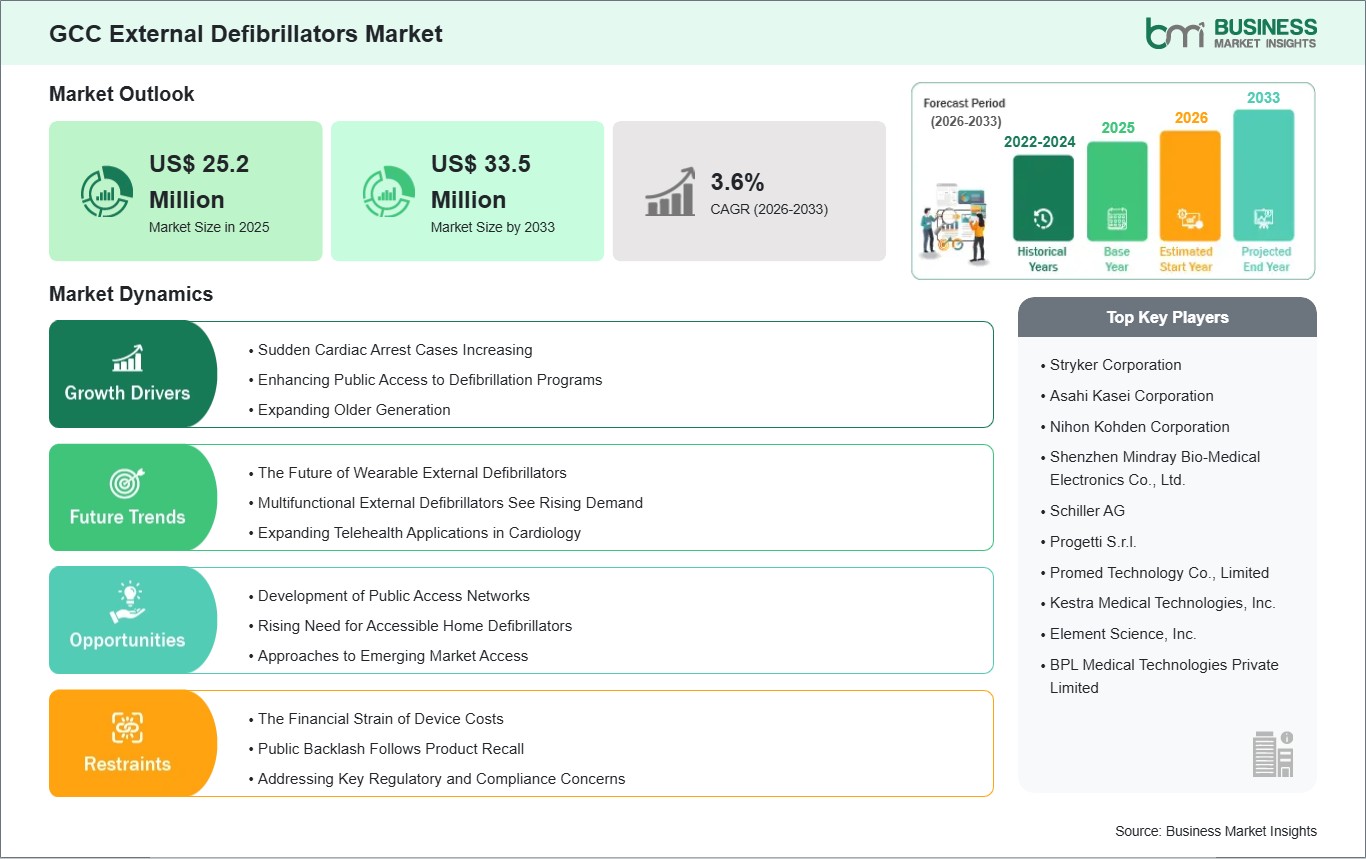
The GCC external defibrillators market has evolved significantly in recent years as healthcare systems across the Gulf Cooperation Council (GCC) prioritize emergency cardiac care and proactive public health initiatives. This region’s growing focus on improving survival outcomes from sudden cardiac arrest has driven stakeholders—including government health ministries, private healthcare providers, and emergency medical services—to invest in external defibrillation solutions. AEDs are incorporated into critical touchpoints such as airports, large commercial complexes, recreational facilities, and healthcare networks, reflecting a broader commitment to responsive and accessible emergency infrastructure. A strong culture of high standards in healthcare delivery across the GCC supports adoption, as does heightened public awareness through community campaigns and training programs promoting the importance of early intervention. Despite these strengths, the market faces distinct challenges. Variability in emergency response readiness between urban centers and remote areas can limit consistent availability of devices. Moreover, differences in regulatory frameworks and procurement processes across member states sometimes hinder seamless cross‑country standardization and large‑scale implementation. Nonetheless, increasing integration of AEDs into public safety initiatives and strategic healthcare planning continues to reinforce the market’s relevance in improving outcomes from cardiac emergencies throughout the Gulf region.
Segment Analysis
GCC External Defibrillators Market Segmentation
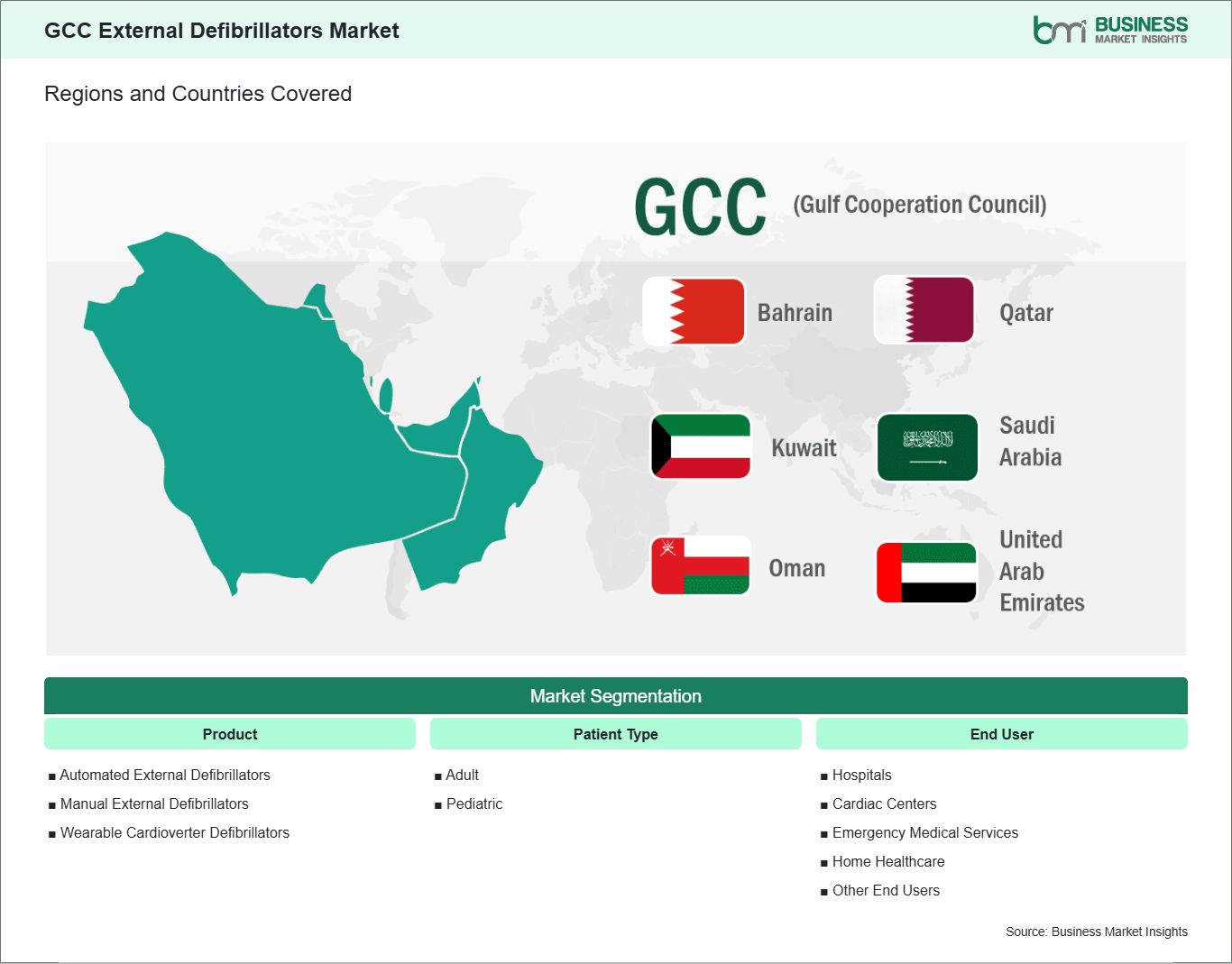
Key segments that contributed to the derivation of the GCC external defibrillators market analysis are product type, patient type, and end user.
- By product type, the external defibrillators market is segmented into automated external defibrillators, manual external defibrillators, and wearable cardioverter defibrillators. The automated external defibrillators segment dominated the market in 2025.
- Based on patient type, the external defibrillators market is classified into adult and pediatric. The adults segment dominated the market in 2025.
- In terms of end user, the external defibrillators market is categorized into hospitals, cardiac centers, emergency medical services, home healthcare, and others. The hospitals segment dominated the market in 2025.
Market Forces
GCC External Defibrillators Market Drivers and Opportunities
Sudden Cardiac Arrest Cases Increasing
Sudden cardiac arrest (SCA) continues to pose a significant health challenge across the GCC region, driven by lifestyle-related risk factors and the increasing prevalence of cardiovascular conditions. Urbanization and fast-paced lifestyles have led to higher incidences of cardiac emergencies in public spaces and workplaces, creating a strong need for rapid-response medical devices like automated external defibrillators (AEDs).
Healthcare systems and organizations are placing greater emphasis on pre-hospital interventions to improve survival outcomes. External defibrillators are incorporated into emergency response strategies, and businesses are viewing them as essential safety equipment. This trend has made AEDs a key component of both public and private emergency preparedness initiatives.
The demographic profile of the region, including a significant working-age population and growing awareness of health risks, reinforces the importance of early defibrillation. Training programs and public awareness campaigns are gradually increasing knowledge of SCA and AED usage, stimulating adoption and supporting steady growth in the external defibrillator market.
Development of Public Access Networks
Public access defibrillator (PAD) networks are expanding steadily across the GCC, aimed at improving response times during cardiac emergencies. AEDs are installed in high-traffic areas, including commercial complexes, transportation hubs, and sports and recreational facilities, ensuring accessibility when critical minutes matter.
Both governmental initiatives and private sector programs are supporting the deployment of AEDs in public areas. Integration with emergency services, clear signage, and awareness campaigns are helping ensure that bystanders can locate and operate these devices confidently. These efforts are building a culture of community-based emergency response and enhancing the efficiency of PAD networks.
Technological innovations are driving growth in the AED market. Connected defibrillators with real-time monitoring capabilities allow for better device management and operational readiness, while user-friendly designs make it easier for non-medical personnel to respond effectively. Combined with growing awareness and broader network coverage, these advancements are fueling the adoption of external defibrillators throughout the region.
Size and Share Analysis
GCC External Defibrillators Market Size and Share Analysis
The GCC external defibrillators market demonstrates steady growth, with size and share analysis highlighting evolving trends and competitive dynamics among key players. The report evaluates important subsegments categorized within product type, patient type, and end user, highlighting their respective contributions to overall market performance.
By product type, the Automated External Defibrillators (AEDs) subsegment dominated the market in 2025. Their widespread adoption is driven by their ease of use, rapid response capability, and effectiveness in treating sudden cardiac arrest outside clinical settings, making them a vital tool in emergency cardiac care.
In terms of patient type, the adults subsegment dominated the market in 2025. This leadership is attributed to the higher incidence of cardiac events among adults, growing awareness about the importance of immediate defibrillation in cardiac emergencies, and increased accessibility to AEDs in public and healthcare settings.
Based on end user, the hospitals subsegment dominated the market in 2025. Hospitals remain the primary distribution channel due to their established emergency response systems, trained medical personnel, access to advanced cardiac care infrastructure, and the ability to provide prompt, life-saving interventions.
Report Coverage
GCC External Defibrillators Market Report Coverage and Deliverables
The "GCC External Defibrillators Market Size and Forecast (2022–2033)" report provides a detailed analysis of the market covering below areas:
- GCC External Defibrillators market size and forecast at regional and country levels for all market segments covered under the scope
- GCC External Defibrillators market trends, as well as drivers, restraints, and opportunities
- GCC External Defibrillators market analysis covering key trends, regional framework, major players, regulations, and recent developments
- Industry landscape and competition analysis covering market concentration, heat map analysis, prominent players, and recent developments for the GCC External Defibrillators market
- Detailed company profiles, including SWOT analysis
Geographic Insights
GCC External Defibrillators Market Geographic Insights
The geographical scope of the GCC External Defibrillators market report is divided into: Saudi Arabia, the United Arab Emirates (UAE), Qatar, Kuwait, Bahrain, and Oman. Saudi Arabia held the largest share in 2025.
Within the GCC, Saudi Arabia has emerged as the dominant market for external defibrillators due to its extensive healthcare modernization initiatives and strategic emphasis on emergency care readiness. The country’s health authorities have prioritized cardiac health as part of national healthcare transformation efforts, embedding defibrillation devices across public hospitals, private clinics, major transportation hubs, and in nonclinical environments such as educational institutions and large community venues. This broad deployment aligns with national policies advocating comprehensive emergency preparedness and reflects robust investment in public health infrastructure. Saudi Arabia also places strong emphasis on professional training and certification for first responders and healthcare workers, ensuring that AED technologies are not only available but effectively utilized during critical situations. Collaboration between government agencies and private sector healthcare providers has supported tailored programs that raise awareness about sudden cardiac arrest and empower both medical and lay responders. Nevertheless, challenges remain in ensuring uniform device distribution outside major urban centers, where logistical complexities and resource allocation can affect coverage consistency. As the largest healthcare system in the Gulf region, Saudi Arabia continues to set implementation benchmarks and stimulate innovation in device integration, training, and emergency response coordination, strengthening its role as the key driver within the GCC external defibrillators market.
Industry Activity
Recent Developments
The GCC external defibrillators market is evaluated by gathering qualitative and quantitative data post primary and secondary research, which includes important corporate publications, association data, and databases. A few of the key developments in the GCC external defibrillators market are:
- In January 2025, Mediana showcased its state‑of‑the‑art emergency medical solutions, including automated external defibrillators (AEDs) and advanced monitor‑defibrillators, at a major regional medical exhibition under the theme “Leading Emergency Solutions,” highlighting its product presence and engagement with regional partners in the Gulf healthcare sector.
- In October 2025, Mediana announced that it brought Saudi‑approved automated external defibrillators (AEDs) to Riyadh, Saudi Arabia, as part of its expansion of emergency medical devices into the Middle East market. This included introducing certified AED models into Saudi healthcare and emergency response supply chains, reflecting Mediana’s strategic push into the GCC region.
Trust & Transparency
Research Methodology
The market analysis combines proprietary research with secondary data from government agencies, company disclosures, regulatory filings, industry databases and expert interviews. Market estimates are validated through data triangulation, cross-market benchmarking and analyst
review.
View Full Research Methodology
Key Sources Referred:
The World BankWorld Health Organization (WHO)Center for Disease Control and Prevention (CDC)European Database on Medical Devices (EUDAMED)European Society of CardiologyAmerican College of CardiologyAmerican Heart AssociationCompany WebsitesCompany Annual ReportsCompany Investor Presentations