Market Summary
Executive Summary and Market Analysis
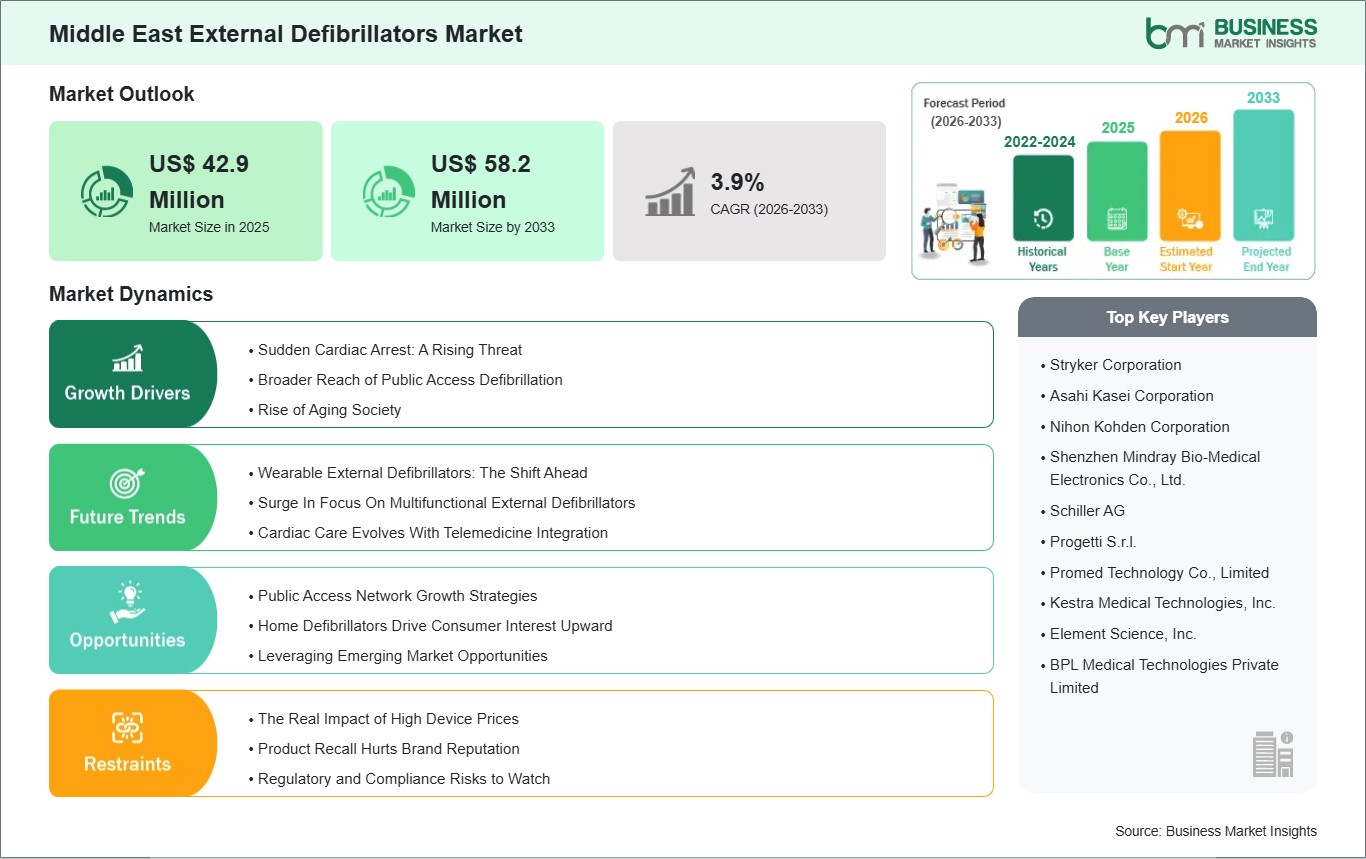
The Middle East external defibrillators market is gaining strategic importance as healthcare systems across the region prioritize emergency cardiac care infrastructure. Rising awareness of sudden cardiac arrest (SCA), combined with broader efforts to modernize emergency medical services, has driven demand for automated external defibrillators (AEDs) in public spaces, workplaces, and healthcare facilities. National healthcare strategies in several Gulf Cooperation Council (GCC) countries emphasize rapid response capabilities, leading to an uptick in AED placements at airports, hotels, shopping complexes, sports venues, and religious pilgrimage sites. Moreover, initiatives focused on first responder training and public access defibrillation programs are influencing government and private sector procurement patterns.
The private healthcare segment is leading hospital networks in adopting advanced defibrillation technologies as part of comprehensive cardiac care services. Corporate health and safety standards, especially in oil, gas, and construction sectors, stimulate demand for portable and ruggedized AED units. However, the market faces challenges related to uneven regulatory harmonization across Middle Eastern countries, which can affect device registration timelines and market entry strategies. Additionally, cost sensitivity in certain economies creates procurement hesitancy, especially outside major urban centers. Nonetheless, improving emergency response frameworks and strategic public-private partnerships continue to strengthen the region's external defibrillator landscape.
Segment Analysis
Middle East External Defibrillators Market Segmentation
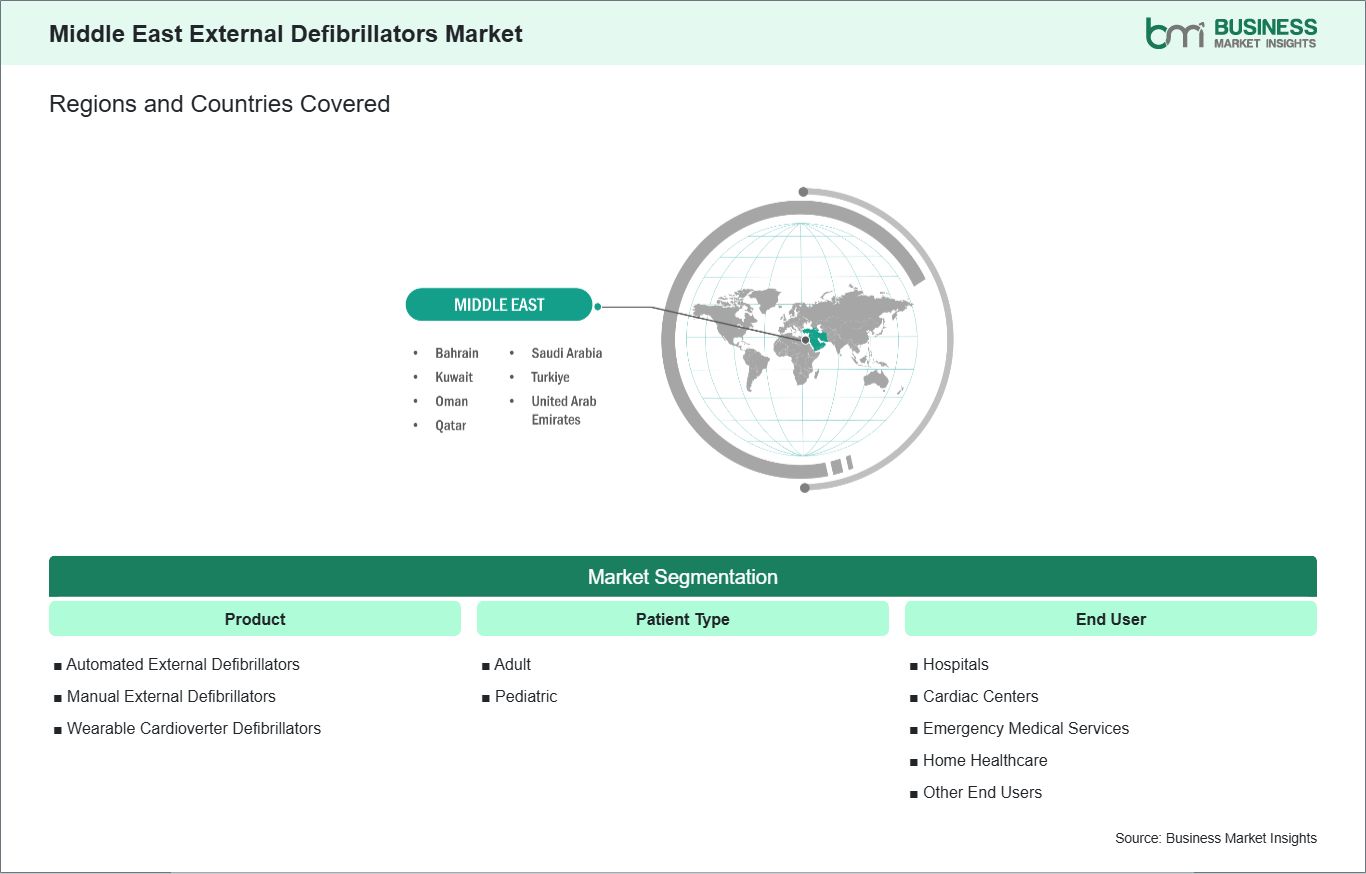
Key segments that contributed to the derivation of the Middle East external defibrillators market analysis are product type, patient type, and end user.
- By product type, the external defibrillators market is segmented into automated external defibrillators, manual external defibrillators, and wearable cardioverter defibrillators. The automated external defibrillators segment dominated the market in 2025.
- Based on patient type, the external defibrillators market is classified into adult and pediatric. The adults segment dominated the market in 2025.
- In terms of end user, the external defibrillators market is categorized into hospitals, cardiac centers, emergency medical services, home healthcare, and others. The hospitals segment dominated the market in 2025.
Market Forces
Middle East External Defibrillators Market Drivers and Opportunities
Sudden Cardiac Arrest: A Rising Threat
Sudden cardiac arrest (SCA) is recognized as a critical health challenge in the Middle East. Rapid urbanization, changes in lifestyle, and a growing prevalence of cardiovascular risk factors have contributed to more cardiac emergencies occurring outside hospitals. This trend has highlighted the need for immediate-response solutions, positioning external defibrillators as essential for saving lives in both clinical and public settings.
In densely populated urban areas, delayed access to professional medical care can significantly reduce survival rates during cardiac emergencies. As a result, external defibrillators, particularly automated models designed for nonmedical users, are becoming a key component of emergency response. They provide critical intervention in the crucial minutes following a cardiac event, bridging the gap until professional help arrives.
Demographic shifts in the region, including a growing segment of the population at higher risk for cardiac events, drive demand. Healthcare providers and institutions are increasingly incorporating external defibrillators into emergency preparedness plans, ensuring that both hospitals and public spaces are better equipped to respond to sudden cardiac arrest.
Public Access Network Growth Strategies
The expansion of public access defibrillator networks is becoming a strategic priority in the Middle East. Efforts are underway to place devices in high-traffic locations such as transportation hubs, commercial centres, workplaces, and large public venues. These initiatives aim to improve survival outcomes by ensuring that defibrillators are readily accessible when cardiac emergencies occur outside hospital settings.
Community engagement and awareness programs are also playing a key role in network growth. Training campaigns are helping bystanders understand how to operate automated external defibrillators safely, improving confidence in emergency response. Integrating device use with basic life support knowledge enhances the effectiveness of public access networks and ensures quicker intervention during sudden cardiac events.
Despite progress in urban centres, gaps in coverage remain in less serviced areas, where access to healthcare infrastructure and emergency services is limited. Portable and easy-to-use external defibrillators are helping address these gaps, while ongoing efforts aim to create more coordinated deployment strategies. Expanding public access networks is expected to remain a primary driver of market growth, increasing the reach of life-saving interventions across the region.
Size and Share Analysis
Middle East External Defibrillators Market Size and Share Analysis
The Middle East external defibrillators market demonstrates steady growth, with size and share analysis highlighting evolving trends and competitive dynamics among key players. The report evaluates important subsegments categorized within product type, patient type, and end user, highlighting their respective contributions to overall market performance.
By product type, the Automated External Defibrillators (AEDs) subsegment dominated the market in 2025. Their widespread adoption is driven by their ease of use, rapid response capability, and effectiveness in treating sudden cardiac arrest outside clinical settings, making them a vital tool in emergency cardiac care.
In terms of patient type, the adults subsegment dominated the market in 2025. This leadership is attributed to the higher incidence of cardiac events among adults, growing awareness about the importance of immediate defibrillation in cardiac emergencies, and increased accessibility to AEDs in public and healthcare settings.
Based on end user, the hospitals subsegment dominated the market in 2025. Hospitals remain the primary distribution channel due to their established emergency response systems, trained medical personnel, access to advanced cardiac care infrastructure, and the ability to provide prompt, life-saving interventions.
Report Coverage
Middle East External Defibrillators Market Report Coverage and Deliverables
The "Middle East External Defibrillators Market Size and Forecast (2022–2033)" report provides a detailed analysis of the market covering below areas:
- Middle East External Defibrillators market size and forecast at regional and country levels for all market segments covered under the scope
- Middle East External Defibrillators market trends, as well as drivers, restraints, and opportunities
- Middle East External Defibrillators market analysis covering key trends, regional framework, major players, regulations, and recent developments
- Industry landscape and competition analysis covering market concentration, heat map analysis, prominent players, and recent developments for the Middle East External Defibrillators market
- Detailed company profiles, including SWOT analysis
Geographic Insights
Middle East External Defibrillators Market Geographic Insights
The geographical scope of the Middle East External Defibrillators market report is divided into: the UAE, Saudi Arabia, Bahrain, Oman, Kuwait, Qatar, and Turkiye. Turkiye held the largest share in 2025.
Turkiye stands out as the dominant external defibrillators market within the Middle East due to its well-developed healthcare infrastructure and proactive emergency response policies. The country's expansive network of hospitals and ambulatory care services integrates defibrillator technologies into standard emergency protocols, ensuring that both manual and automated external defibrillators are accessible across urban and peri‑urban areas. Public health authorities have also spearheaded campaigns to increase awareness of sudden cardiac arrest and the life‑saving potential of AEDs, leading to greater adoption in high‑traffic public domains such as major transit stations, shopping centers, educational institutions, and government facilities.
The strategic positioning of Turkiye as both a healthcare hub and a bridge between Europe and Asia has facilitated access to global medical device suppliers, expanding the availability of internationally certified defibrillation equipment. Collaboration between local distributors and multinational manufacturers has enhanced product training, after‑sales service networks, and healthcare provider engagement. Corporate health and safety mandates within industrial sectors have also encouraged the integration of AEDs into workplace emergency response plans. While economic volatility and currency fluctuations can influence procurement decisions, Turkiye's regulatory alignment with international medical device standards and commitment to emergency care readiness sustain its leading role in the external defibrillators market across the Middle East.
Industry Activity
Recent Developments
The Middle East external defibrillators market is evaluated by gathering qualitative and quantitative data post primary and secondary research, which includes important corporate publications, association data, and databases. A few of the key developments in the Middle East external defibrillators market are:
- In October 2025, Mediana announced that it brought Saudi-approved external defibrillators to Riyadh, following clearance of its AED models A15 and A16 and monitor External Defibrillators D100 and D700 by the Saudi Food and Drug Authority, enabling local market entry and expanded sales opportunities.
- In January 2025, Mediana announced that it participated in Arab Health 2025 in Dubai to showcase its emergency medical solutions, including AEDs and advanced external defibrillators, to expand its customer base and presence in the Middle East emergency medical device market.
Trust & Transparency
Research Methodology
The market analysis combines proprietary research with secondary data from government agencies, company disclosures, regulatory filings, industry databases and expert interviews. Market estimates are validated through data triangulation, cross-market benchmarking and analyst
review.
View Full Research Methodology
Key Sources Referred:
The World BankWorld Health Organization (WHO)Center for Disease Control and Prevention (CDC)European Database on Medical Devices (EUDAMED)European Society of CardiologyAmerican College of CardiologyAmerican Heart AssociationCompany WebsitesCompany Annual ReportsCompany Investor Presentations