Market Summary
Executive Summary and Market Analysis
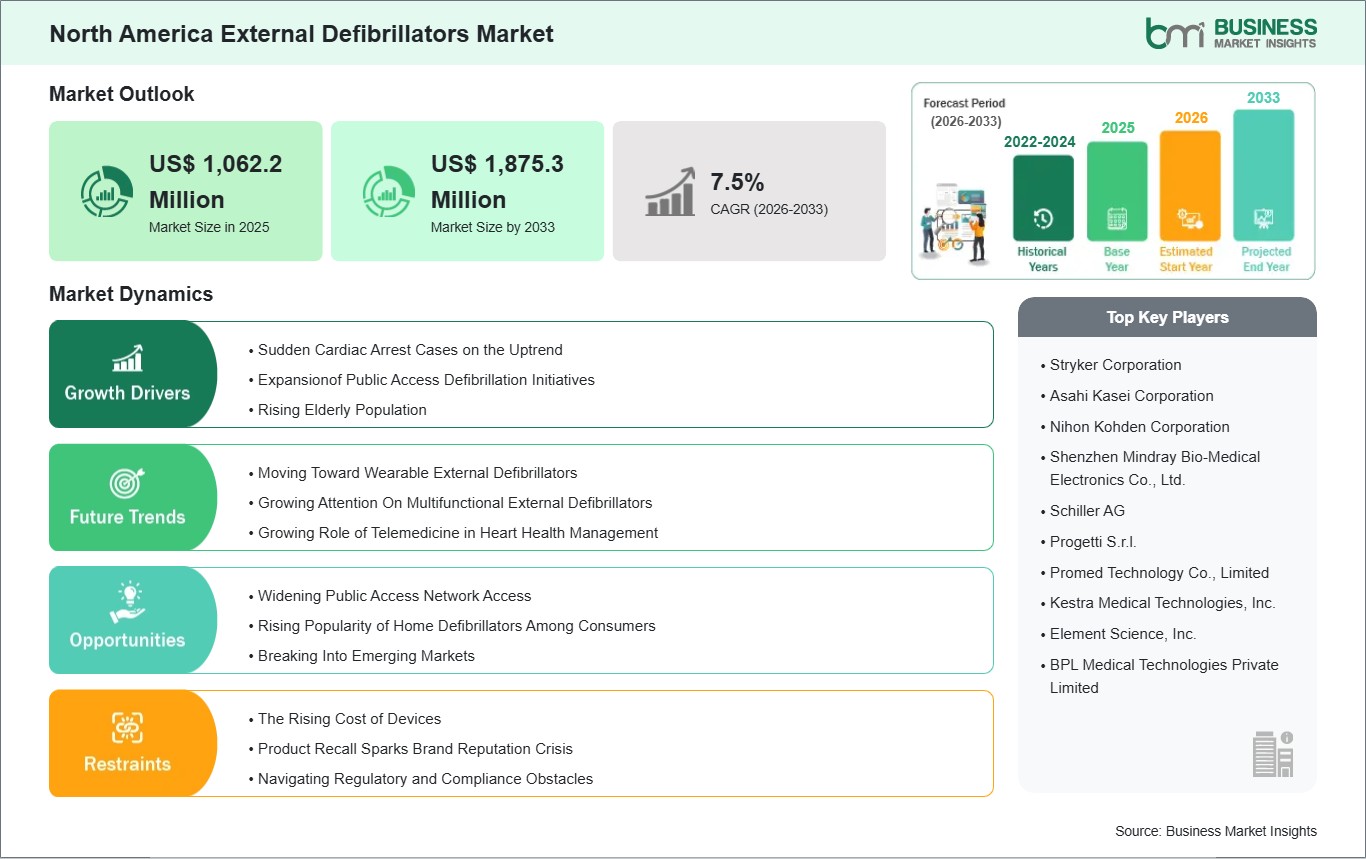
The North America external defibrillators market is characterized by a high level of awareness regarding sudden cardiac arrest and an established healthcare infrastructure that supports emergency care solutions. In this region, strong emphasis on improving out‑of‑hospital cardiac arrest survival rates has fostered widespread adoption of automated external defibrillators (AEDs) across public spaces, corporate environments, educational institutions, and residential communities. A robust network of emergency medical services, ongoing advocacy by nonprofit organizations, and integration of first‑responder programs elevate market traction. Regulatory clarity and supportive policies on the placement of AED units in public and private facilities also encourage procurement and training initiatives. However, the market faces restraints related to cost sensitivity among smaller organizations and the complexity of maintaining compliance with evolving safety standards. Additionally, disparities in accessibility between urban and rural communities temper uniform market growth. Technological developments such as connectivity features and user‑friendly interfaces continue to shape the competitive landscape, while increasing partnerships between manufacturers and healthcare providers are improving device reach and end‑user confidence.
Segment Analysis
North America External Defibrillators Market Segmentation
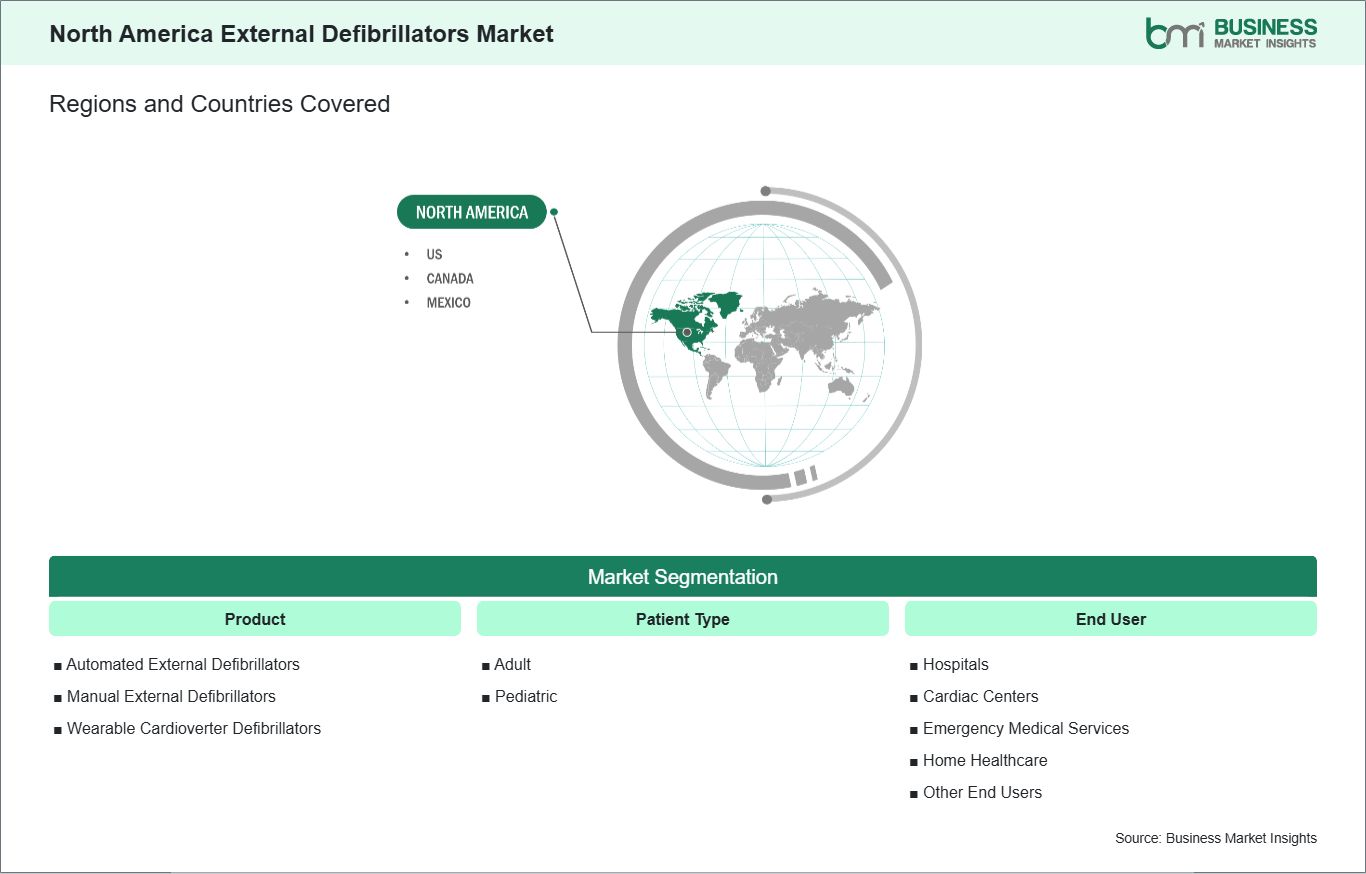
Key segments that contributed to the derivation of the North America external defibrillators market analysis are product type, patient type, and end user.
- By product type, the external defibrillators market is segmented into automated external defibrillators, manual external defibrillators, and wearable cardioverter defibrillators. The automated external defibrillators segment dominated the market in 2025.
- Based on patient type, the external defibrillators market is classified into adult and pediatric. The adults segment dominated the market in 2025.
- In terms of end user, the external defibrillators market is categorized into hospitals, cardiac centers, emergency medical services, home healthcare, and others. The hospitals segment dominated the market in 2025.
Market Forces
North America External Defibrillators Market Drivers and Opportunities
Sudden Cardiac Arrest Cases on the Uptrend
Sudden cardiac arrest (SCA) remains a pressing health concern across North America, driving the demand for external defibrillators. Hospitals and emergency responders have focused on improving survival rates, which has led to wider recognition of the critical role that timely defibrillation plays. As awareness grows among both healthcare professionals and the public, the adoption of automated external defibrillators (AEDs) has accelerated.
In urban areas, high population density and fast-paced lifestyles mean cardiac emergencies often occur outside clinical settings. This trend has prompted communities to rethink emergency response strategies, ensuring that AEDs are accessible not only in hospitals but also in schools, offices, and public venues. North America’s emphasis on rapid intervention highlights a proactive approach to reducing preventable fatalities.
The growing prevalence of cardiovascular risk factors, such as lifestyle-related health issues, is also contributing to market growth. Manufacturers are responding by designing AEDs that are user-friendly and suitable for quick deployment, meeting the urgent need for devices that both trained professionals and bystanders can operate in public settings.
Widening Public Access Network Access
North America has seen a significant push to expand public access to defibrillation. Public spaces, workplaces, and community centers are increasingly equipped with AEDs, creating a safety network where life-saving interventions can happen before emergency responders arrive. This expansion reflects a cultural emphasis on preparedness and community health responsibility.
Local authorities and organizations have collaborated to ensure AED placement is strategic and accessible. Public training programs complement this deployment, educating citizens on how to operate defibrillators confidently. By combining infrastructure with awareness, North American communities have strengthened the overall effectiveness of emergency response networks.
Technology is enhancing the public access network. Modern AEDs often include features such as easy-to-follow instructions, maintenance alerts, and compact designs for portability. These innovations not only increase usability but also encourage broader adoption, ensuring that more people have immediate access to life-saving equipment wherever cardiac emergencies may occur.
Size and Share Analysis
North America External Defibrillators Market Size and Share Analysis
The North America external defibrillators market demonstrates steady growth, with size and share analysis highlighting evolving trends and competitive dynamics among key players. The report evaluates important subsegments categorized within product type, patient type, and end user, highlighting their respective contributions to overall market performance.
By product type, the Automated External Defibrillators (AEDs) subsegment dominated the market in 2025. Their widespread adoption is driven by their ease of use, rapid response capability, and effectiveness in treating sudden cardiac arrest outside clinical settings, making them a vital tool in emergency cardiac care.
In terms of patient type, the adults subsegment dominated the market in 2025. This leadership is attributed to the higher incidence of cardiac events among adults, growing awareness about the importance of immediate defibrillation in cardiac emergencies, and increased accessibility to AEDs in public and healthcare settings.
Based on end user, the hospitals subsegment dominated the market in 2025. Hospitals remain the primary distribution channel due to their established emergency response systems, trained medical personnel, access to advanced cardiac care infrastructure, and the ability to provide prompt, life-saving interventions.
Report Coverage
North America External Defibrillators Market Report Coverage and Deliverables
The "North America External Defibrillators Market Size and Forecast (2022–2033)" report provides a detailed analysis of the market covering below areas:
- North America External Defibrillators market size and forecast at the regional and country levels for the market segments covered under the scope
- North America External Defibrillators market trends, as well as drivers, restraints, and opportunities
- North America External Defibrillators market analysis covering key trends, regional framework, major players, regulations, and recent developments
- Industry landscape and competition analysis covering market concentration, heat map analysis, prominent players, and recent developments for the North America External Defibrillators market
- Detailed company profiles, including SWOT analysis
Geographic Insights
North America External Defibrillators Market Geographic Insights
The geographical scope of the North America external defibrillators market report is divided into: The US, Canada, and Mexico. The US held the largest share in 2025.
In the US, the external defibrillators landscape is driven by heightened public health campaigns and concerted efforts to reduce fatal outcomes from cardiac events outside hospital settings. AED placement is common in arenas, transportation hubs, corporate campuses, and educational institutions, supported by advocacy from health agencies and civic groups. A well‑developed emergency response system that prioritizes rapid defibrillation enhances demand for technologically advanced, easy‑to‑operate devices. Manufacturers emphasize post‑sale support, including maintenance services and first‑aid training certifications, to build long‑term adoption among businesses and community organizations. Nevertheless, the market contends with challenges related to varying state‑level regulations on AED registration, mandatory training requirements, and liability protection, which can influence purchase decisions. Furthermore, smaller enterprises and community centers sometimes struggle with upfront procurement and ongoing servicing obligations, affecting wider deployment. Competitive dynamics in the US are shaped by local innovation, strategic collaborations with EMS networks, and emphasis on reliable supply chains to ensure that defibrillators are available where and when they are needed most.
Industry Activity
Recent Developments
The North America external defibrillators market is evaluated by gathering qualitative and quantitative data post primary and secondary research, which includes important corporate publications, association data, and databases. A few of the key developments in the North America external defibrillators market are:
- In December 2025, ZOLL Medical Corporation (via a collaboration with PulsePoint) announced the launch “Anyone Can Register” initiative to expand the National Emergency AED Registry (NEAR) across the US and Canada, mobilizing volunteers, manufacturers, and AED owners to map and share AED locations to improve emergency access.
- In January 2023, Avive Solutions, Inc. announced that it had received US FDA pre-market approval for its Avive Connect automated external defibrillator (AED), a handheld, connected device with cellular/Wi-Fi/GPS capabilities designed to enhance emergency response and remote monitoring in North America.
Trust & Transparency
Research Methodology
The market analysis combines proprietary research with secondary data from government agencies, company disclosures, regulatory filings, industry databases and expert interviews. Market estimates are validated through data triangulation, cross-market benchmarking and analyst
review.
View Full Research Methodology
Key Sources Referred:
The World BankWorld Health Organization (WHO)Center for Disease Control and Prevention (CDC)European Database on Medical Devices (EUDAMED)European Society of CardiologyAmerican College of CardiologyAmerican Heart AssociationCompany WebsitesCompany Annual ReportsCompany Investor Presentations