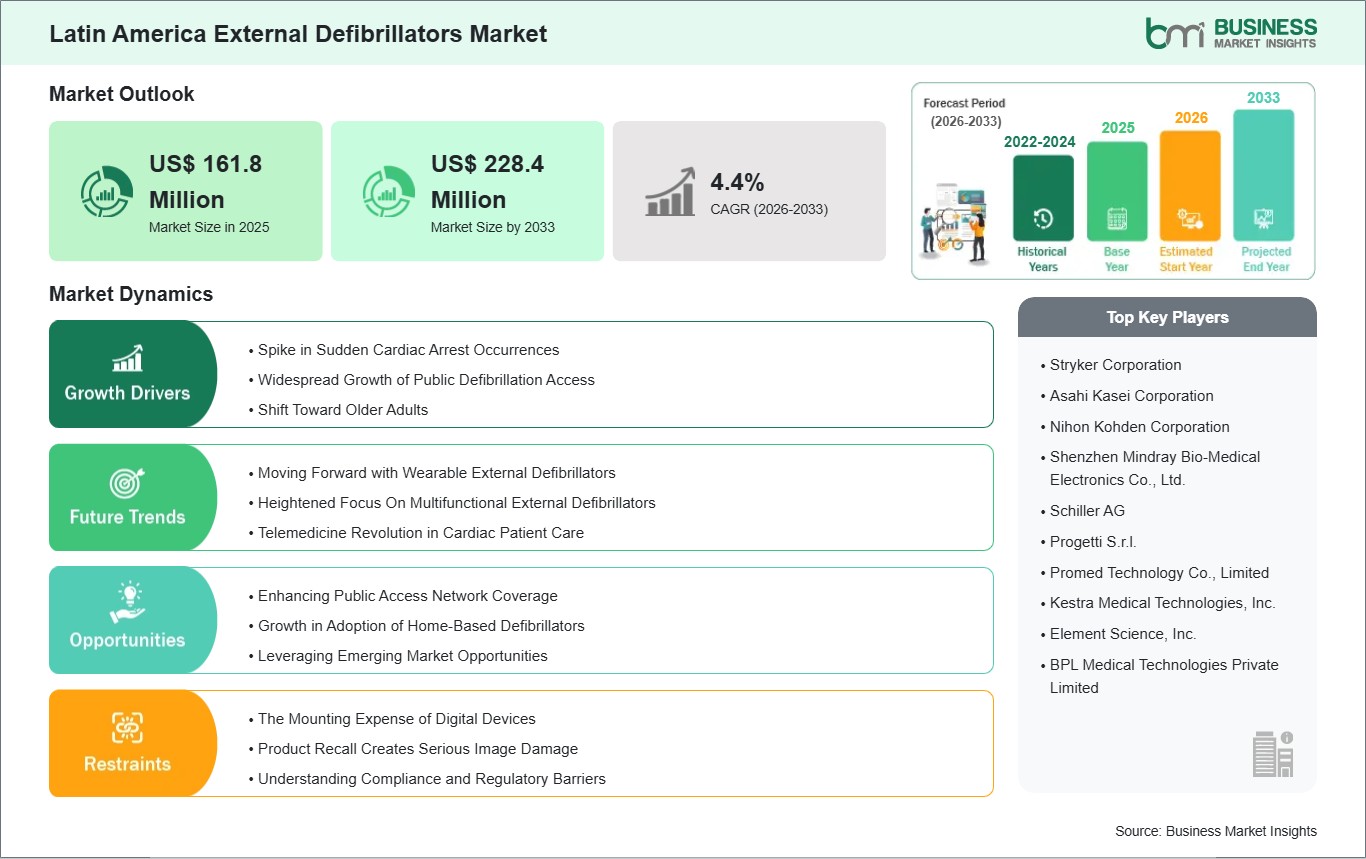
The Latin America external defibrillators market size is expected to reach US$ 228.4 million by 2033 from US$ 161.8 million in 2025. The market is estimated to record a CAGR of 4.4% from 2026 to 2033.
The Latin America external defibrillators market has evolved as awareness of sudden cardiac arrest (SCA) and emergency response preparedness gains priority across both public and private sectors. A growing emphasis on strengthening pre-hospital care infrastructure in urban centers has driven investments in Automated External Defibrillators (AEDs) for settings such as airports, shopping centers, corporate campuses, and educational institutions. Government initiatives aimed at broadening public access to life-saving technologies have cultivated partnerships with healthcare providers and non-governmental organizations to install AEDs in high-footfall locations and popular sporting venues. Additionally, the region's expanding focus on community health and first-responder training programs has increased demand for user-friendly and portable defibrillator devices.
The adoption of external defibrillators in Latin America faces notable barriers. Inconsistencies in regulatory frameworks across countries continue to complicate device certification and distribution. Limited reimbursement pathways and budget constraints in public healthcare systems also temper procurement, particularly in rural and underserved areas. Despite these challenges, growing cardiology patient loads and the integration of digital health platforms for remote monitoring are positioning external defibrillators as indispensable components of regional emergency care strategies.

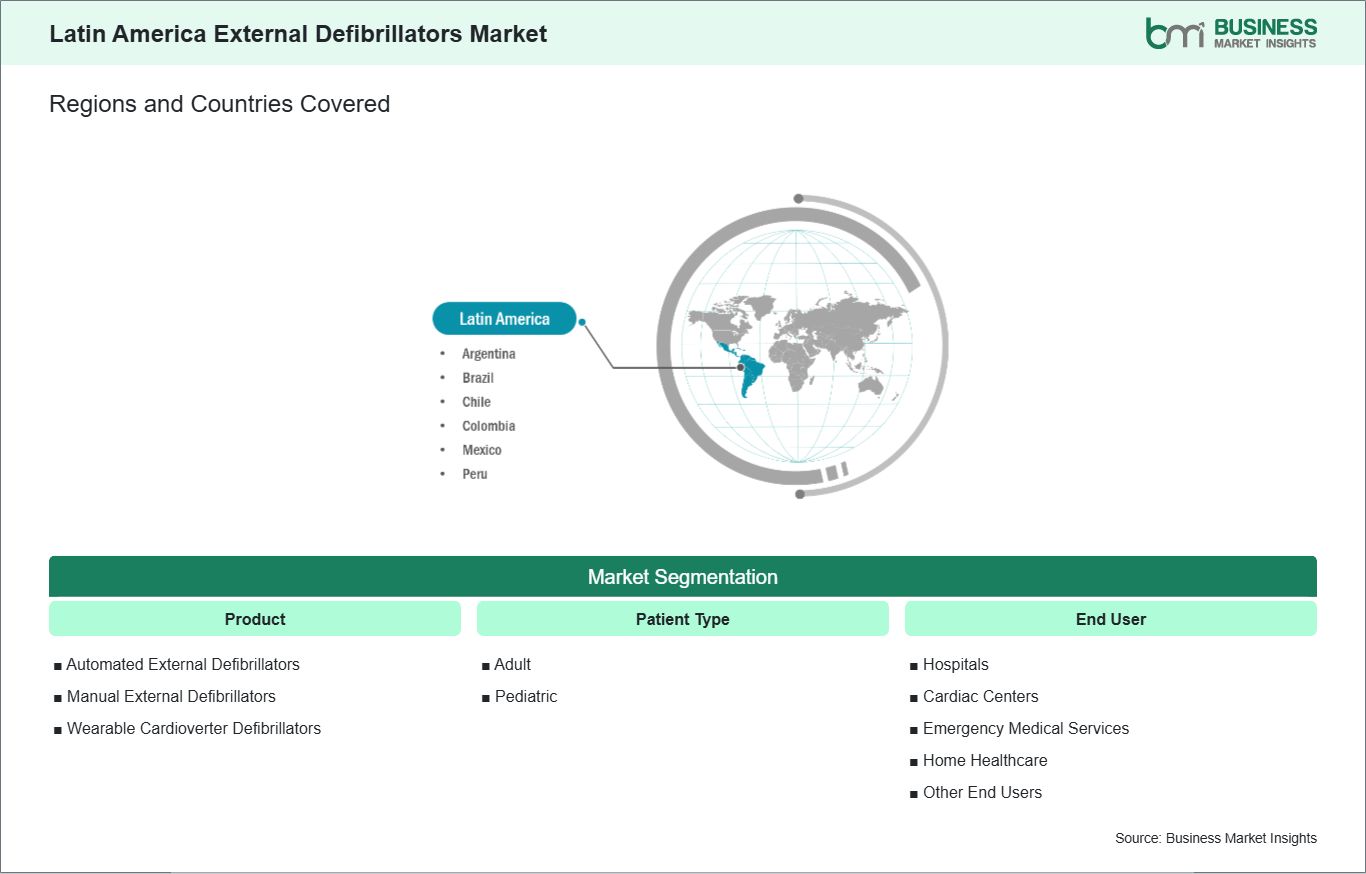
Key segments that contributed to the derivation of the Latin America external defibrillators market analysis are product type, patient type, and end user.
The rising burden of cardiovascular diseases and related complications across the region is propelling the Latin America external defibrillators market. Rapid urban expansion, changing dietary habits, increasing obesity rates, and sedentary lifestyles have collectively elevated the risk of sudden cardiac arrest (SCA) among adult populations. As cardiovascular conditions remain a leading cause of mortality, the demand for immediate-response solutions such as automated external defibrillators (AEDs) continues to strengthen across both healthcare and community environments.
A significant proportion of cardiac arrest events occur outside hospital settings, where timely intervention is critical to survival. In densely populated urban corridors, delayed emergency medical response times further highlight the importance of readily accessible defibrillation devices. This reality has prompted healthcare providers, facility operators, and emergency response planners to prioritize the integration of external defibrillators into ambulances, clinics, and high-footfall commercial locations.
Demographic shifts are contributing to sustained market momentum. Gradual population aging and the growing prevalence of lifestyle-related risk factors are expanding the pool of individuals vulnerable to cardiac emergencies. Simultaneously, healthcare modernization efforts and greater awareness of early intervention benefits are encouraging broader adoption of both manual and automated external defibrillators, reinforcing steady growth prospects for the regional market.
Public access defibrillation initiatives are increasingly shaping the competitive landscape of the Latin America external defibrillators market. Authorities and health organizations are emphasizing the strategic placement of AEDs in transportation hubs, corporate buildings, educational institutions, and recreational facilities to improve survival outcomes in out-of-hospital cardiac arrest cases. This shift reflects a broader transition toward decentralized emergency response systems.
The private sector is playing a growing role in expanding defibrillator networks. Employers, property developers, and event organizers are incorporating AED deployment into risk management and safety compliance frameworks. Concurrently, community training programs and awareness campaigns are helping to improve bystander readiness, essential for maximizing the effectiveness of public access defibrillation programs.
Coverage disparities remain between metropolitan and less-developed areas, where healthcare infrastructure and emergency preparedness resources are comparatively limited. These gaps are driving interest in portable, easy-to-use defibrillator models suited for remote deployment. As regulatory structures mature and public awareness deepens, the expansion of accessible defibrillation networks is expected to remain a core driver of market growth throughout the region.

The Latin America external defibrillators market demonstrates steady growth, with size and share analysis highlighting evolving trends and competitive dynamics among key players. The report evaluates important subsegments categorized within product type, patient type, and end user, highlighting their respective contributions to overall market performance.
By product type, the Automated External Defibrillators (AEDs) subsegment dominated the market in 2025. Their widespread adoption is driven by their ease of use, rapid response capability, and effectiveness in treating sudden cardiac arrest outside clinical settings, making them a vital tool in emergency cardiac care.
In terms of patient type, the adults subsegment dominated the market in 2025. This leadership is attributed to the higher incidence of cardiac events among adults, growing awareness about the importance of immediate defibrillation in cardiac emergencies, and increased accessibility to AEDs in public and healthcare settings.
Based on end user, the hospitals subsegment dominated the market in 2025. Hospitals remain the primary distribution channel due to their established emergency response systems, trained medical personnel, access to advanced cardiac care infrastructure, and the ability to provide prompt, life-saving interventions.
| Report Attribute | Details |
|---|---|
| Market size in 2025 | US$ 161.8 Million |
| Market Size by 2033 | US$ 228.4 Million |
| CAGR (2026 - 2033) | 4.4% |
| Historical Data | 2022-2024 |
| Forecast period | 2026-2033 |
| Segments Covered | By Product
|
|
Regions and Countries Covered
| |
| Latin America | Mexico, Brazil, Argentina, Peru, Chile, Colombia |
| Market leaders and key company profiles |
|
The "Latin America External Defibrillators Market Size and Forecast (2022–2033)" report provides a detailed analysis of the market covering below areas:
The geographical scope of the Latin America external defibrillators market report is divided into: Brazil, Mexico, Argentina, Colombia, Chile, and Peru. Mexico held the largest share in 2025.
In Mexico, external defibrillators have become a focal point of emergency care modernization, reflecting national priorities to improve outcomes from sudden cardiac events. Mexico's public health authorities have actively promoted AED deployment in transit hubs, commercial complexes, and major sporting arenas, supporting the shift from predominantly hospital-based to community-accessible emergency interventions. Complementing this, nonprofit campaigns emphasizing bystander response training have encouraged greater adoption of defibrillators outside clinical environments, particularly in metropolitan areas.
Private healthcare facilities and corporate entities in Mexico are also advancing internal health and safety policies that include the strategic placement of AEDs accompanied by staff training programs. This combined approach has enhanced the visibility of external defibrillators as essential tools in workplace and community preparedness planning. Regulatory developments have aimed to streamline approval processes for medical devices, facilitating smoother market entry for international and local manufacturers. While logistical limitations in remote regions remain a consideration, Mexico's concentrated efforts to integrate AEDs into public health frameworks underline its leadership role in the broader Latin American external defibrillators market.

The Latin America external defibrillators market is evaluated by gathering qualitative and quantitative data post primary and secondary research, which includes important corporate publications, association data, and databases. A few of the key developments in the Latin America external defibrillators market are:
The Latin America External Defibrillators Market is valued at US$ 161.8 Million in 2025, it is projected to reach US$ 228.4 Million by 2033.
As per our report Latin America External Defibrillators Market, the market size is valued at US$ 161.8 Million in 2025, projecting it to reach US$ 228.4 Million by 2033. This translates to a CAGR of approximately 4.4% during the forecast period.
The Latin America External Defibrillators Market report typically cover these key segments-
The historic period, base year, and forecast period can vary slightly depending on the specific market research report. However, for the Latin America External Defibrillators Market report:
The Latin America External Defibrillators Market is populated by several key players, each contributing to its growth and innovation. Some of the major players include:
The Latin America External Defibrillators Market report is valuable for diverse stakeholders, including:
Essentially, anyone involved in or considering involvement in the Latin America External Defibrillators Market value chain can benefit from the information contained in a comprehensive market report.
Please tell us your area of interest
(Market Segments/ Regions and Countries/ Companies)