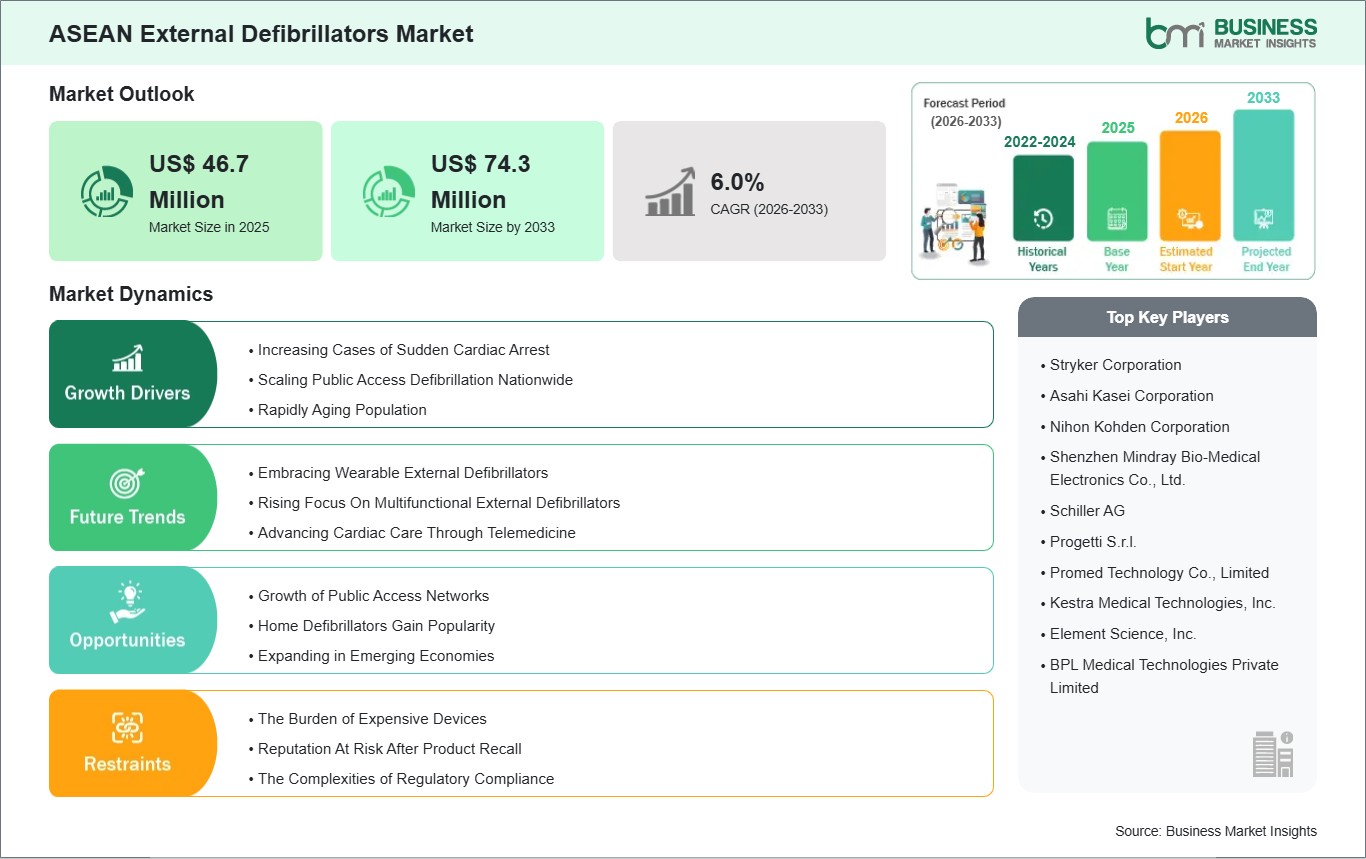
The ASEAN external defibrillators market size is expected to reach US$ 74.3 million by 2033 from US$ 46.7 million in 2025. The market is estimated to record a CAGR of 6.0% from 2026 to 2033.
The ASEAN external defibrillators market is evolving amid growing awareness of cardiac emergencies and strengthening healthcare systems across Southeast Asia. Demand for external defibrillators in this region is largely driven by rising concerns around cardiovascular health, increased public and private investment in emergency response capabilities, and focused efforts to integrate life‑saving technologies into both clinical and non‑clinical environments. Urbanization trends have placed greater emphasis on public access defibrillation—especially in airports, shopping centers, corporate campuses, and recreational venues—where high footfall creates a pressing need for rapid response tools. Healthcare providers in key ASEAN countries are also emphasizing better training for first responders and frontline healthcare workers to improve survivability from out‑of‑hospital cardiac arrest events. Nevertheless, the market continues to face challenges, including disparity in healthcare infrastructure between urban and rural areas, limited trained personnel outside major cities, and budgetary pressures in lower‑income member states, which can slow widespread adoption. Regulatory environments vary across ASEAN nations, influencing how quickly devices can be procured and deployed. Despite these hurdles, gradual improvements in emergency care frameworks, growing partnerships between governments and private health technology providers, and increased awareness campaigns are collectively supporting steady uptake of external defibrillators. The ASEAN market is positioned for continued development as regional health priorities recognize the role of rapid cardiac intervention in saving lives.

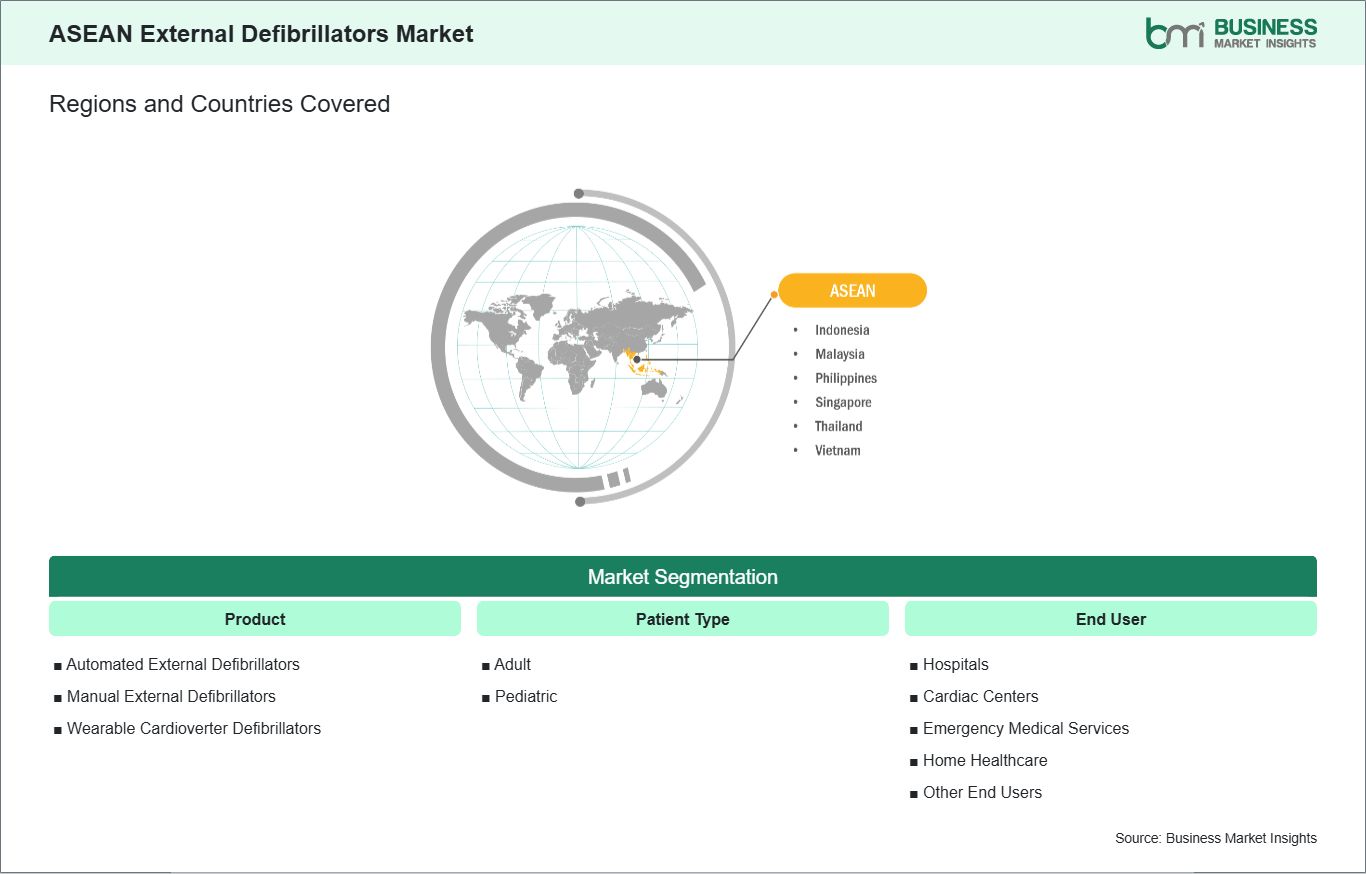
Key segments that contributed to the derivation of the ASEAN external defibrillators market analysis are product type, patient type, and end user.
The ASEAN region is witnessing a notable rise in sudden cardiac arrest (SCA) incidents driven by growing urban populations, lifestyle shifts, and increasing prevalence of cardiovascular risk factors. Nations such as Indonesia, Malaysia, Thailand, and the Philippines report rising rates of hypertension, diabetes, and coronary artery disease, conditions closely linked to sudden cardiac events. Rapid economic development and urbanization have also contributed to sedentary lifestyles and higher obesity levels, factors that heighten the risk of SCA among both older adults and younger demographics.
Healthcare providers across ASEAN are responding by integrating advanced cardiac care technologies into clinical and emergency settings. Major hospitals in Bangkok, Kuala Lumpur, Jakarta, and Manila are equipping emergency departments and intensive care units with automated external defibrillators (AEDs) and training staff in advanced life support protocols. These investments reflect a broader regional recognition that early defibrillation is critical to improving survival outcomes from out‑of‑hospital cardiac arrests, particularly in densely populated metropolitan areas where response times can be delayed by traffic congestion.
Despite progress in larger urban centers, many secondary cities and rural areas within ASEAN countries face gaps in emergency cardiac care infrastructure. Limited access to AEDs outside hospital settings and variable emergency medical services (EMS) coverage hinder timely intervention for sudden cardiac events. In response, several regional health authorities are exploring community‑based programs that place defibrillators in strategic public locations and integrate them with EMS dispatch systems, aiming to reduce disparities in survival rates across both urban and underserved areas.
Public access defibrillator (PAD) initiatives are gaining momentum across ASEAN as governments, private organizations, and non‑profits partner to place AEDs in high‑traffic public spaces. In Singapore, AEDs are now commonly found in shopping centers, transportation hubs, and sports venues, supported by mandatory registration with the national EMS network. These efforts ensure that bystanders and first responders can rapidly locate and use AEDs during cardiac emergencies, increasing the chances of survival from out‑of‑hospital SCA.
In countries such as Thailand and Malaysia, collaborations between municipal authorities and healthcare NGOs are expanding PAD programs to include community training in cardiopulmonary resuscitation (CPR) and AED use. Large‑scale public education campaigns, often conducted in multiple languages to cater to diverse populations, are helping to demystify defibrillator operation and encourage volunteer participation in emergency response. These efforts are especially visible around universities, markets, and tourist districts where the risk of public cardiac events is higher.
However, challenges remain in scaling PAD networks uniformly across ASEAN. Funding limitations, varying regulatory frameworks, and logistical hurdles in maintaining and servicing AED units present ongoing obstacles for widespread deployment. Rural and remote areas, in particular, lack sufficient public defibrillation infrastructure. Nonetheless, continuous investments by both public and private stakeholders, coupled with rising public awareness of cardiac health, are steadily strengthening PAD coverage. As these networks mature, ASEAN countries are poised to significantly improve early intervention rates for sudden cardiac arrest outside traditional clinical settings.

The ASEAN external defibrillators market demonstrates steady growth, with size and share analysis highlighting evolving trends and competitive dynamics among key players. The report evaluates important subsegments categorized within product type, patient type, and end user, highlighting their respective contributions to overall market performance.
By product type, the Automated External Defibrillators (AEDs) subsegment dominated the market in 2025. Their widespread adoption is driven by their ease of use, rapid response capability, and effectiveness in treating sudden cardiac arrest outside clinical settings, making them a vital tool in emergency cardiac care.
In terms of patient type, the adults subsegment dominated the market in 2025. This leadership is attributed to the higher incidence of cardiac events among adults, growing awareness about the importance of immediate defibrillation in cardiac emergencies, and increased accessibility to AEDs in public and healthcare settings.
Based on end user, the hospitals subsegment dominated the market in 2025. Hospitals remain the primary distribution channel due to their established emergency response systems, trained medical personnel, access to advanced cardiac care infrastructure, and the ability to provide prompt, life-saving interventions.
| Report Attribute | Details |
|---|---|
| Market size in 2025 | US$ 46.7 Million |
| Market Size by 2033 | US$ 74.3 Million |
| CAGR (2026 - 2033) | 6.0% |
| Historical Data | 2022-2024 |
| Forecast period | 2026-2033 |
| Segments Covered | By Product
|
|
Regions and Countries Covered
| |
| ASEAN | Indonesia, Malaysia, Philippines, Singapore, Thailand, Vietnam |
| Market leaders and key company profiles |
|
The "ASEAN External Defibrillators Market Size and Forecast (2022–2033)" report provides a detailed analysis of the market covering below areas:
The geographical scope of the ASEAN external defibrillators market report is divided into: Indonesia, Malaysia, the Philippines, Singapore, Thailand, and Vietnam. Indonesia held the largest share in 2025.
Indonesia stands out as the dominant force within the ASEAN external defibrillators market, reflecting its extensive healthcare modernization efforts and focus on strengthening emergency care services. In Indonesia, large metropolitan areas have seen the greatest penetration of external defibrillator devices across hospitals, ambulance services, and high‑traffic public venues, where healthcare administrators and policy planners well understand the need for immediate cardiac arrest intervention. Public access initiatives, led by collaborations between government health agencies and non‑profit organizations, have supported awareness and training programs designed to equip local communities with the skills to use Automated External Defibrillators (AEDs) confidently. The private healthcare sector in Indonesia also plays a vital role, with private hospitals and clinics often acting as early adopters for advanced defibrillation technology, influencing broader market demand. Challenges remain in extending access beyond major urban centers, where disparities in infrastructure and emergency response reach can limit deployment into remote islands and rural districts. Budgetary constraints and competing health priorities necessitate careful allocation of resources, with stakeholders prioritizing areas with high population density and traffic. Indonesia's position as a dominant market in ASEAN is reinforced by its proactive approach to integrating emergency medical equipment into health planning, its engagement with community training initiatives, and a growing recognition of external defibrillators as essential tools in public health and emergency response frameworks.

The ASEAN external defibrillators market is evaluated by gathering qualitative and quantitative data post primary and secondary research, which includes important corporate publications, association data, and databases. A few of the key developments in the ASEAN external defibrillators market are:
The ASEAN External Defibrillators Market is valued at US$ 46.7 Million in 2025, it is projected to reach US$ 74.3 Million by 2033.
As per our report ASEAN External Defibrillators Market, the market size is valued at US$ 46.7 Million in 2025, projecting it to reach US$ 74.3 Million by 2033. This translates to a CAGR of approximately 6.0% during the forecast period.
The ASEAN External Defibrillators Market report typically cover these key segments-
The historic period, base year, and forecast period can vary slightly depending on the specific market research report. However, for the ASEAN External Defibrillators Market report:
The ASEAN External Defibrillators Market is populated by several key players, each contributing to its growth and innovation. Some of the major players include:
The ASEAN External Defibrillators Market report is valuable for diverse stakeholders, including:
Essentially, anyone involved in or considering involvement in the ASEAN External Defibrillators Market value chain can benefit from the information contained in a comprehensive market report.
Please tell us your area of interest
(Market Segments/ Regions and Countries/ Companies)