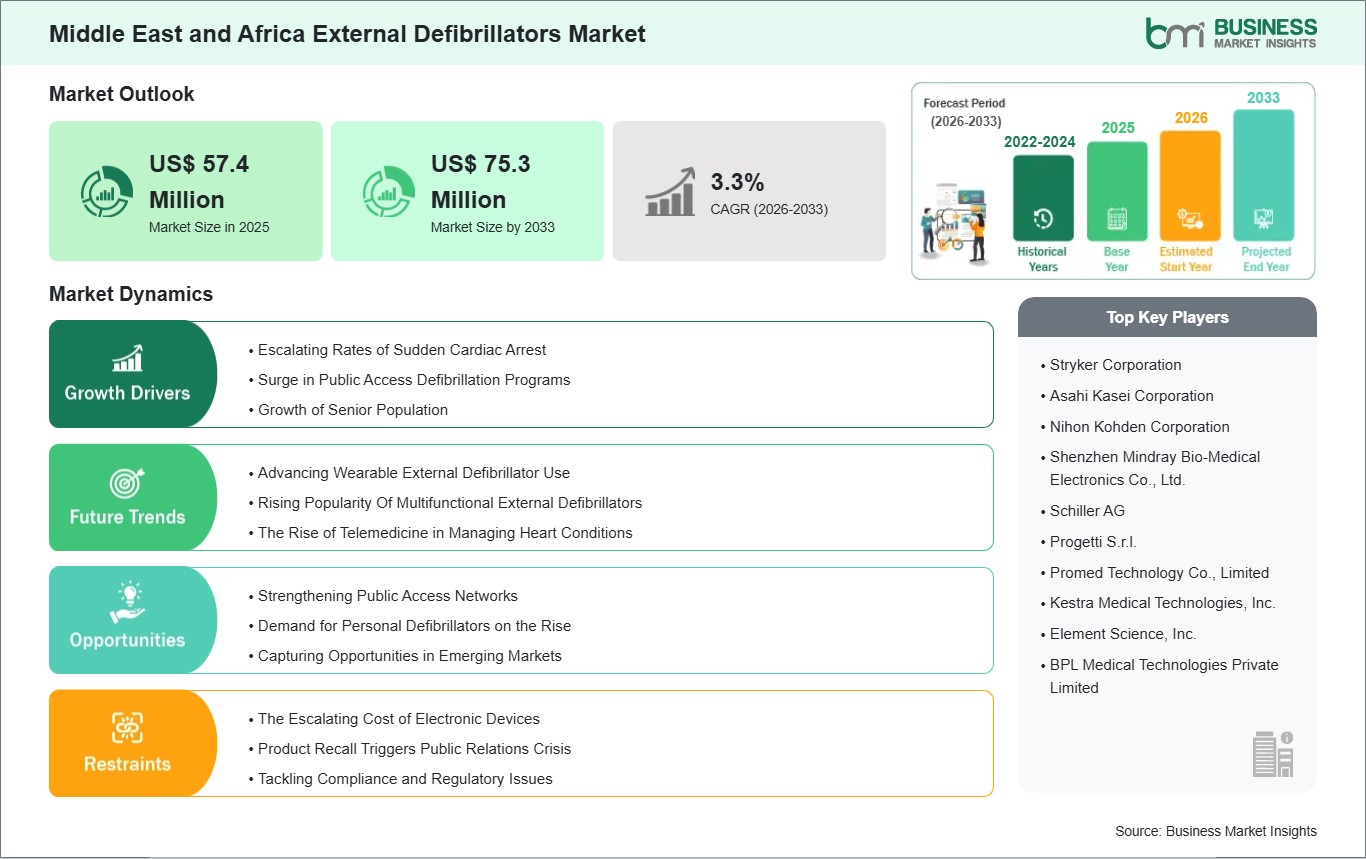
The Middle East and Africa external defibrillators market size is expected to reach US$ 75.3 million by 2033 from US$ 57.4 million in 2025. The market is estimated to record a CAGR of 3.3% from 2026 to 2033.
The Middle East & Africa external defibrillators market is developing steadily, supported by growing awareness of sudden cardiac arrest and broader healthcare modernization initiatives across key economies. Urbanization, lifestyle-related cardiovascular conditions, and increasing participation in large-scale public events have heightened the need for accessible emergency cardiac care. Governments in the Gulf Cooperation Council countries and select African economies are strengthening emergency medical services frameworks, incorporating automated external defibrillators (AEDs) into airports, hospitality infrastructure, religious gathering sites, and sports complexes. The expansion of private hospital networks and internationally accredited healthcare facilities has stimulated the procurement of advanced manual and automated external defibrillation systems.
Corporate workplace safety policies and oil & gas sector compliance requirements also contribute to demand, particularly in industrial zones and remote operational sites where rapid emergency response is critical. However, uneven healthcare infrastructure across Sub-Saharan Africa and limited trained personnel in rural regions restrict widespread deployment. Procurement processes in public health systems can be lengthy, and reliance on imported devices increases cost sensitivity in price-conscious markets. Despite these constraints, strategic public access defibrillation initiatives and emergency preparedness reforms continue to strengthen the region's long-term market foundation.

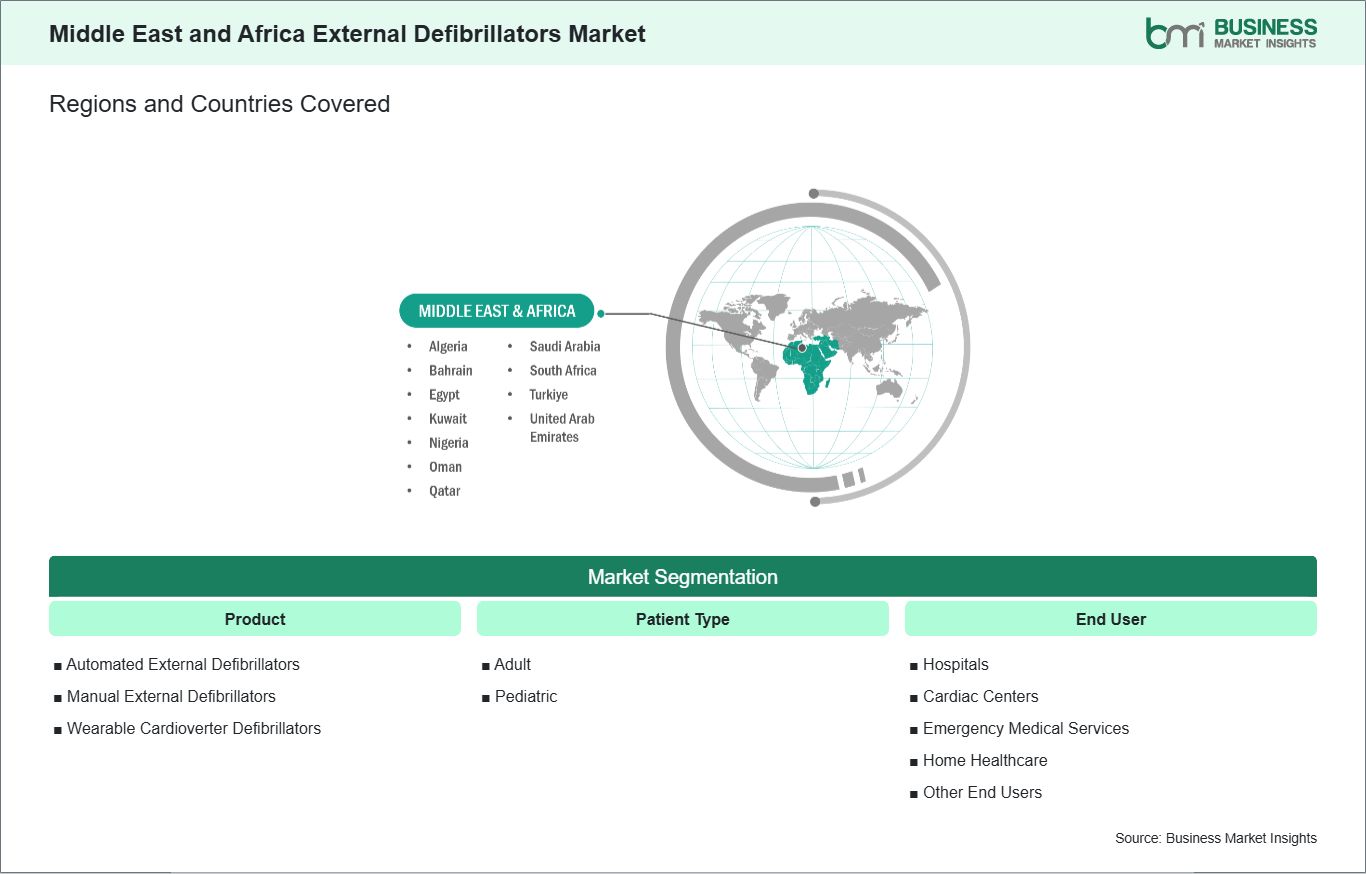
Key segments that contributed to the derivation of the Middle East and Africa external defibrillators market analysis are product type, patient type, and end user.
The Middle East and Africa external defibrillators market is witnessing growth due to a rise in sudden cardiac arrest (SCA) incidents across the region. Changes in lifestyle, urbanization, and the increasing prevalence of cardiovascular risk factors have made cardiac emergencies more frequent. This has emphasized the need for rapid-response solutions, positioning external defibrillators as critical tools for saving lives in both clinical and community settings.
A large portion of cardiac events occur outside hospitals, making timely intervention essential. In urban areas with dense populations, delayed emergency response can significantly reduce survival rates. As a result, external defibrillators, especially automated devices that can be used by non-medical personnel, are becoming indispensable in ambulances, clinics, workplaces, and public spaces.
Demographic shifts, including a growing aging population and a rising number of people susceptible to heart conditions, support demand for external defibrillators. Healthcare providers and institutions are integrating these devices into emergency preparedness plans, ensuring that sudden cardiac events can be managed effectively wherever they occur.
Public access to external defibrillators is gradually expanding across the Middle East and Africa, reflecting a stronger focus on community-level emergency preparedness. Efforts to place defibrillators in high-traffic areas, workplaces, and public venues aim to improve survival outcomes by providing rapid access to life-saving devices before professional help arrives.
Training programs and awareness initiatives are helping communities understand how to respond to cardiac emergencies effectively. By familiarizing the public with the use of automated external defibrillators, these programs increase confidence among bystanders and improve the chances of timely intervention during sudden cardiac arrest events.
Despite progress in urban centers, gaps remain in rural and remote areas, where emergency infrastructure is limited. Portable and easy-to-use defibrillator models are helping bridge this gap, allowing emergency responders and community members to act quickly even in decentralized locations. Strengthening these public access networks is expected to remain a key driver for the regional external defibrillators market.

The Middle East and Africa external defibrillators market demonstrates steady growth, with size and share analysis highlighting evolving trends and competitive dynamics among key players. The report evaluates important subsegments categorized within product type, patient type, and end user, highlighting their respective contributions to overall market performance.
By product type, the Automated External Defibrillators (AEDs) subsegment dominated the market in 2025. Their widespread adoption is driven by their ease of use, rapid response capability, and effectiveness in treating sudden cardiac arrest outside clinical settings, making them a vital tool in emergency cardiac care.
In terms of patient type, the adults subsegment dominated the market in 2025. This leadership is attributed to the higher incidence of cardiac events among adults, growing awareness about the importance of immediate defibrillation in cardiac emergencies, and increased accessibility to AEDs in public and healthcare settings.
Based on end user, the hospitals subsegment dominated the market in 2025. Hospitals remain the primary distribution channel due to their established emergency response systems, trained medical personnel, access to advanced cardiac care infrastructure, and the ability to provide prompt, life-saving interventions.
| Report Attribute | Details |
|---|---|
| Market size in 2025 | US$ 57.4 Million |
| Market Size by 2033 | US$ 75.3 Million |
| CAGR (2026 - 2033) | 3.3% |
| Historical Data | 2022-2024 |
| Forecast period | 2026-2033 |
| Segments Covered | By Product
|
|
Regions and Countries Covered
| |
| Middle East and Africa | Saudi Arabia, United Arab Emirates, Kuwait, Bahrain, Qatar, Oman, Turkiye, South Africa, Egypt, Nigeria, Algeria |
| Market leaders and key company profiles |
|
The "Middle East and Africa external defibrillators Market Size and Forecast (2022–2033)" report provides a detailed analysis of the market covering below areas:
The geographical scope of the Middle East and Africa External Defibrillators market report is divided into: Saudi Arabia, the United Arab Emirates, Kuwait, Bahrain, Qatar, Oman, Turkiye, South Africa, Egypt, Nigeria, Algeria, and the Rest of MEA. Turkiye held the largest share in 2025.
Turkiye leads the Middle East & Africa external defibrillators market due to its structured healthcare system, expanding hospital capacity, and proactive emergency response reforms. The country's well-established emergency medical services network integrates defibrillators within ambulances, public hospitals, and trauma centers, reinforcing rapid cardiac intervention capabilities. Public health authorities have also promoted AED placement in transportation hubs, large shopping centers, municipal buildings, and sports facilities, reflecting growing institutional recognition of out-of-hospital cardiac arrest management.
Turkiye's strategic geographic position between Europe and Asia has enabled easier access to global medical device manufacturers, fostering competitive distribution channels and technological upgrades. Domestic medical device distributors collaborate with international brands, facilitating training programs for healthcare professionals and first responders. Additionally, increasing corporate compliance standards in the manufacturing and tourism sectors encourages AED installation within commercial properties and hotels. While economic fluctuations and currency volatility occasionally affect procurement cycles, Turkiye's regulatory alignment with international medical device standards and its strong private healthcare sector position it as the dominant and most structurally mature external defibrillators market within the Middle East & Africa.

The Middle East and Africa external defibrillators market is evaluated by gathering qualitative and quantitative data post primary and secondary research, which includes important corporate publications, association data, and databases. A few of the key developments in the Middle East and Africa External Defibrillators market are:
The Middle East and Africa External Defibrillators Market is valued at US$ 57.4 Million in 2025, it is projected to reach US$ 75.3 Million by 2033.
As per our report Middle East and Africa External Defibrillators Market, the market size is valued at US$ 57.4 Million in 2025, projecting it to reach US$ 75.3 Million by 2033. This translates to a CAGR of approximately 3.3% during the forecast period.
The Middle East and Africa External Defibrillators Market report typically cover these key segments-
The historic period, base year, and forecast period can vary slightly depending on the specific market research report. However, for the Middle East and Africa External Defibrillators Market report:
The Middle East and Africa External Defibrillators Market is populated by several key players, each contributing to its growth and innovation. Some of the major players include:
The Middle East and Africa External Defibrillators Market report is valuable for diverse stakeholders, including:
Essentially, anyone involved in or considering involvement in the Middle East and Africa External Defibrillators Market value chain can benefit from the information contained in a comprehensive market report.
Please tell us your area of interest
(Market Segments/ Regions and Countries/ Companies)