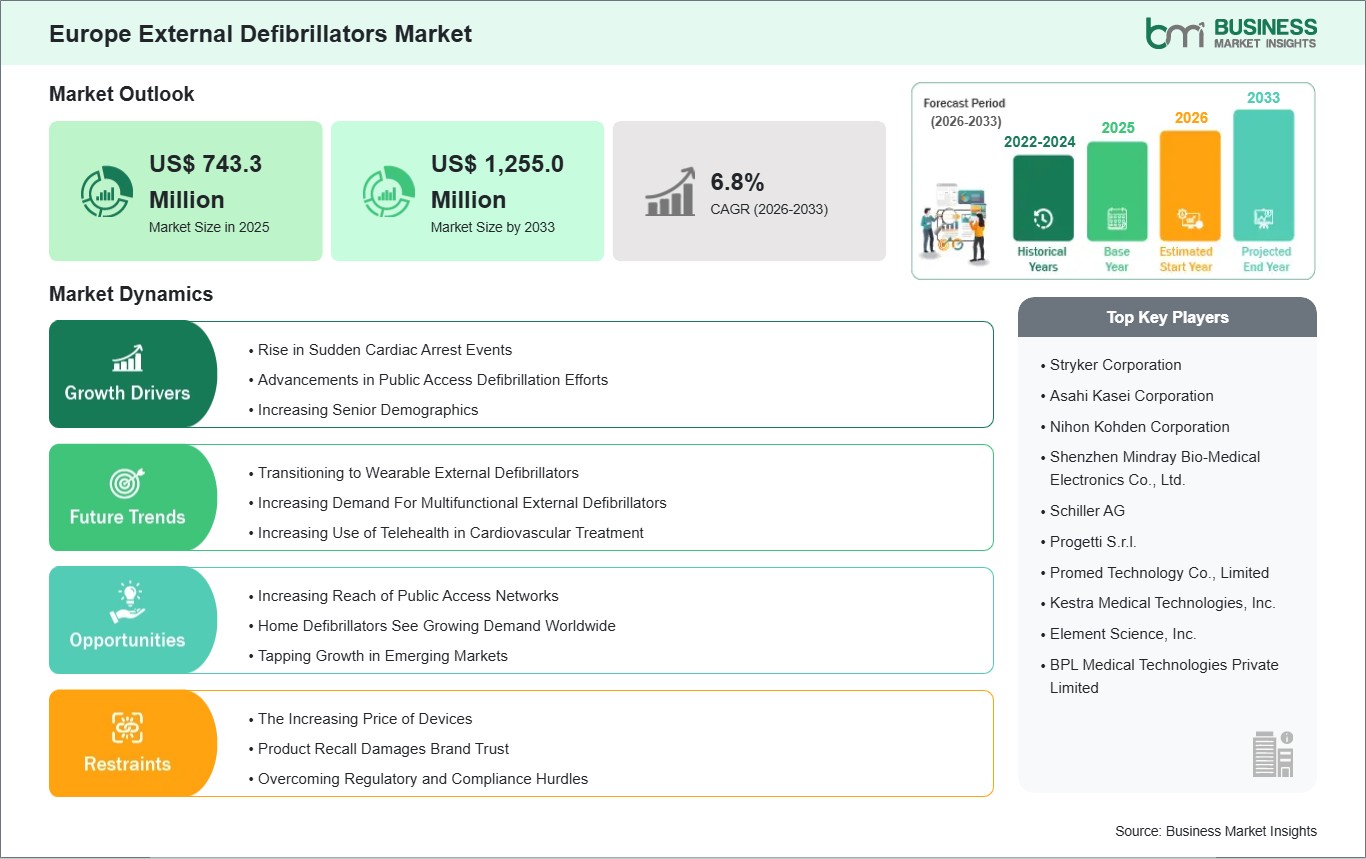
The Europe external defibrillators market size is expected to reach US$ 1,255.0 million by 2033 from US$ 743.3 million in 2025. The market is estimated to record a CAGR of 6.8% from 2026 to 2033.
The Europe external defibrillators market is growing steadily due to an increasing emphasis on cardiovascular health and emergency preparedness. Governments and healthcare institutions across the region are actively promoting the deployment of automated external defibrillators (AEDs) in public spaces, hospitals, and workplaces to improve survival rates from sudden cardiac arrest. The market growth is also supported by heightened public awareness and community training programs, which encourage bystanders to intervene confidently during emergencies. Technological innovations in AED design, portability, and ease of use are fueling adoption. However, the market faces certain challenges. The cost of high-quality devices and ongoing maintenance requirements can be a barrier for smaller facilities or rural areas. Additionally, inconsistent training coverage and varying regulatory requirements across countries can slow uniform adoption. Despite these restraints, the outlook remains positive, as Europe continues to prioritize accessible emergency response solutions and invests in programs that integrate defibrillators into everyday public and healthcare infrastructure.

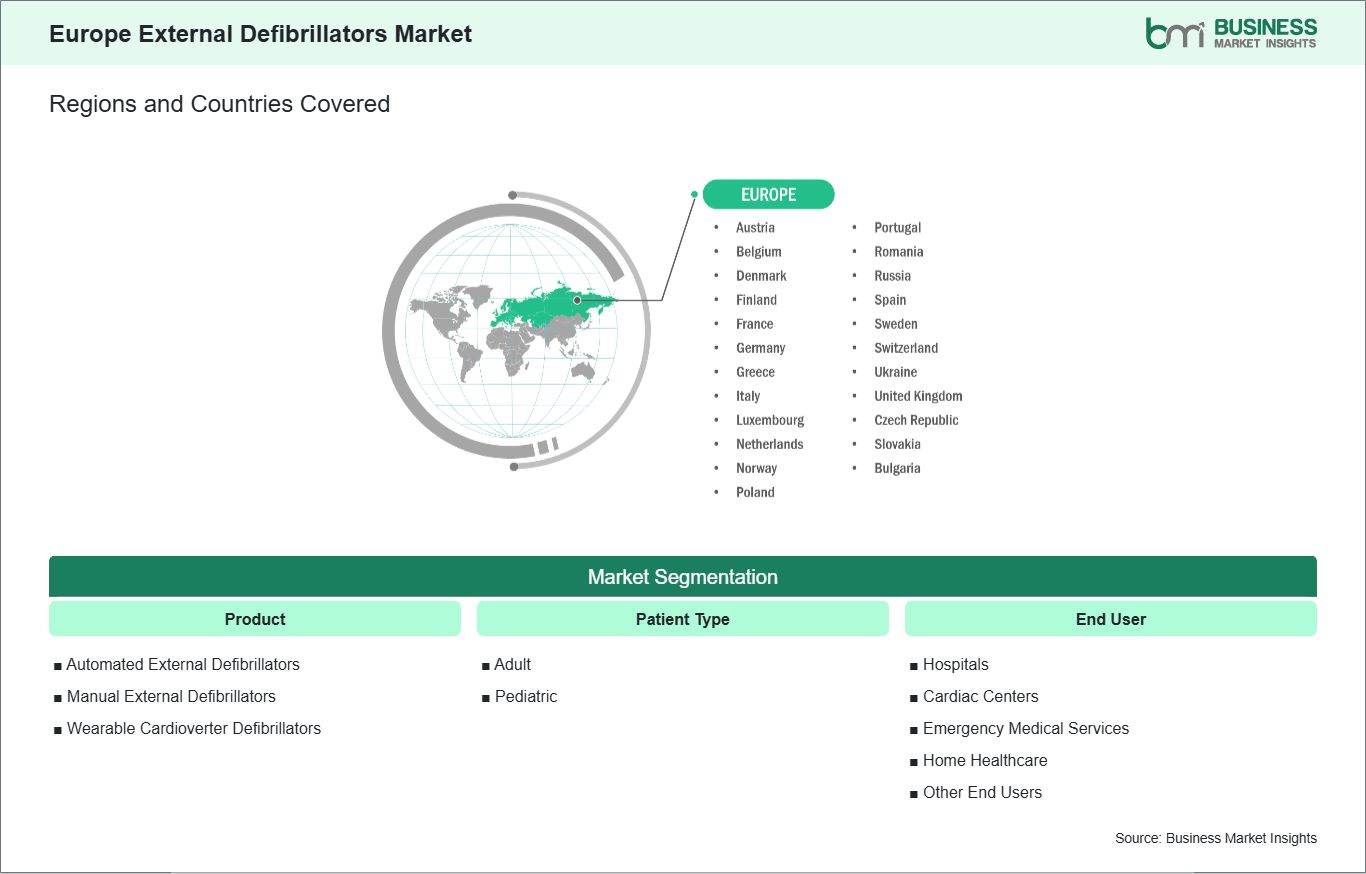
Key segments that contributed to the derivation of the Europe external defibrillators market analysis are product type, patient type, and end user.
Sudden cardiac arrest (SCA) remains a critical public health challenge across Europe, influencing the external defibrillator market. High population density in urban centers such as London, Paris, and Berlin increases the probability of cardiac events occurring in public spaces, making rapid access to automated external defibrillators (AEDs) essential. Hospitals, clinics, and emergency response teams are emphasizing pre-hospital interventions, driving the adoption of AEDs in both public and private sectors.
The growing awareness of SCA risks among European citizens has prompted organizations to prioritize the placement of external defibrillators in workplaces, schools, and recreational facilities. Corporations and institutions recognize that having an AED on-site is not just a safety measure but a compliance and reputational consideration. This shift has created sustained demand in regions where businesses and public venues seek to enhance emergency preparedness.
Demographic trends, particularly aging populations across Western and Northern Europe, escalate the need for defibrillation devices. Regions with higher proportions of elderly residents face elevated cardiovascular risks, encouraging governments and municipalities to implement policies supporting widespread AED deployment. Consequently, the market is experiencing continuous growth as AEDs become an integral part of the community and institutional health infrastructure.
Public access defibrillator (PAD) networks are expanding rapidly throughout Europe, helping reduce response times during cardiac emergencies. Major cities are deploying AEDs strategically in high-traffic areas such as transport hubs, shopping centers, and sports facilities. This broader accessibility ensures that bystanders can respond effectively, often bridging the critical gap before professional medical help arrives.
Government initiatives and private partnerships have strengthened the availability of AEDs across both urban and rural areas. National campaigns in countries such as Germany, France, and Italy promote registration of AEDs and integration with emergency services, creating a coordinated response network. In addition, visible signage and public education efforts are increasing awareness of device locations, making defibrillation more approachable for the general population.
Technology is enhancing PAD networks. Many AEDs now feature connectivity options that communicate with emergency dispatch centers, allowing rapid identification and guidance during cardiac events. This integration ensures that devices are operational, monitored, and accessible, reinforcing their adoption in a wide range of public settings. As a result, the combination of technological advancement and policy support is fueling robust growth in the European external defibrillator market.

The Europe external defibrillators market demonstrates steady growth, with size and share analysis highlighting evolving trends and competitive dynamics among key players. The report evaluates important subsegments categorized within product type, patient type, and end user, highlighting their respective contributions to overall market performance.
By product type, the Automated External Defibrillators (AEDs) subsegment dominated the market in 2025. Their widespread adoption is driven by their ease of use, rapid response capability, and effectiveness in treating sudden cardiac arrest outside clinical settings, making them a vital tool in emergency cardiac care.
In terms of patient type, the adults subsegment dominated the market in 2025. This leadership is attributed to the higher incidence of cardiac events among adults, growing awareness about the importance of immediate defibrillation in cardiac emergencies, and increased accessibility to AEDs in public and healthcare settings.
Based on end user, the hospitals subsegment dominated the market in 2025. Hospitals remain the primary distribution channel due to their established emergency response systems, trained medical personnel, access to advanced cardiac care infrastructure, and the ability to provide prompt, life-saving interventions.
| Report Attribute | Details |
|---|---|
| Market size in 2025 | US$ 743.3 Million |
| Market Size by 2033 | US$ 1,255.0 Million |
| CAGR (2026 - 2033) | 6.8% |
| Historical Data | 2022-2024 |
| Forecast period | 2026-2033 |
| Segments Covered | By Product
|
|
Regions and Countries Covered
| |
| Europe | Germany, Italy, France, U.K., Spain, Belgium, Netherlands, Luxembourg, Norway, Finland, Denmark, Sweden, Switzerland, Austria, Greece, Portugal, Russia, Poland, Romania, Czech Republic, Ukraine, Slovakia, Bulgaria |
| Market leaders and key company profiles |
|
The "Europe External Defibrillators Market Size and Forecast (2022–2033)" report provides a detailed analysis of the market covering below areas:
The geographical scope of the Europe External Defibrillators market report is divided into: Germany, Italy, France, the UK, Spain, Belgium, the Netherlands, Luxembourg, Norway, Finland, Denmark, Sweden, Austria, Switzerland, Russia, Romania, Greece, the Czech Republic, Portugal, Ukraine, Poland, Slovakia, and Bulgaria. Germany held the largest share in 2025.
Germany is the leading market for external defibrillators in Europe, driven by its advanced healthcare system and strong focus on public health initiatives. The country has integrated defibrillators extensively into hospitals, emergency services, and public facilities, making them widely accessible to both medical professionals and trained laypersons. There is a strong culture of safety and preparedness, supported by training programs that teach CPR and AED usage across schools, workplaces, and community centers. Germany also benefits from innovation within its medical technology sector, which produces user-friendly, portable, and reliable defibrillators. Therefore, Germany is a hub for both adoption and development of advanced external defibrillator technologies in Europe. Regulatory measures ensure that devices are maintained and functional, reinforcing the country's leadership position in the regional market.

The Europe external defibrillators market is evaluated by gathering qualitative and quantitative data post primary and secondary research, which includes important corporate publications, association data, and databases. A few of the key developments in the Europe external defibrillators market are:
The Europe External Defibrillators Market is valued at US$ 743.3 Million in 2025, it is projected to reach US$ 1,255.0 Million by 2033.
As per our report Europe External Defibrillators Market, the market size is valued at US$ 743.3 Million in 2025, projecting it to reach US$ 1,255.0 Million by 2033. This translates to a CAGR of approximately 6.8% during the forecast period.
The Europe External Defibrillators Market report typically cover these key segments-
The historic period, base year, and forecast period can vary slightly depending on the specific market research report. However, for the Europe External Defibrillators Market report:
The Europe External Defibrillators Market is populated by several key players, each contributing to its growth and innovation. Some of the major players include:
The Europe External Defibrillators Market report is valuable for diverse stakeholders, including:
Essentially, anyone involved in or considering involvement in the Europe External Defibrillators Market value chain can benefit from the information contained in a comprehensive market report.
Please tell us your area of interest
(Market Segments/ Regions and Countries/ Companies)