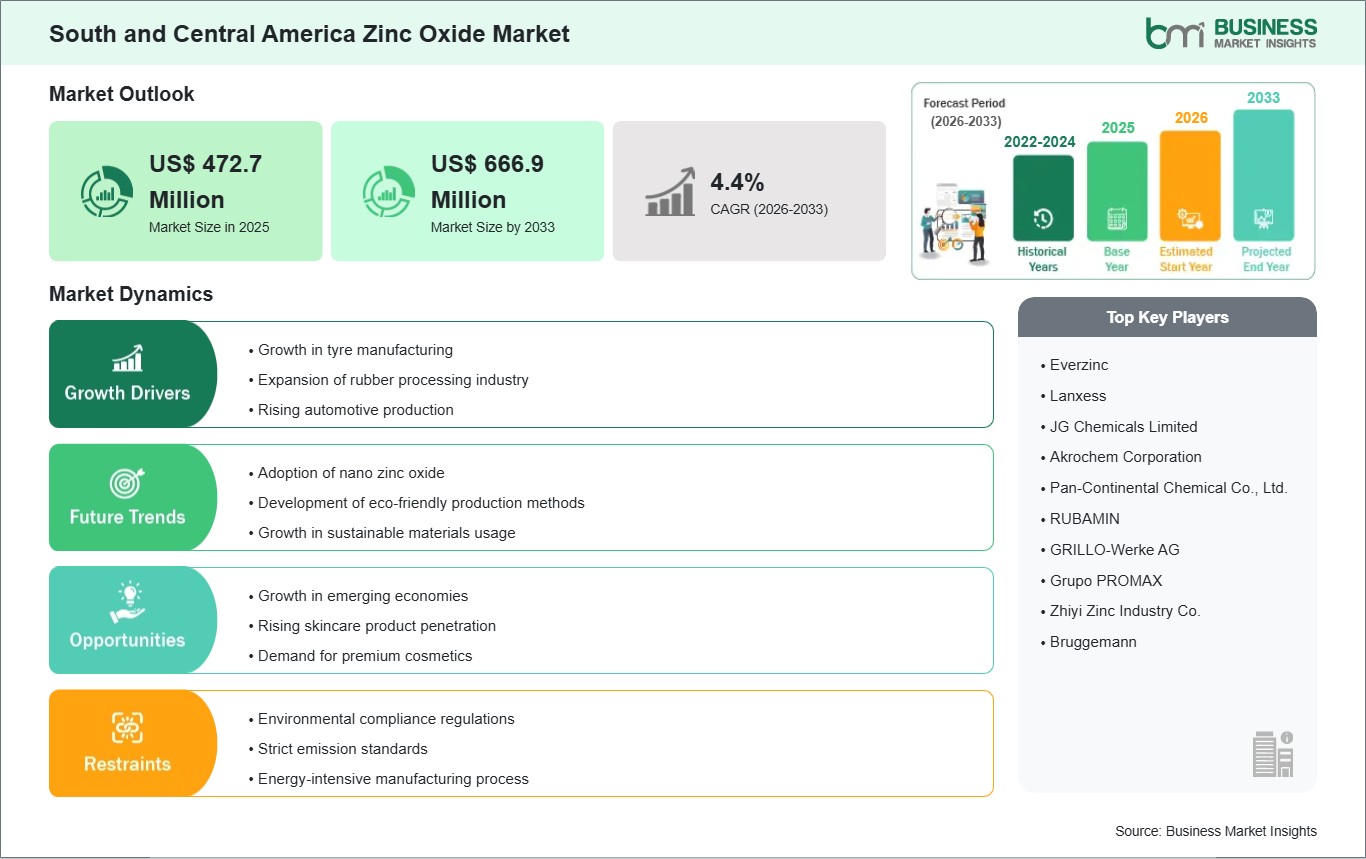
The South and Central America zinc oxide market size is expected to reach US$ 666.9 million by 2033 from US$ 472.7 million in 2025. The market is estimated to record a CAGR of 4.4% from 2026 to 2033.
The zinc oxide market in South and Central America is evolving positively, owing to rising industrial development, modernization of agriculture, and high demands from the automobile aftermarket, rubber industry, and the construction sector. Zinc oxide finds widespread application due to the wide array of benefits including rubber vulcanizing, anti-corrosive paints, ceramics, animal feeds, and agrochemicals. The market trends and dynamics of the South and Central American region reflect the strong influence of the dominance of resource-based industries and rising local manufacturing capacity in bigger economies of the region. Rising agricultural production is another key factor fueling the growth of zinc oxide and other zinc compounds in South and Central America. Several nations in the region face deficiency of micronutrients in agricultural lands; hence, their demands for zinc-enriched fertilizers and feed supplements will remain on the rise. Moreover, the zinc oxide markets in some regions in the South and Central America witness high usage due to the presence of a developed automobile repair and tire retreading industry. The construction sector, which also feeds the market demand in terms of paints, ceramics, and infrastructural coatings, needs to have better moisture, corrosion, and weather resistance features. The restraints facing the market include economic instability, industrial investments, and dependency on zinc oxide materials from overseas that need to be of superior quality. The other restraint comes from the fact that technology in producing high-quality zinc oxide is not much developed in some countries, hence hindering their penetration in electronics and pharmaceutical industries.

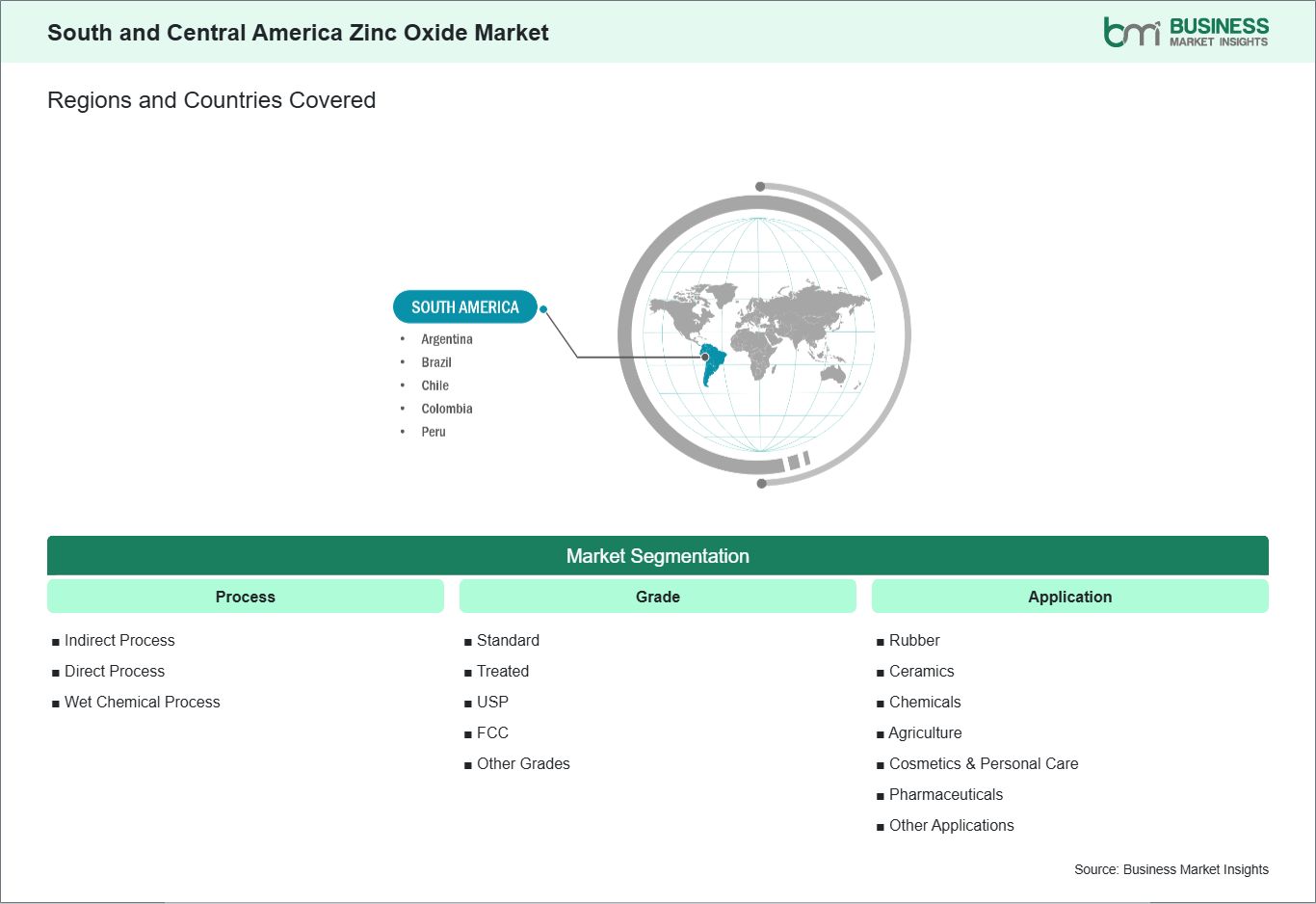
Key segments that contributed to the derivation of the South and Central America zinc oxide market analysis are process, grade, application.
There has been an increasing trend of zinc oxide utilization in South and Central America due to the increasing tyre manufacturing activities in the regions, especially in Brazil, Argentina and the Mexico-associated supply chain network in Central America. The material plays a vital role in making rubber that helps in the process of rubber vulcanization that makes tires elastic, durable, resistant to heat, and resistant to abrasions. Brazil leads the way in terms of automotive and tire manufacture in the region due to its well-developed industry and high domestic demand for automobiles. The tire manufacturing companies and foreign tire firms with tire manufacturing plants located in São Paulo and other regions of Brazil provide constant consumption of zinc oxide in tire manufacturing.
The rise in demand for transportation and logistic services in the area has also resulted in an increase in demand for tire replacement. Due to the expansion of agricultural exports by Brazil and Argentina, and the operations of mining in nations like Chile and Peru, there has been an increase in the number of heavy duty trucks and other off road vehicles in use. This implies that the tire compounds must be of high durability to endure the long distance driving on tough surfaces, resulting in the use of zinc oxide reinforced rubber tires.
Further, investment in local manufacturing activities adds another layer of positive expectation for the market environment. Some countries within the region are pushing for manufacturing of auto parts within their territory as a means of cutting back on imports. Some industrial zones within Brazil and Colombia are starting to lure some suppliers who manufacture rubber products, industrial hoses, conveyor belts, and auto seals – products that require the use of zinc oxide in the manufacturing process. As ownership of vehicles increases in the region, demand for zinc oxide in tires and rubber will steadily rise.
The rise in emerging economies across South America and Central America has been creating more demand for zinc oxide in industries like construction, agriculture, ceramics, chemicals, and consumer goods. Countries like Brazil, Colombia, Peru, and Guatemala are witnessing a steady increase in industrialization, which can be attributed to the factors of urbanization, infrastructural development, and increased middle-class demographics. The use of zinc oxide in paints, coatings, adhesives, fertilizers, and ceramic items is gradually becoming popular due to diversified industrial activities beyond commodity exports.
Increased urbanization in metro cities like Sao Paulo, Bogota, Lima, and San Jose has been creating more demand for zinc oxide. Materials containing protective coatings made of zinc oxide are being used in large amounts in building constructions due to their UV-resistance and corrosion resistance features. Various public infrastructures, including transport, energy, and industry, are becoming an important consumer of specialty chemicals and engineered materials requiring zinc oxide as a key ingredient.
Agriculture continues to be another growth catalyst for emerging markets in the region. The usage of zinc oxide as feed supplements and micronutrient fertilizers in order to enhance agriculture production efficiency and animal health continues to grow especially in countries that have a very high level of agricultural output such as Brazil and Argentina. Higher level of knowledge concerning the need to manage soil nutrients and produce high quality agro produce has led to increased usage of zinc oxides in the agricultural sector. On the other hand, higher level of industrialization is causing higher usage of zinc oxides in the manufacture of rubber, pharmaceutical, and cosmetic products.

The South and Central America zinc oxide market is experiencing steady growth, with market size and share analysis reflecting evolving treatment preferences and competitive dynamics among key players. The report evaluates important subsegments categorized within process, grade, and application highlighting their respective contributions to overall market performance.
By process, the indirect subsegment dominated the market in 2025, because it produces high-purity zinc oxide, which is essential for rubber, pharmaceuticals, and cosmetics. It ensures uniform particle size and better performance consistency, which industries require for quality-critical applications. Even though it is costlier than direct process, its product reliability and compliance with strict standards make it the preferred choice.
Based on grade, the standard subsegment dominated the market in 2025 due to its massive use in bulk manufacturing industries, especially rubber, ceramics, and paints. It offers a cost-effective balance between purity and performance, making it suitable for high-volume consumption. Industries prefer it because it is easily available and economically viable compared to high-purity grades.
On the basis of application, the rubber subsegment dominated the market in 2025, because zinc oxide is a key activator in vulcanization, which is essential for tire production. The global expansion of automotive and tire manufacturing directly drives demand. It improves strength, durability, and heat resistance of rubber products, making it irreplaceable. Continuous growth in mobility, logistics, and EV tires further strengthens its dominance.
| Report Attribute | Details |
|---|---|
| Market size in 2025 | US$ 472.7 Million |
| Market Size by 2033 | US$ 666.9 Million |
| CAGR (2026 - 2033) | 4.4% |
| Historical Data | 2022-2024 |
| Forecast period | 2026-2033 |
| Segments Covered | By Process
|
|
Regions and Countries Covered
| |
| South and Central America | Brazil, Argentina, Chile, Colombia, Peru |
| Market leaders and key company profiles |
|
The "South and Central America Zinc Oxide Market Size and Forecast (2022-2033)" report provides a detailed analysis of the market covering below areas:
The geographical scope of the South and Central America zinc oxide market report is divided into: Brazil, Argentina, Chile, Colombia, Peru, and the Rest of South and Central America. Brazil held the largest share in 2025.
Brazil holds dominance in South and Central American markets in terms of consumption of zinc oxide due to the country's highly industrialized economy, significant agriculture, and well-developed automobile and manufacturing industries. Being the leading hub for the processing of rubber products, tires, coating, and chemicals in the region, Brazil sees considerable demand from these industries for the metal compounds. Among others, automotive sector has been seen to be one of the largest segments contributing towards zinc oxide demand in Brazil due to their consumption in tire manufacturing and aftermarkets for rubber products. Zinc oxide is heavily consumed in vulcanizing systems for tires, conveyor belts, hoses, and various other rubber products used for transporting, mining, and agricultural purposes. The country’s agricultural sector also presents a significant demand base for zinc oxide and zinc-based micronutrient products. Industrialized farming practices have increasingly opted for soil enhancement technologies to boost plant yield and nutrient absorption, especially in soils deficient in zinc content. The animal feed sector adds another layer that sustains constant use in feed preparations. The construction and paint sectors in Brazil also drive zinc oxide sales as part of ceramic raw materials, paints, and anticorrosive infrastructure construction materials. Simultaneously, the country is also making progress in developing chemical processing abilities and becoming less reliant on imported chemical compounds. Even with such dominance, Brazil also suffers from various operational issues such as exchange rate concerns, legal complexities, and industrial costs among others. Despite this, the country’s varied economic structure, agricultural background, and industrialized manufacturing systems still guarantee its leading market status in South and Central America zinc oxide market.

The South and Central America Zinc oxide market is evaluated by gathering qualitative and quantitative data post primary and secondary research, which includes important corporate publications, association data, and databases. A few of the key developments in the South and Central America zinc oxide market are:
The South and Central America Zinc Oxide Market is valued at US$ 472.7 Million in 2025, it is projected to reach US$ 666.9 Million by 2033.
As per our report South and Central America Zinc Oxide Market, the market size is valued at US$ 472.7 Million in 2025, projecting it to reach US$ 666.9 Million by 2033. This translates to a CAGR of approximately 4.4% during the forecast period.
The South and Central America Zinc Oxide Market report typically cover these key segments-
The historic period, base year, and forecast period can vary slightly depending on the specific market research report. However, for the South and Central America Zinc Oxide Market report:
The South and Central America Zinc Oxide Market is populated by several key players, each contributing to its growth and innovation. Some of the major players include:
The South and Central America Zinc Oxide Market report is valuable for diverse stakeholders, including:
Essentially, anyone involved in or considering involvement in the South and Central America Zinc Oxide Market value chain can benefit from the information contained in a comprehensive market report.
Please tell us your area of interest
(Market Segments/ Regions and Countries/ Companies)