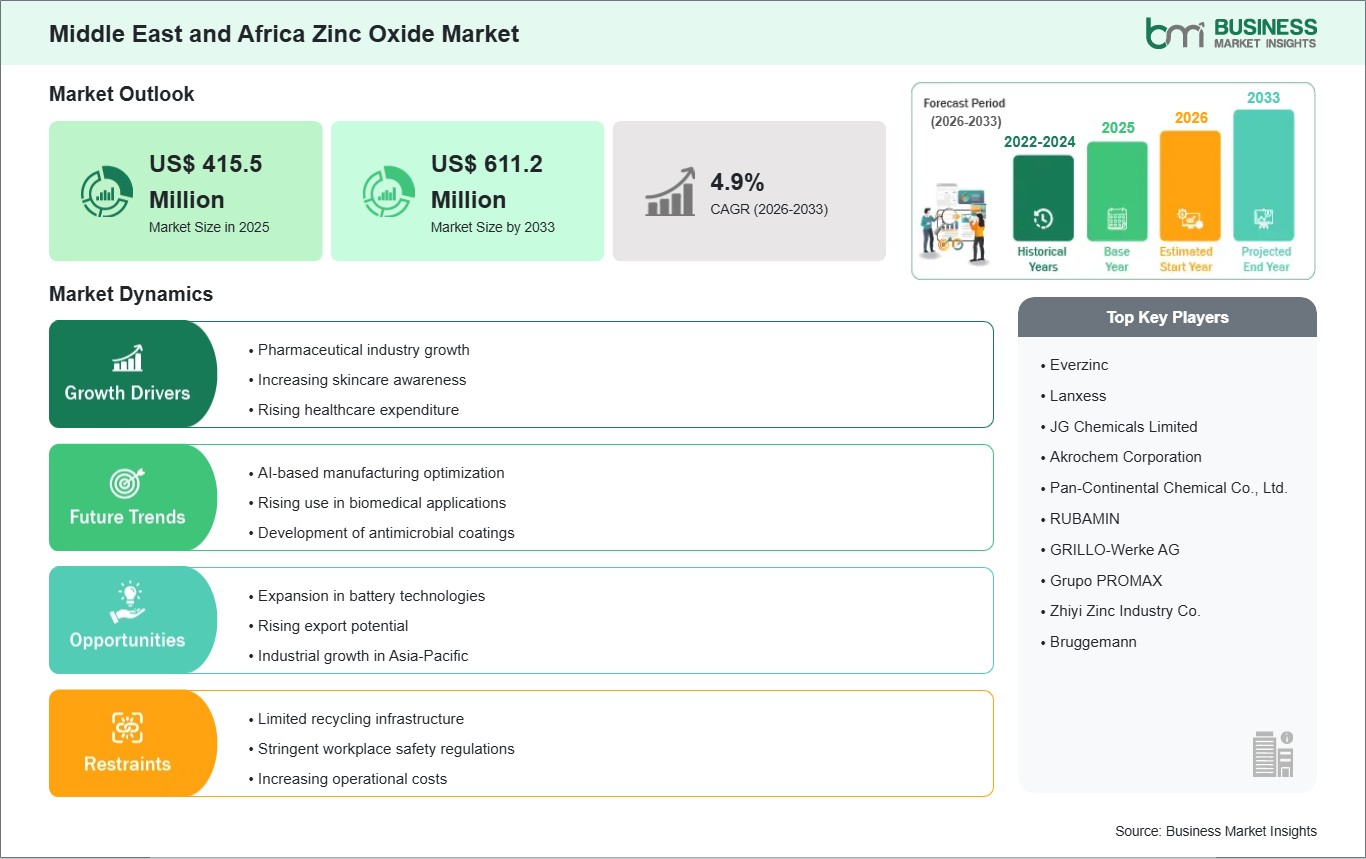
The Middle East and Africa zinc oxide market size is expected to reach US$ 611.2 million by 2033 from US$ 415.5 million in 2025. The market is estimated to record a CAGR of 4.9% from 2026 to 2033.
The Middle East and Africa market for zinc oxide represents a developing yet strategically significant region that is largely driven by gradual industrial diversification, infrastructure development, and higher consumption by industries of construction, agriculture, and basic manufacturing. The uses of zinc oxide are widespread throughout the region due to its diverse application in the manufacture of rubber, paints and coatings, ceramics, fertilizers, animal feed supplements, and certain pharmaceuticals. These include features like corrosion resistance, UV stability, and nutritional supplementation which contribute to the suitability of this material for the requirements of the region. The main drivers of growth in the region include the development of large construction and urbanization projects, especially in areas of fast population growth and establishment of industrial zones. In addition to being used in paints and coatings, cement and ceramic products, zinc oxide plays an important role in construction due to its properties that ensure higher durability under challenging climate conditions like high temperatures, humidity variations, and marine corrosion exposure. Moreover, agriculture also remains an important industry contributing to the demand for zinc oxide due to its fertilizing capabilities. Moreover, the rubber and automobile aftermarket industry provides steady demand in economies where car repairs, tire reconditioning, and transport maintenance are more common than vehicle manufacturing. But the market faces restrictions due to lack of local manufacturing facilities, high dependence on imported zinc oxide, and unequal industrialization processes between nations. Restrictions are also imposed by weak infrastructure and supply chain management. Nevertheless, the region exhibits a potential for gradual growth because of industrialization, infrastructure investments from governments, and growing realization about the application of new materials in construction, agriculture, and healthcare sectors.

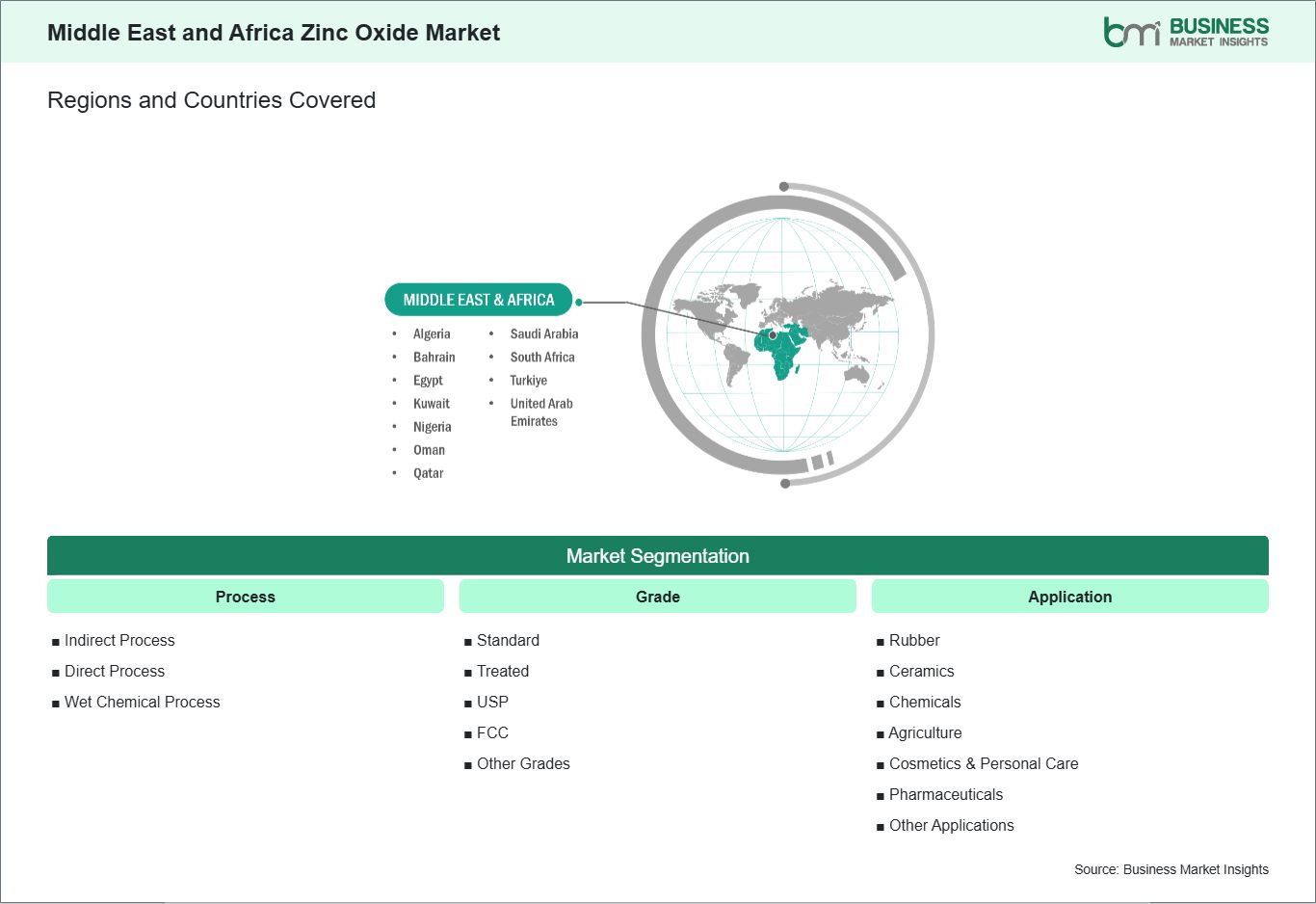
Key segments that contributed to the derivation of the Middle East and Africa zinc oxide market analysis are process, grade, and application.
The market for zinc oxide in Middle East and Africa is showing consistent growth owing to the rising demand for pharmaceutical products in major economies of the region such as Saudi Arabia, UAE, Egypt, South Africa, and Kenya. Zinc oxide finds wide application in various creams and skin formulations because of its soothing, anti-bacterial and skin barrier forming attributes. Improved healthcare spending along with increased availability of healthcare facilities is expected to drive up the demand for pharmaceutical grade zinc oxide in Middle East and Africa.
Middle Eastern countries such as Saudi Arabia and UAE have been actively focusing on the expansion of their domestic pharmaceutical industry as a part of their economic diversification strategy. Manufacturing centers in cities such as Riyadh, Jeddah and Dubai have started producing topical medicines and dermatology products that utilize zinc oxide as an ingredient. On the other hand, Africa is also witnessing slow but sure development of its pharmaceutical industry, with South Africa, Egypt and Nigeria leading the pack owing to their increasing urban population and higher health consciousness among consumers.
The climatic conditions prevailing in the region also help in enhancing the demand for zinc oxide in health care applications. The hot weather conditions and high exposure to UV rays in desert and tropical climates cause increased incidences of skin irritations, sunburns, and other related dermatological problems, thereby increasing the application of zinc oxide based products in sunscreens and other skin protection creams. Moreover, the growing incidence of lifestyle related skin problems and enhanced distribution channels via pharmacies and retail health care companies will help drive the demand for zinc oxide in pharmaceutical applications.
The Middle East and African markets of zinc oxide are gradually benefiting from new investments in battery technologies owing to increased interest in renewable energy storage solutions, electric vehicles, and modernization of power grids. Zinc oxide can be used in batteries as one of the conductive additives, and in electrochemical applications because of its semi-conductive nature and stability. Despite the fact that the Middle East is not yet as advanced in battery production as Asia and Europe, strategic investments in energy storage capacity creation open up new possibilities for zinc-based materials.
The Middle East countries, such as the United Arab Emirates and Saudi Arabia, invest substantially in the development of renewable energy projects, which include construction of solar farms and implementation of energy storage solutions. Projects of this type, especially in areas like NEOM in Saudi Arabia and Masdar City in the United Arab Emirates, increase demand for innovative batteries. Zinc oxide is considered an alternative material for future batteries' applications.
The growth in the use of off-grid solar systems and decentralized power generation technology in Africa is fueling the demand for battery storage from rural to semi-urban areas. Countries such as Kenya, South Africa, and Morocco have adopted the use of solar coupled with storage technology in an effort to increase their electricity access. The increased use of energy storage technology is indirectly boosting the demand for raw materials used in the manufacture of batteries, including zinc oxide. Another factor boosting the demand for zinc oxide in batteries is the increasing use of electric vehicles.

The Middle East and Africa zinc oxide market is experiencing steady growth, with market size and share analysis reflecting evolving treatment preferences and competitive dynamics among key players. The report evaluates important subsegments categorized within process, grade, and application highlighting their respective contributions to overall market performance.
By process, the indirect subsegment dominated the market in 2025, because it produces high-purity zinc oxide, which is essential for rubber, pharmaceuticals, and cosmetics. It ensures uniform particle size and better performance consistency, which industries require for quality-critical applications. Even though it is costlier than direct process, its product reliability and compliance with strict standards make it the preferred choice.
Based on grade, the standard subsegment dominated the market in 2025 due to its massive use in bulk manufacturing industries, especially rubber, ceramics, and paints. It offers a cost-effective balance between purity and performance, making it suitable for high-volume consumption. Industries prefer it because it is easily available and economically viable compared to high-purity grades.
On the basis of application, the rubber subsegment dominated the market in 2025, because zinc oxide is a key activator in vulcanization, which is essential for tire production. The global expansion of automotive and tire manufacturing directly drives demand. It improves strength, durability, and heat resistance of rubber products, making it irreplaceable. Continuous growth in mobility, logistics, and EV tires further strengthens its dominance.
| Report Attribute | Details |
|---|---|
| Market size in 2025 | US$ 415.5 Million |
| Market Size by 2033 | US$ 611.2 Million |
| CAGR (2026 - 2033) | 4.9% |
| Historical Data | 2022-2024 |
| Forecast period | 2026-2033 |
| Segments Covered | By Process
|
|
Regions and Countries Covered
| |
| Middle East and Africa | Saudi Arabia, United Arab Emirates, Kuwait, Bahrain, Qatar, Oman, Turkiye, South Africa, Egypt, Nigeria, Algeria |
| Market leaders and key company profiles |
|
The "Middle East and Africa Zinc Oxide Market Size and Forecast (2022-2033)" report provides a detailed analysis of the market covering below areas:
The geographical scope of the Middle East and Africa Zinc oxide market report is divided into: Saudi Arabia, the United Arab Emirates, Kuwait, Bahrain, Qatar, Oman, Turkey, South Africa, Egypt, Nigeria, Algeria, and the Rest of MEA. Turkiye held the largest share in 2025.
Turkiye occupies the leading position in the zinc oxide market of the Middle East and Africa because of its relatively developed industrial infrastructure, strong manufacturing industry, and geographical location that connects Europe, Asia, and the Middle East. The country enjoys its well-developed chemical industry and good integration into global value chains that allow for steady production and consumption of zinc oxide in various industries. The automotive and rubber industry is one of the key sources of demand for zinc oxide in Turkiye. The country has a developed automobile manufacturing industry and supply chain that exports products overseas. Zinc oxide is used extensively in tire production, rubber components, and seals. There is also a high consumption rate of the product because of the presence of both OEM and aftermarket industries. The construction and infrastructure industry in Türkiye also forms an integral part of the usage of zinc oxide. The material finds wide application in coating, ceramics, and cement-based products to increase resistance to moisture, corrosion, and environmental degradation. Continuous urbanization, building construction, and infrastructural development also provide impetus to zinc oxide consumption. Furthermore, Turkiye's agriculture sector also increases zinc oxide consumption by using the material in fertilizers and animal nutrition products. Zinc compounds are now increasingly used to enhance soil fertility and productivity in livestock due to their deficiency in some soils. The country also has a growing industry in pharmaceuticals and personal care products that include dermatological creams, sunscreens, and medicinal ointments. Nevertheless, challenges such as high energy costs, currency fluctuations, and dependency on imported raw materials for high-quality zinc production have continued to characterize the industry. Despite these challenges, the country’s diverse industrial base and export-oriented approach make Turkiye a key player in the Middle East and Africa zinc oxide market.

The Middle East and Africa zinc oxide market is evaluated by gathering qualitative and quantitative data post primary and secondary research, which includes important corporate publications, association data, and databases. A few of the key developments in the Middle East and Africa zinc oxide market are:
The Middle East and Africa Zinc Oxide Market is valued at US$ 415.5 Million in 2025, it is projected to reach US$ 611.2 Million by 2033.
As per our report Middle East and Africa Zinc Oxide Market, the market size is valued at US$ 415.5 Million in 2025, projecting it to reach US$ 611.2 Million by 2033. This translates to a CAGR of approximately 4.9% during the forecast period.
The Middle East and Africa Zinc Oxide Market report typically cover these key segments-
The historic period, base year, and forecast period can vary slightly depending on the specific market research report. However, for the Middle East and Africa Zinc Oxide Market report:
The Middle East and Africa Zinc Oxide Market is populated by several key players, each contributing to its growth and innovation. Some of the major players include:
The Middle East and Africa Zinc Oxide Market report is valuable for diverse stakeholders, including:
Essentially, anyone involved in or considering involvement in the Middle East and Africa Zinc Oxide Market value chain can benefit from the information contained in a comprehensive market report.
Please tell us your area of interest
(Market Segments/ Regions and Countries/ Companies)