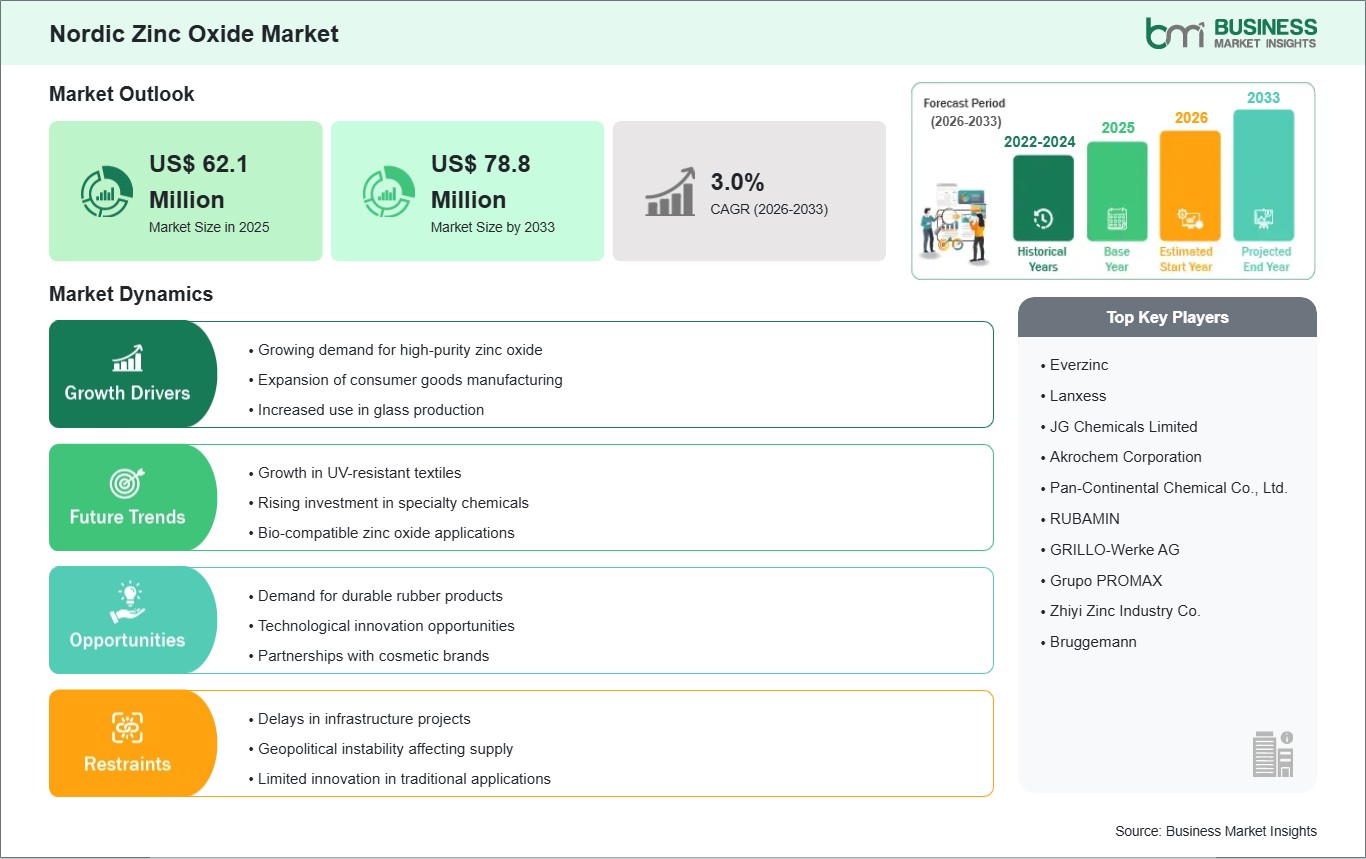
The Nordic zinc oxide market size is expected to reach US$ 78.8 million by 2033 from US$ 62.1 million in 2025. The market is estimated to record a CAGR of 3.0% from 2026 to 2033.
The Nordic market for zinc oxide is characterized by an extremely sophisticated industrial setting, strict environmental regulation, and reliance on high-end chemical applications. Zinc oxide demand in the region is fueled by its incorporation in specialized rubber goods, coating technologies, pharmaceutical drugs, cosmetics, ceramic materials, and other unique industrial products. The Nordic market for zinc oxide corresponds to the regional approach to clean technology, circular economy, and advanced material development. In the wider Nordic region, Finland makes an important contribution through the paper and pulp industry, coatings, and industrial machinery industry, while Norway aids in meeting the demand through offshore energy structures, marine coatings, and construction industries. In Denmark, pharmaceuticals, food chemicals, and industrial applications from the renewable energy sector where zinc oxide finds its applications are significant contributors.However, the market encounters limitations associated with high costs of production, environment-related requirements, and lack of availability of raw materials within the region. Besides, energy-intensive processes are another limiting factor, especially for nations that have higher electricity costs and carbon emission reduction targets. The dependency on imports for zinc feedstock is also a limitation.

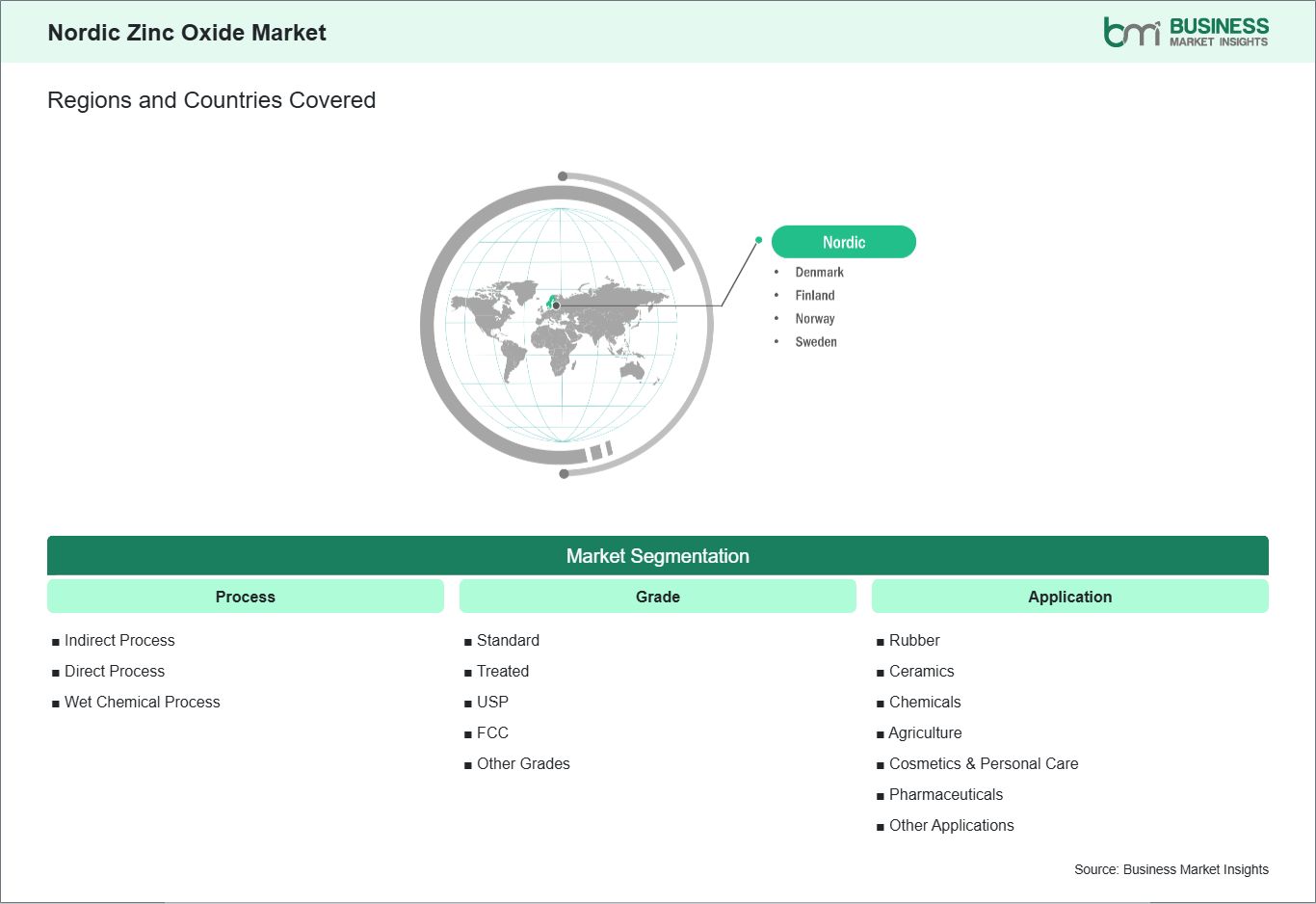
Key segments that contributed to the derivation of the Nordic zinc oxide market analysis are process, grade, and application.
In the Nordic countries of Sweden, Denmark, Norway, and Finland, the zinc oxide market has been increasingly influenced by robust consumer interest in high purity varieties, which find application in industrial and electronic products and specialty chemicals. This high level of development in the industrial manufacturing industry in addition to the strict environmental and quality requirements has made it necessary to focus on zinc oxide formulations that are purified and standardized. Purity is of great significance in industries like electronics, pharmaceuticals, and ceramics, as even minute impurities may impact the final product's performance.
In Denmark and Norway, there is an increasing demand for energy technology and environmental applications. In Denmark, the strong presence of wind energy manufacturing calls for the need for highly functional materials used in the construction of turbines. Norway, being an oil and gas producing nation, uses corrosion-resistant coating and other special materials in their operations, which require the high quality of zinc oxide. High-purity zinc oxide is used in protective coatings, as a catalyst, and as a material in sensor technologies that are applied in the energy and industries. Furthermore, R&D in sustainable materials will continue to drive demand for high purity zinc oxide products.
The electronics and battery materials industry in Finland is also driving the demand. With increasing investment in energy storage technologies and green transition, zinc oxide finds its application in research on batteries, optoelectronic, and nanotechnology. Industrial laboratories and universities in Helsinki and Espoo are conducting research on semiconductor and sensor materials using high-purity zinc oxide. Strict regulatory policies and industrial innovation policies in the Nordics make the market outlook positive for the continued growth of the market in high-purity zinc oxide.
The important factor driving the Nordic zinc oxide market is the increasing demand for durable rubber products in applications such as automobiles, industries, construction, and heavy machinery. Zinc oxide is a crucial compound in the process of rubber vulcanization, which improves its elasticity, durability, heat resistance, and aging properties. Rubber products made in countries like Sweden and Finland, where industrial machinery, mining equipment, and forestry contribute significantly to the economy, must be durable to withstand the climatic conditions in those countries.
The offshore oil and gas industry in Norway is another important consumer of durable rubber products. The rubber compounds that are resistant to high-pressure conditions and exposure to saltwater and different temperatures are required in this application area, which is why zinc oxide is a key component in manufacturing rubber products. Rubber products are also extensively used in Denmark's logistics and transport industry in tires, conveyor belts, and other industrial machines. With the rise in the electrification of transport in the Nordic region, the use of zinc oxide in rubber products will increase.
Construction and infrastructure works in the Nordic area are also one more crucial aspect that drives the need for zinc oxide in rubber goods. As a result of the urbanization of such cities as Stockholm, Oslo, and Helsinki, there is a higher need for rubber products used in construction for insulating purposes and dampening vibrations and moisture. The high level of durability and environmental resistance makes zinc oxide an indispensable element for such products, particularly in the areas with extremely cold winters and harsh weather conditions. Sustainable manufacturing practices in the Nordic nations have resulted in the popularity of durable and reusable rubber products.

The Nordic zinc oxide market is experiencing steady growth, with market size and share analysis reflecting evolving treatment preferences and competitive dynamics among key players. The report evaluates important subsegments categorized process, grade, and application, highlighting their respective contributions to overall market performance.
By process, the indirect subsegment dominated the market in 2025, because it produces high-purity zinc oxide, which is essential for rubber, pharmaceuticals, and cosmetics. It ensures uniform particle size and better performance consistency, which industries require for quality-critical applications. Even though it is costlier than direct process, its product reliability and compliance with strict standards make it the preferred choice.
Based on grade, the standard subsegment dominated the market in 2025 due to its massive use in bulk manufacturing industries, especially rubber, ceramics, and paints. It offers a cost-effective balance between purity and performance, making it suitable for high-volume consumption. Industries prefer it because it is easily available and economically viable compared to high-purity grades.
On the basis of application, the rubber subsegment dominated the market in 2025, because zinc oxide is a key activator in vulcanization, which is essential for tire production. The global expansion of automotive and tire manufacturing directly drives demand. It improves strength, durability, and heat resistance of rubber products, making it irreplaceable. Continuous growth in mobility, logistics, and EV tires further strengthens its dominance.
| Report Attribute | Details |
|---|---|
| Market size in 2025 | US$ 62.1 Million |
| Market Size by 2033 | US$ 78.8 Million |
| CAGR (2026 - 2033) | 3.0% |
| Historical Data | 2022-2024 |
| Forecast period | 2026-2033 |
| Segments Covered | By Process
|
|
Regions and Countries Covered
| |
| Nordic | Sweden, Denmark, Norway, Finland |
| Market leaders and key company profiles |
|
The "Nordic Zinc Oxide Market Size and Forecast (2022-2033)" report provides a detailed analysis of the market covering below areas:
The geographical scope of the Nordic Zinc oxide market report is divided into: Sweden, Norway, Denmark, and Finland. Sweden held the largest share in 2025.
Among the countries in the Nordic region, Sweden stands out as the dominant country in the zinc oxide market due to its highly developed manufacturing processes and engineering skills, along with an understanding of sustainable practices in manufacturing industries. The high-end manufacturing industry in the country includes the manufacture of automobiles, chemicals, paints, and engineering parts, thus increasing the demand for zinc oxide. The use of zinc oxide in the manufacturing of tires and vibration control components, seals, hoses, and other industrial rubber components forms one of the key factors responsible for zinc oxide usage in the automotive industry in Sweden. The country has a well-established automotive engineering industry, which makes extensive use of zinc oxide due to its high purity and performance optimization capabilities. There is also the contribution from the Swedish market coatings and surface treatments market sector to the use of zinc oxide due to the climatic condition in the country characterized by cold and moisture resulting in the increased demand for protective coatings that are resistant to corrosion. The inclusion of zinc oxide in the production of coatings is attributed to its ability to increase the resistance to UV light, protection against corrosion, and increasing product lifespan. The other sectors that have demand for zinc oxide in Sweden include pharmaceuticals and personal care sectors that use zinc oxide in the manufacture of dermatological creams, sunscreens, and medicinal ointments. Due to the quality standards in Sweden, there is an increased demand for special grades of zinc oxide. The zinc oxide is also utilized in the ceramics and glass sector in improving the glazing and thermal properties of advanced materials. Nevertheless, Sweden faces several challenges such as expensive energy, strict environmental regulations, and lack of natural resources of zinc ore.

The Nordic zinc oxide market is evaluated by gathering qualitative and quantitative data post primary and secondary research, which includes important corporate publications, association data, and databases. A few of the key developments in the Nordic zinc oxide market are:
The Nordic Zinc Oxide Market is valued at US$ 62.1 Million in 2025, it is projected to reach US$ 78.8 Million by 2033.
As per our report Nordic Zinc Oxide Market, the market size is valued at US$ 62.1 Million in 2025, projecting it to reach US$ 78.8 Million by 2033. This translates to a CAGR of approximately 3.0% during the forecast period.
The Nordic Zinc Oxide Market report typically cover these key segments-
The historic period, base year, and forecast period can vary slightly depending on the specific market research report. However, for the Nordic Zinc Oxide Market report:
The Nordic Zinc Oxide Market is populated by several key players, each contributing to its growth and innovation. Some of the major players include:
The Nordic Zinc Oxide Market report is valuable for diverse stakeholders, including:
Essentially, anyone involved in or considering involvement in the Nordic Zinc Oxide Market value chain can benefit from the information contained in a comprehensive market report.
Please tell us your area of interest
(Market Segments/ Regions and Countries/ Companies)