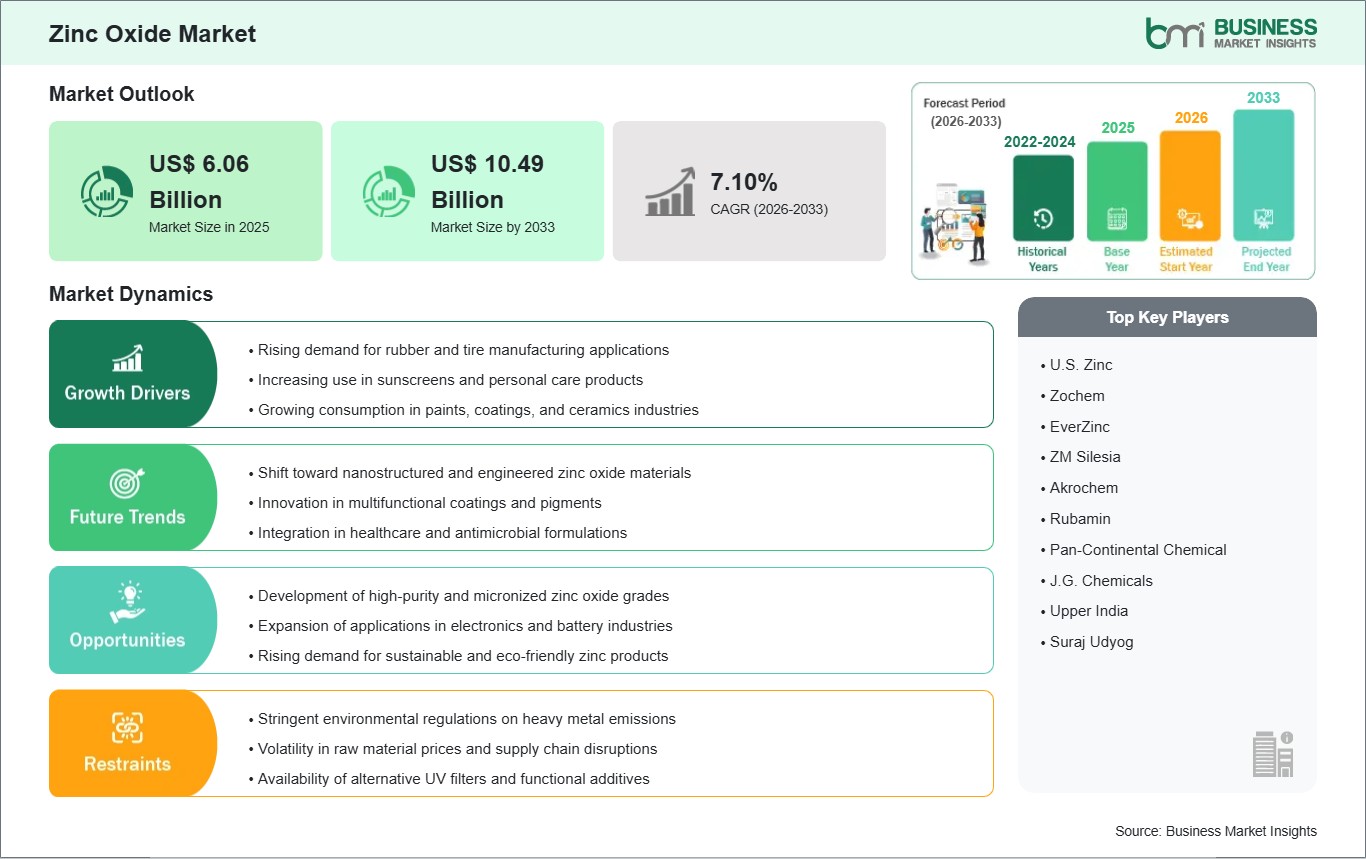
Rising Demand for Rubber and Tire Manufacturing Applications
Zinc oxide functions as a critical activator in rubber vulcanization, improving tensile strength, thermal stability, abrasion resistance, and durability in tires and industrial rubber goods. The material remains indispensable for manufacturing high-performance radial tires, conveyor belts, hoses, and engineered rubber components that require consistent elasticity and wear resistance. Rapid vehicle ownership growth in emerging economies, coupled with increasing freight transportation activity, has accelerated global tire manufacturing volumes, supporting sustained demand for zinc oxide. Tire manufacturers are adopting advanced rubber compounds to enhance fuel efficiency and rolling resistance performance, reinforcing zinc oxide utilization in production processes.
The International Rubber Study Group (IRSG) in December 2024 stated that global rubber consumption by tire and tire products reached approximately 18.04 million tons in 2024, representing a 2% increase compared with 2023, driven by increasing demand from automotive, industrial goods, medical products, and construction applications. The International Organization of Motor Vehicle Manufacturers in 2024 reported that global motor vehicle production exceeded 93.5 million units in 2023, reflecting a strong recovery in automotive manufacturing activity. A 2024 study published by the American Chemical Society (ACS) highlighted that zinc oxide remains one of the most widely used curing activators in passenger vehicle tires due to its effectiveness in enhancing tire performance and operational safety. These trends demonstrate how expanding automotive and tire manufacturing activities are creating sustained consumption of zinc oxide.
The ongoing evolution of rubber compounding technologies and tightening performance requirements is expected to reshape procurement patterns for zinc oxide, with manufacturers prioritizing high-purity and optimized particle-size grades to improve dispersion efficiency in rubber matrices. Growing emphasis on cost optimization and process efficiency in tire manufacturing is encouraging the adoption of advanced activator systems that enhance vulcanization performance while reducing material intensity. These shifts are likely to influence product differentiation strategies among zinc oxide suppliers, reinforcing the importance of technical-grade innovation and consistent quality standards.
Development of High-Purity and Micronized Zinc Oxide Grades
As industries such as personal care, pharmaceuticals, specialty rubber, and high-performance coatings shift toward precision-formulated inputs, demand is moving away from conventional bulk zinc oxide toward engineered grades that deliver superior efficiency and application-specific benefits. This transition is enabling manufacturers to strengthen value addition, improve product differentiation, and access higher-margin segments within an otherwise commodity-driven market.
Regulatory and technical frameworks, such as those outlined by the European Chemicals Agency (ECHA) under REACH, emphasize the importance of particle size distribution, purity levels, and surface characteristics in determining the safety and performance classification of zinc-based substances used in cosmetics and industrial applications. The U.S. Food and Drug Administration (FDA) recognizes zinc oxide as a key active ingredient in topical formulations, where formulation quality and particle characteristics influence product performance and regulatory acceptance. These regulatory expectations indirectly reinforce demand for controlled, high-purity material grades suitable for sensitive and high-compliance applications, particularly in personal care and pharmaceutical sectors.
The increasing emphasis on performance consistency, regulatory compliance, and advanced formulation requirements is expected to accelerate the adoption of micronized and high-purity zinc oxide grades. This shift will create opportunities for manufacturers to invest in particle design technologies, purification systems, and application-specific product development, enabling stronger positioning in premium industrial and consumer segments. As a result, value-added grade differentiation is likely to become a strategic growth avenue in the zinc oxide market.