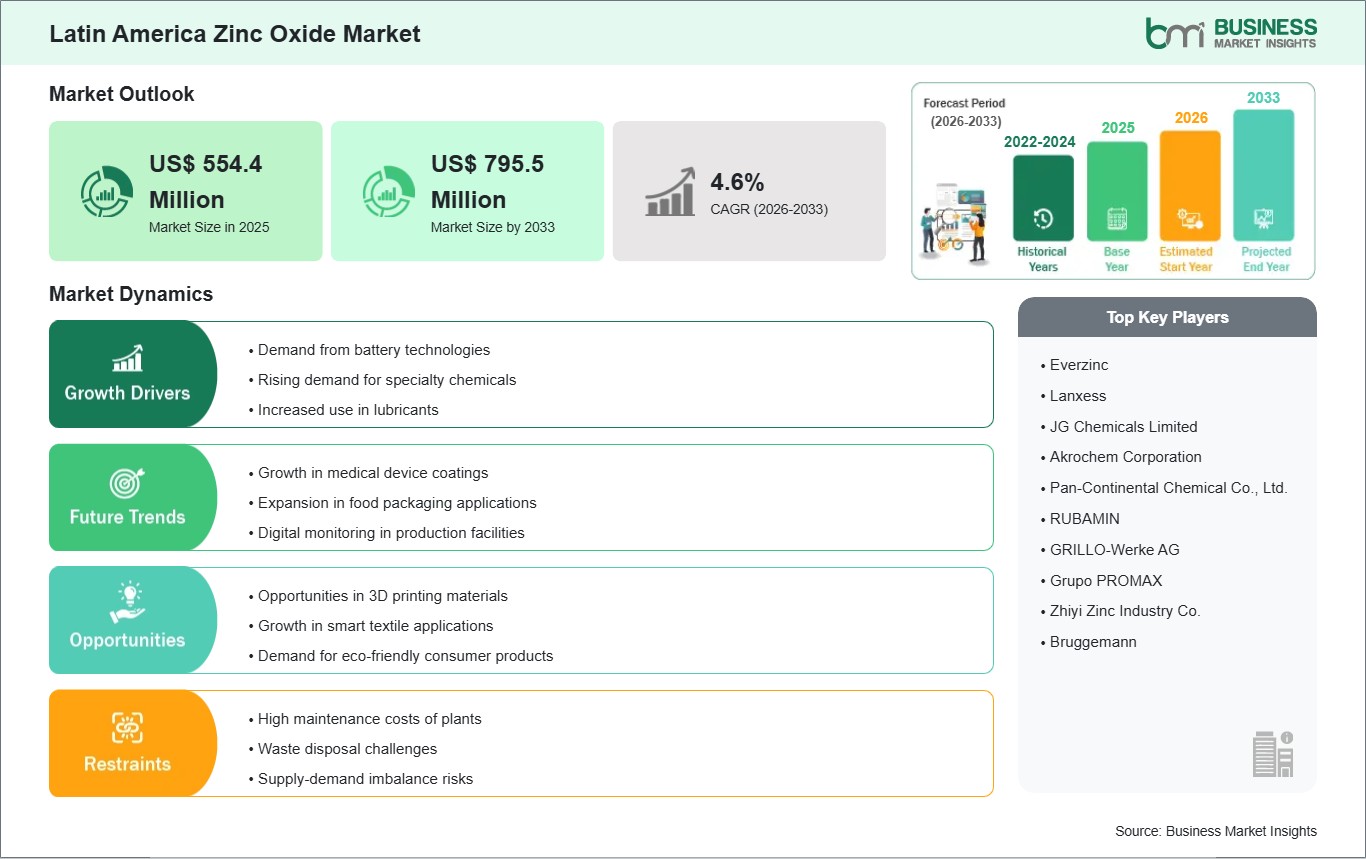
The Latin America zinc oxide market size is expected to reach US$ 795.5 million by 2033 from US$ 554.4 million in 2025. The market is estimated to record a CAGR of 4.6% from 2026 to 2033.
There is a wide industrial base in the Latin American zinc oxide market, ranging from the manufacturing of automobiles to rubber industries, agriculture, constructions, ceramics, and chemicals. The primary demand for zinc oxide arises from the rising consumption of tires and rubber products, increased infrastructure development works, and sustained growth in personal care and pharmaceuticals. Zinc oxide is an essential material used in rubber vulcanization, coating, UV protection compounds, and agricultural feed supplements. Brazil too is a notable consumer market because of the country’s construction sector, agricultural chemicals industry, and local rubber manufacturing activities. Argentina makes its contribution via its industries in coatings, ceramics, and food processing. The smaller economies located in the Andean and Central American regions cater to niche markets which are related to construction and basic manufacturing industries. Moreover, the growth in the cosmetics and personal care industry in Latin America is driving up demand for high-quality zinc oxide used in sunscreen and skincare products that are suitable for a tropical climate. There are certain structural barriers to the market such as inadequate industrial infrastructure, reliance on imported raw material inputs in some countries, and economic instability affecting manufacturing outputs. Poor logistics and different regulations among countries present logistical problems for producers and distributors of zinc oxide. Increasing environmental regulations, especially in more industrialized countries like Mexico and Brazil, have made life difficult for traditional manufacturers. Despite these barriers, the market for zinc oxide in Latin America has been showing steady growth because of industrial diversification and rising automobile integration.

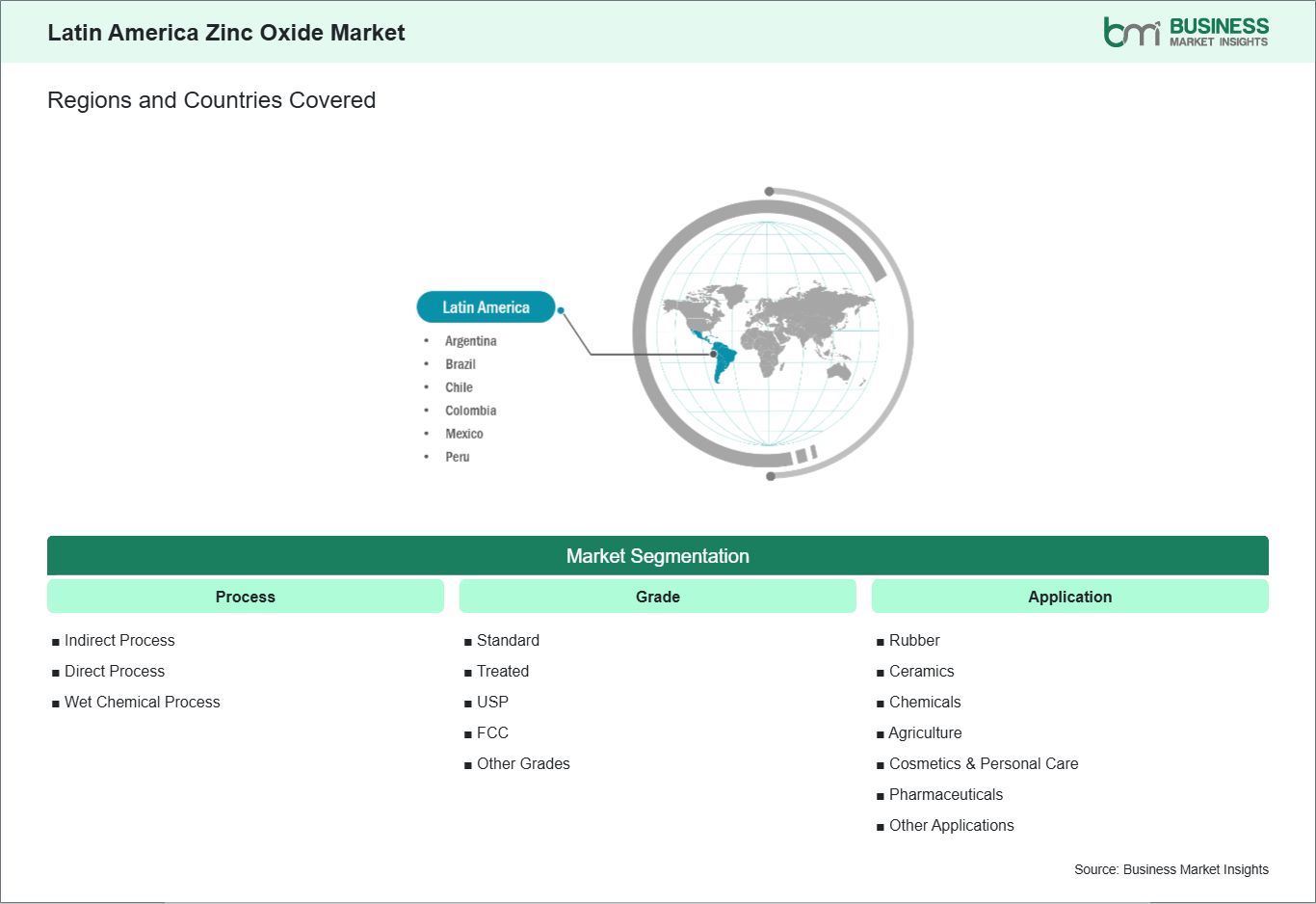
Key segments that contributed to the derivation of the Latin America zinc oxide market analysis are process, grade, and application.
Growth in the zinc oxide market of Latin America is being fueled by advances in battery technology especially in countries such as Brazil, Chile, Argentina, and Mexico. Zinc oxide is becoming popular in batteries because of its stability and ability to improve charge transport within batteries. Batteries that use zinc oxide include electrodes, separators, and coatings. Brazil is a major lithium-ion battery manufacturing country in the region for consumer electronic products and EVs. The country is incorporating zinc oxide into future battery technology for improved cycle life and safety.
Chile and Argentina, as two prominent producers of lithium in the "Lithium Triangle," are making large investments into downstream battery value chains. The emphasis of Chile on increased production of cathodes and battery cells opens up possibilities for specialty materials like zinc oxide, which may be used in the stabilization of electrodes and enhanced conductivity of hybrid energy storage systems. At the same time, Argentina's growing interest in renewable energy storage for its northern sun-drenched regions creates a need for robust and economical battery materials. Research projects on zinc batteries as an alternative to lithium systems are underway in Argentina.
A well-developed automotive industry in Mexico contributes to the need for improved battery materials. With increased EV and hybrid vehicle production taking place in industrial hubs like Nuevo León and Guanajuato, zinc oxide finds use as an ingredient in protective coatings and battery component additives. In Latin America, increased investments in renewable energy integration and stabilization initiatives are forecast to boost the demand for economical and temperature-stable battery materials. With increased deployments of energy storage systems, zinc oxide is gaining traction as an auxiliary material for both lithium-ion batteries and zinc-based alternatives.
Zinc oxide demand from Latin America is also growing due to opportunities arising from use of additive in 3D printing materials on account of increased demand in the manufacture of products for industrial, healthcare, and automobile sectors. Countries like Brazil, Mexico, and Colombia have started using additive manufacturing techniques in order to cut down costs associated with production and decrease time taken in bringing products to market. Zinc oxide has been found to be suitable for use in 3D printing polymers, ceramics, and composite resins.
Additive manufacturing in Brazil has emerged as a leader in the region, primarily in aerospace parts, automotive prototyping, and biomedical devices. There are efforts to explore zinc oxide-reinforced polymer filaments that help to increase toughness and thermal stability in printed components. In Mexico, the presence of robust manufacturing facilities specializing in automotive and electronics manufacturing is creating the demand for innovative materials for 3D printing in tooling, replacement parts, and rapid prototyping. Zinc oxide-based additives are being explored to boost surface finish and structural stability in printed components.
The use of 3D printing in Argentina and Chile is gradually increasing in manufacturing parts for mining equipment, healthcare implants, and educational purposes. The biocompatibility and antibacterial properties of zinc oxide have made it highly suitable for medical and dental applications through 3D printing. Colombia is also witnessing an increasing trend of adopting additive manufacturing technology in construction modeling and industrial design. It is believed that with increasing investment in Industry 4.0 and localized manufacturing in the region, there will be continuous growth in the use of innovative 3D printing materials.

The Latin America zinc oxide market is experiencing steady growth, with market size and share analysis reflecting evolving treatment preferences and competitive dynamics among key players. The report evaluates important subsegments categorized within process, grade, and application, highlighting their respective contributions to overall market performance.
By process, the indirect subsegment dominated the market in 2025, because it produces high-purity zinc oxide, which is essential for rubber, pharmaceuticals, and cosmetics. It ensures uniform particle size and better performance consistency, which industries require for quality-critical applications. Even though it is costlier than direct process, its product reliability and compliance with strict standards make it the preferred choice.
Based on grade, the standard subsegment dominated the market in 2025 due to its massive use in bulk manufacturing industries, especially rubber, ceramics, and paints. It offers a cost-effective balance between purity and performance, making it suitable for high-volume consumption. Industries prefer it because it is easily available and economically viable compared to high-purity grades.
On the basis of application, the rubber subsegment dominated the market in 2025, because zinc oxide is a key activator in vulcanization, which is essential for tire production. The global expansion of automotive and tire manufacturing directly drives demand. It improves strength, durability, and heat resistance of rubber products, making it irreplaceable. Continuous growth in mobility, logistics, and EV tires further strengthens its dominance.
| Report Attribute | Details |
|---|---|
| Market size in 2025 | US$ 554.4 Million |
| Market Size by 2033 | US$ 795.5 Million |
| CAGR (2026 - 2033) | 4.6% |
| Historical Data | 2022-2024 |
| Forecast period | 2026-2033 |
| Segments Covered | By Process
|
|
Regions and Countries Covered
| |
| Latin America | Mexico, Brazil, Argentina, Peru, Chile, Colombia |
| Market leaders and key company profiles |
|
The "Latin America Zinc Oxide Market Size and Forecast (2022-2033)" report provides a detailed analysis of the market covering below areas:
The geographical scope of the Latin America zinc oxide market report is divided into: Brazil, Mexico, Argentina, Colombia, Chile, and Peru. Mexico held the largest share in 2025.
Mexico is the dominating country in Latin American region due to its robust manufacturing sector, high degree of integration in the automotive industry, and geographic location in the North American supply chain. It acts as a principal center for auto assembly, tires, and industrial rubber production-industries that utilize zinc oxide in their processes. Mexico has many industrial zones in northern regions, such as Nuevo León, Coahuila, and Chihuahua, where there are numerous manufacturing facilities using zinc oxide for rubber vulcanization and heat resistance. A significant driver of zinc oxide demand in Mexico is the automotive and tire manufacturing industry. The country has developed a strong export-oriented automotive ecosystem, supplying vehicles and components to the United States and other global markets. Zinc oxide is extensively used in tires, seals, gaskets, belts, and vibration-dampening components, supporting both original equipment manufacturing and aftermarket demand. The presence of global automotive suppliers and tire manufacturers further strengthens consistent consumption patterns. The Mexican agricultural industry also makes an indirect contribution by using zinc oxide in the feed additives and crop protection products. Nonetheless, the issues related to dependency on imports for zinc feedstock, regional differences in industrial infrastructure, and economic fluctuations based on exports to the US need to be addressed. The environmental laws are getting stricter, especially in industrial locations. Mexico continues to dominate the Latin America zinc oxide market because of its large-scale production, exports, and diversified industries.

The Latin America zinc oxide market is evaluated by gathering qualitative and quantitative data post primary and secondary research, which includes important corporate publications, association data, and databases. A few of the key developments in the Latin America zinc oxide market are:
The Latin America Zinc Oxide Market is valued at US$ 554.4 Million in 2025, it is projected to reach US$ 795.5 Million by 2033.
As per our report Latin America Zinc Oxide Market, the market size is valued at US$ 554.4 Million in 2025, projecting it to reach US$ 795.5 Million by 2033. This translates to a CAGR of approximately 4.6% during the forecast period.
The Latin America Zinc Oxide Market report typically cover these key segments-
The historic period, base year, and forecast period can vary slightly depending on the specific market research report. However, for the Latin America Zinc Oxide Market report:
The Latin America Zinc Oxide Market is populated by several key players, each contributing to its growth and innovation. Some of the major players include:
The Latin America Zinc Oxide Market report is valuable for diverse stakeholders, including:
Essentially, anyone involved in or considering involvement in the Latin America Zinc Oxide Market value chain can benefit from the information contained in a comprehensive market report.
Please tell us your area of interest
(Market Segments/ Regions and Countries/ Companies)