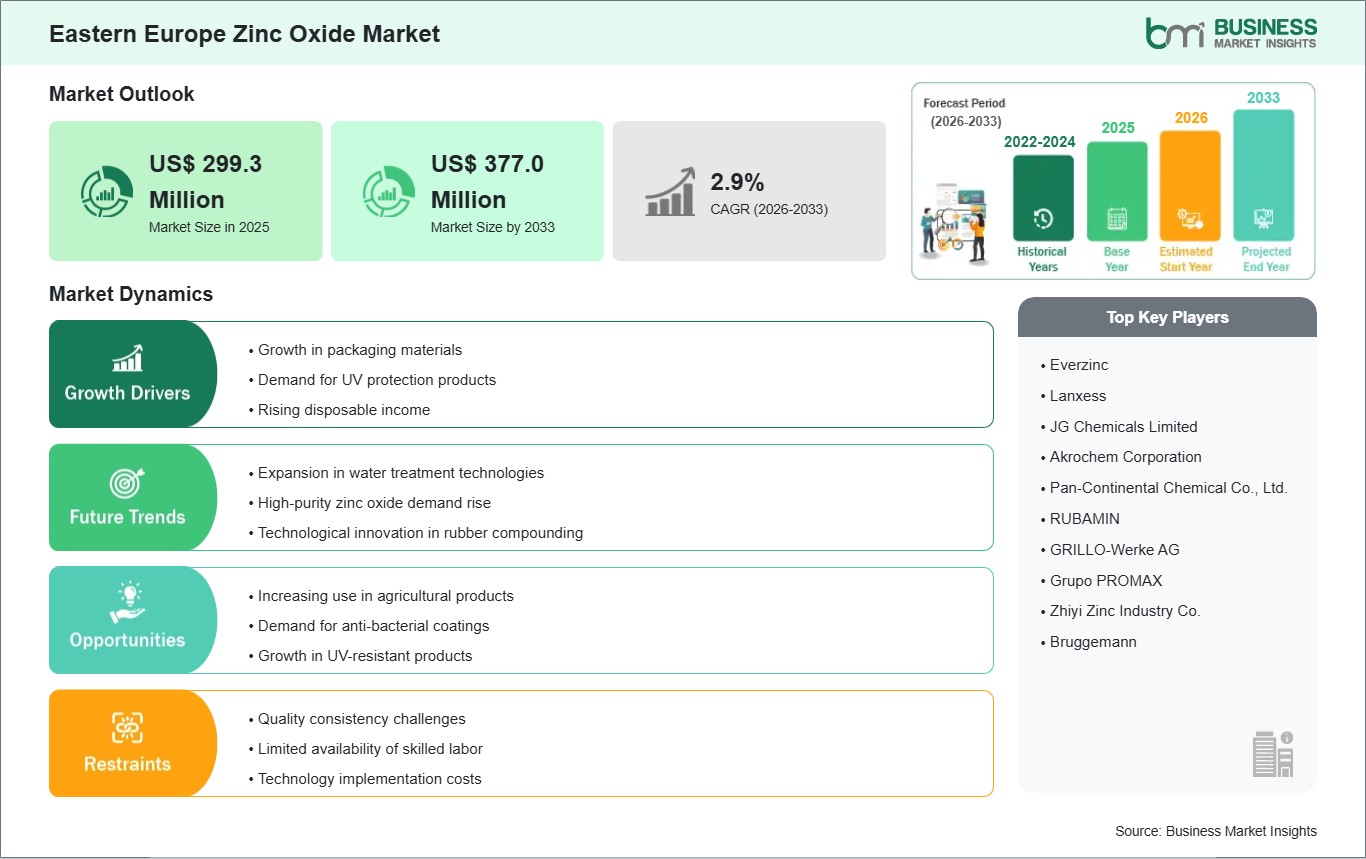
The Eastern Europe Zinc oxide market size is expected to reach US$ 377.0 million by 2033 from US$ 299.3 million in 2025. The market is estimated to record a CAGR of 2.9% from 2026 to 2033.
The zinc oxide market in Eastern Europe is largely determined by the presence of an advanced industrial infrastructure involving metallurgy, automotive parts, building materials, and chemical industry. The use of zinc oxide in Eastern Europe is mainly focused on rubber goods, ceramic products, paints, pharmaceuticals, and animal feed. The market is dependent on industries that are heavily engaged in industrial activities, especially in such countries as Russia and others where there are established chemical industries. Further, in Eastern Europe, the demand is driven by Poland, Ukraine, and Romania as the manufacturing industry, producing automotive parts, building materials, and industrial coatings, ensures constant consumption. In addition, the ceramic and glass industries in the region also make use of zinc oxide for the purpose of thermal stability and material strengthening. Moreover, the pharmaceuticals and agriculture industries are increasingly using zinc oxide in creams, supplements, and animal feed preparations. The Eastern Europe zinc oxide market is also hindered by certain restraints, which include geopolitics, industrial modernization, and varying regulations in different regions. Limited access to advanced technologies and potential disruptions in the supply chain pose as an obstacle to the efficient production of zinc oxide. Further, environmental regulation becomes more severe in industrialized areas due to metallurgical activities. Nonetheless, the market still benefits from strong underlying industries, presence of raw material, and constant demand in manufacturing sectors.

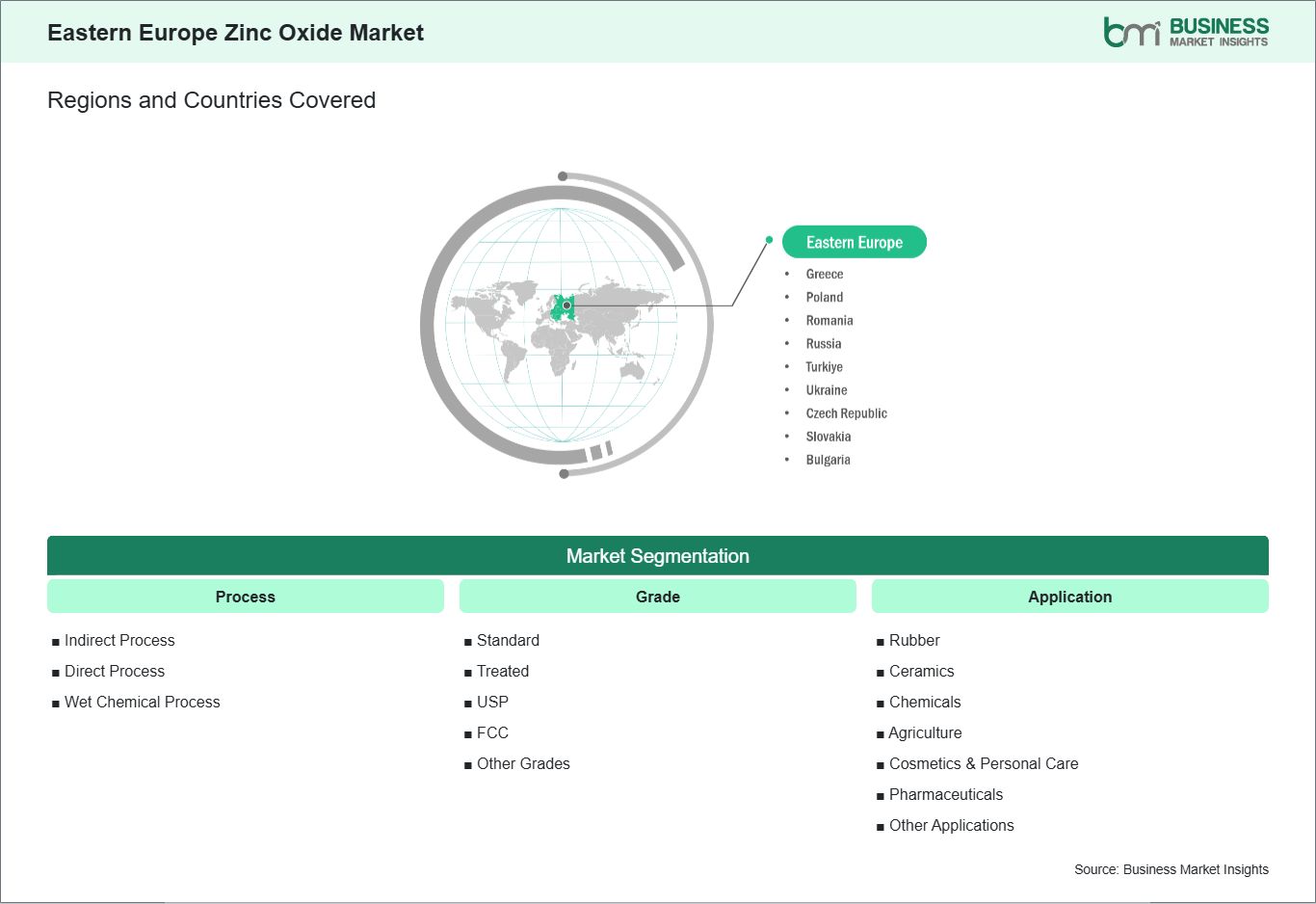
Key segments that contributed to the derivation of the Eastern Europe Zinc oxide market analysis are process, grade, and application.
The market for zinc oxide in Eastern Europe is growing rapidly owing to increased demand for innovative packaging materials in countries like Poland, Czech Republic, Hungary, Romania, and Baltic nations. The fast growth in e-commerce, retail modernization, and consumption of processed foods has created a need for high-quality packaging products. Zinc oxide is becoming an essential component of polymer film, coating, and multilayer packaging systems as it helps provide better protection against moisture, oxygen, and ultraviolet rays. In Poland, the growth in the manufacture of packaging material has been consistent due to the growth of its food processing and export industry.
The rise in the development of automotive and industrial logistics systems has also been playing an indirect role in boosting the demand for packaging in nations such as Hungary and Czech Republic. Export-driven manufacturing necessitates high-quality protective packaging of electronic parts, machine parts, and automobile parts. The use of zinc oxide in plastic films and coatings has increased because it increases resistance to wear and tear due to long-distance transportation in the European market. Romania’s expanding retail and FMCG industry is driving up the demand for flexible packaging materials.
The Baltic region, including Estonia, Latvia, and Lithuania, is seeing rising demand for sustainable and recyclable packaging solutions, supported by EU environmental directives. Manufacturers are increasingly shifting toward multifunctional additives that improve packaging strength while reducing material usage. Zinc oxide is gaining importance due to its antimicrobial and UV-blocking properties, especially in premium food packaging and pharmaceutical containers. Across Eastern Europe, stricter food safety standards and sustainability regulations are accelerating innovation in packaging materials, positioning zinc oxide as a key functional additive in next-generation packaging systems.
The market for zinc oxide in Eastern Europe is getting boosted by its growing applications in the agricultural industry, specifically in crop protection, fertilizers, and animal feed additives. The agricultural industry continues to be one of the key sectors in economies like Poland, Ukraine, Romania, and Hungary due to the extensive cultivation of grains, maize, and sunflower, thus necessitating the use of efficient agrochemicals. Zinc oxide acts as an important micronutrient in fertilizers, which improves the fertility of the soil and enhances yield.
The intensive use of land for farming purposes and export-oriented farming activities have led to the greater utilization of fertilizers enriched with micronutrients in Ukraine and Romania. For instance, the use of zinc oxide is common in soil application as well as foliar spray methods to boost the development of crops and ensure their resistance to adverse environmental conditions. Moreover, zinc-based nutrients are utilized in the agriculture of Hungary, especially in the country's viticulture and cereal production industries. The increased need for such minerals is motivated by the desire of the agricultural industry to achieve higher yields through efficient utilization of limited arable lands amidst changing climatic conditions.
Another rapidly developing sector that promotes the demand for zinc oxide in Eastern Europe relates to animal nutrition. Specifically, in Poland and Romania, there is an increased use of zinc oxide in various feed products to promote better health, digestion, and immune system functioning in animals, including pigs and chickens. Although the EU regulatory framework encourages responsible consumption of zinc oxide in the region, the demand for advanced formulations continues to increase. Furthermore, sustainable farming practices in the Baltic states have encouraged the implementation of precision agriculture practices through zinc-based nutrients.

The Eastern Europe zinc oxide market is experiencing steady growth, with market size and share analysis reflecting evolving treatment preferences and competitive dynamics among key players. The report evaluates important subsegments categorized within process, grade, and application, highlighting their respective contributions to overall market performance.
By process, the indirect subsegment dominated the market in 2025, because it produces high-purity zinc oxide, which is essential for rubber, pharmaceuticals, and cosmetics. It ensures uniform particle size and better performance consistency, which industries require for quality-critical applications. Even though it is costlier than direct process, its product reliability and compliance with strict standards make it the preferred choice.
Based on grade, the standard subsegment dominated the market in 2025 due to its massive use in bulk manufacturing industries, especially rubber, ceramics, and paints. It offers a cost-effective balance between purity and performance, making it suitable for high-volume consumption. Industries prefer it because it is easily available and economically viable compared to high-purity grades.
On the basis of application, the rubber subsegment dominated the market in 2025, because zinc oxide is a key activator in vulcanization, which is essential for tire production. The global expansion of automotive and tire manufacturing directly drives demand. It improves strength, durability, and heat resistance of rubber products, making it irreplaceable. Continuous growth in mobility, logistics, and EV tires further strengthens its dominance.
| Report Attribute | Details |
|---|---|
| Market size in 2025 | US$ 299.3 Million |
| Market Size by 2033 | US$ 377.0 Million |
| CAGR (2026 - 2033) | 2.9% |
| Historical Data | 2022-2024 |
| Forecast period | 2026-2033 |
| Segments Covered | By Process
|
|
Regions and Countries Covered
| |
| Eastern Europe | Russia, Poland, Romania, Czech Republic, Greece, Ukraine, Slovakia, Bulgaria |
| Market leaders and key company profiles |
|
The "Eastern Europe Zinc Oxide Market Size and Forecast (2022-2033)" report provides a detailed analysis of the market covering below areas:
The geographical scope of the Eastern Europe zinc oxide market report is divided into: Russia, Poland, Romania, the Czech Republic, Ukraine, Romania, Greece, Slovakia, and Bulgaria. Russia held the largest share in 2025.
Among the countries in Eastern Europe, Russia is considered the market leader in zinc oxide, largely because of its advanced industrial base, metallurgical expertise, and supply chain linkages between the production of zinc and zinc-based chemicals. For Russia, the demand for zinc oxide is heavily influenced by its heavy industries such as automobiles, construction materials, mining machinery, and mega construction projects. The presence of the already established non-ferrous metallurgy industry gives Russia an edge in terms of availability of raw materials for zinc chemical production. The main reason behind the consumption of zinc oxide in Russia is its use in rubber products that include tires, industrial belts, hydraulic hoses, and rubberized components of mining and construction equipment. The extreme weather conditions in several parts of Russia ensure that there is a steady demand for rubber products, where zinc oxide plays a vital role in improving thermal stability and mechanical resistance. Moreover, the automobile spare parts market keeps the demand for tires alive, hence zinc oxide consumption. The use of zinc oxide is gaining momentum in the pharmaceuticals and agriculture industries as it is used in medical creams and skincare products as well as supplements for livestock feeding. The industry faces challenges in the form of unstable economic performance, unstable production volumes in some sectors, and lack of cutting-edge technology. Moreover, environmental regulations have been getting stricter with the increased focus on emissions from the chemical and metallurgical industries. Despite these constraints, Russia maintains its dominant position in the Eastern Europe zinc oxide market due to its resource base, industrial scale, and sustained demand from core manufacturing and infrastructure sectors.

The Eastern Europe zinc oxide market is evaluated by gathering qualitative and quantitative data post primary and secondary research, which includes important corporate publications, association data, and databases. A few of the key developments in the Eastern Europe zinc oxide market are:
The Eastern Europe Zinc Oxide Market is valued at US$ 299.3 Million in 2025, it is projected to reach US$ 377.0 Million by 2033.
As per our report Eastern Europe Zinc Oxide Market, the market size is valued at US$ 299.3 Million in 2025, projecting it to reach US$ 377.0 Million by 2033. This translates to a CAGR of approximately 2.9% during the forecast period.
The Eastern Europe Zinc Oxide Market report typically cover these key segments-
The historic period, base year, and forecast period can vary slightly depending on the specific market research report. However, for the Eastern Europe Zinc Oxide Market report:
The Eastern Europe Zinc Oxide Market is populated by several key players, each contributing to its growth and innovation. Some of the major players include:
The Eastern Europe Zinc Oxide Market report is valuable for diverse stakeholders, including:
Essentially, anyone involved in or considering involvement in the Eastern Europe Zinc Oxide Market value chain can benefit from the information contained in a comprehensive market report.
Please tell us your area of interest
(Market Segments/ Regions and Countries/ Companies)