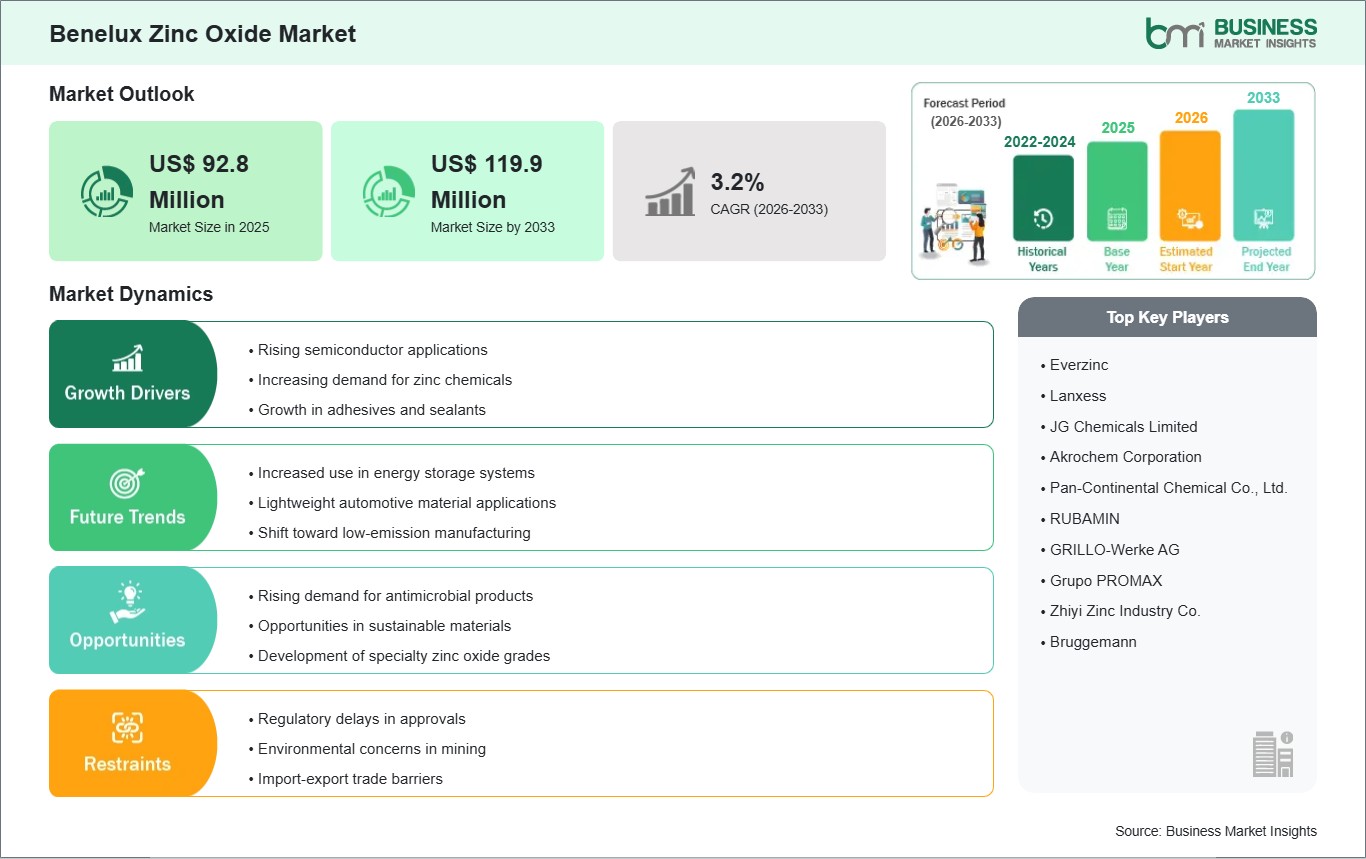
The Benelux zinc oxide market size is expected to reach US$ 119.9 million by 2033 from US$ 92.8 million in 2025. The market is estimated to record a CAGR of 3.2% from 2026 to 2033.
The Benelux zinc oxide market is known for its highly integrated nature with chemical industry processes that are environmentally friendly and have specialized applications. The main demand driver for zinc oxide in Benelux comes from the presence of advanced rubber, coating, ceramics, pharmaceutical, and animal feed industries in the region. Benelux countries, specifically the Netherlands and Belgium, act as production and distribution centers for specialty chemicals in Europe, resulting in steady consumption of zinc oxide in both local and export-oriented industries. There is an increasing influence of the regional focus on manufacturing that complies with environmental laws and circular economy principles. The manufacturers of zinc oxide in Benelux are implementing clean production processes and utilizing recycled zinc raw materials in accordance with the sustainability models in Europe. This is particularly pertinent in industries such as eco-friendly rubber formulations, non-toxic coatings, and high-end ceramics in electronics and industrial engineering. The rising requirements for quality tires and industrial rubber components in Europe are driving the demand for zinc oxide. But there are limitations on account of expenses of complying with environmental regulations and the increase in energy costs because of the production of zinc oxide at high temperatures. Another limitation that producers face is that of low-cost imports that come from outside Europe, especially in the standard grades of zinc oxide. But the market is resilient, which is thanks to its focus on producing high-quality zinc oxide products, innovative environment of production, and the integration with the industrial sector of Europe.

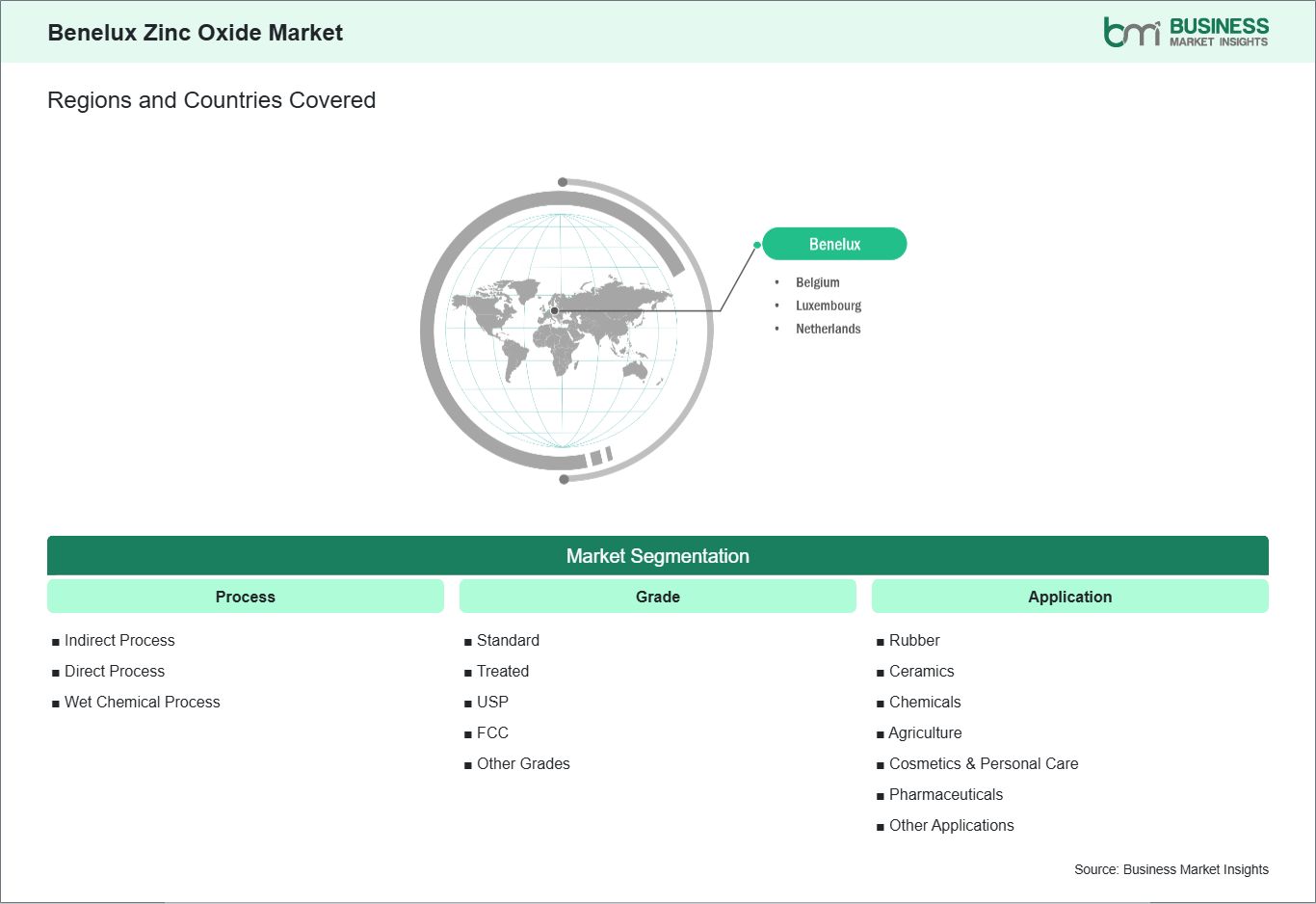
Key segments that contributed to the derivation of the Benelux zinc oxide marketanalysis are process, grade, and application.
There is an increased growth in the use of zinc oxide in the Benelux area as a result of the accelerated growth of semiconductor and microelectronic activities in the Netherlands, Belgium, and Luxembourg. Benelux has earned itself a reputation for its high level of specialization in technological manufacture, chip designing, and semiconductor research, especially through advanced engineering centers in Eindhoven and Leuven. This growth is due to the high mobility of electrons in zinc oxide, thermal stability, and transparency. These characteristics make zinc oxide useful in semiconductors as sensors, thin film transistors, and electronic coatings. With the drive by European industries for more independence in semiconductors, there is an increase in investments in Benelux.
The Netherlands continues to be an important contributor to the demand for semiconductors within the region, owing to its favorable environment for semiconductor equipment fabrication and photonics technology. The growing manufacture of AI processors, automotive semiconductors, and industrial automation components is leading to increased interest in innovative conductive materials and nanocoatings. The utilization of zinc oxide nanoparticles for flexible electronics, optoelectronics, and transparent semiconductors has been rising due to their relatively cheaper cost of production in comparison with certain rare earth minerals. Moreover, Belgium has been making headway in nanoelectronic research, as the partnerships between universities and technology companies are fostering innovation in high-performance semiconductors.
A new wave of demand from electric cars and intelligent industrial operations is also shaping up to be an additional opportunity for the industry. More and more manufacturers within the Benelux are developing miniaturized and energy-saving electronic parts that can be used for renewable energy sources, smart devices, and automotive sensors. New research is also being conducted in terms of using zinc oxide materials as a base for future semiconductors due to their superior properties in relation to thermal stability and durability. The development of digitalization and smart manufacturing programs backed by the state in Luxembourg encourages investment in advanced electronics and material processing.
The increasing demand for antimicrobial products in sectors such as healthcare, cosmetics, food packaging, and industrial hygiene is boosting the Benelux zinc oxide market. Zinc oxide is known for its antibacterial and antifungal properties and hence is used in creams, ointments, and coatings. The consumers in the Benelux countries are becoming more conscious about hygiene-related products. The consumers are giving preference to such products that offer better hygiene protection, especially in the skincare and healthcare segments. This trend has resulted in the increased adoption of zinc oxide in dermatology, baby care, and mineral cosmetics for sensitive skin.
Cosmetics and personal care sector emerges as one of the most promising segments. Consumers in Benelux prefer natural UV filters and organic skincare products without any chemicals, thus boosting the use of zinc oxide in sunscreens and other cosmetic products. High-end skincare products from the Netherlands and Belgium are adding zinc oxide to their formulas in order to provide a multifunctional effect, namely, sun protection and antibacterial properties. Moreover, the problem of skin allergies and environmental issues associated with the usage of synthetic components contribute to the popularity of mineral ingredients like zinc oxide.
The industrial and healthcare sectors are boosting market growth even more. Medical textiles, touch surfaces, and equipment in hospitals and other healthcare institutions in Benelux have become increasingly reliant on antimicrobial coatings to enhance their cleanliness standards. Antimicrobial packaging using zinc oxide nanoparticles for wound care materials and pharmaceutical and food products has been developed. Companies in Belgium and the Netherlands engaged in food processing have started investing in antimicrobial packaging technology. Public health, sustainability, and infection control have received increasing attention from policymakers and manufacturers, which is expected to ensure healthy growth in the demand for zinc oxide across antimicrobial applications in Benelux through.

The Benelux zinc oxide marketis experiencing steady growth, with market size and share analysis reflecting evolving treatment preferences and competitive dynamics among key players. The report evaluates important subsegments categorized within process, grade, and application, highlighting their respective contributions to overall market performance.
By process, the indirect subsegment dominated the market in 2025, because it produces high-purity zinc oxide, which is essential for rubber, pharmaceuticals, and cosmetics. It ensures uniform particle size and better performance consistency, which industries require for quality-critical applications. Even though it is costlier than direct process, its product reliability and compliance with strict standards make it the preferred choice.
Based on grade, the standard subsegment dominated the market in 2025 due to its massive use in bulk manufacturing industries, especially rubber, ceramics, and paints. It offers a cost-effective balance between purity and performance, making it suitable for high-volume consumption. Industries prefer it because it is easily available and economically viable compared to high-purity grades.
On the basis of application, the rubber subsegment dominated the market in 2025, because zinc oxide is a key activator in vulcanization, which is essential for tire production. The global expansion of automotive and tire manufacturing directly drives demand. It improves strength, durability, and heat resistance of rubber products, making it irreplaceable. Continuous growth in mobility, logistics, and EV tires further strengthens its dominance.
| Report Attribute | Details |
|---|---|
| Market size in 2025 | US$ 92.8 Million |
| Market Size by 2033 | US$ 119.9 Million |
| CAGR (2026 - 2033) | 3.2% |
| Historical Data | 2022-2024 |
| Forecast period | 2026-2033 |
| Segments Covered | By Process
|
|
Regions and Countries Covered
| |
| Benelux | Belgium, Netherlands, Luxembourg |
| Market leaders and key company profiles |
|
The "Benelux Zinc Oxide Market Size and Forecast (2022-2033)" report provides a detailed analysis of the market covering below areas:
The geographical scope of the Benelux Zinc oxide marketreport is divided into: Belgium, the Netherlands, and Luxembourg. The Netherlands held the largest share in 2025.
Netherlands can be considered the leader among the countries within the Benelux zinc oxide market, owing to its advanced chemical production capabilities, logistics facilities, and geographical position in European industrial trade. In this context, the country serves as a gate for specialty chemical goods moving into or out of Europe, which allows zinc oxide producers and distributors to have good connectivity with the region. The Netherlands has a number of industrial clusters based in Rotterdam and other port-linked regions, contributing greatly to the country's prominence in zinc oxide production and distribution. Among the major growth drivers in the Netherlands, one can mention the development of the advanced rubber and specialty chemical industries. Zinc oxide is widely used in various advanced rubber applications, such as tires for automobiles, industrial rubber products, technical rubber, and marine elastomers. Moreover, there is increasing demand in the Netherlands for sustainable low-emission rubber compounds, where zinc oxide is used in order to enhance the efficiency of vulcanization process. Therefore, manufacturers focus on the development of environmentally friendly formulations of zinc oxide. Apart from rubber applications, there is a growing demand for zinc oxide from the animal nutrition, pharmaceuticals, paints, ceramics, and cosmetics sectors. In particular, high-quality zinc oxide is critical in pharmaceutical creams, skin care products, and feed additives owing to the strict quality standards required for such products in European countries. In addition, the research environment in the Netherlands fosters innovations in the use of zinc oxide nanoparticles and other specialty chemicals that are used in the electronics and coating industries. In the Netherlands, recycling is well-developed, and the manufacturers are increasingly using recycled zinc oxides in their production processes. Nevertheless, the issue of high energy consumption is becoming more acute for the industry, especially given the volatile costs of industrial energy and strict emission regulations. Moreover, competition from low-cost zinc oxide products imported from other countries poses additional threats to local manufacturers, primarily for commodity grade products. Despite these difficulties, the Netherlands still retains its competitive advantage by virtue of technological capabilities, high-value specialty production, and integration into the logistics infrastructure of Europe.

The Benelux zinc oxide marketis evaluated by gathering qualitative and quantitative data post primary and secondary research, which includes important corporate publications, association data, and databases. A few of the key developments in the Benelux zinc oxide marketare:
The Benelux Zinc Oxide Market is valued at US$ 92.8 Million in 2025, it is projected to reach US$ 119.9 Million by 2033.
As per our report Benelux Zinc Oxide Market, the market size is valued at US$ 92.8 Million in 2025, projecting it to reach US$ 119.9 Million by 2033. This translates to a CAGR of approximately 3.2% during the forecast period.
The Benelux Zinc Oxide Market report typically cover these key segments-
The historic period, base year, and forecast period can vary slightly depending on the specific market research report. However, for the Benelux Zinc Oxide Market report:
The Benelux Zinc Oxide Market is populated by several key players, each contributing to its growth and innovation. Some of the major players include:
The Benelux Zinc Oxide Market report is valuable for diverse stakeholders, including:
Essentially, anyone involved in or considering involvement in the Benelux Zinc Oxide Market value chain can benefit from the information contained in a comprehensive market report.
Please tell us your area of interest
(Market Segments/ Regions and Countries/ Companies)