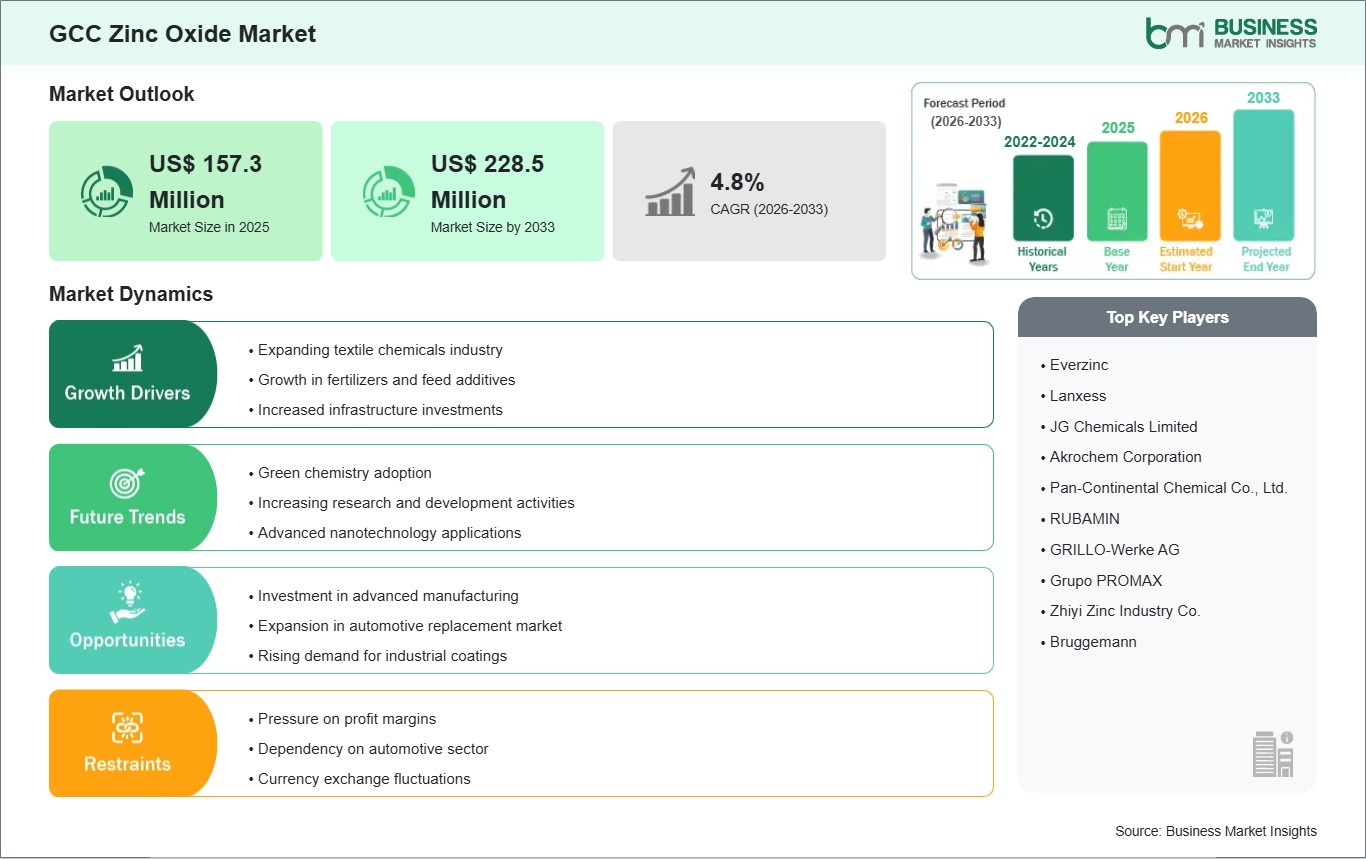
The GCC zinc oxide market size is expected to reach US$ 228.5 million by 2033 from US$ 157.3 million in 2025. The market is estimated to record a CAGR of 4.8% from 2026 to 2033.
GCC zinc oxide industry is characterized by fast-paced diversification of industries, high integration of petrochemicals, and increased downstream manufacturing operations in construction, rubber compounding, coatings, and specialty chemicals. The consumption of zinc oxide in the GCC countries is mainly propelled by its uses in rubber vulcanization, protective coatings, ceramics, pharmaceuticals, and personal care products. The GCC zinc oxide market is highly dependent on large-scale infrastructure projects, industrial diversification policies beyond oil, and localization of chemical manufacturing processes in GCC nations. In the GCC, countries like UAE, Qatar, and Oman continue to add to the demand side in terms of construction-driven economies, upgrading infrastructure, and establishing manufacturing areas. The UAE, in particular, emerges as an important country for the trade and re-trade of specialty chemicals, which ensures that zinc oxide is supplied to other countries in the region. Moreover, the growing trend of cosmetics and personal care products in the GCC is leading to demand for high-purity zinc oxide to be used in skin care and sunscreens suitable for extreme climates. The market is, however, constrained by the shortage of domestic resources, dependence on imported zinc as raw materials, and increased costs of manufacturing due to energy-intensive operations. In addition to that, environmental laws concerning industrial emissions and chemical handling are becoming stricter, especially for urban-based industrial areas. Also, changes in the supply chain of global zinc may affect pricing stability in the region. Overall, the market in the GCC is growing steadily owing to diversification in industries, construction activities, and the growing demand for specialty chemicals.

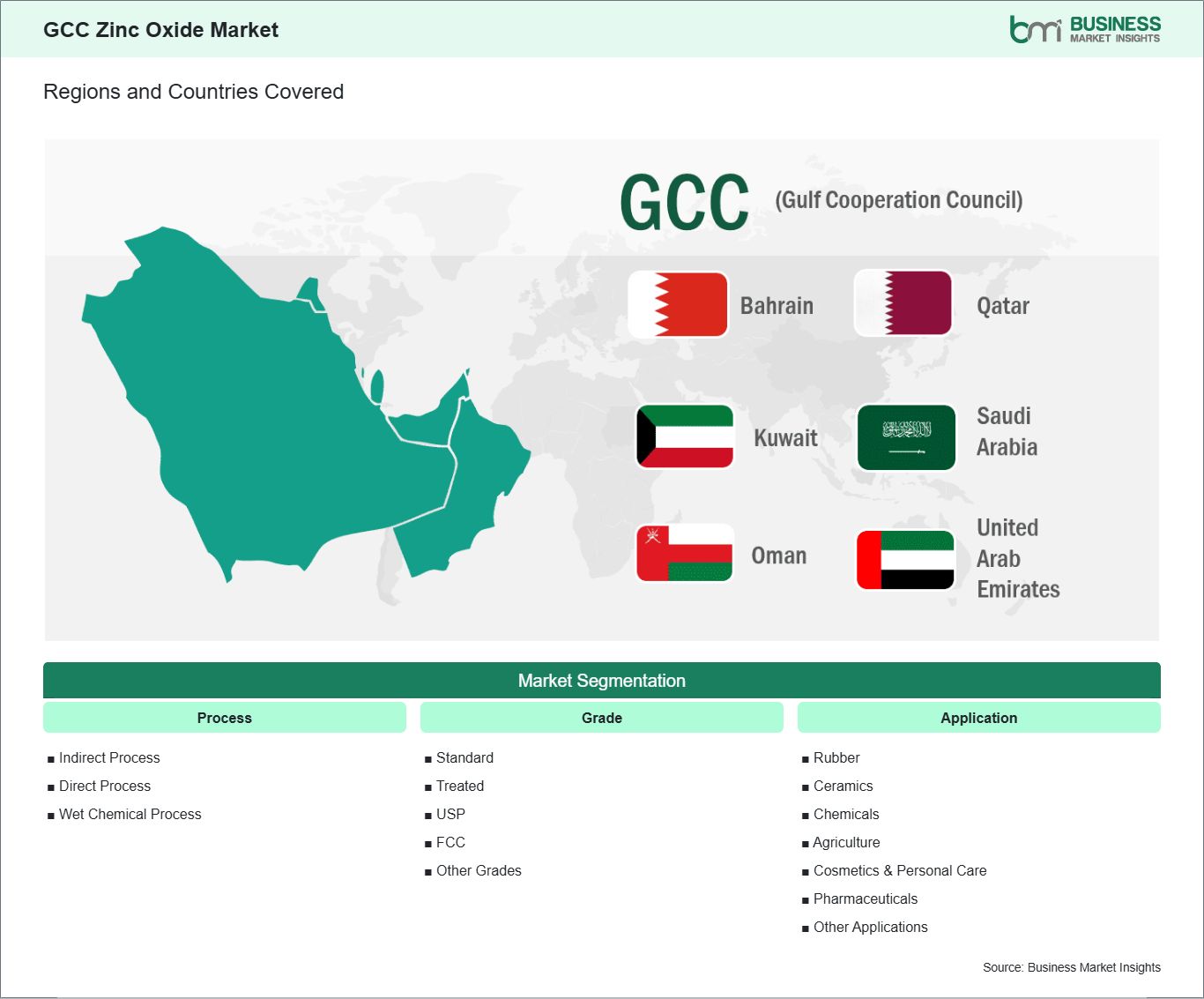
Key segments that contributed to the derivation of the GCC zinc oxide market analysis are process, grade, and application.
The GCC market for zinc oxide continues to grow steadily, thanks to the growth in the production of textile chemicals in nations like Saudi Arabia, the UAE, and Oman. Although the GCC nations are not major centers of textile production, they have become adept at producing technical textiles, clothing finish, and industrial fabrics. Zinc oxide has come to be used more and more in textile chemicals because of its anti-bacterial, UV protective, and deodorizing capabilities. This becomes particularly useful in the GCC, which enjoys a hot climate where the need for UV-protecting and breathable fabrics is increasing.
Textile finishing and functional textile manufacturing are growing in Saudi Arabia as part of the country's efforts at industrial diversification. The industrial cities of Jubail and Yanbu are developing textile finishes based on petrochemicals and therefore promoting the inclusion of zinc oxide in coating solutions and treatment of synthetic fibers. Dubai and Abu Dhabi in the United Arab Emirates have become centers of high-performance textiles in the hospitality, military, and sportswear industries. Zinc oxide-treated textiles are increasingly being utilized in uniforms, protective garments, and outdoor clothing because of their ability to withstand degradation from ultraviolet radiation and microorganisms in high temperatures.
Oman and Bahrain are also slowly establishing their textile and garment manufacturing capacity, especially industrial textiles. The use of antimicrobial textiles in the health care and hospitality sectors is driving demand for zinc oxide. Hospitals and hotels in the Gulf Cooperation Council countries are incorporating treated textiles in beddings, curtains, and upholstery to enhance hygiene levels. As consumers become more aware of the importance of functional and sustainable textiles, zinc oxide will continue to be incorporated in textile chemical formulations.
The GCC zinc oxide market is being significantly impacted by increasing investments in advanced manufacturing technologies amid the diversification efforts away from oil-based economies. The Vision 2030 of Saudi Arabia and the industrial plans of the UAE have been instrumental in the rapid emergence of advanced manufacturing clusters, especially in the chemicals, electronics, and materials processing sectors. Zinc oxide finds extensive application in these industries owing to its use in the manufacturing of ceramics, coatings, electronics, and rubber processing.
The kingdom of Saudi Arabia is making significant investments in industrial mega projects such as NEOM and the development of its petrochemical downstream sector which includes the manufacturing of advanced materials and coatings. Zinc oxide is utilized in the manufacturing of corrosion protection coatings, catalysis, and rubber products for automotive and industrial purposes. In the UAE, free zones such as Jebel Ali and KIZAD are attracting many international players in the manufacture of electronics, automotive parts, and specialty chemicals, further boosting the need for zinc oxide in industrial applications.
Similarly, Qatar, Oman, and Bahrain are playing their part in driving advanced manufacturing through the processing of aluminum, construction materials, and petrochemical derivatives. Zinc oxide finds extensive use in heat resistant ceramic materials, industrial adhesives, and protective coatings for infrastructure facing extreme heat exposure and corrosive conditions due to proximity to the coast. With the increasing trend towards localization of manufacturing activities in the GCC region, the market for zinc oxide is set to see steady growth in the coming years.

The GCC zinc oxide market is experiencing steady growth, with market size and share analysis reflecting evolving treatment preferences and competitive dynamics among key players. The report evaluates important subsegments categorized within process, grade, and application, highlighting their respective contributions to overall market performance.
By process, the indirect subsegment dominated the market in 2025, because it produces high-purity zinc oxide, which is essential for rubber, pharmaceuticals, and cosmetics. It ensures uniform particle size and better performance consistency, which industries require for quality-critical applications. Even though it is costlier than direct process, its product reliability and compliance with strict standards make it the preferred choice.
Based on grade, the standard subsegment dominated the market in 2025 due to its massive use in bulk manufacturing industries, especially rubber, ceramics, and paints. It offers a cost-effective balance between purity and performance, making it suitable for high-volume consumption. Industries prefer it because it is easily available and economically viable compared to high-purity grades.
On the basis of application, the rubber subsegment dominated the market in 2025, because zinc oxide is a key activator in vulcanization, which is essential for tire production. The global expansion of automotive and tire manufacturing directly drives demand. It improves strength, durability, and heat resistance of rubber products, making it irreplaceable. Continuous growth in mobility, logistics, and EV tires further strengthens its dominance.
| Report Attribute | Details |
|---|---|
| Market size in 2025 | US$ 157.3 Million |
| Market Size by 2033 | US$ 228.5 Million |
| CAGR (2026 - 2033) | 4.8% |
| Historical Data | 2022-2024 |
| Forecast period | 2026-2033 |
| Segments Covered | By Process
|
|
Regions and Countries Covered
| |
| GCC | UAE, Bahrain, Saudi Arabia, Oman, Qatar, Kuwait |
| Market leaders and key company profiles |
|
The "GCC Zinc Oxide Market Size and Forecast (2022-2033)" report provides a detailed analysis of the market covering below areas:
The geographical scope of the GCC Zinc oxide market report is divided into: Saudi Arabia, the UAE, Qatar, Kuwait, Bahrain, and Oman. Saudi Arabia held the largest share in 2025.
Saudi Arabia is the dominant market for zinc oxide in the GCC region, thanks to its well-developed industrial base, integration with petrochemicals, and efforts towards non-oil economic diversification. The industrialization strategy adopted by Saudi Arabia has resulted in an increase in downstream industries like rubber, building material production, paints, ceramics, and specialty chemicals that are end users of zinc oxide. One of the key reasons for the use of zinc oxide in Saudi Arabia is the construction industry. Big urban development programs, smart cities, and industrial zones need high-quality coatings and sealants that utilize zinc oxide because of its ability to prevent corrosion and enhance durability. The construction of buildings and other facilities also drives the use of ceramic tiles and glass products containing zinc oxide. The automobile industry and the industrial manufacturing sector are also becoming significant players. Though the country does not have much involvement in the manufacture of automobiles, there has been an increasing trend in automobile assembly, components manufacturing, and maintenance facilities. Zinc oxide is extensively utilized in rubber-based products like tires, belts, hoses, and industrial gaskets to support logistics, transport, and heavy equipment use in the growing industrial areas of the Kingdom. There is ample potential in the petrochemicals and specialty chemicals sector of Saudi Arabia as a base for downstream processing of zinc oxide. There are industrial cities like Jubail and Yanbu that allow clustering of chemical industries for both local consumption and export-oriented production. Increasing demands are being witnessed in the healthcare sector in the form of pharmaceuticals, cosmetics, and personal care products using zinc oxide in sunscreen lotions.

The GCC zinc oxide market is evaluated by gathering qualitative and quantitative data post primary and secondary research, which includes important corporate publications, association data, and databases. A few of the key developments in the GCC zinc oxide market are:
The GCC Zinc Oxide Market is valued at US$ 157.3 Million in 2025, it is projected to reach US$ 228.5 Million by 2033.
As per our report GCC Zinc Oxide Market, the market size is valued at US$ 157.3 Million in 2025, projecting it to reach US$ 228.5 Million by 2033. This translates to a CAGR of approximately 4.8% during the forecast period.
The GCC Zinc Oxide Market report typically cover these key segments-
The historic period, base year, and forecast period can vary slightly depending on the specific market research report. However, for the GCC Zinc Oxide Market report:
The GCC Zinc Oxide Market is populated by several key players, each contributing to its growth and innovation. Some of the major players include:
The GCC Zinc Oxide Market report is valuable for diverse stakeholders, including:
Essentially, anyone involved in or considering involvement in the GCC Zinc Oxide Market value chain can benefit from the information contained in a comprehensive market report.
Please tell us your area of interest
(Market Segments/ Regions and Countries/ Companies)